Data Entry Services: Your Ultimate Guide to What’s Evolved & How to Outsource in 2026

Table of Contents
- The Evolving Landscape of Data Entry Services in 2026
- The AI-Human Partnership in Data Entry: Where Automation Ends and Human Intelligence Begins
- Sectors where Manual Data Entry Services are Still Needed for Good Reasons
- Data Entry Services: What You Can Outsource in 2026
- Technology Trends in Data Entry Outsourcing
- Reasons Why Companies Outsource Data Entry Services
- Supporting Next-Gen Enterprise Data Requirements
- Selecting the Right Partner for Outsourcing Data Entry Services
- How to Outsource Data Entry: Step-by-Step Guide
- Common Pitfalls to Avoid When Outsourcing Data Entry Services
- The Strategic Takeaway
The traditional perception of data entry as a slow, manual process has been transformed by advancements in Robotic Process Automation (RPA), Artificial Intelligence (AI), and Machine Learning (ML). Today, data is automatically extracted from various sources—such as documents, images, videos, and even voice recordings. AI tools like Optical Character Recognition (OCR) and Natural Language Processing (NLP) can now understand and categorize unstructured data, turning it into usable, organized information in seconds.
All of it leads us to believe that traditional data entry services are dead. That “data entry” as an operation has been rendered obsolete. However, the market suggests otherwise.
While demand for manual data-entry clerks has certainly decreased, the need for specialists who can validate data, provide context, and monitor AI outcomes is increasing rapidly. The service category exists but has been substantially repositioned and technologically reimagined at a “cellular level,” and that’s what we’ll explore here.
The Evolving Landscape of Data Entry Services in 2026
Today’s market views “data entry” through three distinct lenses.
- The first positions it as a niche commodity service for organizations with legacy systems or specialized needs for human judgment.
- The second frames it as AI-augmented hybrid data processing, with human operators supervising and validating automated systems.
- The third conceptualizes it as Intelligent Document Processing (IDP). This technology-forward category emphasizes machine learning, computer vision, and natural language processing over human labor, with strategic points of human oversight.
However, traditional data entry has not disappeared — it has bifurcated. Organizations with legacy systems, specialized compliance requirements, or highly variable document types continue to use human-intensive processes. In contrast, those with standardized, high-volume document flows have migrated to automated solutions.
At the same time, outsourcing data entry now includes “Technology-as-a-Service.” Organizations aren’t just outsourcing to “people houses” anymore; they are outsourcing to “AI-enabled vendors” who can work with AI-assisted data software and have human auditors in place, i.e., human-in-the-loop data services.
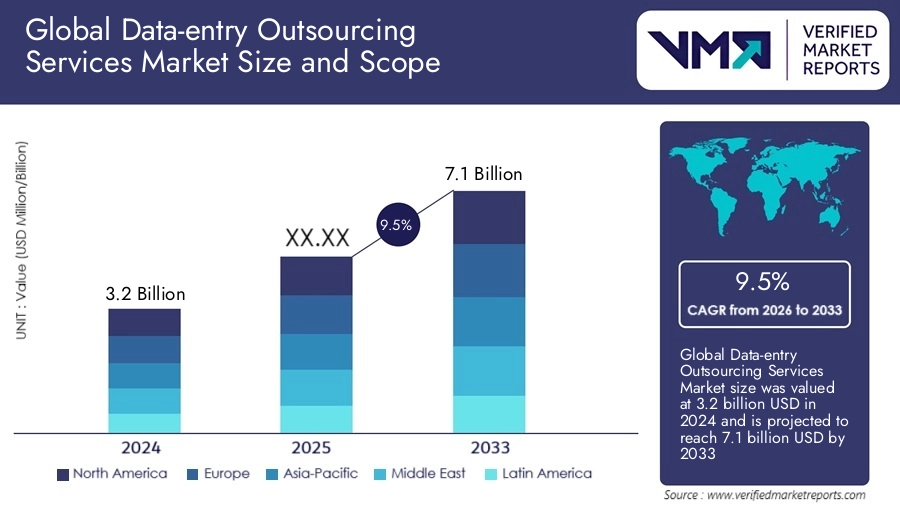
This Transformation is Reflected in Market Dynamics
[Source: Verified Market Reports | Data Entry Outsourcing Services Market Insights]
Market research firms have segmented what was once a unified market.
Verified Market Reports put the global data entry outsourcing market at US$3.2 billion in 2024, projected to reach US$7.1 billion by 2033, with a compound annual growth rate (CAGR) of 9.5% between 2026 and 2033. Global Industry Analysts valued the narrow “data entry outsourcing services” category at just $586.6 million globally in 2024, estimated to reach US$747.9 million by 2030 (based on specific document types, such as “eCommerce Product Data Entry” and “Invoice Data Entry). WiseGuy Reports estimated the broader “data entry outsourcing” market at US$3.36 billion the same year (they include BPO functions where data entry is the foundation, but not the only service). The most methodologically rigorous estimate among these comes from DataHorizzon Research, which placed the core data entry services market at $5.2 billion for 2024.
Here’s what we can infer from the data:
- Data entry (typing, basic transcription) has the lowest valuation and is growing at the slowest rate, indicating that manual data entry is becoming a “legacy” service.
- In 2026 and beyond, you can no longer buy “just” data entry; data validation, cleansing, and AI-auditing are now bundled in that service definition.
- The market for data entry has shifted from a labor expense (paying people to type) to a capital/technology investment (paying for an AI-human integrated system that delivers results).
The AI-Human Partnership in Data Entry: Where Automation Ends and Human Intelligence Begins
Data entry services now operate on a collaborative model in which AI and human workers each handle their respective strengths. This hybrid approach allows the data entry outsourcing company to maximize efficiency without sacrificing accuracy or judgment.
What AI Handles Well:
- Processing large volumes rapidly (minutes vs. hours)
- Pattern recognition, initial data capture, and rule-based validation
- Seamless integration with ERP, CRM, and cloud systems
- 24/7 processing without fatigue
- Maintaining compliance through consistent protocols
Where Human Intelligence Remains Essential:
- Processing unstructured data—interpreting context, intent, and nuance
- Exception handling and creative problem-solving
- Quality judgment—assessing whether output is truly “right” or simply “technically correct”
- Complex decision-making involving ambiguity or competing priorities
- Subtle signal interpretation—understanding what’s implied, not just stated
Sectors where Manual Data Entry Services are Still Needed for Good Reasons
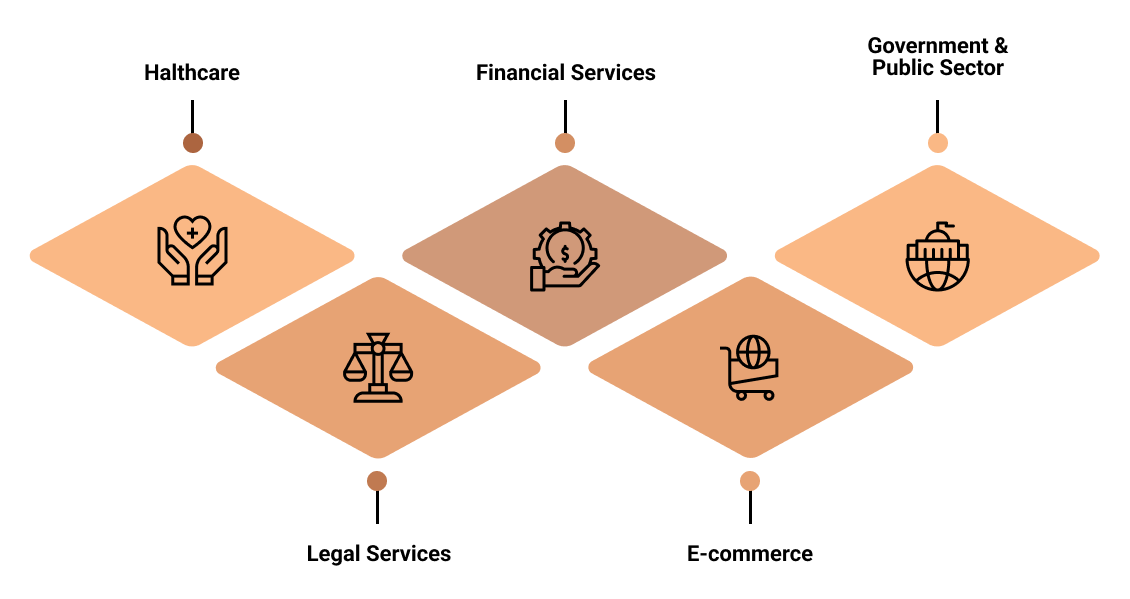
Certain industries will continue to require sustained human involvement in data entry, including healthcare, legal services, financial services, and government. The data these sectors handle is often complex and context-dependent, requiring a nuanced understanding and careful interpretation. They are heavily regulated, demanding high levels of accuracy and traceability to ensure compliance. Given the high-risk nature of the data, errors can lead to severe legal and financial consequences. Additionally, these sectors manage sensitive information that must be safeguarded to protect privacy and maintain trust.
Healthcare & Medical Data
Automation has almost replaced traditional transcription with AI tools such as speech-to-text software, but it’s far from perfect. Medical records often include complex terminology, abbreviations, and shorthand that AI tools misinterpret. Manual data entry with verification, handled by trained medical professionals or data entry experts, helps resolve these inconsistencies.
For instance,
- AI may misinterpret a medical term or abbreviation (such as STEMI or RCA) due to a lack of context from the patient’s medical history or symptoms. Data entry experts can fill in the gaps by validating and correcting data to ensure it accurately reflects the patient’s condition.
- If an MRI result or a patient’s medical history is recorded in one system but needs to be migrated to a new system (patients often see multiple health practitioners, so their data is recorded in various systems), human intervention is required to re-enter or format the data accurately.
- Many healthcare systems still rely on legacy software and databases that do not integrate easily with modern AI-powered systems. In these cases, data entry specialists play a critical role in transferring and formatting data across systems.
Legal Services & Case Documentation
Legal work demands an extreme, non-negotiable level of accuracy, confidentiality, and contextual understanding that automation cannot consistently provide. Legal documents contain critical information—dates, case numbers, financial amounts—where a single error can cause significant legal discrepancies, lost cases, or penalties.
For instance,
- Law firms handle a wide variety of non-standardized documents: handwritten notes, damaged or aged case files, and diverse legal forms. While OCR can scan these materials, it frequently misinterprets complex or poorly formatted information. Human operators provide the contextual judgment needed to accurately interpret and verify data, serving as a critical quality assurance layer.
- AI tools cannot understand legal nuance, such as determining the relevance of a particular precedent or correctly classifying complex case evidence. Human specialists interpret these subtleties, ensuring information is categorized correctly for efficient retrieval and case research.
- Legal data requires strict confidentiality. Manual entry by trusted professionals enables controlled handling of sensitive records, secure file transfer protocols, and the ability to redact privileged information before digitization—minimizing exposure to cyber threats associated with cloud-based automation tools.
Financial Services & Compliance
Manual data entry services remain critical in financial services and compliance because they provide accuracy, context-driven critical thinking, and adaptability that fully automated systems cannot consistently deliver. Despite the rise of automation, the high cost of errors in finance makes manual validation indispensable for handling complex, unstructured data and ensuring regulatory compliance.
For instance,
- Financial documents—invoices, bank statements, loan applications—often arrive in non-standardized formats, including handwritten notes and poor-quality scans. Human operators interpret ambiguous information, adapt to varying document layouts, and resolve inconsistencies that automated extraction mishandles.
- KYC and AML compliance demand absolute precision. While automated tools handle standard verifications, manual entry serves as a critical validation layer for edge cases: documents from unfamiliar jurisdictions, multi-layered corporate ownership structures, and records with conflicting information. Human specialists intervene when automation fails, preventing compliance breaches.
- Some institutions prefer manual handling of highly confidential data to mitigate the risks associated with cloud-based AI tools. Trained professionals provide controlled access to sensitive records and can identify and redact private information before digitization, which is crucial for regulatory compliance.
E-commerce & Product Catalog Management
E-commerce platforms manage massive product datasets—SKUs, pricing, specifications, variants, and category attributes. Automation handles bulk imports and standard formats, but manual entry remains critical for interpretation, quality control, and exception handling.
For instance,
- Product attribution for new or niche categories—assigning accurate specifications, writing descriptions that reflect brand voice, and differentiating similar variants—requires human judgment. AI handles routine attribution but struggles with products that lack standardized data or require subjective quality assessment.
- Marketplaces such as Amazon, Walmart, and eBay enforce distinct category rules and compliance requirements. Mapping products across platforms with incompatible taxonomies, or onboarding suppliers with inconsistent data structures, requires manual reconciliation to maintain listing accuracy.
- Exception handling—resolving records with conflicting supplier data, validating ambiguous product claims, and assessing returned items where condition affects restocking decisions—requires contextual evaluation that rule-based automation cannot reliably perform.
Government & Public Sector Records
Government data spans taxation, licensing, public health, and social welfare. Much of it originates on paper or in siloed legacy systems, making full automation impractical. Regulatory and accessibility standards add further complexity.
For instance,
- Many records—including vital documents such as birth certificates and land surveys—still exist on paper or in legacy databases. Digitization requires human intervention to ensure accurate indexing and compliance with jurisdiction-specific archival standards.
- Benefits, license, and permit applications often arrive handwritten or partially completed, with supporting documents that vary in format and quality. OCR struggles with inconsistent handwriting and non-standard forms, requiring specialists to interpret submissions and validate applicant information against source documents.
- Census and demographic data inform policy decisions and demand verified accuracy. Consolidating records across agencies or digitizing archives requires manual cross-referencing to ensure data continuity and long-term accessibility.
Data Entry Services: What You Can Outsource in 2026
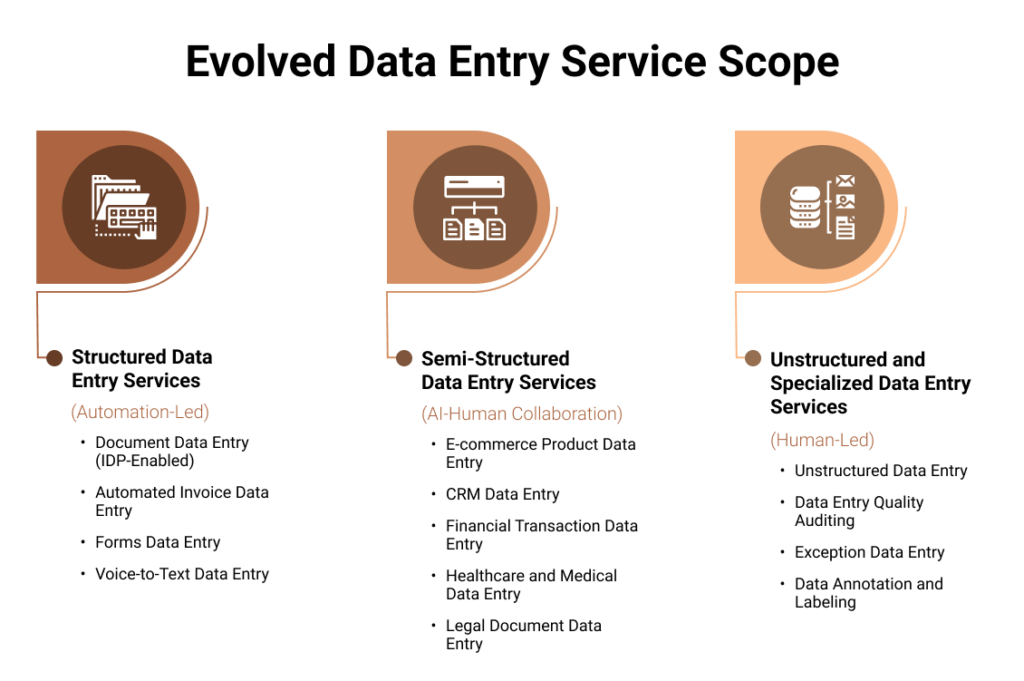
We already discussed how the market views “data entry” through three distinct lenses. When outsourcing data entry services, you should do the same.
Determine the type of data you need support for:
- Structured data — typed invoices, digital forms, standardized documents: These follow predictable patterns that AI (OCR, NLP, ML) can handle at scale, with humans stepping in only for exceptions.
- Semi-structured data — healthcare claims, legal contracts, financial records: These arrive in partially standardized formats but still incorporate industry regulations and domain-specific terminology, requiring AI and humans to work as equal partners.
- Unstructured and specialized data — handwritten notes, documents, paper records, unlabeled training datasets: These have no predictable patterns, making human judgment the primary driver.
Currently, the data entry agencies typically offer the following services under the data entry service umbrella.
Structured Data Entry Services (Automation-Led)
- Document Data Entry (IDP-Enabled): IDP uses OCR, NLP, and ML to extract data from invoices, contracts, and forms. Humans review only flagged entries with low system confidence.
- Automated Invoice Data Entry: AI reads line items, amounts, and vendor details into accounting systems. Humans intervene for handwritten corrections, non-standard layouts, or record discrepancies, validating invoice data.
- Forms Data Entry: Surveys, applications, and questionnaires with defined fields are processed by AI. Humans handle handwritten responses and ambiguous or non-standard entries.
- Voice-to-Text Data Entry: Speech recognition converts spoken input into structured data. Humans correct misrecognized words and verify accuracy, especially with noisy recordings or specialized terminology.
Semi-Structured Data Entry Services (AI-Human Collaboration)
- E-commerce Product Data Entry: AI manages bulk uploads of SKUs, pricing, and images, generates product descriptions, and synchronizes the catalog. Humans handle tasks requiring judgment, such as reviewing descriptions, ensuring precise categorization, maintaining brand consistency, and making context-specific adjustments.
- CRM Data Entry: AI syncs routine updates — contact details, interaction logs — from emails and web forms. Humans manage complex records involving relationship context, customer histories, and deduplication.
- Financial Transaction Data Entry: AI extracts data from invoices, payment records, and reconciliation entries. Humans verify accuracy, flag discrepancies, and ensure correct classification.
- Healthcare and Medical Data Entry: AI captures data from patient records, claims, and clinical trial documents. Trained professionals verify clinical accuracy and ensure compliance with HIPAA and related regulations.
- Legal Document Data Entry: AI extracts dates, parties, and clauses from contracts, case files, and court documents. Legal professionals ensure interpretive accuracy and handle contractual nuances and jurisdictional differences.
Unstructured and Specialized Data Entry Services (Human-Led)
- Unstructured Data Entry: Handwritten notes, legacy records, and inconsistent formats demand human interpretation — a physician’s handwriting or a faded decades-old ledger offers no patterns for AI to learn from.
- Data Entry Quality Auditing: Auditors review AI-processed data for contextual accuracy. An AI may extract an invoice total correctly but assign it to the wrong vendor, or consistently misread an abbreviation — errors only a trained reviewer catches.
- Exception Data Entry: Entries outside standard patterns are routed to humans. Reconciling conflicting data across systems or interpreting a water-damaged document requires creative problem-solving that no rule-based system can provide.
- Data Annotation and Labeling: Professionals label images, text, and audio to build AI training datasets. AI cannot label what it hasn’t learned — rare conditions in medical imaging or nuanced sentiment in multilingual feedback, for example.
Technology Trends in Data Entry Outsourcing
The future of data entry outsourcing is driven by AI-enabled automation that captures, validates, and routes data at scale, reducing manual effort and improving speed and consistency. By 2026, most of the data entry outsourcing companies will rely heavily on human-AI collaboration to maximize operational efficiency and accuracy.
Current Technologies
- OCR (Optical Character Recognition): Converts printed/handwritten text from images into machine-readable data
- ICR (Intelligent Character Recognition): Advanced OCR that learns and improves accuracy for handwritten text
- RPA (Robotic Process Automation): Automates repetitive data entry tasks across applications
- Cloud-Based Data Entry Platforms: Enable real-time access, collaboration, and automatic backup
- Machine Learning Pattern Recognition: Systems learn data patterns to automate categorization and validation
- Automated Data Validation: Real-time verification against rules, databases, and historical patterns
Emerging Trends
- Generative AI Integration: AI interprets context, suggests corrections, handles ambiguous entries, and auto-completes fields
- Intelligent Document Processing (IDP): End-to-end automation combining OCR, NLP, and ML for complete document understanding
- Natural Language Processing (NLP): Enables systems to understand and process human language in unstructured documents
- Real-Time Processing Capabilities: Instant data entry and validation as documents are received
- API Integrations for Seamless Workflows: Direct connections between data entry systems and ERP, CRM, and cloud platforms
- Hyper-Automation: AI + RPA + business process automation combined for end-to-end processing
- Blockchain for Data Entry Security: Tamper-proof records ensuring data integrity and compliance
- Voice Recognition for Data Entry: AI-powered hands-free data input in healthcare, logistics, and customer service
The Role of Human Experts in Data Entry Outsourcing
Even with OCR, IDP, and hyper-automation, human oversight remains essential in the workflow of any data entry agency because real-world data is messy and unstructured. Humans review edge cases (illegible scans, missing fields, conflicting values), validate judgment-based decisions (what to prioritize, how to interpret context), and enforce rules that tools often miss (compliance, client-specific standards, and audit requirements). This human-in-the-loop layer transforms automated output into reliable, business-ready data.
Reasons Why Companies Outsource Data Entry Services
So far, we have established that data entry services have moved beyond manual typing tasks to AI-assisted data capture and validation. Companies now outsource to teams that can combine automation (OCR, Intelligent Document Processing, and RPA) with human validation to handle high volumes without compromising accuracy, auditability, or compliance. The model works best when automation handles repetitive work, and specialists handle exceptions, edge cases, and quality.
Here are some reasons why companies prefer to hand over the nitty-gritty of manual data entry with specialized data validation at scale, accurately, to professional data entry service providers.
1. Access to AI-Enhanced Capabilities
Organizations outsource to partners with technology they can’t build internally:
- AI-powered extraction tools
- RPA integration with existing systems
- Real-time validation engines
- Cloud-based processing platforms
2. The Human-AI Combination
Outsourcing provides both technology & skilled professionals:
- Trained data specialists who understand AI-assisted workflows
- Quality analysts who can supervise automated processes
- Domain experts for industry-specific data requirements
- Multilingual capabilities for global operations
3. Scalability Without Infrastructure Investment
By outsourcing, companies can
- Handle volume spikes without hiring
- Scale down during slower periods
- Access 24/7 operations across time zones
- Integrate with ERP and CRM faster
4. Quality Assurance at Scale
Leading providers achieve 99%+ accuracy through:
- Human validation for exceptions and low-confidence data
- QA sampling with defined error thresholds
- Audit logs for edits, approvals, and traceability
- Compliance-aligned checks using client rules
5. Cost Optimization
Cost benefits extend beyond labor arbitrage:
- Elimination of technology investment
- Reduced training and management overhead
- Fewer error-related costs
- Faster time-to-value
6. Compliance and Security Expertise
Outsourcing to certified providers ensures:
- ISO 27001 information security
- GDPR, HIPAA, CCPA compliance
- Industry-specific regulatory adherence
- Audit-ready documentation
Supporting Next-Gen Enterprise Data Requirements
Discover how an Italian company generated accurate and timely heating system reports by leveraging multilingual data entry & processing services.
Selecting the Right Partner for Outsourcing Data Entry Services
Choosing the right data entry outsourcing company is a critical decision that can significantly impact your business’s efficiency, accuracy, and overall performance. Here’s a guide to help you navigate the selection process.
Pre-Partnership Considerations
Assess Your Requirements First
- Document current data entry processes and pain points
- Identify data types, volumes, and complexity levels
- Define accuracy standards and turnaround expectations
- Determine human vs. automation needs for different data types
Evaluate Technology Capabilities
- AI/ML integration (OCR, NLP, RPA)
- Cloud platform compatibility
- Real-time validation capabilities
- API integration with your systems
Verify Security Protocols
- ISO 27001 certification or equivalent
- Compliance with relevant regulations (GDPR, HIPAA, CCPA, PCI DSS)
- Data encryption, access controls, and audit procedures
Assess Human Expertise
- Team qualifications and training processes
- Domain-specific knowledge (medical, legal, financial)
- Quality control methodology
- Language capabilities
Post-Partnership Considerations
Establish Clear SLAs
- Accuracy rate requirements (e.g., 99% minimum)
- Turnaround time commitments
- Escalation procedures
Implement Quality Control Measures
- Regular sampling and audit schedules
- Performance dashboards
- Error tracking and root cause analysis
Plan for Continuous Improvement
- Regular review meetings
- Process optimization initiatives
- Technology upgrade roadmap
How to Outsource Data Entry: Step-by-Step Guide
Outsourcing data entry services isn’t just a cost-cutting measure anymore—it’s a strategic move that can drive efficiency, scalability, and accuracy across operations.
Step 1: Identify the Requirements
- Define data types, source formats, and monthly volume
- List mandatory fields, validation rules, and exception scenarios
- Confirm output format and destination systems (ERP, CRM, databases, spreadsheets)
Step 2: Research Potential Providers
- Prioritize providers with AI-enhanced capabilities
- Review technology stack and integrations
- Create initial shortlist
Step 3: Budget and Planning
- Calculate current in-house costs as baseline
- Factor in technology investment avoidance
- Establish a timeline for implementation
Step 4: Request Proposals (RFP)
- Include sample data for accurate quoting
- Request a technology demonstration
- Ask about human-AI workflow balance
Step 5: Evaluate Proposals
- Score against predefined criteria
- Conduct technology demos
- Check references in your industry
Step 6: Conduct Pilot Project
- Test with a limited scope
- Evaluate accuracy, turnaround, and communication
- Assess both AI and human performance
Step 7: Contract and Agreement
- Document SLAs with specific metrics
- Include security requirements and NDAs
- Define exit provisions
Step 8: Transition and Onboarding
- Provide comprehensive process documentation
- Train provider on your systems
- Begin with a supervised processing period
Common Pitfalls to Avoid When Outsourcing Data Entry Services
Outsourcing data entry can offer significant benefits but also presents challenges. To ensure a successful partnership, businesses must avoid several common pitfalls:
A. Inadequate Research
- Failing to evaluate technology capabilities alongside human expertise
- Not checking references
- Ignoring industry experience
B. Poor Communication
- Unclear requirements documentation
- Insufficient ongoing communication
- Lack of feedback loops
C. Overlooking Data Security
- Not verifying compliance certifications
- Ignoring security protocols
- Failing to implement NDAs
D. Ignoring Quality Control
- No established metrics or KPIs
- Lack of regular audits
- Missing performance reviews
E. Over-Relying on Automation
- Assuming AI can handle everything without human oversight
- Underestimating exception management needs
- Neglecting quality validation of AI outputs
F. Failing to Plan for Evolution
- Not building in technology upgrade provisions
- Missing continuous improvement mechanisms
- No roadmap for expanding AI capabilities
The Strategic Takeaway
Outsourcing data entry services is not just about partnering with a team that can handle entry and validation requirements; it’s about choosing a reliable partner that can leverage new-age tools and technology alongside human experts to deliver fast, error-free, regulatory-compliant data entry services.
For those considering outsourcing data entry or seeking more detailed insights, our experts are here to provide invaluable guidance and support. We offer a free consultation to help you make informed decisions about your data entry needs. Contact our team at info@suntecindia.com.


Rohit Bhateja, Director - Digital Engineering Services & Head of Marketing
Rohit Bhateja, Director of Digital Engineering Services and Head of Marketing at SunTec India, is an award-winning leader in digital transformation and marketing innovation. With over a decade of experience, he is a prominent voice in the digital domain, driving conversation around the convergence of technology, strategy, customer experience, and human-in-the-loop AI integration.