10 Mobile App Architecture Mistakes that Become Expensive After Launch

Organizations spend an additional 10% to 20% of project costs addressing technical debt. At the same time, more than 20% of organizational budgets intended for new products are diverted to resolving existing technology issues. For mobile applications, this burden often starts with architecture decisions that seem efficient during development but become increasingly expensive once the app is in production.
With product evolution, mobile app architecture mistakes, including tight coupling, rigid APIs, weak observability, limited connectivity resilience, and poorly planned scaling, can turn routine enhancements into complex migrations and regression-heavy releases. At the same time, the growing adoption of Agentic mobile apps and adaptive interfaces adds further architectural pressure.
As a result, architecture increasingly determines how efficiently an application can absorb change without driving up maintenance costs. In this blog, we explore 10 mobile app architecture mistakes that inflate after launch and how mobile application developers can avoid them.
10 Mobile App Architecture Mistakes and How to Avoid Them
Mobile app architecture shortcuts often survive the MVP stage because the conditions that expose them have not arrived yet. The following mistakes are common in mobile app development teams.
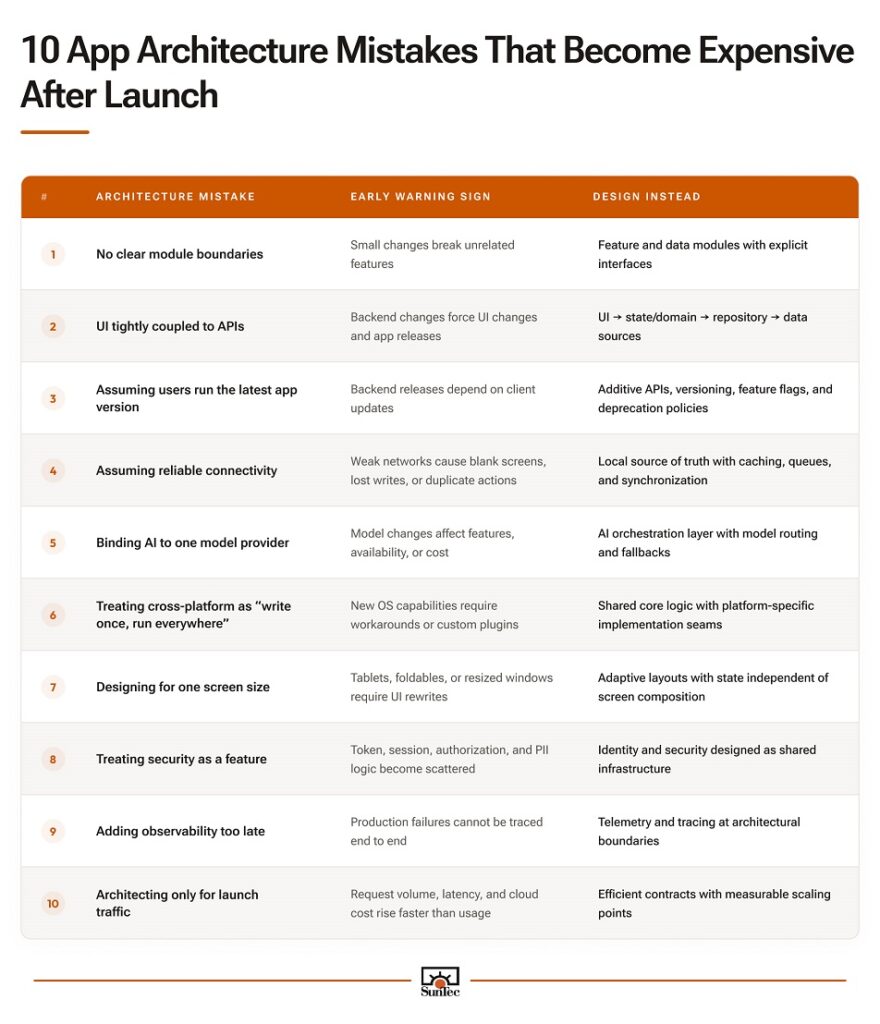
Mistake 1: Building Features Without Clear Module Boundaries
When UI, networking, authentication, analytics, and business logic are tightly coupled and depend directly on one another, the dependency graph gradually becomes difficult to control. A shared common module often becomes the point through which unrelated features are connected.
As the application grows, a small change can affect distant functionalities, unit tests might require larger application contexts, and build caching or parallel compilation has fewer isolated units to exploit. The original speed advantage therefore reverses as user base and features increase. To avoid this:
- Split responsibilities across :feature, :data, and :core modules with one-way dependencies.
- Expose stable public contracts while keeping implementations internal.
- Enforce dependency rules automatically through CI.
- Avoid excessive fragmentation, since overly granular modules add configuration and build overhead.
Mistake 2: Coupling the UI Directly to APIs and Business Logic
A direct Screen > API response > UI flow is quick to implement, but it allows backend details such as serialization types, nullable fields, nested structures, and error codes to leak into presentation code. Once that happens, a renamed field or schema change can require UI changes and another store release.
Business rules also get duplicated across screens, and offline support becomes harder because the interface depends on a remote response rather than a stable application data model. To fix this issue, mobile app developers should isolate the UI behind a stable data contract by:
- Using UI to state/domain to repository to data sources.
- Keeping network and persistence models inside the data layer and mapping them into application models.
- Defining repository contracts independently from their implementations.
Mistake 3: Assuming Every User Runs the Latest App Version
A backend can be updated immediately, but installed mobile apps cannot. After API V4 goes live, many users may still be running app versions built for V2 or V3 because they have not updated yet. If the backend removes a field, changes its data type, or returns a new value that an older client does not understand, those users can experience errors even though the latest app works correctly.
Therefore, backend changes must account for multiple active app versions at the same time. This problem can be eliminated if mobile app engineers:
- Prefer additive changes and ensure clients tolerate unknown fields.
- Introduce explicit versions only when incompatible behavior requires them.
- Use published deprecation windows informed by real version-adoption data.
- Apply expand-and-contract schema migrations alongside feature flags, remote configuration, and minimum-version gates.
Mistake 4: Assuming Reliable Connectivity
When every workflow depends on an immediate server response, weak or intermittent connectivity becomes a direct failure path. Users may encounter blank screens, lost writes, stale data, or duplicate submissions when retries repeat non-idempotent operations.
Retrofitting resilience later is expensive because offline support changes where the app state lives and how every feature reads and writes data. Therefore, mobile app developers must define the architecture connectivity behavior by:
- Using a local store as the UI’s source, with repositories coordinating synchronization.
- Choosing online-only, queued, or local-first writes according to workflow risk.
- Using idempotency keys, exponential backoff with jitter, and explicit conflict-resolution rules.
- Implementing full offline-first behavior only where core workflows actually require it.
Mistake 5: Binding AI Features to One Cloud Model
Connecting a feature directly to one model API also ties it to that provider’s pricing, quotas, latency, context limits, privacy policies, and release cycles. As AI models evolve, changes in capabilities, response patterns, or performance may require revalidation to maintain a consistent user experience. Furthermore, on-device AI introduces another category of mobile app architecture mistakes that inflate after launch because inference availability and performance vary across device hardware, OS versions, and resource constraints.
AI development costs can also expand beyond inference itself through retries, embeddings, moderation, and evaluation. What begins as a simple integration can therefore become a product-level dependency. To decouple features from individual AI models, mobile app developers should:
- Route the feature to an orchestration layer to a model router to an on-device / cloud / private model.
- Select models according to privacy, latency, connectivity, context size, capability, and cost.
- Define explicit fallback paths when preferred models are unavailable.
- Pin model versions where appropriate and run regression evaluations whenever prompts or models change.
- Track token usage, latency, failure rate, and cost per feature.

Mistake 6: Treating Cross-Platform as “Write Once, Run Everywhere”
Cross-platform development becomes restrictive when every OS capability is forced through the same abstraction. Authentication, notifications, biometrics, background execution, hardware access, and native AI APIs evolve differently on Android and iOS.
If the architecture does not preserve platform-specific seams, engineering teams often compensate with custom plugins, conditional code, or native forks that eventually complicate framework upgrades. In such cases, shared code remains valuable, but only when the underlying behavior genuinely changes for the same reasons. To address this challenge, mobile app developers must:
- Keep business logic, validation, networking, models, and analytics contracts in shared layers where appropriate.
- Place OS-driven capabilities behind platform interfaces.
- Use mechanisms such as expect/actual, platform channels, or native modules at those boundaries.
- Keep custom native modules limited, owned, documented, and tracked for compatibility.
Mistake 7: Designing Around One Screen Size
A portrait-phone architecture becomes expensive when the mobile application later needs to support tablets, foldables, resizable windows, or desktop-style layouts. The problem is structural, where larger windows may require different navigation models, list-detail compositions, and persistent selection state.
If state is embedded inside individual screens, adapting the interface becomes a state-management and navigation refactor rather than a layout adjustment. Platform changes increasingly make these assumptions harder to preserve. Hence, separate application state from layout structure by:
- Hoisting state into holders that survive resizing, rotation, and folding.
- Driving layout decisions from available window size rather than device labels.
- Keeping navigation and selection state independent from view hierarchies.
- Testing resizable and multi-window behavior early so layout changes do not expose deeper architectural coupling.
Mistake 8: Treating Security as a Login Feature
Security architecture extends well beyond the sign-in screen because authentication affects how identities, sessions, credentials, permissions, and sensitive data move between the app and backend. Passkeys make this dependency clear: the mobile app must use platform credential APIs, the backend must support WebAuthn flows, and account recovery must work when credentials or devices are lost.
If you postpone these decisions, adding stronger security later can require API changes, credential migrations, forced reauthentication, and updates across multiple application layers. Therefore, mobile app developers should:
- Separate authentication from authorization and enforce permissions server-side.
- Use OIDC with PKCE, short-lived access tokens, refresh-token rotation, and revocation.
- Store credentials using platform-secure facilities such as Keychain or hardware-backed Keystore.
- Design passkey recovery alongside authentication.
- Redact PII from logs, analytics, traces, and crash telemetry.
Mistake 9: Adding Observability After Production Problems Appear
Crash reporting explains what crashed, but not why a checkout stalled, a screen froze, synchronization failed on one carrier, or an AI request repeatedly exceeded its latency target. Without structured telemetry, mobile app engineers must reproduce incidents manually and correlate disconnected mobile and backend logs.
This manual task becomes harder as application versions, devices, feature flags, and distributed services multiply. For this reason, production observability should be designed into architectural boundaries rather than added only after support incidents begin. Mobile app developers must:
- Instrument repositories, service adapters, module boundaries, and critical user journeys.
- Track startup time, ANRs, frame performance, API latency, sync failures, and AI metrics.
- Propagate trace context such as W3C traceparent into backend services.
- Tag telemetry with app version, device class, and feature-flag state.
- Sample deliberately and remove PII before export.
Mistake 10: Architecting Only for Launch Traffic
A mobile app architecture designed only around launch traffic may perform well initially, but the same design can become inefficient as usage grows. For example, several API calls triggered by a single screen may have little impact with a few hundred users, yet the same pattern can generate millions of requests at scale. This can also increase database reads, network traffic, latency, cloud consumption, and mobile app development costs.
However, preparing for growth does not mean building complex distributed infrastructure from day one, since premature microservices and messaging systems create their own operational burden. The better approach is to:
- Use BFF aggregation, cursor pagination, HTTP caching, and lean payloads to reduce unnecessary work.
- Add idempotency, rate limiting, and retry backoff before traffic magnifies the impact of their absence.
- Move long-running workloads to asynchronous processing where appropriate.
- Track latency, error rates, throughput, and cost per active user.
- Add infrastructure capacity only when those signals justify the additional complexity.

Design Mobile Application Architecture for a Dynamic Environment, Not Just Day-One Performance
The strongest mobile architecture is not the one that ships fastest, but the one that can absorb change without repeatedly increasing engineering cost. As apps scale across new OS versions, devices, workloads, and third-party API integrations, mobile app architecture mistakes show up as longer release lead times, higher regression rates, rising infrastructure spend, and complex migrations.
For CTOs and other stakeholders, this makes changeability, observability, and controlled coupling core architecture metrics. In a well-designed mobile app architecture, clear module boundaries, repository abstractions, backward-compatible APIs, schema evolution strategies, local-first data patterns, platform-specific escape hatches, and AI orchestration layers reduce the blast radius of change. Additionally, architectural observability should combine operational controls such as distributed tracing and feature flags with performance metrics such as p95 latency, crash and ANR rates, synchronization failures, and AI inference cost. Together, these signals help teams identify architectural stress points before they become larger scalability or maintenance issues.
The key takeaway for decision-makers to avoid mobile app architecture mistakes after launch is to design apps with a tightly coupled MVP architecture and avoid premature distributed complexity. That delivers more value than technical sophistication alone because a mobile application architecture that protects release velocity, limits technical debt, and keeps future change economically manageable.
Frequently Asked Questions (FAQs)
The most expensive mobile app architecture mistake that inflates after launch is tight coupling between UI, business logic, data sources, and external services. It increases regression risk and makes API changes, scaling, testing, platform upgrades, and provider replacements significantly harder after launch.
Mobile app maintenance costs vary by app complexity, user volume, infrastructure, integrations, security requirements, and release frequency. Ongoing application maintenance expenses typically include bug fixes, OS updates, monitoring, backend operations, cloud services, security patches, and feature improvements.
Refactor mobile applications when the core architecture remains usable and problems are isolated. Rebuild when technical debt affects most layers, platform limitations block product goals, dependencies are obsolete, or incremental changes cost more than replacing the underlying architecture.
Yes, cross-platform mobile app development can be cost-effective, especially when business logic and UI components are genuinely reusable across platforms. It becomes expensive when the app relies heavily on platform-specific APIs, custom native modules, hardware access, or OS-specific user experiences.
We develop AI-ready app architectures by introducing an orchestration layer that separates application features from individual AI models. This enables flexible routing across on-device, cloud, or private models while managing latency, cost, privacy, model changes, and fallback scenarios. We also design supporting data flows, evaluation processes, and monitoring mechanisms to ensure AI features remain reliable as models and requirements evolve.
Common signs of technical debt in legacy mobile codebases include slow releases, difficult testing, fragile integrations, rising maintenance effort, and changes in one feature unexpectedly affecting unrelated parts of the application.


Rohit Bhateja, Director - Digital Engineering Services & Head of Marketing
Rohit Bhateja, Director of Digital Engineering Services and Head of Marketing at SunTec India, is an award-winning leader in digital transformation and marketing innovation. With over a decade of experience, he is a prominent voice in the digital domain, driving conversation around the convergence of technology, strategy, customer experience, and human-in-the-loop AI integration.