What to Look for When Hiring Flutter Developers with AI Skills?
Every AI interaction processed in the cloud creates dependencies on infrastructure spending, network availability, and third-party data handling. As adoption increases, these dependencies raise operating costs and reduce control over latency, service continuity, and data movement. To address this challenge, organizations are moving toward on-device AI, which executes selected workloads directly on customer hardware. Its benefits include operational efficiency, faster response times, improved privacy, offline functionality, and better cost predictability. These advantages are increasingly shaping product and infrastructure decisions, as reflected in the rapid expansion of the on-device AI market.
The on-device AI market is projected to reach approximately $13.6 billion by the end of 2026 and exceed $75.5 billion by 2033, with smartphones representing nearly half of the opportunity. This growth raises a product question for CXOs around how quickly mobile applications can adopt local AI capabilities without increasing architectural complexity or operational overhead. For organizations already building with Flutter, that question becomes relevant because Flutter 3.44 and Dart 3.12 updates expand the framework’s role in supporting on-device AI use cases. [Source]
Implementing on-device AI requires a combination of application-framework expertise and edge-model deployment skills. Flutter developers must bridge Dart with native Android and iOS APIs, platform-specific AI runtimes, hardware accelerators, and low-level device constraints such as memory, storage, and thermal limits. This means conventional Flutter proficiency alone is insufficient.
To help you find the right expertise, the blog ahead examines what Flutter-based on-device AI implementation involves, the engineering capabilities required, how to evaluate candidates, and where to find qualified Flutter developers.
Why On-device AI Implementation Has Become Crucial?
1. Better Data Privacy Without Sacrificing AI Capability
When inference runs on the user’s device, sensitive information such as personal messages, documents, and confidential records doesn’t need to pass through an external cloud service. This reduces exposure during transmission and third-party processing without removing the AI capabilities users expect.
2. Evolving Compliance Requirements
In Europe, regulations such as the GDPR and the EU AI Act do not directly mandate organizations to process data on-device. However, requirements around data minimization, security, accountability, and controlled data processing present edge-based architectures as a practical way to reduce compliance exposure during data transit and third-party processing. As data-localization and AI-governance requirements continue to evolve, building on-device capabilities early can help organizations address these compliance challenges without relying entirely on centralized cloud infrastructure.
3. Improved Responsiveness and User Retention
Every cloud-based AI request must travel to a remote service before the model can begin processing and return a response. If this is removed, the network round-trip can reduce latency across chat, in-app search, live assistance, and content-generation features. The result is faster responses that can improve engagement, session continuity, and the likelihood that users continue using the feature.
4. Functionality Reliability that Doesn’t Depend on Connectivity
A cloud-dependent AI feature stops working the moment connectivity drops because of poor network coverage, service interruptions, or high-latency connections. On the other hand, on-device AI models continue to function regardless of network conditions. This improves reliability for mobile-first, global, and field-based applications where consistent connectivity cannot be assumed.
5. More Predictable AI Economics
Cloud inference costs scale with usage, so the more successful an AI feature is, the more expensive it becomes to run. On-device AI shifts inference costs onto the user’s hardware instead. For any AI feature expected to be used frequently or at scale, this fundamentally changes the product’s unit economics.
Skillset Required for Flutter On-Device AI Implementation
The required expertise depends on the selected model, runtime, platforms, and deployment architecture. Therefore, evaluation of Flutter engineers should cover the following areas:
1. Advanced Flutter and Dart Engineering
A qualified Flutter developer for hire should be able to design a maintainable Flutter architecture that separates the interface, application state, and inference orchestration layers. This foundation matters most when operations are asynchronous, resource-intensive, and depend on native components.
They should understand Dart futures, streams, isolates, request cancellation, plugin development, lifecycle management, integration testing, and performance profiling. The Flutter experts must also manage state without retaining unnecessary model outputs, buffers, or native references. They should also know when to move work to a background isolate.
2. On-Device Inference Runtimes and Native Bridging
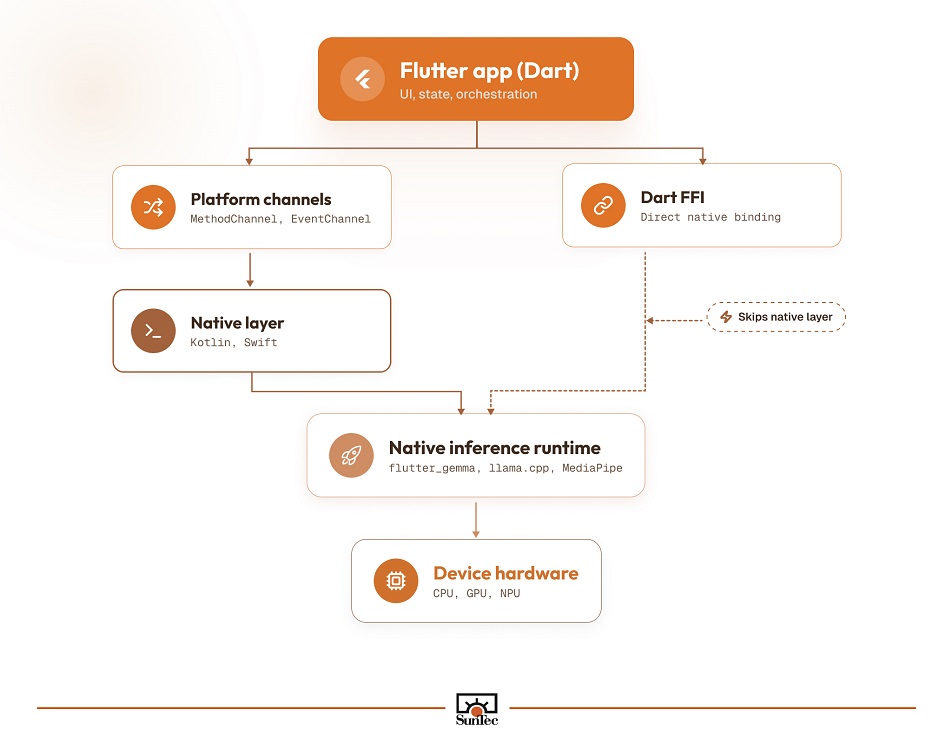
Flutter on-device LLM/SLM implementation requires moving beyond standard UI frameworks to integrate low-level inference runtimes directly into the Flutter app lifecycle. Therefore, Flutter engineers must be proficient in embedding cross-platform engines like LiteRT (formerly TensorFlow Lite), ONNX Runtime, MediaPipe, or ExecuTorch, while seamlessly interoperating with platform-native frameworks. Furthermore, candidates need deep experience using Dart FFI or custom Platform Channels to invoke native C/C++ libraries.
3. Model Optimization and Hardware Acceleration
Standard AI models are usually too large and resource-intensive for direct mobile deployment, making optimization expertise essential. A Flutter developer for hire must understand model quantization techniques. This includes converting floating-point weights to INT8 or FP16 precision and pruning weights to drastically reduce memory usage without sacrificing acceptable inference accuracy. Additionally, Flutter coders must know how to configure and balance hardware acceleration delegates across diverse mobile chipsets.
4. Sensor Pipelines and Tensor Transformations
On-device AI models operate on high-dimensional tensor matrices, whereas mobile applications collect unstructured raw data from onboard sensors. Therefore, Flutter programmers must be skilled at building data transformation pipelines that capture live camera image streams, audio buffers, or text and convert them into formatted input tensors. After model execution, they must post-process complex output tensors and map them back into reactive UI state management architectures like BLoC or Riverpod without causing render stutter.
5. Memory Management and Thread Isolation
Flutter developers implementing on-device AI must be skilled in Dart Isolates and background worker threads to offload heavy matrix computations and keep the main rendering at 60 or 120 FPS. Furthermore, engineers need extensive experience using tools like Flutter DevTools, Xcode Instruments, and Android Profiler to monitor heap allocations, detect memory leaks, and prevent thermal throttling.
6. Model Security
Find Flutter engineers who know how to safeguard model assets using asset obfuscation, dynamic memory decryption, AES encryption at rest, and SHA-256 integrity checks. At the same time, they must design zero-telemetry local architectures where sensitive user data stays entirely on-device, processing inferences locally without leaking data to cloud endpoints.
7. Native Interoperability Expertise
Flutter developers implementing on-device AI should be proficient in enabling interoperability. They should know when to use platform channels to access Kotlin, Swift, or operating-system frameworks, and understand how event channels support native data streams and how Pigeon improves type safety. Flutter developers should be able to select the appropriate integration method based on the runtime interface, data volume, streaming requirements, debugging effort, and long-term maintenance needs.
8. Model Deployment Knowledge
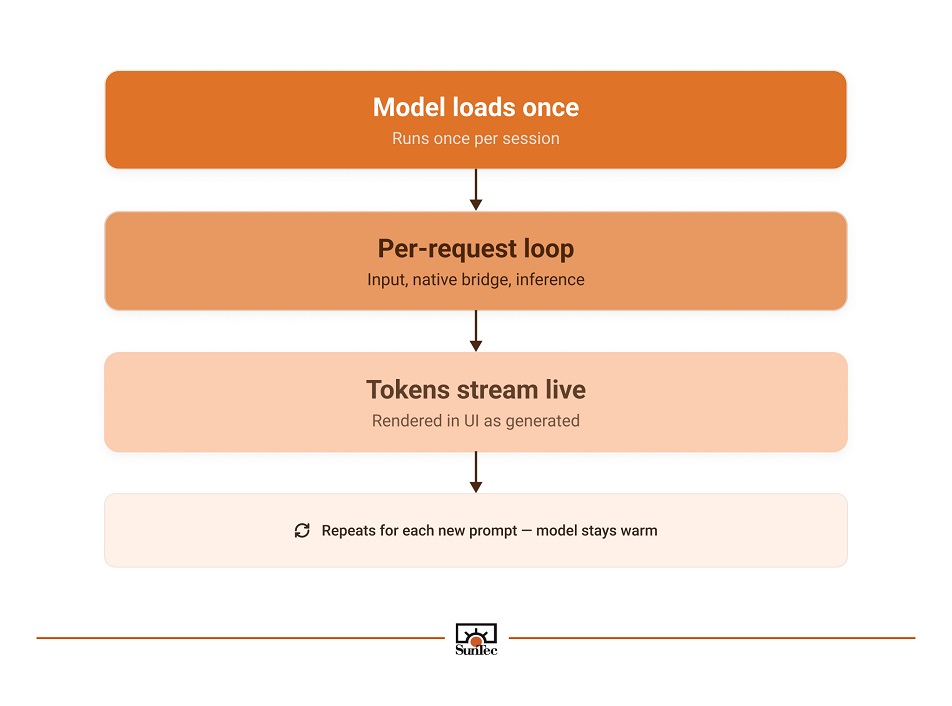
The Flutter engineer must know model formats, tokenizers, prompt templates, context windows, KV caches, sampling parameters, structured outputs, model warm-up, and hardware backend selection. Another important consideration is quantization; the developer should be able to evaluate model changes against a representative test set.
9. Mobile AI Performance Engineering
Flutter developers working on on-device AI should have hands-on experience in model performance engineering beyond basic generation speed. They should know how to measure model and application sizes, initialization time, prompt processing speed, peak and sustained memory usage, battery consumption, thermal throttling, UI frame stability, and crash rate. The developers should also be proficient in benchmarking models on representative physical devices rather than relying on emulators or development systems.
Where to Find Flutter Developers for Your Project?
Each channel below lets you hire Flutter experts with strong technical expertise in Flutter on-device AI implementation.
1. Specialized IT Staffing and Outsourcing Partners
A specialized IT staff augmentation partner can provide faster access to Flutter engineers with relevant AI and ML experience. These augmentation companies maintain a pre-vetted talent bench and have already completed the initial sourcing and screening. This approach can be especially valuable when an on-device AI initiative is already approved, and the organization cannot support an extended hiring cycle because of the initiative’s time-consuming, capital-intensive nature.
Advantages of Hiring from an IT Staff Augmentation Company
1. Quick Access to Pre-Vetted Experts
A direct search for Flutter engineers may take several weeks to months. A staffing agency with an established talent pool can present relevant profiles within days, sometimes within hours.
2. Flexible Team Scaling
Some on-device AI projects often begin with architecture validation or a technical prototype. They may later expand into platform integration, model optimization, QA, and production support. You can scale the augmented team up or down as the project moves through these phases, unlike fixed in-house staff.
3. Better Delivery Accountability
When you hire Flutter engineers for on-device LLMs through an IT staff augmentation firm, you get better project delivery. These providers typically provide project managers and operate under defined SLAs, performance expectations, NDAs, and developer-replacement provisions.
4. Access to Complementary Expertise
You may need another expert, in addition to a Flutter engineer, during the project. An IT staff sourcing partner can add other specialized engineers without requiring the organization to source every role independently.
5. Saves Time and Cost
While traditional hiring takes weeks to months to hire dedicated experts, onboarding augmented experts reduces this hiring overhead and costs because the staffing partner handles the heavy lifting. Additionally, you pay only for working hours, saving budget for other areas like customer experience, adding features, and improving infrastructure.
Disadvantages of Hiring from an IT Staff Augmentation Company
1. Developer Quality Depends on the Provider
Some providers may rely on resume keywords or basic interviews rather than practical assessments of on-device AI implementation. To mitigate this challenge, always ask to review the developer’s portfolio and include coding exercises in the technical interview process.
2. Knowledge Drain Risk
When the project concludes, specialized, project-specific knowledge leaves with the hired Flutter developers implementing on-device AI, forcing in-house teams to relearn workflows if systems require future updates. This can be prevented by making documentation and continuous knowledge transfer sessions compulsory.
2. Flutter Ecosystem and Community Channels
Flutter-specific communities can help organizations identify engineers actively solving on-device AI implementation challenges. Some relevant channels include Flutter Gems, Discord communities, Slack groups, developer forums, conference networks, package-maintainer groups, and local Flutter meetups. These platforms can surface expert engineers through their technical discussions, package work, published demonstrations, and peer recommendations.
Advantages of Hiring from Community Channels
1. Access to Active Practitioners
Community participants often discuss real integration problems, package limitations, performance issues, and platform changes. This creates a stronger signal than a static resume or generic job application.
2. Lower Direct Sourcing Costs
Community-based sourcing usually involves fewer platform or agency fees. The primary investment is the time required to build visibility, engage appropriately, and evaluate potential candidates.
3. Broader Visibility into Emerging Expertise
Communities frequently surface engineers working with new packages and runtimes before those skills appear widely in recruitment databases. This can be useful when hiring for rapidly developing on-device AI technologies.
Disadvantages of Hiring from Community Channels
1. Less Suitable for Urgent Hiring
Effective community sourcing depends on credibility and relationship-building. As a result, this route is less suitable when the role must be filled within a fixed, short timeline.
2. Unstructured Candidate Comparison
The contributions in community activities do not follow a consistent format. One engineer may publish packages, while another contributes through technical discussions or private projects. This requires a standardized evaluation process to compare candidates fairly.
3. Possible Network Bias
The communities are usually concentrated around particular regions, employers, packages, or social groups, and relying on one network may exclude capable candidates who participate elsewhere or remain less publicly visible.
3. Freelance Platforms
Freelance platforms such as Upwork, Toptal, Freelancer, and Fiverr provide access to a global marketplace of independent Flutter developers implementing on-device AI. These platforms allow organizations to post project requirements, review developer profiles, evaluate past work, and engage talent on flexible terms. They are commonly used for short-term projects, prototypes, technical validations, or well-defined development tasks. For Flutter on-device AI implementation, these platforms can help identify developers who claim relevant experience, but you must validate their actual capability through shipped applications, repositories, or technical assessments.
Advantages of Hiring from Freelancing Platforms
1. Immediate Access to Global Talent
Freelance platforms provide a wide pool of developers across different geographies, experience levels, and pricing tiers. Organizations can quickly begin sourcing candidates without setting up a formal recruitment pipeline.
2. Flexible Engagement Models
These platforms allow you to hire dedicated developers on an hourly, fixed-price, or milestone basis. This flexibility is useful for exploratory work, pilot projects, or when the scope is still evolving.
3. Less Operational Risk
Since freelancers usually use their own hardware and software, organizations can save on operational and office-setup expenses.
Disadvantages of Hiring from Freelancing Platforms
1. Inconsistent Quality and Expertise
Freelance platforms provide developers with widely varying levels of experience. Many profiles may claim AI expertise without demonstrating real on-device inference or runtime integration experience. This makes it difficult to identify truly qualified candidates without deep technical screening.
2. High Internal Evaluation Effort
Organizations must independently assess each candidate’s technical capability, review portfolios, and conduct interviews or tests. This increases the burden on internal engineering or hiring teams.
3. IP and Confidentiality Concerns
Organizations must explicitly define intellectual property (IP) ownership, confidentiality terms, and data access controls. Without clear agreements, disputes or unintended exposure of proprietary assets are possible.
Common Mistakes to Avoid While Hiring Flutter Programmers
Hiring the wrong Flutter engineer rarely causes immediate, visible project failure. The consequences usually show up as dropped UI frames during inference, unexpected out-of-memory crashes on mid-range devices, severe battery drain, and unoptimized model runtimes. The following section lists the common mistakes that are particularly costly when you hire Flutter AI developers, along with their fixes.
1. Searching for Candidates Before Defining the Architecture
The most common failure point is starting candidate outreach before you’ve scoped the project with any precision. Without a clear brief that includes target platforms, architecture, performance constraints, and integration requirements, it’s hard to evaluate a candidate. The fix is a written project brief covering scope, technical constraints, and success criteria, in place before beginning the candidate search.
2. Hiring on Framework Familiarity Alone
The candidate must have relevant hands-on Flutter experience, but it is not sufficient for on-device AI implementation. Therefore, leadership teams should evaluate candidates across three connected areas. The first is cross-platform application engineering. Secondly, expertise in native mobile engineering, including Kotlin, Swift, coroutines, and native platform APIs. Lastly, model deployment, including model formats, quantization, tokenizers, and physical-device benchmarking. The fix is to evaluate candidates against a role-specific competency matrix covering Flutter, native interoperability, model deployment, performance engineering, and production reliability.
3. Treating the Quoted Price as the Complete Budget
Decision-makers often compare candidates primarily by salary or hourly rate, which can obscure the actual cost of bringing a project to production. A more accurate approach is to evaluate each hiring model against the total delivery cost required to meet defined technical, performance, and acceptance criteria. This lets CXOs compare direct hires, freelancers, staffing partners, and specialist consultancies based on delivered value rather than resource rates alone.
4. Selecting the Lowest Bid Without Evaluating Delivery Risk
The cost differences often reflect variations in experience, availability, communication, testing discipline, and technical ownership. In on-device AI implementation, an inexperienced engineer can create technical debt below the Flutter interface. Therefore, select the lowest bid only when it meets the same technical and operational standards as the alternatives.
5. Skipping Technical Assessments
A portfolio can demonstrate relevant exposure, but it cannot confirm how much of the displayed work the candidate personally completed. Portfolio projects can also conceal developers’ weaknesses. That is why evaluating Flutter programmers should also include a one-to-one technical assessment before onboarding.
Hiring the Right Flutter Talent is Crucial
The long-term value of on-device AI implementation lies in building a repeatable internal capability, not delivering a single feature. The first initiative should establish reusable integration patterns, device-support criteria, evaluation datasets, benchmark procedures, security controls, and release standards. These assets reduce uncertainty in future projects and prevent teams from revisiting the same architectural decisions. Their value, however, depends on the engineers who create and document them.
Therefore, hiring success should be measured by more than initial delivery. The right Flutter developer for hire should complete the immediate implementation while establishing clear technical practices and transferring enough knowledge for internal teams to maintain and extend the solution. For CXOs, the objective is to build long-term readiness for evolving models, runtimes, hardware, and platform APIs. The hiring decision should strengthen that capability and reduce the cost, risk, and rework associated with future on-device AI initiatives.


Murli Pawar, VP - Technology
Murli Pawar is the Vice President of TechnoScore (the dedicated Digital Engineering Division of SunTec India), leading enterprise-wide technology innovation and solution delivery. With over 20 years of experience, he specializes in software architecture, automation, AI integration, and digital modernization, helping global enterprises enhance agility, scalability, and business value through advanced technology solutions.