What AI Evangelists aren’t Telling you About the Actual AI Agent Development Costs

Table of Contents
- AI Agent Development Cost by Solution Type and Complexity
- Industry-Wise Cost Breakdown for AI Agent Development
- Key Drivers that Affect AI Agent Development Cost
- Ways to Reduce AI Agent Development Cost Across the Lifecycle
- Build a Custom AI Agent or Buy an Off-the-Shelf Agent?
- Closing Thoughts
- Frequently Asked Questions
AI Agents have crossed the line from experiment to default. 70% of organizations have now deployed an AI Agent in at least one core business function. This indicates a decisive shift toward operationalized agentic systems in production. What gets far less airtime is the bill. For all the talk of autonomy and productivity, few discussions account for what it truly costs to develop, run, and maintain an agent — and that gap between expectation and reality is where many projects quietly stall.
As these agents increasingly automate business workflows, the focus shifts from whether to adopt them to how to budget for them. A basic chatbot can answer questions with limited context, but an enterprise-grade AI Agent must retrieve the right data, choose the right action, follow access rules, while keeping costs predictable. That added capability is exactly what makes AI Agent development expensive, as the cost is driven by a series of architectural and deployment decisions, including functional scope, model choice, data readiness, autonomy boundaries, and security controls.
This guide paints a realistic picture of AI Agent development cost, beginning with costs by solution type and business function. It then explains the key factors that influence the budget, details how costs can be optimized without compromising system reliability, and helps you evaluate the build-vs-buy decision before moving forward.
AI Agent Development Cost by Solution Type and Complexity
AI Agent development cost is easier to estimate when agents are grouped by solution type and complexity. Some agents only answer questions, while others retrieve enterprise knowledge, trigger workflows, process voice or documents, coordinate multiple agents, or operate under strict governance controls. The more autonomy, system access, data complexity, and risk involved, the higher the development cost becomes.

1. Basic Conversational Agent
A basic conversational agent answers user questions using fixed, structured knowledge sources. Unlike rigid chatbots that only recognize exact keywords, these conversational agents use smaller language models (SLMs) or distilled large language models to understand user intent and handle natural phrasing. These AI Agents do not perform external actions or log in to other systems; instead, they function purely as a helpful text interface for predefined information.
The primary use cases may include providing basic troubleshooting guides, sharing product or service information, and supporting internal teams by providing access to policy or process-related FAQs. Since their scope is limited, they are usually faster and less expensive to build than agents that retrieve enterprise data or trigger workflow actions.
- Conversational Agent Development Cost Range: $15,000 to $50,000.
- Factors Affecting Conversational AI Agent Development Cost: Initial prompt setup, text cleanup, and embedding the chat window in a website or app
2. RAG-Based Knowledge Agent
Retrieval-Augmented Generation (RAG) knowledge agents connect large language models (LLMs) directly to live enterprise databases, document repositories, and cloud storage systems. These agents use RAG to read a user’s question, search private corporate files for relevant data, and provide the exact context to the model to generate accurate responses.
The primary use cases include automating complex regulatory compliance audits, conducting detailed legal contract reviews, serving as an enterprise-wide intelligent search engine, and extracting in-depth technical product information. Because these agents rely heavily on precision, they are deployed in environments where answers must be backed by clear source citations.
- RAG-Based Knowledge Agent Development Cost Range: $40,000 to $150,000.
- Factors Affecting RAG-Based Agent Development Cost: Building stable data ingestion pipelines, establishing vector database storage, and configuring advanced semantic search retrieval algorithms.
3. Task Automation AI Agent
A task automation agent transitions beyond text-based responses to actively execute functional business operations across disparate software systems. These agents translate intent into specific commands by integrating with third-party tools via APIs, workflow connectors, or controlled automation layers, completing digital forms and updating or modifying database records. They use multi-step reasoning capabilities to continually verify successful execution and resolve technical friction like timeouts without human intervention.
The primary use cases center on high-volume operational workflows, such as automatically updating sales CRM entries, matching invoices, streamlining client onboarding sequences, and resolving multi-step customer support tickets. These digital copilots are ideal for removing manual overhead from repetitive, deterministic business tasks.
- Task Automation Agent Development Cost Range: $75,000 to $250,000.
- Factors Affecting Task Automation Agent Development Cost: The age and quantity of target systems, the availability of modern cloud APIs versus legacy interfaces, and the depth of custom error-recovery logic required.
4. Domain-Specific Decision-Support AI Agent
A domain-specific decision-support AI Agent acts as an advanced advisory tool within complex, high-stakes enterprise environments. These agents combine strict industry-specific rules with semantic understanding to analyze massive datasets, model various operational outcomes, and surface optimal strategic recommendations. To maintain absolute safety and accountability, they leave final authorization to human experts while showing supporting evidence, confidence scores, decision factors, and recommended next steps.
The primary use cases excel at structurally dense operations, such as dynamic logistics and supply chain route planning, risk triage during healthcare patient intake, insurance claims validation, and procurement cost optimization. They are explicitly designed as copilots to assist human professionals in making faster, well-informed decisions under pressure.
- Decision-Support Agent Development Cost Range: $100,000 to $300,000.
- Factors Affecting Domain-Specific Agent Development Cost: Domain data formatting, industry-specific model fine-tuning, and designing specialized UIs that show step-by-step logic and confidence scores.
5. Multi-Agent System (MAS)
A multi-agent system orchestrates a decentralized network of specialized, autonomous software nodes to solve macro-level business challenges. Instead of routing a complex workflow through a single prompt, a designated manager agent breaks the overarching goal into discrete sub-tasks and delegates them to specialized nodes. These nodes collaborate, cross-check their outputs, and dynamically pass context until the project is finalized.
The primary use cases are in highly non-deterministic domains, including autonomous software engineering pipelines, global supply chain disruption tracking, and macro market intelligence compilation. This architecture is crucial when a workflow is too large or too unpredictable for a single agent to execute reliably.
- Multi-Agent System Development Cost Range: $200,000 to $500,000+.
- Factors Affecting Multi-Agent System Development Cost: Designing inter-agent communication protocols, implementing safeguards to prevent infinite prompt token loops, and building system-wide observability tracing frameworks.
6. Voice or Multimodal AI Agent
A voice or multimodal AI Agent natively processes and generates multiple data streams simultaneously, handling real-time audio, video, images, and documents. These AI Agents coordinate specialized models concurrently to utilize automated speech recognition for transcription, a core LLM for intent extraction, and expressive text-to-speech tools for audio output. They handle continuous data streaming to achieve natural, human-like interaction loops.
The primary use cases focus on media-rich or hands-free environments, such as high-volume customer contact center automation, voice-driven field service assistant tools, and real-time multilingual medical translation, etc.
- Voice or Multimodal Agent Development Cost Range: $120,000 to $450,000+.
- Factors Affecting Voice or Multimodal AI Agent Development Cost: Strict latency and speed optimizations, real-time media synchronization layers, and premium usage fees for advanced vision and speech APIs.
7. Highly Regulated Enterprise AI Agent
A regulated or high-autonomy AI Agent operates independently within heavily monitored industries, executing critical transactions or clinical, financial, or legal workflows under strict human, regulatory, and audit oversight. Due to the high levels of programmatic freedom granted, these systems are wrapped in strict internal validation networks. They cross-check every proposed action against compliance guardrails, strip sensitive information, and write immutable audit logs.
The primary use cases are strictly positioned within highly scrutinized sectors, including autonomous banking and non-banking institutions, medical diagnostics, algorithmic trading, automated corporate tax compliance reporting, and legal case analysis. These applications require continuous background validation to ensure that autonomous decisions never violate corporate, legal, or governmental regulations.
- Regulated AI Agent Development Cost Range: $250,000 to $1,000,000+.
- Factors Affecting Regulated AI Agent Development Cost: Enterprise-grade data masking engines, detached secondary safety layers, strict role-based access control (RBAC) mechanisms, and rigorous legal and security code audits.
Industry-Wise Cost Breakdown for AI Agent Development
AI Agent costs also change depending on the business function they are built for. To help you plan a realistic budget, we have broken down enterprise AI Agent investments by business function. The matrix below shows the agent types built for each department along with their ballpark figures:
| Business Function | Solution Type Behind it | Ballpark Cost |
|---|---|---|
| Customer Support | Basic conversational, RAG-based, task automation, or voice agent | $20,000–$150,000 |
| Software Development | Multi-agent, sandbox, or task automation agent | $100,000–$350,000+ |
| Marketing | RAG-based, data analysis, or task automation agent | $30,000–$150,000 |
| HR and IT | Conversational, RAG-based, or task automation agent | $35,000–$180,000 |
| Finance | Data extraction, task automation, or regulated enterprise agent | $75,000–$300,000 |
| Legal | RAG-based, document processing, or decision-support agent | $70,000–$300,000 |
| Healthcare and Wellness | Multimodal, decision-support, or regulated enterprise agent | $100,000–$500,000+ |
| Insurance | Document processing, decision-support, or regulated enterprise agent | $120,000–$500,000+ |
| Banking and NBFCs | Regulated enterprise, task automation, or decision-support agent | $150,000–$700,000+ |
| Supply Chain and Logistics | Decision-support, task automation, or multi-agent system | $100,000–$450,000 |
| eCommerce | Conversational, RAG-based, or task automation agent | $40,000–$220,000 |
| Business Intelligence (BI) | Data analysis or decision-support agent | $80,000–$250,000 |
| Data Processing | Document processing or task automation agent | $60,000–$200,000 |
Key Drivers that Affect AI Agent Development Cost
The cost of developing an AI Agent is the sum of decisions across architecture, build approach, inference, data, features, governance, and maintenance. The drivers below are grouped by one-time build costs and recurring costs for the life of the agent.
1. Architecture and Design
Architecture sets the cost ceiling before development begins. The more complex the agent architecture, the more time is required for system design, testing, orchestration, and long-term maintenance.
Agent Topology
The structural relationship between your AI components impacts both development complexity and runtime token consumption.
- Single-Agent Systems: A single agentic controller handles the workflow from request to response. It may still call tools, retrieve documents, or use different models, but the orchestration logic remains centralized, making it cheaper to build, test, and debug.
- Multi-Agent Orchestration: These systems divide work among specialized agents for planning, retrieval, validation, execution, or review. This can improve task decomposition and output checking, but it also adds coordination cost, testing effort, token usage, and failure points.
Reasoning Pattern
The cognitive framework governing how the agent processes information impacts processing latency and compute spend.
- Simple Prompt-Chaining: Hardcoded, deterministic execution paths where the output of one step feeds the next step. This approach is cost-effective but lacks the flexibility to handle complex edge cases.
- Autonomous ReAct Planning Loops: Reasoning and Acting (ReAct) frameworks empower the agent to dynamically analyze a problem, formulate a plan, invoke an external tool, inspect the result, and iteratively adjust its strategy. While providing flexibility, these non-deterministic loops can occasionally spiral into infinite execution when strict guardrails are not enforced, resulting in enormous accidental token bills.
Retrieval Strategy
The mechanism of adding enterprise domain knowledge directly influences your upfront data engineering and ongoing inference budgets.
- Prompt-Only Injection: It involves stuffing static context directly into the system prompt. This wastes expensive context-window tokens on every interaction.
- Retrieval-Augmented Generation (RAG): It involves dynamically querying and pulling relevant document chunks from an external database based on semantic similarity. This shifts costs to mid-tier data prep, embedding generation pipelines, and vector database upkeep when designed well.
- Model Fine-Tuning: It involves modifying a model’s behavior using curated, task-specific examples. It adds cost for dataset preparation, model training, evals, and deployment, but can improve output consistency, domain-specific behavior, formatting accuracy, and task reliability.
Memory and State Management
Retaining contextual continuity across multiple interactions requires balancing back-end storage architecture with token payloads.
- Stateless vs. Short-Term Memory: The agent either treats each prompt as entirely new or simply reloads the last 5 to 10 historical turns into the active context window. This is cheap and straightforward to implement, but severely limits the agent’s utility.
- Persistent Long-Term Memory: The agent continuously compresses conversations, extracts core user preferences, and indexes them in a knowledge graph or relational database to recall across weeks or months. This requires engineering an asynchronous memory compaction pipeline into core metadata, introducing secondary processing architecture and hidden LLM execution costs.
Reasoning Depth and Autonomy Level
The limits placed on an agent’s freedom to think and act contribute to increased development costs.
- Reasoning Depth Boundaries: Every planning step, self-correction cycle, or tool-use loop can trigger additional model calls. This increases both latency and inference costs, especially when the agent is allowed to repeatedly validate outputs.
- Autonomy and Blast Radius: An action-taking agent that mutates databases or interacts with live customers requires multi-layered validation, deterministic fallbacks, and high-coverage test suites, approval checks, rollback paths, and audit logs.
2. Model Selection and Inference
Unlike many predictable software workloads where costs scale linearly with traffic, AI Agents’ model inference represents a massive, highly variable recurring bill that can quickly erode product gross margins.
Model Tier Strategy
Matching the specific complexity of a given sub-task to the commercial cost of the model’s intelligence.
- Frontier API Models: Deploying top-tier proprietary models ensures maximum reasoning capability but subjects your operation to premium per-million-token commercial pricing.
- Mid-Tier, Small, and Open-Source Models: Highly specialized sub-tasks like classification, entity extraction, or structured formatting can be routed to smaller, faster models. Self-hosting open-source models on dedicated cloud GPUs via AWS, RunPod, or vLLM clusters shifts costs from variable per-token fees to fixed compute hosting costs. This is highly profitable at a massive scale, but expensive during periods of low utilization. Factor in the operational overhead, too: self-hosting adds DevOps, scaling, monitoring, and reliability work that API pricing typically covers for you, which is why the break-even volume is higher than it first appears.
Token Dynamics and Volume Optimization
Managing the physical data payloads transferred during agent operations is one of the most critical aspects of runtime cost containment.
- Token Consumption and Chattiness: AI Agents inherently execute internal planning loops and tool validations before providing a final response to the user. This creates highly variable operational expenditure (OpEx) because a seemingly simple user prompt can silently generate 20,000+ internal tokens during the agent’s reasoning.
- Context Window Size: To maintain accuracy, developers frequently send large enterprise documents, historical interaction logs, or massive system instructions into the agent’s active memory window. This introduces a compounding expense because input tokens are not billed just once; they are resent and rebilled on every conversational turn within a user session.
3. Data Preparation and Integration
The structural readiness of your corporate data ecosystem is often the largest barrier to a profitable deployment. It is also the most underestimated line item in an AI project budget.
Data Readiness and Vector Infrastructure
This is responsible for transforming fragmented enterprise data into highly structured corporate intelligence.
- Data Preparation Pipeline: Before an agent can safely search your internal knowledge bases, your unstructured data must be cleaned, deduplicated, parsed, and properly labeled. This data engineering phase routinely consumes 20% to 40% of the entire project’s timeline and budget.
- Vector Database Hosting: The computing overhead required to run continuous embedding pipelines whenever data shifts, paired with the storage and rapid query costs of enterprise-grade vector infrastructure (e.g., Pinecone, Qdrant, Milvus).
Integration Count and System Type
This involves the complexity of connecting the AI Agent’s reasoning engine to your existing operational systems.
- Modern Cloud APIs: Interfacing with software ecosystems that have mature, RESTful webhooks and well-documented JSON APIs (such as Slack, Salesforce, or Stripe) is predictable and highly cost-effective to build.
- Legacy and Heavy Enterprise Systems: Connecting to on-premise legacy software, mainframe applications, or systems lacking modern APIs requires custom middleware or computer-use automation. This demands extensive development hours, custom exception handling, and deep security isolation, which adds to the total cost.
4. Feature Selection and Agents’ Capabilities
The functional capabilities required by the end-user expand the overall engineering effort, latency, testing surface area, and cost of developing artificial intelligence agents.
Modality and Real-Time Constraints
If you are developing an AI Agent that moves beyond plain-text interactions, it will significantly increase backend complexity and development costs.
- Multimodal Capabilities: Processing or generating voice streams, high-resolution visual inputs, videos, or complex engineering documents incurs premium API surcharges and requires heavy data-parsing pipelines.
- Latency Engineering: If your application requires real-time responsiveness, you cannot wait for an LLM to take much time. To facilitate this, you need to spend significant budgets optimizing streaming response architectures, managing WebSocket connections, minimizing time-to-first-token (TTFT), and configuring low-latency edge deployments.
Enterprise-Level Features
The non-negotiable software foundations required to safely deploy an agent within a corporate environment.
- Personalization and Multilingual Support: Dynamically tailoring agent behavioral styles based on localized user traits, and translating core prompt logic across global languages without losing systemic intent.
- Access Control & Multi-Tenancy: Embedding Role-Based Access Control (RBAC) natively into the agent’s data retrieval pipeline. This guarantees that a general employee querying the agent cannot inadvertently retrieve RAG data from restricted executive HR files, requiring tight, layered metadata filtering on every single vector search.
5. Quality, Safety and Governance
These invisible operational line items are responsible for transforming an unpredictable prototype into an auditable and enterprise-compliant product.
Evaluation, Monitoring and Safety Systems
The infrastructure required to track, validate, and protect your AI Agent also adds up to the overall cost of developing artificial intelligence agents.
- Eval Frameworks: Non-deterministic AI Agent testing must be done against thousands of synthetic and real-world test cases, which is a huge expense.
- Observability and Tracing: Production agents require specialized tracing tools, such as Arize Phoenix and Langfuse, to map multi-step execution paths, detect logic drift, track per-feature token costs, and pinpoint loop failures.
- Guardrails and Content Safety: Deploying programmatic interceptors, such as Llama Guard, NVIDIA NeMo Guardrails, etc., to detect prompt-injection attacks, redact PII before it reaches external LLM vendors’ servers, and filter out inappropriate responses.
Human-in-the-Loop and Compliance
The organizational cost of keeping human oversight over autonomous actions.
- Human-in-the-Loop (HITL) Workflows: For high-stakes decisions (such as medical triage or large financial transfers), you must build internal software interfaces that allow a human reviewer to approve or reject an agent’s proposed action. This adds permanent labor overhead to the agent’s operations.
- Compliance, Auditability, & Sovereignty: Regulated industries require extensive audit logging of every triggered action, data residency enforcement, and rigorous documentation to meet regulatory compliance standards.
6. AI Agent’s Ongoing Maintenance
Post-launch maintenance costs for AI Agents are structurally higher than traditional software due to the evolving nature of foundation models.
- Prompt Decay and Model Deprecations: LLM model behavior, pricing, versions, or endpoints may change over time, meaning a prompt may require retesting after model, data, or workflow changes.
- Continuous Optimization and Scaling: As real-world users interact with your agent, you must consistently re-evaluate performance. This requires continuous budget allocations for re-tuning or updating fine-tuned models. Additionally, resources must be allocated to scale the underlying infrastructure to ensure continuous uptime, high throughput, and seamless load balancing during peak operational hours, when concurrent agent loops can strain servers.
Ways to Reduce AI Agent Development Cost Across the Lifecycle
Agentic systems are inherently non-deterministic, therefore, architectural or scoping errors can compound into exponential infrastructure bills post-launch. The cost of developing AI Agents can be controlled by building structural financial guardrails across the entire development lifecycle.
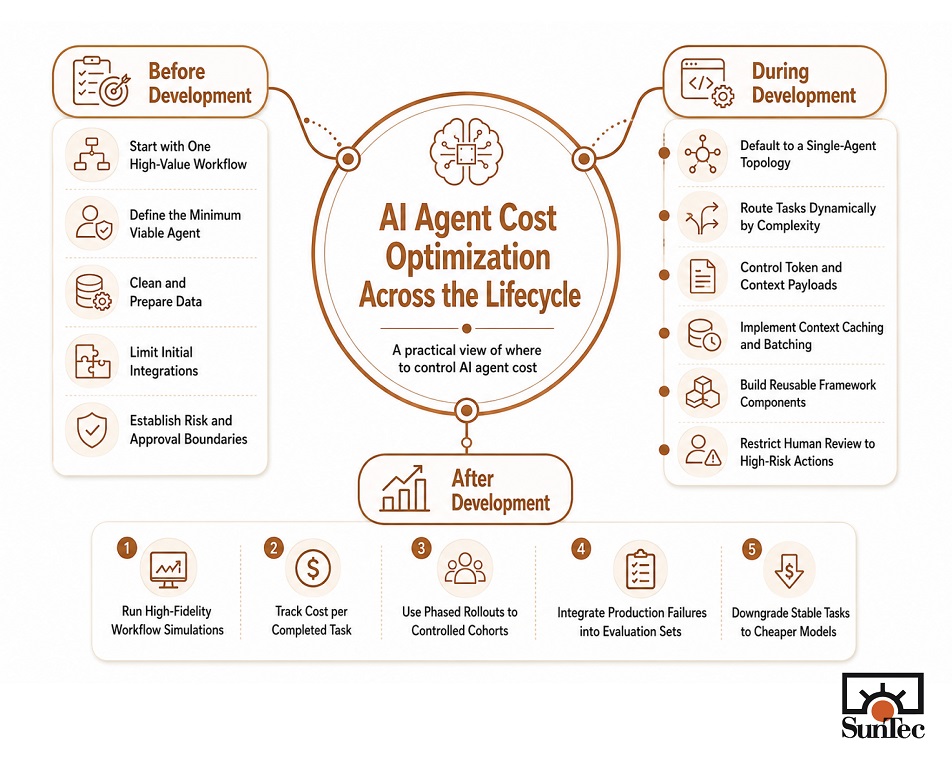
How to Optimize AI Agent Cost Before the Development Begins?
Decisions made in this initial phase set a definitive cost ceiling before a single line of code is written.
1. Start with One High-Value Workflow
Building an all-purpose, multi-department agent in your first version creates severe intent-routing friction and an unmanageable prompt matrix. Instead, you should isolate a high-margin bottleneck for automation.
2. Define the Minimum Viable Agent
Focus on building a minimum viable agent (MVA) that relies on textual orchestration and deterministic tool execution, rather than integrating advanced capabilities such as voice processing, multilingual support, and complex tool calls. This approach minimizes your initial validation costs and significantly shortens the time-to-value loop.
3. Clean and Prepare Data
Deploying an agent on top of fragmented corporate repositories forces the underlying model into continuous reasoning loops and hallucinations. Therefore, clean, deduplicate, and properly tag your source data infrastructure to optimize variable token expenses.
4. Limit Initial Integrations
Every external CRM, ERP, or legacy database connection adds distinct authentication layers, custom exception handling, and security vectors, inflating development hours and costs. Hence, you should cap your initial release strictly to the core execution systems required to complete the primary workflow.
5. Establish Risk and Approval Boundaries Early
You must define exactly which data the agent can mutate and which actions require manual human approval before finalizing your software architecture. This clear boundaries setup aligns the project with legal guidelines early and avoids over-engineering.
How to Optimize AI Agent Cost During its Development?
The implementation phase must focus on building automated financial, routing, and payload controls directly into the system’s software fabric.
1. Default to a Single-Agent Topology
AI Agent developers should default to a minimalist, single-agent topology backed by deterministic code execution to reduce orchestration complexity and minimize failure points. On the other hand, multi-agent orchestration should only be greenlit when a workflow is so non-deterministic that it cannot be structurally decomposed into linear steps.
2. Control Token and Context Payloads
Input tokens are rebilled on each sequential turn within an active user session, causing costs to compound rapidly. Hence, developers must implement background compaction loops to compress historical chats into short metadata summaries. Additionally, semantic re-ranking models should be used to trim payloads down to the exact target sentences.
3. Implement Context Caching and Batching
Architecting programmatic context caching early allows the system to reuse static prompt components, such as system instructions and stable corporate policy documents. Concurrently, you should funnel any workload that does not require an immediate user response into asynchronous batch processing queues.
4. Build Reusable Framework Components
AI product managers must mandate the creation of a centralized library of reusable AI components to reduce future AI Agent development costs. Core utilities like vector database connectors, token-tracking middleware, PII redaction guardrails, and authentication protocols should be built once and shared across all subsequent projects.
5. Enforce Per-Task and Per-Day Token Budgets
Put hard token ceilings on every agent run and on each day’s total usage, so costs stay bounded and predictable rather than scaling with whatever the agent decides to do. Per-task budgets stop a single job from spiraling through infinite loops, redundant retries, or bloated context windows. Per-day budgets cap total spend across all runs and users. And when an agent approaches either limit, threshold-based fallbacks kick in, trimming context, switching to a smaller model, or pausing the run.
How to Optimize AI Agent Cost Before its Launch?
The pre-launch phase serves as the final financial gate to ensure the autonomous system is safe to interact with production infrastructure and sustainable under real-world load patterns.
1. Run High-Fidelity Workflow Simulations
Synthetic unit tests often miss the unstructured nature of production environments. You must subject the agent to rigorous stress testing in a sandboxed environment, using uncurated historical logs, edge cases, and adversarial user patterns to expose system weaknesses, tool failures, and reasoning deadlocks.
2. Track Cost-per-Completed-Task
Decision-makers must actively calculate the exact cost per completed task, such as the total token and infrastructure expenses per resolved support ticket or processed invoice.
3. Use Phased Rollouts to Controlled Cohorts
Deploying the agent to an isolated cohort of internal power users allows teams to monitor real-world behavior. This strategy lets you catch edge cases, optimize token flow, and ensure a low-risk environment before scaling infrastructure across the broader organization.
How to Optimize AI Agent Cost After Launch?
The capital expenditure of the build phase is finite, but operational expenditure continues throughout the agent’s lifecycle to ensure the system remains lean as utilization scales.
1. Integrate Production Failures into Evaluation Sets
You should capture live user corrections, escalations, and edge-case failures to expand your internal evaluation datasets. This robust test suite allows AI engineers to test future prompt adjustments, safety guardrails, and system upgrades without causing quality drift.
2. Downgrade Stable Tasks to Cheaper Models
Continuously audit live production telemetry data to check which tasks do not require a premium frontier model and can be comfortably handled by cheaper alternatives.
Build a Custom AI Agent or Buy an Off-the-Shelf Agent?
The comparison below explains when buying an AI Agent is a good choice and when building is a better choice. It also covers how custom development can be approached either by outsourcing the full project or by strengthening your in-house team with AI specialists through staff augmentation.
| Decision Factor | Buy an Off-the-Shelf AI Agent | Build a Custom AI Agent |
|---|---|---|
| Best Fit | Standard workflows | Industry-specific, regulated workflows that need custom logic and security |
| Development Approach | Subscribe to or configure an existing AI Agent platform with vendor-managed infrastructure | Either outsource the full project to an AI Agent development agency or build in-house by hiring AI Agent experts through staff augmentation |
| Upfront Cost | Lower upfront cost because the basic workflows are already available | Higher upfront cost because development, testing, and deployment must be planned and built |
| Time to Launch | Faster | Timelines depend on workflow complexity, data readiness, integrations and development approach |
| Customization Scope | Limited to vendor-supported templates, prompts, and settings | Highly customizable, as built around exact business logic and system requirements |
| Data Control | Depends on the vendor’s data storage, training, and access policies | Higher control over data access, storage, encryption, masking, retention, and audit trails |
| Security and Compliance | Limited to the platform’s existing security and compliance controls | Can be designed around RBAC, regulatory workflows, and internal security policies |
| Long-Term Cost Risk | Vendor-lock risks including subscription, usage, and add-on costs | Better control over optimization, integrations, reusable components, and scaling |
| Use Cases | Common, low-risk, and does not require deep customization or sensitive system access | Strategic, complex, regulated, action-taking, or deeply connected to business operations |
Closing Thoughts
We have seen in the blog that the AI Agent development cost is rarely determined solely by the visible build effort. The larger cost pattern comes from how the agent reasons, retrieves information, uses tools, accesses systems, and remains reliable after deployment. This is why budgeting should focus on the total cost of ownership, not only the initial build estimate.
An agent can become expensive in production if it sends excessive context, retrieves poorly structured data, or needs frequent human correction. On the other hand, a well-planned AI Agent controls long-term spend through focused workflows, cleaner knowledge sources, model routing, bounded autonomy, escalation paths, and measurable performance thresholds.
The practical budgeting framework for leadership teams is simple: scope, run, govern, and scale. Scope defines the workflow and business outcome. Run estimates model usage, infrastructure, integrations, and human review. Govern accounts for security, compliance, auditability, and risk controls. Scale determines whether the agent can expand across teams without multiplying cost at the same rate.
When these four areas are planned together, AI Agent development shifts from a speculative technology spend to a controlled business investment with a clearer path to ROI. For organizations planning this shift, the right AI Agent development company can help define a tailored strategy that aligns the agent’s architecture, budget, governance, and measurable business value before development begins.
Frequently Asked Questions
The cost of building an AI Agent depends on its complexity, autonomy, integrations, and governance needs. A simple single-purpose assistant usually costs $15,000 to $50,000. A RAG-based workflow agent may cost $40,000 to $150,000. A multi-step autonomous agent can range from $120,000 to $300,000 or more. A multi-agent enterprise system can cost between $120,000 and $300,000. Beyond development, businesses should budget for annual run-and-maintain costs of around 20% to 40% of the initial build cost. These ongoing costs are usually driven by inference, token usage, monitoring, evaluations, maintenance, and model updates.
A scoped proof of concept can take 2–6 weeks. A production-ready RAG or workflow agent typically takes 2–4 months including integration, evals, and guardrails. Complex multi-agent or heavily regulated systems run 6–12 months or more. The timeline is driven less by raw coding than by data readiness, the number of integrations, the depth of testing required, and security/compliance reviews.
The most damaging are: skipping an evaluation harness (so you can’t measure or safely change anything); over-engineering with multi-agent architectures when a single agent would suffice; ignoring inference economics until the production bill arrives; underestimating data-cleaning effort; omitting human-in-the-loop checkpoints for high-stakes actions; budgeting nothing for maintenance and model migration; and launching without defined success metrics, which makes ROI impossible to prove.
Buy an off-the-shelf AI Agent when the workflow is common, low-risk, and speed-to-value matters most. This approach reduces upfront build cost and shortens deployment time. However, it also entails recurring licensing costs, limited customization, and reduced control over the architecture or data.
Build a custom AI Agent when the workflow is proprietary, integration-heavy, regulated, or strategically important. Custom development gives greater control over system design, data handling, model choices, and cost optimization at scale.


Rohit Bhateja, Director - Digital Engineering Services & Head of Marketing
Rohit Bhateja, Director of Digital Engineering Services and Head of Marketing at SunTec India, is an award-winning leader in digital transformation and marketing innovation. With over a decade of experience, he is a prominent voice in the digital domain, driving conversation around the convergence of technology, strategy, customer experience, and human-in-the-loop AI integration.