The Chatbot & Co-Pilot Era Just Ended – Are You Positioned for the AI Agent Revolution?
Table of Contents
- Why Exactly Enterprises are Shifting from Chatbots and Co-Pilots to AI Agents?
- How AI Agents Overcome Operational Failures of Chatbots and Co-Pilots?
- Enterprise Use Cases Where AI Agents Outperform Chatbots and Co-Pilots
- Fix Infrastructure Gaps Before Deploying an AI Agent
- Decision Framework for Leaders: Chatbot, Copilot, or AI Agent?
- Final Thoughts: AI Agents Will Extend Chatbots’ Capabilities
- Frequently Asked Questions (FAQs)
Back in 2016, chatbots felt like a disruption as almost every tech company raced to launch one. Facebook launched its Messenger bot platform, and other technology companies quickly followed suit, positioning conversational interfaces as a new layer between users and apps or the web. For typical, rules-based interactions, chatbots provided value by classifying intent, retrieving predefined responses, surfacing structured information, and reducing the load on internal service teams.
As enterprise AI matured, copilots became the next trend. They helped employees draft content, summarize documents, analyze information, write code, and make better decisions while keeping humans in control. But copilots still depend on a human supervisor to review the output and complete the final action. That limitation made the next shift inevitable.
Enterprises shifted toward context-aware AI systems capable of executing multi-step, autonomous workflows across disparate enterprise applications. That is where the shift from chatbots and copilots to Agentic AI workflows begins, and 70% of tech-forward enterprises are already betting on it. But the real question is why enterprises are moving beyond chatbots now. In this blog, we will break down where chatbots and co-pilots fall short, how AI Agents extend automation from conversation to execution, and what businesses must consider before adopting them.
Why Exactly Enterprises are Shifting from Chatbots and Co-Pilots to AI Agents?
Chatbots started the conversational revolution that copilots followed, but modern businesses now need tools that don’t just talk, but act. Let’s unpack the critical factors driving this major paradigm shift as organizations upgrade from simple messaging interfaces or assistants to autonomous, goal-driven AI systems.
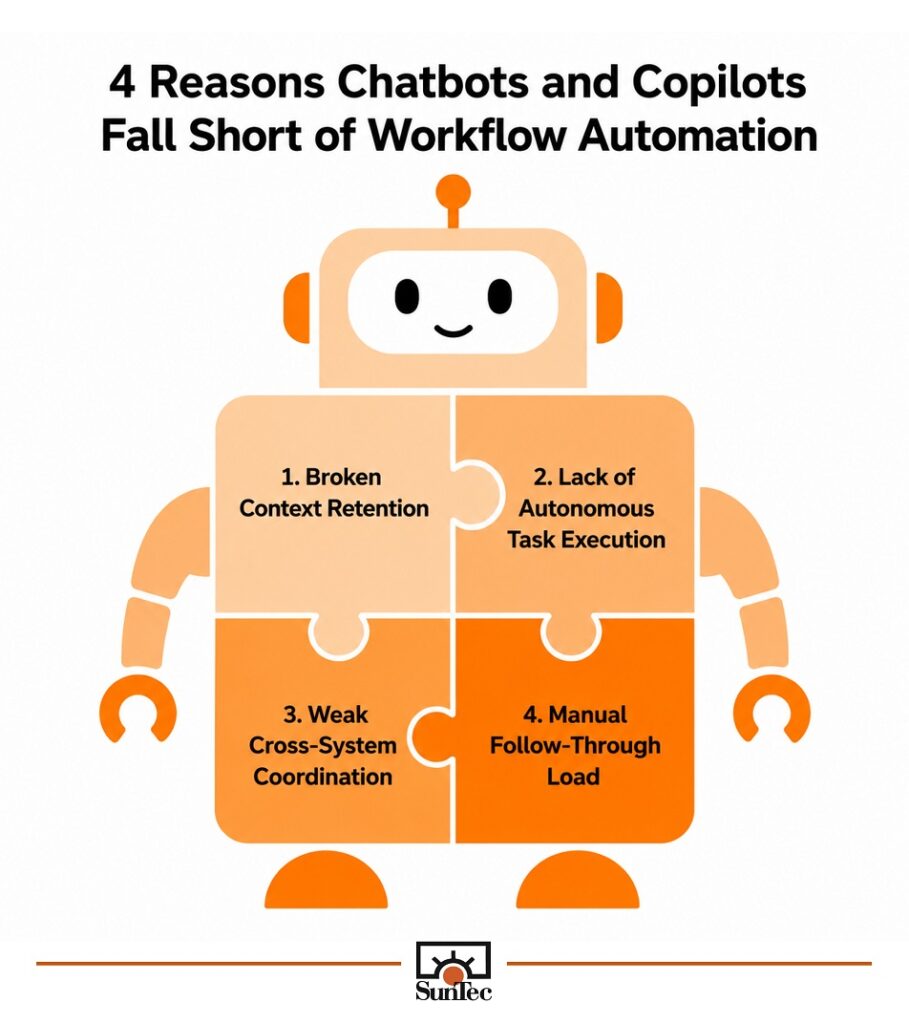
1. Brittle Context Continuity
In the case of chatbots, many rely on short-session state and turn-level intent detection, which limits their ability to preserve context across extended, cross-conversational contexts. At an enterprise-level workflow, this becomes a serious constraint because users need to repeat inputs or restart the flow.
On the other hand, copilots usually assist within a task or workspace, but they do not always carry context across multiple steps, tools, or business systems. This brittle session continuity makes chatbots and copilots unreliable for workflows that require multi-turn reasoning and process-level context.
2. Built to Respond and Assist, Not Execute
Traditional conversational chatbots fail because their architecture relies strictly on intent classification, shallow retrieval logic, and deterministic response templates. For instance, a bot can create or route a support ticket, but it cannot resolve the ticket by checking logs, updating records, triggering approvals, and closing the workflow.
Copilots can support humans in drafting, summarizing, analyzing, or recommending, but the user still has to review, switch systems, and complete the task manually. This limitation of not being able to act autonomously without human intervention makes chatbots and co-pilots unreliable for enterprise-level workflow automation.
3. Limited System Integration and Orchestration
Traditional chatbots usually operate through scripted flows, predefined intents, and narrow backend integrations. Even when connected to CRM, ERP, ITSM, or knowledge-base systems, they typically handle data retrieval only within a limited scope of interaction.
A copilot can also help interpret information, but it often cannot coordinate actions across the enterprise ecosystem. Enterprise workflows, however, depend on orchestration capabilities to collate information across enterprise systems, which chatbots and co-pilots often lack.
4. Persistent Downstream Handoffs
In many enterprise use cases, chatbots could capture inputs, classify the query, and push the case into a ticketing queue, but resolution still depended on human supervision. Each escalation added nearly 6.4 hours per week due to bot-sitting to feed context, check outputs, and fix errors.
Copilots help individuals work faster, but the underlying business process may remain fragmented and manual. This is why chatbots and co-pilots enhance productivity and streamline operations, but the downstream execution efforts remain the same.
How AI Agents Overcome Operational Failures of Chatbots and Co-Pilots?
We have seen so far that chatbots and copilots struggle when workflows require memory, system access, action, and follow-through. The next section explains how AI agents address these limitations at the enterprise level.
1. Persistent State and Long-Horizon Memory
Chatbots store context in a short-lived session buffer, which is discarded once the turn or conversation ends. AI Agents replace this with a layered memory model. In short-term memory for the active reasoning loop, and long-term memory persisted to an external store, typically a vector database for semantic recall. As the agent works, it writes checkpoints of its progress (goal, completed steps, retrieved data, pending actions) to this store, enabling the context to be reconstructed from durable state.
2. Autonomous Execution via a Plan-Act-Observe Loop
A chatbot’s pipeline ends at response generation. An agent runs a control loop that turns a goal into a sequence of executed actions. The agent decomposes the objective into sub-tasks, selects a tool or action for each, executes it, and feeds the result back into its reasoning to decide the next step.
3. Cross-System Orchestration
Agentic AI systems treat every system as a tool exposed through a uniform interface, and the agent’s planner decides at runtime which tools to call and in what order. This shifts integration from static wiring to dynamic orchestration. The agent can read an entity from one system, reconcile it against a second, and write the resolved outcome to a third, while respecting the data dependencies and sequencing constraints. It manages the execution graph by running independent calls in parallel where possible, chaining dependent ones in sequence, and passing state between them. For workflows that require approvals or atomicity, the agent can also enforce ordering and rollback semantics that a stateless bot cannot express.
Enterprise Use Cases Where AI Agents Outperform Chatbots and Co-Pilots
While chatbots excel at answering simple queries, they fall short when complex workflows require autonomous action. Here are the key enterprise use cases where AI Agents take the lead, proving why the future of automation belongs to them.
1. Healthcare
Autonomous artificial intelligence agents in healthcare can manage complex care administration and patient scheduling workflows that conversational bots failed to do. Legacy chatbots could only answer pre-determined patients’ queries. They lacked the reasoning and capability required to manage the workflow end-to-end without a human administrator. AI Agents, however, are securely integrated with EHR systems and calendars to capture patient intake details and insurance coverage, match care requirements with providers’ availability, and book or reschedule appointments.
A practical example can be seen in Cancer care provider Color Health, which has deployed an AI Agent to support breast cancer risk assessment and screening. The agent gathers eligibility information, answers patient questions, and routes cases to clinicians for review when needed.
2. Legal
Agentic AI is useful in legal operations where case analysis depends on large volumes of documents, timelines, evidence, medical records, policy details, and review workflows. Traditional conversational bots were limited to front-end keyword searches and passive handbook lookups, unable to map chronological, multi-document histories, extract event timelines, and support decision-making.
Here, AI Agents add value by combining OCR (Optical Character Recognition) and NLP (Natural Language Processing) to perform document categorization, case summarization, timeline creation, and more. A practical example is A&O Shearman, which incorporated its expertise into AI Agents that can conduct research and engage in multi-step reasoning over matter-specific documents and curated data.
3. eCommerce and Retail
Agentic AI is useful in eCommerce and retail because customer journeys and retail operations involve many interconnected decisions. A shopper may need help discovering products, comparing options, tracking an order, understanding return terms, or resolving a post-purchase issue. Chatbots supported these journeys at the information level only by answering FAQs, sharing product links, or providing tracking details.
To solve the incompetence of chatbots, AI Agents go further by connecting customer intent with product data, inventory context, pricing rules, fulfillment status, and service workflows. These AI-based autonomous systems help businesses guide customers toward the next best action by providing personalized recommendations throughout their shopping journey.
4. Supply Chain and Logistics
Supply chain and logistics workflows depend on demand signals, inventory movement, warehouse status, route planning, fulfillment exceptions, and store-level availability. Chatbots could answer basic status questions, but they could not coordinate real-time signals across inventory, transportation, replenishment, and fulfillment systems.
Agentic AI adds more value here by helping teams detect stock imbalances, recommend next steps, reroute inventory, and act on operational exceptions faster. The real-life example is Walmart’s global supply chain transformation, which reflects this shift. Its AI-enabled systems are being used to predict demand, reroute inventory, reduce waste, and support associates with agentic tools that turn shortage-related questions into instant insights and recommended actions.
5. HR and Talent Management
HR and talent operations are moving beyond basic chatbot support because recruitment involves more than answering candidate questions. Recruitment teams need to manage high applicant volumes, screen profiles, assess role fit, coordinate interviews, and maintain a consistent candidate experience across multiple stages. Traditional HR chatbots could explain job openings, share application steps, or answer onboarding FAQs.
AI Agents, on the other hand, evaluate candidate signals or support recruiter decision-making. This AI-based recruitment automation is implemented in Unilever to support sourcing, screening, gamified assessments, video interviews, and onboarding. The company used HireVue and Pymetrics to process large volumes of applicants, reduce recruiters’ workload, and keep final hiring decisions under human review.
6. Finance Operations
The use of Agentic AI in finance operations involves account context, transaction history, eligibility rules, approval paths, and regulated data access. Chatbots could answer basic questions about fees, statements, policies, or service terms. Still, they are often limited in retrieving information when the task requires system-level validation or a controlled action.
This is enabled by Agentic AI, which allows approved agents to query financial records, interpret user intent, retrieve relevant account insights, and support workflow execution within defined permissions. Morgan Stanley is moving in this direction by opening its workplace wealth platforms, ShareWorks and Equity Edge, so external AI Agents can access stock administration data and insights more directly.
7. IT Operations
Agentic AI is transforming IT operations by moving workplace IT support beyond basic troubleshooting and ticket routing. Earlier, chatbots could share password reset steps, link to VPN setup guides, answer software access FAQs, create support tickets, or route incidents to the right queue.
AI Agents, on the other hand, add value by interpreting the issue, checking environment signals, recommending fixes, initiating governed workflows, and escalating with structured diagnostic details. These autonomous systems can also diagnose device behavior, check system context, correlate logs, validate user permissions, and trigger approved remediation across ITSM, identity, endpoint, and monitoring tools.
8. Customer Service Resolution
Customer service requests often begin with routine questions about orders, payments, refunds, invoices, cancellations, or account access, but the resolution usually depends on the customer’s specific context. This is where chatbots fall short because they can share policy links, answer basic queries, or route users to support, but often cannot connect previous interactions and approved next steps.
AI Agents close this gap by using that context to support faster case handling, better escalation, and more consistent resolution. A real-life example is a UK-based aviation parts supplier that handled up to 1,000 inquiries per day during high traffic, achieving 98% match accuracy and reducing support calls by 50%.
9. Knowledge Management
Agentic AI is improving knowledge management by helping employees find, interpret, and apply information spread across documents, wikis, policy repositories, ticket histories, product manuals, and internal systems. Basic conversational bots could answer FAQs, return document links, or search a knowledge base, but they often struggled with source relevance, version control, access permissions, and cross-document reasoning.
AI Agents mitigate the limitations of chatbots for knowledge management. These autonomous systems retrieve approved information, compare policy versions, synthesize context from multiple repositories, cite source material, and guide users toward the next step. This makes them useful for research-heavy workflows where employees need accurate, up-to-date, and role-specific answers rather than isolated search results.
Fix Infrastructure Gaps Before Deploying an AI Agent
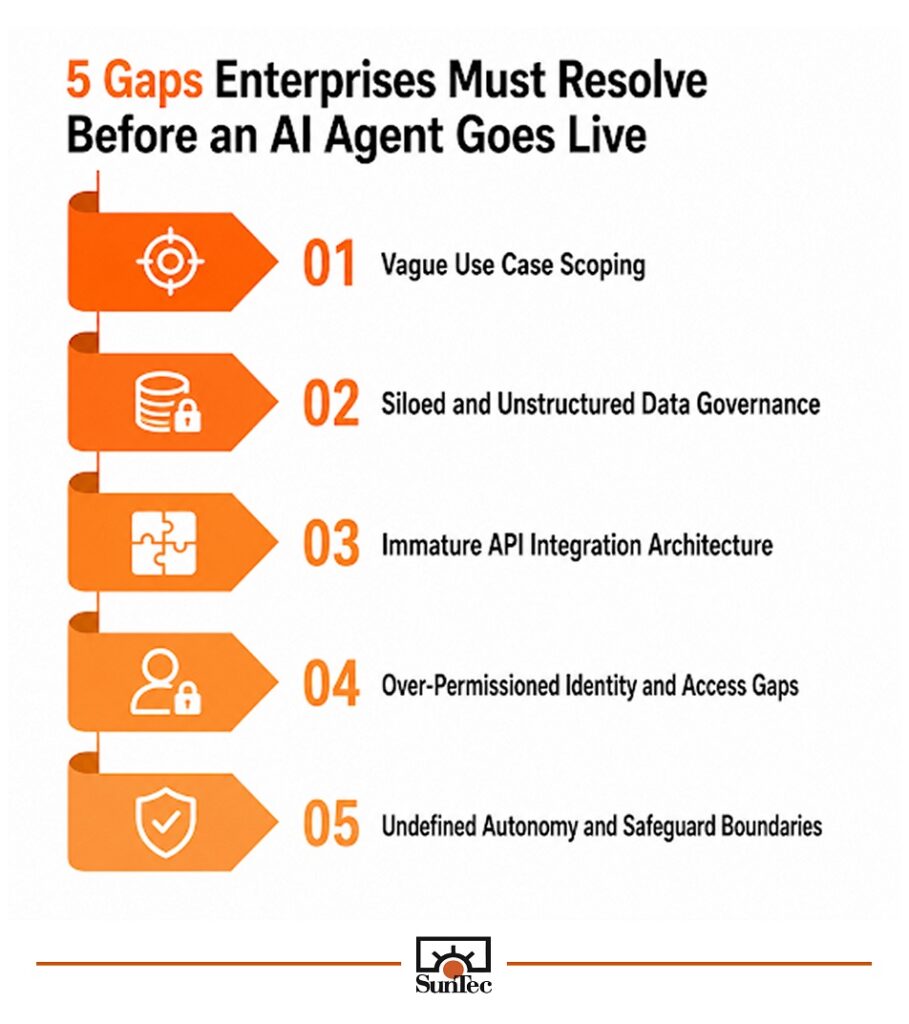
An ROI-driven AI Agent can’t be deployed on a broken or weak foundation. Before automating workflows with autonomous agents, you must bridge critical infrastructure gaps in security, data, and API maturity. Read the following blueprint to ensure your enterprise is ready to launch a production-ready Agentic AI workflow.
1. Select a High-Value Use Case
To successfully deploy Agentic AI, the initial scope must be narrowed to a single, high-volume, rules-based workflow with an explicitly measurable outcome. Building an open-ended, multi-purpose corporate assistant in your first version is an ambitious stretch; it widens the scope, cost, and risk all at once. A safer path is to begin with one or two low-risk, well-defined workflows, prove value there, and expand from a working foundation. The following things need to be done by AI product managers, CTOs, tech leads and other stakeholders responsible for AI Agent development:
- Review operational workflows to isolate tasks with high volume, clear rules, repetition, and measurable outcomes.
- Establish concrete parameters for what a completed task looks like, ensuring the outcome can be verified programmatically without ambiguous interpretation.
- Measure current human timelines, error rates, and costs for the chosen workflow to serve as a benchmark for the agent’s performance.
- Outline how the lessons, prompt architectures, and infrastructure from this first bounded deployment will be applied to broader business units later.
2. Prepare Foundational Data Infrastructure and Governance
One of the strongest predictors of agentic success is the quality of your underlying data architecture. Since an AI Agent autonomously reasons, synthesizes, and executes actions based on enterprise data, unstructured or siloed repositories directly cause erratic and unreliable behaviors. This requires:
- Removing redundant, obsolete, or trivial (ROT) data from every internal database, API, and unstructured document repository that the agent will access.
- Building an automated ingestion pipeline that attaches mandatory security classification, regional jurisdiction, and last-updated timestamps to all unstructured files.
- Deploying a centralized data virtualization layer or semantic mesh that allows the AI Agent to query live information on demand without duplicating sensitive files securely.
- Setting up continuous data-quality monitoring systems that screen inputs for anomalies and raise immediate system flags if an agent attempts to pull data from an unverified source.
3. Assess API Maturity and Integration Engineering
The real value of AI Agents is generated from their ability to work across enterprise software, such as CRM, ERP, and databases, interpret context, and perform the intended action. This operational capability hinges entirely on your API infrastructure, so your enterprise APIs must be discoverable, well-documented, and highly reliable to support autonomous tool calling. To streamline this connectivity, the following must be done:
- Audit existing corporate endpoints for latency, strict payload schemas, and uptime reliability under heavy simulation loads.
- Ensure all target APIs feature comprehensive OpenAPIs or Swagger specifications so the agent can autonomously discover and interpret tool schemas.
- Assess integration architectures against emerging open standards, such as the Model Context Protocol (MCP), to minimize the need for brittle connection code.
- Provision isolated testing environments with realistic mock data, where the agent can practice tool-calling and error handling without affecting live systems.
4. Define IAM and Architectural Security
Over-permissioned agents are among the most critical security vulnerabilities. Hence, AI Agents require tightly controlled access because they retrieve data, call tools, update records, or trigger workflows. Each agent should have a defined identity, scoped permissions, and access aligned only to the specific workflow it performs. Before an artificial intelligence agent goes live, organizations must follow the required actions:
- Assign each agent a unique managed identity instead of shared credentials.
- Restrict token lifetimes and explicitly limit the HTTP methods (e.g., forcing Read-Only GET requests and blocking DELETE capabilities) that the agent can execute.
- Apply a combination of RBAC (Role-Based Access Control) and ABAC (Attribute-Based Access Control) to ensure agent permissions dynamically scale with real-time environmental factors, such as time of day or data classification.
- Wire agent credentials into corporate security information and event management (SIEM) systems to trigger immediate isolation upon detection of anomalous access behavior.
5. Set Autonomy Boundaries and Human-in-the-Loop Safeguards
Enterprises need to establish rigid, testable boundaries that dictate when an agent can act autonomously versus when it must halt for human intervention. This is crucial for highly regulated industry operations, such as financial transactions, legal review, HR decisions, healthcare workflows, production deployments, and external customer communication. To enforce a controlled autonomy, enterprises must:
- Program explicit boundary thresholds directly into the agent’s routing logic, forcing halts whenever confidence scores drop below a strict percentage.
- Build a dedicated dashboard for human reviewers to inspect, modify, approve, or reject pending agent actions before they are finalized.
- Categorize all agent activities into low, medium, and high-risk brackets, assigning automated execution to low-risk tasks while anchoring high-risk tasks to mandatory manual overrides.
- Create clear organizational lines for where rejected or failed agent actions are sent, mapping them directly to the appropriate human operations teams for manual resolution.
Decision Framework for Leaders: Chatbot, Copilot, or AI Agent?
Not every AI interface solves the same business problem. Before investing, leaders need to understand when a chatbot is enough, when a copilot adds value, and when an AI Agent is necessary.
| Factor | Chatbot | Copilot | AI Agent |
|---|---|---|---|
| Primary Function | Responds to repetitive, predefined queries. | Assists users with drafting, analysis, summarization, or decision support. | Executes defined workflows through governed, system-connected actions. |
| Best-Fit Task | Informational, predictable, and low-risk tasks. | Knowledge work where human judgment remains central. | Multi-step processes that require context, tool use, and enterprise system access. |
| Human Role | Intervenes when the chatbot cannot resolve the query. | Reviews, edits, approves, and remains fully accountable for the output. | HITL for exceptions and risk-sensitive actions. |
| System Access | Usually limited to FAQs, knowledge bases, or basic backend lookups. | Often connected to documents, workspaces, reports, or productivity tools. | Connected to CRM, ERP, ITSM, HRMS, finance systems, databases, and workflow platforms. |
| Context Requirement | Requires limited session-level context. | Uses relevant business context to improve the quality of human output. | Retains and applies context across multiple steps. |
| Action Capability | Provides answers, links, status updates, or guided instructions. | Drafts, summarizes, analyzes, explains, compares, or recommends. | Retrieves data, calls tools, updates records, triggers workflows, and routes approvals. |
| Risk Profile | Low | Moderate | Low to moderate, depending on governance and approval gates. |
| Common Use Cases | FAQs, policy lookup, order-status queries, password-reset guidance. | Summarization, report analysis and review. | Invoice exception handling, IT ticket triage, claims intake, customer case resolution, onboarding workflows. |
| Success Metrics | Reduced query volume, faster response time, and lower support load. | Improved productivity. | Reduced cycle time, fewer handoffs, higher completion rates, and improved process accuracy. |
| Executive Decision Rule | Use when the task only requires a consistent answer. | Use when the user needs AI assistance but still wants to remain in control. | Use when a repetitive business operation requires last-mile execution, without human intervention. |
Final Thoughts: AI Agents Will Extend Chatbots’ Capabilities
The rise of Agentic AI does not mean chatbots or copilots are completely obsolete. Even the market size for chatbots and co-pilots is projected to grow each year, with CAGRs of 25.10% and 27.4%, respectively [Source: Research and Markets]. This proves that conversational bots remain in demand, have a clear business need, and will continue to serve as highly effective, low-cost tools for simple front-end informational queries. What is changing in enterprise environments is their position in the technology stack, from standalone response tools to access points for deeper agentic workflows.
This means the chatbot remains the familiar touchpoint for users, co-pilots continue to support humans with tasks, and specialized AI Agents operate behind the scenes to handle repetitive business tasks. The user may still experience a conversational interface, but the actual work happens at the workflow layer, where agents retrieve data, apply business rules, and coordinate actions across enterprise systems.
Ultimately, this transition redefines the value proposition of conversational bots rather than replacing them. Enterprises do not have to choose between the accessibility of a chatbot or the capabilities of an autonomous AI Agent; instead, they get the best of both worlds. They can leverage chatbots as the intuitive front-end and Agentic AI as the intelligent back-end engine to automate complex, repetitive tasks. The real opportunity lies in developing governed Agentic AI workflows that improve speed, accuracy, and operational capacity without losing human oversight where judgment is required.
Frequently Asked Questions (FAQs)
The main difference between a chatbot and an AI Agent is that a chatbot is mainly designed to respond to user queries through a conversational interface. It works well for FAQs, guided support, status checks, and other predictable interactions. An AI Agent goes further by using context, tools, enterprise data, and defined business rules to complete multi-step tasks. In simple terms, a chatbot answers the request, while an AI Agent can help execute the workflow behind it.
An enterprise should deploy an AI Agent when an operational workflow requires backend system write-access, complex logical processing, or cross-platform orchestration. Examples include autonomously reconciling inventory discrepancies across a supply chain, cross-referencing and processing vendor invoices, or diagnosing a recurring technical issue by correlating support tickets with system logs and drafting a remediation plan for engineer approval.
The biggest risks of AI Agents come from their ability to act across business systems. An agent may trigger the wrong workflow, update the wrong record, execute an action without approval, use outdated enterprise data, or continue a process even when an exception should be escalated. These risks become more serious when agents have broad system access, unclear autonomy limits, weak audit trails, or poor integration controls. To mitigate this, enterprises need strict permissions, action-level guardrails, human approval gates, and continuous monitoring before allowing agents to operate inside production workflows.
Yes, robust human oversight is essential for safe enterprise deployment, though the human role shifts from active execution to high-level supervision. Organizations must build explicit Human-in-the-Loop (HITL) gates directly into the agentic architecture for high-risk thresholds. Sensitive transactional steps, such as approving external financial payments, pushing code to production, or dispatching unreviewed communications to major corporate clients, must halt the system and require a human supervisor.
Enterprises should prepare clean, well-governed data, clear use cases, API-ready systems, access controls, human approval rules, monitoring infrastructure, and measurable success metrics. They should also define what the agent can and cannot do, and when it must escalate.
Enterprise AI agent development cost typically ranges from $50,000 to over $150,000, depending on architectural complexity. While simple data-retrieval agents cost less, production-grade task-execution workers require custom API integrations, strict runtime guardrails, and secure tool gateways. The factors that add up to development cost are model inference tokens, vector infrastructure, and observability tracing platforms.


Rohit Bhateja, Director - Digital Engineering Services & Head of Marketing
Rohit Bhateja, Director of Digital Engineering Services and Head of Marketing at SunTec India, is an award-winning leader in digital transformation and marketing innovation. With over a decade of experience, he is a prominent voice in the digital domain, driving conversation around the convergence of technology, strategy, customer experience, and human-in-the-loop AI integration.