Follow Us





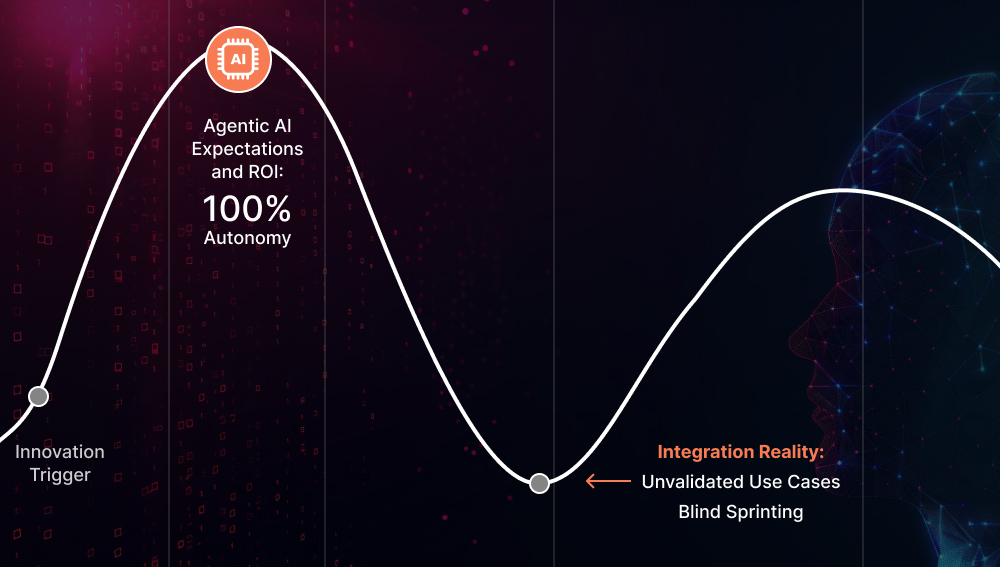
In the wake of ChatGPT’s release in 2022, organizations rushed to integrate generative AI, often without fully understanding its potential or evaluating their actual needs. Fast forward to 2025, and many are facing the consequences of hasty adoption: untested use cases, overstretched resources, and underwhelming results.
A recent MIT study revealed that 95% of generative AI pilots in enterprises fail to deliver tangible financial returns. As someone with over a decade in the IT space, it’s a sobering reminder that hype can’t replace a well-thought-out strategy and validated use cases.【Source: Forbes】
In fact, having recently worked with a client who jumped on the AI bandwagon, the picture is way too clear. They had a vision and the resources, but they jumped on the pilot too soon and without validating their use case. But without a proper strategy, their pilot project fizzled out, leaving them with wasted resources and unrealized potential. It’s a pattern we’ve seen often.
With Agentic AI now making waves, I fear leaders might be on the verge of making the same mistakes.
The Agentic AI Hype: Understanding the Gold Rush
Agentic AI was the most talked-about concept in enterprise tech in 2025. Every vendor presentation mentions it. Every conference agenda features it. Every CTO is being asked about their Agentic AI roadmap.
The reality is that enthusiasm is often misaligned with execution. According to Anushree Verma, Senior Director Analyst at Gartner,
Most Agentic AI integrations right now are early-stage experiments or proofs of concept that are mostly driven by hype and are often misapplied.
This has led to a flywheel effect:
- The market is flooded with products claiming to be "Agentic AI" that are, in fact, nothing of the sort.
- Organizations are building AI Agents for use cases that do not even require agentic capabilities.
What has actually happened: This gold rush is creating dangerous confusion in the marketplace. CTOs and CEOs are burning millions, making substantial investments in capabilities they don’t need and might not even exist.
Why Most Use Cases Don’t Require Agentic AI Integrations?
There are two primary reasons for us to believe so:
Organizations can often achieve significant benefits with basic AI, sometimes even through rule-based automation.
- Need to extract data from invoices? That's basic document AI, not Agentic AI.
- Want to generate marketing copy? That's generative AI, not Agentic AI.
- Looking to automate repetitive workflows? That's RPA or traditional process automation, not Agentic AI.
Even sophisticated applications, such as predictive maintenance or fraud detection, typically don't need autonomous agents—they need good models and solid integration.
Agentic AI technology is not yet mature enough to deliver the business value companies expect.
Another report by Gartner predicts that more than 40% of Agentic AI projects will be cancelled by 2027. And that’s okay.
We are currently at the PoC stage, and concepts are often meant to fail. That is their purpose: to allow organizations to test, learn, and move forward. Each failure helps them filter Agentic AI hype from actual business value. Similarly, PoCs that survive are nothing less than gold – they will redefine how businesses operate in the future.
The Blind Following: When Tech Giants Lead, Everyone Follows
There's another factor accelerating this Agentic AI hype cycle.
Companies like Google, Microsoft, OpenAI, and Anthropic are publicly shifting their resources toward Agentic AI R&D. As a result, the entire market responds.
If these companies (with their immense resources and technical expertise) are betting billions on building AI Agents, surely every other enterprise should follow suit—right? This momentum generates a ripple effect that compels others to jump on the bandwagon.
But here’s the catch:
- They are operating at a scale and with resources that most enterprises can only dream of.
- They're not only developing the foundational platforms for Agentic AI integration but also solving problems that require specialized talent, massive data sets, and long-term research investments.
When smaller companies or organizations with limited resources attempt to replicate this approach without the proper infrastructure, expertise, or validated use cases, they’re setting themselves up for failure.
What Enterprises Should Do Instead: Start With an Honest Agentic AI Assessment
The gap between expectation and execution remains wide. To bridge this gap, enterprises should take a step back and conduct a thorough, honest assessment of their readiness for Agentic AI integration.
This assessment should touch base on:
- The state of your existing infrastructure
- Quality and quantity of your data needed to support AI Agents
- Dependencies on legacy systems
- Potential use cases/ Agentic AI vision
- Whether your workforce is equipped to manage the complexity that comes with deploying AI Agents
- Most importantly, is the business problem complex enough to justify the investment?
Agentic AI Readiness Assessment
A Self-Audit Framework for Enterprises Considering AI Agents
Agentic AI promises a self-optimizing, autonomous ecosystem—but only 1 in 10 enterprises is ready to deploy it at scale. Having worked with that 1 (and 9 others), we know what tells. Which is why we have devised a self-audit framework that helps diagnose Agentic AI readiness gaps across infrastructure, governance, and strategy—before making costly implementation mistakes.
Use it to:
- Benchmark your organization’s AI maturity
- Identify where AI Agents can realistically add value
- Prioritize foundational investments for scalable adoption
Assess Your Organization’s Agentic AI Readiness
Take this comprehensive multi-stage assessment to evaluate your digital maturity and identify where your organization stands today.
How SunTec India Can Help
At SunTec India, we help enterprises move from AI aspiration to AI readiness by building the foundations that make Agentic AI viable, scalable, and secure.
We don’t push integrations for the sake of trend adoption. Every recommendation begins with a validation-first approach—understanding your data maturity, evaluating the fit, and mapping measurable outcomes before suggesting any AI implementation.
Our Role in Your Agentic AI Readiness Journey
- Data Infrastructure Modernization: Centralizing fragmented data into unified, analytics-ready repositories.
- API & System Integration: Enabling interoperability through API-first modernization of legacy systems.
- Cloud Enablement: Designing scalable, cloud-native architectures optimized for AI-grade workloads.
- Data Quality & Governance: Establishing standards and compliance controls (ISO 27001 and 9001, GDPR, CCPA, SOC 1 and 2, HIPAA).
- AI Validation & Advisory: Running controlled pilots to validate ROI and technical feasibility before integration.
Why you should build your AI Agents with us?
Extensive digital engineering expertise across data, cloud, and emerging AI tech ecosystems.
Proven validation frameworks to mitigate risk in Agentic AI adoption.
AI Agent
1,500+ full-time specialists, including AI consultants, engineers, and architects, delivering modernization and AI-readiness projects worldwide.
Human-in-the-loop precision, ensuring accuracy, compliance, and continuous improvement.
Ready to validate your Agentic AI readiness?
Get a free Agentic AI readiness check from our Agentic AI experts. Connect with us at info@suntecindia.com for a no-cost consultation today!

Rohit Bhateja
Rohit Bhateja, Director of Digital Engineering Services and Head of Marketing at SunTec India, is an award-winning leader in digital transformation and marketing innovation. With over a decade of experience, he is a prominent voice in the digital domain, driving conversation around the convergence of technology, strategy, customer experience, and human-in-the-loop AI integration.
