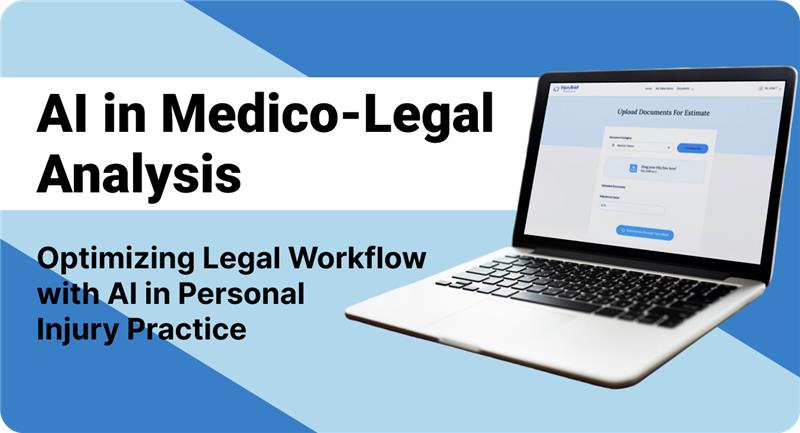
See how we delivered a scalable AI-powered solution for personal injury practitioners to automate document processing, case analysis, and client management.
How MCP Simplifies AI Integration at Enterprise Level?
As more AI use cases move into production, disconnected tools and workflows slow down its progress. To mitigate this challenge, we help you build a Model Context Protocol (MCP) layer to unify all your integrations into a single, seamless system.
- Standardizes tool discovery, invocation patterns, and metadata.
- Makes multi-tool orchestration more stable in production environments.
- Separates tools, resources, and reusable prompts at the protocol level.
- Improves composability across agent workflows.
- Dynamic capability discovery instead of hardcoded tool registries.
- Adapts more easily to changing systems, permissions, and environments.
- Structured initialization, version coordination, and session management.
- Reduces runtime failures caused by assumptions between client and server.
Comprehensive MCP Development Services
See how we bridge the gap between your private data and powerful AI models. Our specialized services build the secure, reliable connections your business needs to turn smart AI into a hardworking team member.
Custom MCP Server Development
We develop custom MCP servers that standardize interface between your internal ecosystem and AI models. By implementing the core MCP specification, we transform your isolated data silos into discoverable resources that AI agents can interact with.
- High-concurrency servers using TypeScript/Node.js and Python for rapid deployment or Go and Rust for low-latency performance.
- Stdio transport for local IDE/desktop integrations and HTTP with SSE for cloud-native deployments.
- Zod and other schema validation libraries to ensure type-safety.

Data Bridging and Modernization
Our MCP development experts build schema-aware connectors that allow AI systems to perform real-time retrieval from modern databases and wrap legacy systems into a standardized MCP interface.
- Database-centric servers for PostgreSQL, MySQL, MongoDB, Snowflake.
- Read-only connection pooling and advanced SQL injection prevention.
- Resource Templates to navigate RDB and historical archives through URI-based access patterns.
API and Third-Party Integration
Most modern enterprises run on a diverse stack of third-party platforms. Our MCP development specialists develop custom MCPs that integrate APIs and third-party services and platforms.
- REST, GraphQL, and gRPC/tRPC endpoints mapping to MCP tool definitions.
- OAuth 2.1 flows and storing tokens natively to prevent credential leakage.
- OpenAPI specifications to automatically generate tool documentation.

Security and Governance
Since MCP grants AI access to internal systems, we prioritize a zero-trust architecture. This ensures every interaction between an AI model and your data is authenticated.
- RBACs/ABACs to ensure exact data matching based on the specific permissions.
- Governance Gateways for centralized logging for all tools and resources.
- Rate-limiting and PII-masking filters to prevent sensitive data exposure.
Agentic Workflow Automation
Our MCP development services include creating Actionable Intelligence beyond simple retrieval. This involves developing multi-step workflows for AI agents to chain together various MCP tools to complete business processes.
- Prompt Templates within the server for business logic and chain-of-thought guidance.
- Generative Engine Optimization(GEO) optimization for AI parsing and citing.
- Stateful tool orchestration for sequence-dependent tasks.

Deployment and Maintenance
Leverage our MCP development services to streamline the integration of MCP servers into your existing ecosystem. We focus on the final mile of implementation, transforming standalone servers into a production-ready AI infrastructure.
- Configuration of AI apps, like Claude Desktop and custom enterprise dashboards.
- JSON-RPC optimization for message passing and transport layers, providing near-instantaneous AI response.
- Logging and monitoring frameworks for ongoing maintenance, tracking server health, and resource usage.
Build Production-Ready Connectors for your AI Models
Deploy custom MCP servers that bridge your enterprise ecosystem with AI systems to automate complex workflows and drive real-time results.
Types of MCP Servers We Help You Develop
We develop specialized Model Context Protocol (MCP) servers that transform static enterprise data into agentic resources. By building these secure bridges, our developers enable AI models to operate with the precision of your internal ecosystem.
Database Servers
Our MCP development engineers develop schema-aware bridges that grant your AI models real-time access to your structured and unstructured data repositories without manual exports.
- Native connectivity for PostgreSQL, MySQL, MongoDB, Redis, and Elasticsearch.
- Direct-to-source querying to ensure AI models receive up-to-the-second data.
API Gateway Integration Servers
Our MCP development team wraps your service architecture into a MCP-compliant interface, making internal microservices programmatically accessible to AI systems.
- OpenAPI specs for auto-generated request validation and tool definitions.
- Secure triggers and orchestrate multi-step API workflows.
SaaS Ecosystem Servers
We facilitate seamless interoperability between AI models and mission-critical business platforms while maintaining strict security standards.
- Secure connectors for Salesforce, HubSpot, Jira, Slack, and Google Workspace.
- Scoped permissions to limit AI interactions to authorized records only.
File System Management Servers
We develop sandboxed gateways that enable AI models to process documentation across diverse storage environments while maintaining total isolation from sensitive system files.
- Cloud and local storage integration including S3, Google Cloud Storage, Azure Blob Storage, and SharePoint.
- Strict path allowlists and sandboxed environments to prevent data leakage.

Custom Domain Servers
For complex enterprise environments, we build custom MCP servers that interface with heavy-duty internal systems and industry-specific proprietary tools.
- Specialized bridges for enterprise ERPs like SAP, Oracle, and legacy databases.
- Custom business logic mapping into tools that mirror your unique workflows.
MCP Solution Architecture Our Experts Help You Build
MCP works as a standard connection layer between AI applications and the systems they need to access. Our MCP development services help you develop an MCP-based foundation that supports secure access and smoother workflow execution across the enterprise.
Host Interface
Build user-facing AI experiences that work in the right environment. We help you develop the host layer where users actually interact with AI. This could be an internal assistant, a customer-facing interface, a desktop workspace, an IDE extension, or a web-based enterprise application.
Web Portals
Desktop Apps
Internal Copilots
IDE Extensions
MCP Client Layer
Build governed Model Context Protocol (MCP) servers to give your AI secure, precise access to core enterprise data and workflows. This equips your AI with the exact context and action surface it needs while strictly protecting your broader systems. By bridging the gap between legacy platforms and modern LLMs, MCP server transforms fragmented backend data into safe, actionable intelligence.
SDKs
Client Runtime
API Connectors
Session Handling
MCP Server Layer
Expose business capabilities through governed MCP servers. We help you develop MCP servers that expose the exact business capabilities your AI applications need. That may include access to internal documents, database lookups, ticket creation, calendar actions, workflow triggers, or other governed enterprise operations. The goal is to give your AI the right action surface and context layer without opening unnecessary access.
Tools
Resources
Prompts
Domain Logic
Transport and Session Layer
Support reliable communication across local and remote MCP environments. Our experts build the transport and session layer that keeps MCP communication stable across different deployment models.
JSON-RPC
stdio
Streamable HTTP
Session State
Security and Access Control
Strengthen access control and security across connected systems. We help you develop MCP architectures with the security layer needed for real enterprise usage.
OAuth 2.1
Access Policies
Consent Controls
Audit Readiness
Enterprise Integration Layer
Connect enterprise systems without creating one-off integrations. Our MCP development specialists help you connect the systems that already power your business. Instead of building separate integrations for every AI workflow, we help you create a more reusable MCP integration layer.
Databases
CRMs
ERPs
Slack
GitHub
Custom APIs
Scale Your AI Capabilities with a Trusted MCP Development Company
We deploy custom server architectures that enable your AI apps to interact directly with internal databases and software, turning isolated models into fully operational business tools.
Tech Stack Our MCP Development Experts Use
Our developers utilize a performance-driven architecture centered on high-concurrency languages and robust transport protocols.
-
TypeScript/
Node.js -

Python
-

Go
-

Rust
-
Stdio (Local/IDE)
-
HTTP + SSE (Remote/Cloud)
-

Zod
-

Pydantic
-
JSON Schema
-

OpenAPI (Swagger)
-
GraphQL
-

gRPC
-
JSON-RPC 2.0
-
Docker
-
Kubernetes
-

AWS
-

Google Cloud
-

Azure
-

OAuth 2.1
-

JWT
-

SSL/TLS 1.3
-
Role-Based Access Control (RBAC)
-

PostgreSQL
-
MySQL
-

MongoDB
-

Redis
-

Snowflake
-

BigQuery