WCAG COMPLIANCE SERVICES
Why Digital Accessibility Requires More Than a One-Time Audit
New releases, design updates, content changes, and third-party components can introduce accessibility gaps. Unless teams have a structured process for testing, remediation, documentation, and ongoing monitoring, digital accessibility compliance will continue to be a challenge.
That is the gap our WGAC compliance services are designed to fill.
Mitigate Legal & Procurement Risk
We audit digital experiences against WCAG 2.1/2.2 and provide VPAT-based ACR documentation to simplify Section 508 compliance.
Go Beyond Automated Checks
We combine automated scanning with manual keyboard and screen reader validation to catch critical barriers that tools miss.
Deliver Continuous Remediation
Our team integrates and prioritizes accessibility fixes directly within your active engineering and release cycles.
Sustain Long-Term Conformance
We establish ongoing monitoring and re-testing frameworks to protect your compliance as content and features evolve.
Comprehensive WCAG Compliance Services
Our WCAG compliance services cover auditing, remediation, documentation, and continuous monitoring to help your digital products meet accessibility requirements and reduce compliance risk.

WCAG Compliance Consulting
We help organizations plan accessibility compliance before audits or remediation begin. Our consultants assess your digital assets and compliance goals to define the right WCAG target, prioritize risks, and plan audits, remediation, documentation, and monitoring.
WCAG Compliance Audit and Gap Analysis
Our WCAG compliance experts audit websites, portals, and applications against WCAG 2.2 Level AA, with cross-references to WCAG 2.1 where needed. You receive a prioritized issue register mapped to the relevant success criteria, with severity, fix guidance, and remediation estimates.
Accessibility Remediation and Code Fixes
We remediate the issues identified during audit across front-end code, component libraries, templates, forms, navigation flows, and interactive states. Our engineering support includes semantic markup, ARIA implementation where appropriate, keyboard access, error handling, and assistive-technology compatibility fixes across modern web stacks and CMS environments.
WCAG Compliance Testing and QA
We combine automated testing with manual accessibility evaluation because automated tools alone cannot determine whether a site meets accessibility standards. Our QA process includes keyboard testing, workflow validation, and assistive technology checks using tools such as axe DevTools, WAVE, and Lighthouse, alongside manual review with screen readers such as NVDA, JAWS, VoiceOver, and TalkBack.

VPAT and ACR Documentation Services
We prepare Accessibility Conformance Reports (ACRs) using the appropriate VPAT 2.5Rev template for your buyer or regulatory context, including WCAG, Section 508, EN 301 549, or international editions where applicable. These documents support federal, enterprise, and higher education procurement reviews by presenting accessibility findings in the standard format buyers already use to assess ICT accessibility.

Accessible Design and UX Consulting
Our UI/UX design experts remediate PDF, Word, PowerPoint, and EPUB assets in accordance with the accessibility requirements for each format. For PDFs, this can include PDF/UA alignment along with WCAG-based content checks. For Word and PowerPoint files, we apply accessible authoring and export practices. For EPUB assets, we review structure, navigation, metadata, and reading order against EPUB accessibility requirements. All engagements prioritize high-impact fixes across volume business documents.

Mobile App Accessibility Testing
We test native iOS and Android apps against the WCAG criteria relevant to mobile experiences, supported by Apple Accessibility/Human Interface Guidelines and Material accessibility guidance. Through our mobile app testing services, we assess screen reader behavior, text scaling, contrast, motion settings, touch target usability, and alternative input support across critical user flows.
Document Accessibility Services
We remediate PDF, Word, PowerPoint, and EPUB assets in accordance with the accessibility requirements for each format. That includes PDF/UA for PDFs, accessible authoring and export practices for Word and PowerPoint, and EPUB Accessibility requirements for EPUB publications. We improve document accessibility by fixing the highest-priority elements first, including structure, reading order, headings, alt text, and tables across high-volume business documents.
Ongoing Compliance Monitoring
We support continuous monitoring to identify regressions as content, templates, and releases change over time. This can include scheduled scans, CI-based accessibility checks, issue tracking, and periodic re-evaluation. Monitoring is valuable for early detection, but it complements rather than replaces manual review and conformance assessment.
Need a Clear Path to WCAG Compliance?
Identify accessibility gaps, prioritize fixes, and move forward with a structured audit, remediation plan, and documentation support aligned with your compliance requirements.
COVERAGE
One Standard, Every Digital Touchpoint
We Deliver WCAG Accessibility Testing Services Across Web, Mobile, Software, and Document Ecosystems
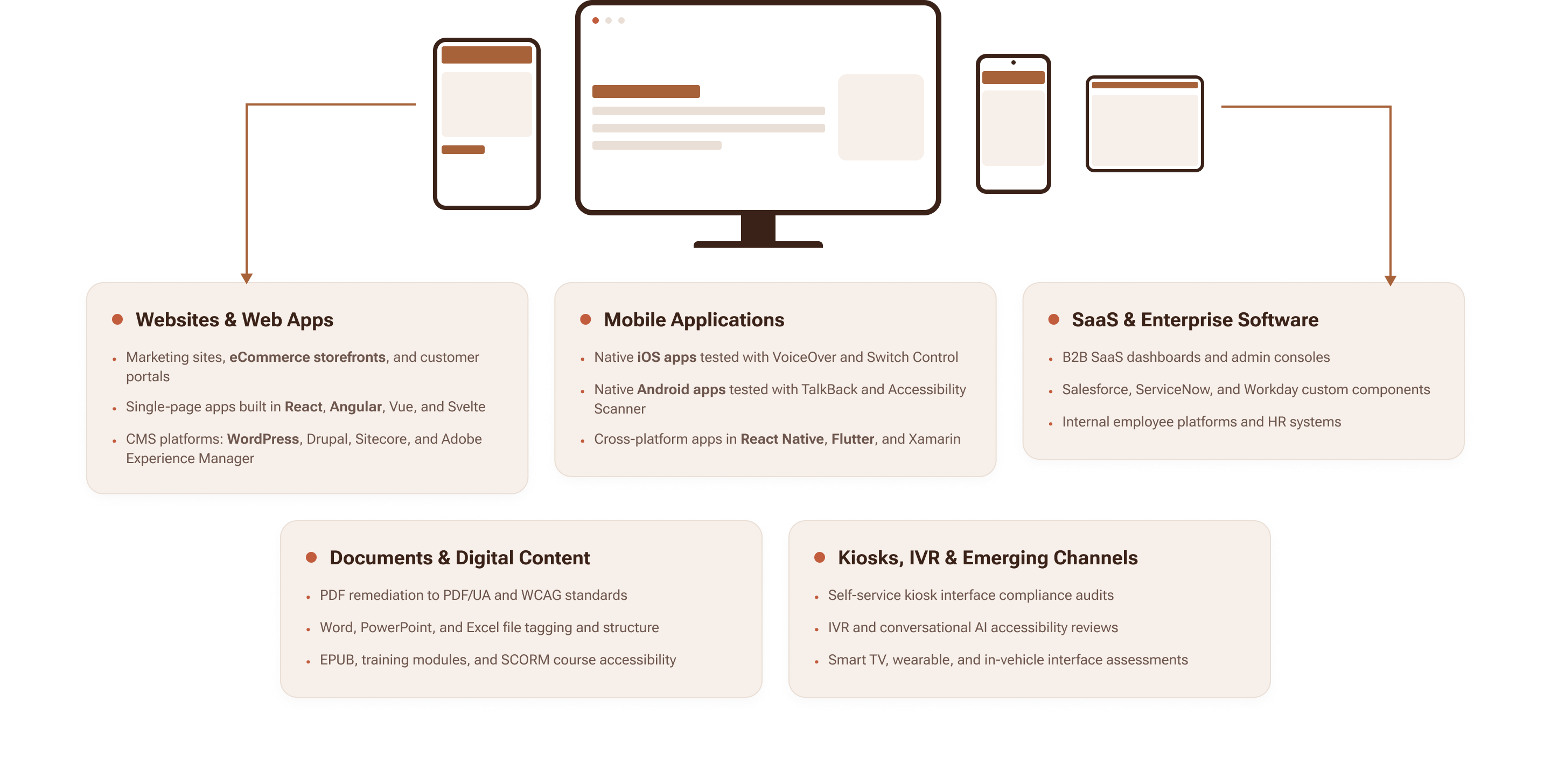
Our WCAG compliance services extend across every channel your customers and employees use. We audit, remediate, and monitor public websites, customer portals, native apps, SaaS platforms, internal tools, and document libraries with one consistent standard of conformance.
Websites and Web Applications
- Marketing sites, eCommerce storefronts, and customer portals
- Single-page apps built in React, Angular, Vue, and Svelte
- CMS platforms: WordPress, Drupal, Sitecore, and Adobe Experience Manager
Mobile Applications
- Native iOS apps tested with VoiceOver and Switch Control
- Native Android apps tested with TalkBack and Accessibility Scanner
- Cross-platform apps in React Native, Flutter, and Xamarin
SaaS and Enterprise Software
- B2B SaaS dashboards and admin consoles
- Salesforce, ServiceNow, and Workday custom components
- Internal employee platforms and HR systems
Documents and Digital Content
- PDF remediation to PDF/UA and WCAG standards
- Word, PowerPoint, and Excel file tagging and structure
- EPUB, training modules, and SCORM course accessibility
Kiosks, IVR, and Emerging Channels
- Self-service kiosk interface compliance audits
- IVR and conversational AI accessibility reviews
- Smart TV, wearable, and in-vehicle interface assessments
Need Ongoing Accessibility Support Across Releases?
From web and mobile to SaaS platforms and documents, we help teams combine WCAG compliance testing, remediation, and ongoing compliance monitoring into one managed delivery model.
Talk to Our Accessibility Team