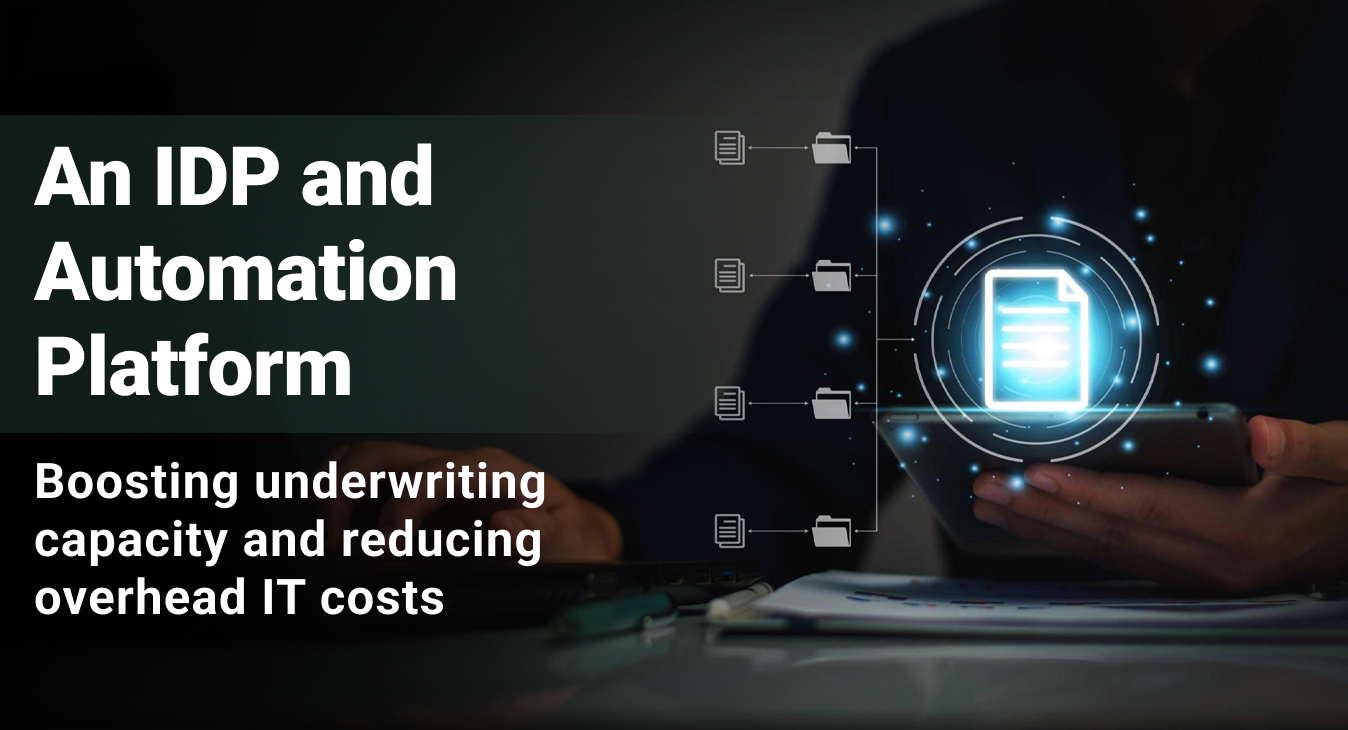
See how we engineered a cloud-native IDP platform on AWS, reducing a commercial lender's loan approval time.
RAG and Model Distillation Services
The Intelligence of Large Models; Delivered at The Economics of Small Ones.
Large foundation models have advanced capabilities and deliver reliable outputs — but running them at scale compounds costs, slows response times, and poses data governance risks that most businesses cannot afford.
Our enterprise RAG solutions and model distillation services solve this by combining the two into one end-to-end pipeline:
RAG (Retrieval-Augmented Generation)
A framework that grounds the AI model in your internal data (documents, contracts, product catalogs, and knowledge bases) so responses are accurate, aligned with your domain, and context-specific.

Model Distillation
A technique that transfers the behavior of a larger ‘teacher’ model into a smaller, faster one built for production, reducing serving costs without sacrificing output quality.
How our RAG Developers Do This?
RAG phase
Distillation phase
1
Build strong RAG
with a large model
2
Observe on real tasks
note model behavior
Distillation phase
3
Distill the behavior
into a smaller model
4
Use in production
fast, lean, scalable
Our Services
Comprehensive RAG Development and Model Distillation Services
Use Case Discovery and Feasibility Mapping
Our RAG development company works with your product and engineering stakeholders to identify workflows where RAG or distillation delivers measurable value. We also map data availability, query volume, latency requirements, and cost thresholds to produce a prioritized feasibility brief before a single line of code is written.
What You Get:
- AI use case assessment for enterprise search, support, knowledge assistants, and copilots
- RAG suitability analysis
- Distillation feasibility assessment
- Baseline model and architecture selection
- Cost, latency, and performance target definition
Knowledge Base Audit and Data Readiness
Our RAG developers assess your existing data sources (structured databases, PDF repositories, CRMs, or API feeds) for completeness, consistency, and suitability for retrieval. We normalize content using LangChain document loaders, custom preprocessing pipelines, and metadata tagging that directly improve downstream retrieval precision.
What You Get:
- Enterprise knowledge base audit
- Document inventory and content source mapping
- Data cleaning and normalization
- Metadata design and enrichment
- Chunking strategy design for retrieval
- Access control and content governance setup
RAG Pipeline Design and Indexing
Our RAG development company's architects build end-to-end RAG pipelines using frameworks such as LangChain, LlamaIndex, and Haystack. This is done with vector stores such as Pinecone and Weaviate, selected to match your infrastructure. To balance accuracy with latency, we also help you with hybrid search configuration (dense + sparse retrieval) and context window management.
What You Get:
- Vector database setup and configuration
- Embedding model selection and tuning
- Document chunking and indexing
- Hybrid search implementation (keyword + semantic)
- Metadata filtering and faceted retrieval
- Multi-source retrieval architecture design
Agentic RAG as a Service
Standard RAG pipelines answer a single question with a single retrieval pass, but real enterprise workflows are rarely that linear. Our Agentic RAG-as-a-service model wraps an autonomous reasoning layer around your RAG pipeline using LangGraph, LlamaIndex Agents, ReAct, and SELF-RAG patterns. This enables the model to decompose complex queries into sub-questions, evaluate whether the retrieved context is sufficient, re-query when it is not, and call external tools or APIs if needed.
What You Get:
- Agentic pipeline design
- Multi-hop query decomposition and sub-question routing
- SELF-RAG and ReAct reasoning loop implementation
- Tool and API integration within the retrieval-generation loop
- Context sufficiency evaluation
- Agentic workflow testing, tracing, and observability setup
Retrieval Quality Improvement
We diagnose weak retrieval using precision-recall analysis and query tracing. Our experts then apply targeted improvements, including re-ranking with cross-encoder models (Cohere Rerank, BGE), query set expansion, HyDE (Hypothetical Document Embeddings), and metadata filtering. The result is a measurable lift in answer relevance without increasing model size or serving cost.
What You Get:
- Query rewriting and expansion
- Retriever tuning
- Re-ranking model implementation
- Top-k and context window optimization
- Hallucination reduction through retrieval controls
- Citation and source-grounding workflows
Teacher Model-Based RAG Orchestration
We deploy a capable teacher model (GPT-4, Claude, or a fine-tuned Llama variant) as the primary reasoning layer within your RAG pipeline, using it to generate grounded responses across your queries. These orchestrated outputs serve a dual purpose: delivering immediate business value while systematically building the labeled dataset your distillation pipeline will learn from.
What You Get:
- Large model orchestration for RAG workflows
- Prompt design for grounded generation
- Answer template and response policy design
- Multi-step retrieval-generation pipeline setup
- Guardrail implementation for factual consistency
- Teacher-model output generation for target tasks
Synthetic Data and Training Set Creation for Distillation
Our AI model distillation engineers prompt larger teacher models (GPT-4, Claude, or Gemini) to generate labeled input-output pairs across your specific task distribution. This also covers edge cases and domain-specific vocabulary that your production data may not adequately represent. We then apply filtering, deduplication, and quality scoring to maximize the quality of the training signal before distillation begins.
What You Get:
- Teacher output generation across real enterprise queries
- Synthetic dataset creation for grounded Q&A
- Reasoning trace and response pattern capture
- Hard example generation for difficult queries
- Dataset labeling and quality review
- Distillation-ready training corpus preparation
Student Model Distillation and Compression
Our AI model distillation experts fine-tune compact student models (such as Mistral, Phi, Llama, and Falcon variants) on teacher-generated datasets. This is done using knowledge distillation, LoRA, and QLoRA techniques, balancing accuracy and efficiency to meet the trade-off your production environment requires. Quantization and pruning are also applied post-training to reduce memory footprint and enable deployment on cost-efficient infrastructure.
What You Get:
- Student model architecture selection
- Knowledge distillation pipeline setup
- Response-style and task-behavior transfer
- Domain-specific model compression
- Fine-tuning plus distillation workflows
- Latency and footprint optimization for production
Distilled RAG Component Optimization
Once a student model is distilled, we integrate it into your RAG pipeline and tune the retrieval-generation interface. This involves adjusting the context format, prompt compression techniques (such as LLMLingua), and output consistency checks. We run component-level benchmarks to confirm the distilled model performs on par with the original teacher across your documented task set before it goes into production.
What You Get:
- Distilled reranker development
- Distilled query classifier development
- Distilled retrieval router models
- Lightweight answer validation models
- Intent detection model compression
- Edge-ready or low-cost inference model preparation
Evaluation, Benchmarking, and Red Team Testing
Our RAG development company evaluates pipeline output quality using RAGAS, TruLens, and custom task-specific benchmarks. Quality KPIs are selected to measure faithfulness, answer relevance, context recall, and hallucination rate against defined thresholds. Our red team exercises simulate adversarial queries, prompt injection attempts, and out-of-distribution inputs to surface failure modes before deployment.
What You Get:
- Retrieval precision and recall evaluation
- Answer quality benchmarking
- Teacher vs. student model comparison
- Hallucination and grounding evaluation
- Adversarial and failure-case testing
- Cost, throughput, and latency benchmarking
Deployment and Production Integration
Our AI model distillation experts package distilled models and RAG pipelines for production using containerization with Docker and Kubernetes, serving frameworks such as vLLM and TGI (Text Generation Inference), and supporting cloud deployment targets (AWS SageMaker, GCP Vertex AI, and Azure ML). We configure autoscaling policies, load balancing, and API gateway integration to ensure the system handles your query volume reliably.
What You Get:
- RAG API integration
- Model serving and inference pipeline deployment
- Cloud, on-prem, or private deployment setup
- Containerization and orchestration support
- Security, permissioning, and audit controls
- Workflow integration with CRM, ERP, CMS, or internal systems
Monitoring, Feedback, and Continuous Optimization
Post-deployment, our model distillation specialists integrate your pipeline with observability tooling (LangSmith, Helicone, etc). This is done to track latency, retrieval hit rate, user feedback signals, and model drift over time. We also run scheduled re-indexing, embedding refresh cycles, and incremental distillation updates to keep your system accurate as your data and query patterns evolve.
What You Get:
- Retrieval drift monitoring
- Model performance monitoring
- Query log analysis
- Re-indexing and retraining workflows
- Distilled model refresh cycles
- Ongoing prompt, retrieval, and ranking optimization
Ready to Experience Large Model Capabilities at a Fraction of The Cost?
We design grounded AI systems that retrieve the right enterprise knowledge and AI capability first, then compress it into smaller, faster, and more cost-efficient production models.
Start TodayOur RAG Development and Model Distillation Workflow
RAG Build Phase
1
Discover and Assess
We identify use cases, map data assets, and assess technical constraints to scope where RAG and distillation add the most business value.
2
Build The RAG Pipeline
We architect and index your knowledge base using LangChain, LlamaIndex, or Haystack with hybrid vector search tuned to your data and query patterns.
3
Orchestrate With A Teacher Model
A capable large model runs on your real production queries, delivering quality output while every inference is logged as labeled training data.
Distillation Phase
6
Deploy and Optimize
We ship using vLLm or TGI with autoscaling on your cloud infrastructure, then monitor drift, refresh embeddings, and iterate to keep it up to date.
5
Evaluate and Harden
We benchmark using RAGAS and TruLens, and run red-team testing to validate accuracy, measure hallucination rates, and surface failure modes pre-launch.
4
Distill into a Smaller Model
We fine-tune compact models (Mistral, Phi, LLaMA) on teacher-generated data using LoRA, QLoRA, and quantization targeting your latency budget.
AI Models We Work With — And What We Distill from Them
We work with both frontier commercial models and leading open-source models, selecting the right teacher based on your task complexity, data sensitivity, and cost profile.
Teacher Models
Used to generate high-quality labeled outputs, run production RAG workflows, and build the training signal for distillation.

GPT-4 / GPT-4o

Claude 3 Opus / Sonnet
Gemini 1.5 Pro
Llama 370B
Mixtral 8x7B
Student Models
Fine-tuned on teacher-generated data to run in production. Smaller, faster, and optimized for your specific task distribution.
Llama 38B
Mistral 7B
Phi-3 Mini / Small
Falcon 7B
Gemma 2B / 7B
Capabilities We Distill
Across all teacher models, we distill the following behavioral capabilities into smaller student models:
- Instruction following — structured, format-consistent response generation aligned to task definition
- Multi-step reasoning — chain-of-thought behavior for classification, triage, and decision support tasks
- Retrieval-grounded response generation — the ability to synthesize answers from the injected document context accurately
- Named entity and clause extraction — precise identification of domain-specific entities from contracts, reports, and logs
- Summarization — domain-calibrated summarization tuned to your document types and output length requirements
- Intent detection and query routing — lightweight classification of incoming queries for triage, escalation, or routing workflows
- Multilingual understanding — cross-language task performance distilled for businesses operating across multiple markets
Common RAG and Model Distillation Use Cases
Where Businesses are Applying RAG and Model Distillation
From automating document-heavy workflows to scaling support operations, RAG and distillation are being deployed across a growing range of enterprise functions. Here are the use cases where we see the maximum business value.
Enterprise Knowledge Search
RAG pipelines that surface precise, document-grounded answers from your entire knowledge base in seconds.
Customer Support Automation
AI Agents and self-serve bots that answer accurately from your product documentation, troubleshooting guides, and ticket history.
Contract and Document Review
RAG-powered assistants that extract clauses, flag deviations, and surface precedents from your own document library.
Compliance and Policy Q&A
RAG systems that ground responses in your approved policy documents, so answers are always traceable and version-controlled.
Product Catalog Intelligence
RAG and AI model distillation pipelines that deliver accurate attribute lookups, comparisons, and recommendation logic without requiring retraining.
Sales Enablement and RFP Assistance
AI systems generating first-draft RFP responses and competitive summaries by retrieving from win/loss data, case studies, and product specs.
Internal Helpdesk Automation
Distilled AI models that handle high query volumes at low latency without dependency on a hosted frontier model for every ticket.
Have Some Other Use Case in Mind?
Our model distillation and RAG development services can customize a solution for you. Share your requirements with our RAG consultants today.
Contact Us