Software Engineering in 2030: How AI Will Reshape Development?
Table of Contents
- The Development Constraint Will Move From Execution to Strategy
- Engineering Will Evolve From Code Production to System Design
- AI Agents Will Become Part of the Engineering Operating Model
- Application Modernization Will Become More Intelligent
- Faster, Agent-Driven Software Creation Will Increase the Need for Governance
- Architecture Will Become a Competitive Advantage
- The Software Engineering Organization of 2030
- What CIOs and CTOs Should Prepare for Now
- Software Engineering Will Become a Strategic Business Capability
Software engineering is entering a significant transition as AI moves from developer assistance toward broader, and more independent participation in software workflows. Gartner predicts that 40% of enterprise applications will include task-specific AI Agents by the end of 2026, up from less than 5% in 2025.
That trajectory points to a change far beyond faster code generation. AI will increasingly influence how enterprises build, test, modernize, and operate software, while engineers take greater responsibility for technology direction and system-level decisions. Gartner’s 2030 research similarly expects AI to reshape software engineering roles, teams, workflows, and the software organizations build. By 2030, the defining question will not be how much code teams can produce. It will be how effectively they can turn AI-enabled engineering capacity into reliable software and measurable business value.
The Development Constraint Will Move From Execution to Strategy
Software delivery has traditionally been controlled by engineering capacity. Because that capacity is finite, organizations end up having a growing backlog of product ideas and digital initiatives that outpace what teams can build. Converting those opportunities into production-ready systems requires coordinated effort across teams, frameworks, and now AI Agents.
Agents have expanded how much web and mobile application development teams can handle within the same capacity. They support planning, development, testing, and other operational activities end-to-end, without human intervention. A 2026 survey found that 78% of organizations are deploying AI Agents in software engineering, including development, testing, and DevOps.
But as implementation becomes easier, organizations face the harder question: Where should they direct that additional engineering capacity?
| Traditional Constraint | Emerging Priority |
|---|---|
| Limited development capacity | Prioritizing the right software initiatives |
| Manual implementation effort | Governing AI-assisted development workflows |
| Slow application changes | Maintaining architectural consistency |
| Resource constraints | Managing software complexity at scale |
This shift will reshape how organizations approach custom software development and application delivery. More engineering capacity will let teams pursue more initiatives, but competitive advantage will come from aligning that capacity with measurable business outcomes.
Engineering Will Evolve From Code Production to System Design
Enterprise software operates within complex environments where integrations, security requirements, scalability, data flows, and business processes determine whether individual components work effectively together. A technically sound feature can still create problems when it introduces an architectural conflict or fails to account for downstream dependencies.
That is where engineering responsibility will change most visibly. As AI handles more implementation, engineers will spend more time defining system behavior, evaluating technical tradeoffs, establishing constraints, and deciding whether a proposed solution belongs in the wider architecture.
| Current Engineering Focus | Future Engineering Responsibility |
|---|---|
| Building individual features | Designing adaptable software systems |
| Writing and modifying code | Establishing technical standards and boundaries |
| Resolving implementation challenges | Evaluating AI-generated solutions and tradeoffs |
| Improving delivery speed | Connecting technology decisions to business value |
For enterprise application development, this shift will make systems thinking increasingly important. Engineers will still need strong programming knowledge, but they will also need to understand how software decisions affect operations, customers, security, and long-term technology direction.
AI Agents Will Become Part of the Engineering Operating Model
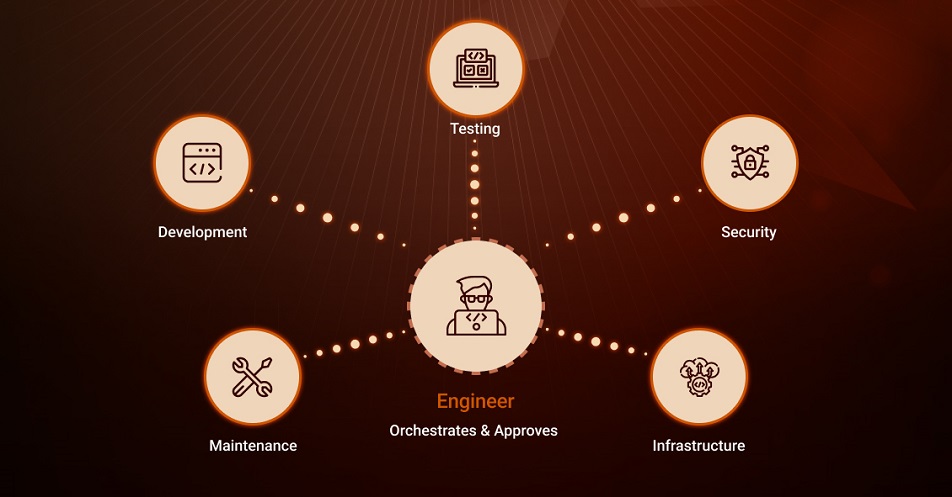
AI Agents will extend software engineering beyond task automation by introducing a new operating model where engineers coordinate autonomous systems rather than manage every implementation activity. By 2030, engineers may oversee multiple specialized AI Agents responsible for different areas of the software lifecycle, while defining the boundaries within which those agents can operate.
Instead of managing junior developers for routine execution, they will increasingly act as systems orchestrators, directing agent-driven workflows across development, testing, security, infrastructure, and maintenance. At the same time, AI Agents will not simply respond to individual requests. You can expect them to proactively identify improvement opportunities, analyze system behavior, recommend changes, and coordinate with other specialized agents to complete complex engineering objectives.
This could entirely shift manual task delegation to confidence-based delegation.
- Routine, high-confidence activities such as dependency patching, unit test generation, documentation updates, and standard schema migrations could run autonomously when predefined conditions are satisfied.
- Low-confidence or high-impact decisions, including architectural changes, core data model modifications, and security-sensitive updates, will require human evaluation and approval.
As adoption expands, the differentiator will not be whether organizations build AI Agents, but how effectively they govern their autonomy, decision authority, and collaboration across engineering environments.
| Current Agent Capabilities | Future Agent-Driven Engineering |
|---|---|
| Executes assigned development tasks | Coordinates multi-step engineering workflows based on defined objectives |
| Operates within a specific task boundary | Manages specialized agents across different engineering domains |
| Waits for engineers to identify improvement areas | Detects optimization opportunities through continuous system analysis |
| Produces changes that require manual coordination | Executes approved actions based on confidence levels and governance rules |
The future of engineering will not be defined by AI Agents replacing developers. It will be defined by engineers managing increasingly autonomous software delivery systems. Human expertise will remain essential for architectural judgment, business trade-offs, risk assessment, and decisions where the consequences extend beyond the immediate code change.
Application Modernization Will Become More Intelligent
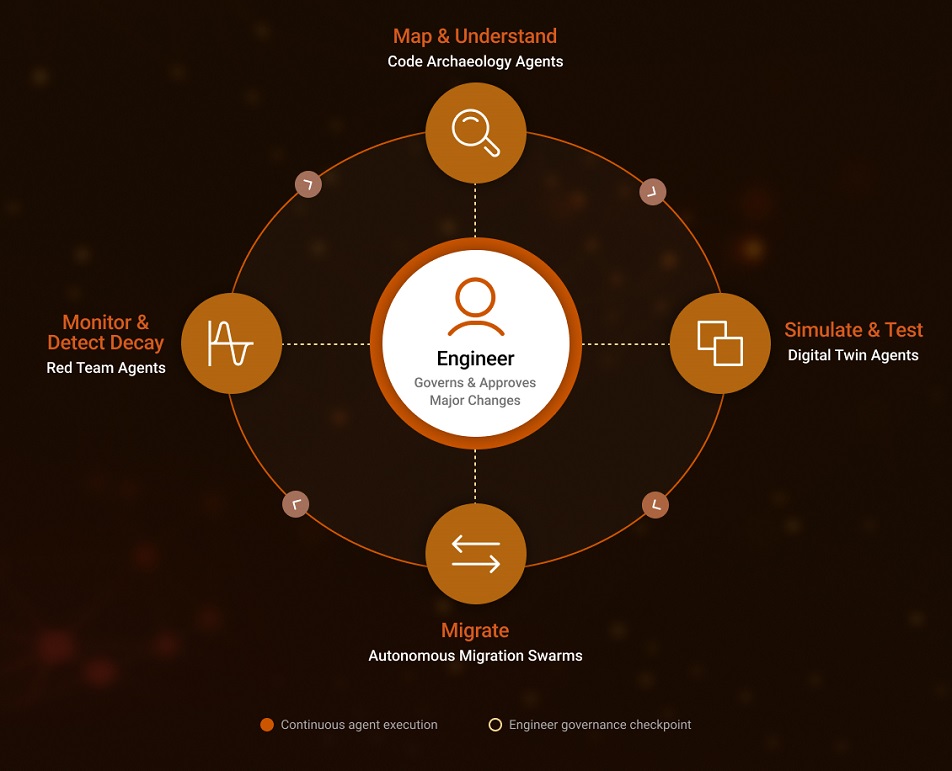
By 2030, application modernization may no longer be a multi-year project with a defined start and finish. Software estates will increasingly be managed as living systems, with AI Agents continuously assessing architectural health, simulating potential changes, and executing low-risk improvements while engineers govern major decisions.
- Living Code Archaeology Will Explain Why Systems Work
Modernization agents will maintain a continuously evolving map of legacy applications, combining source code with production behavior, data flows, historical changes, and business rules. Instead of simply documenting what a legacy function does, they could reconstruct why it exists, which processes depend on it, and what could break if it changes.
- Digital Twins Will Test Modernization Before Production
Organizations would maintain digital twins of critical application environments where agents test modernization strategies against realistic workloads. This enables development teams to compare alternative architectures, migration paths, performance impacts, and operating costs before changing production systems.
- Autonomous Migration Swarms Will Get the Work Done
Migration will increasingly involve coordinated agent teams rather than large groups performing repetitive conversion work. Interpreter agents could translate legacy logic, architecture agents could restructure dependencies, and testing agents could attempt to break the resulting system. Engineers would govern the migration strategy and approve changes with significant business or operational consequences.
- Modernization Will Become a Continuous Process
Once applications are modernized, Red Team Agents could continue identifying architectural decay, obsolete dependencies, inefficient components, and emerging infrastructure constraints. Organizations can implement low-risk changes continuously, keeping systems current instead of letting another decade of technical debt accumulate.
For organizations investing in application modernization services, this shifts the strategic objective from completing a migration to maintaining an application estate that can evolve continuously. The advantage will belong to organizations that build modernization into the operating model rather than treating it as a periodic technology program.
Faster, Agent-Driven Software Creation Will Increase the Need for Governance
The rapid proliferation of AI coding agents is undoubtedly driving an unprecedented surge in code velocity and throughput. However, this acceleration exposes a critical bottleneck: sub-par, legacy governance and code review paradigms that are fundamentally ill-equipped to handle the resulting operational load.
This friction is compounded by a pronounced institutional trust deficit. Per Stack Overflow’s 2025 Developer Survey, 46% of practitioners actively distrust the fidelity of AI outputs, compared to just 33% who express confidence in them. More critically, 66% report friction stemming from “hallucinated correctness”—solutions that are syntactically plausible and almost functional, yet introduce subtle logic flaws or regression risks that consume extensive debugging cycles.
To mitigate these risks without stalling delivery, enterprise engineering organizations must shift governance left. Rather than relying on traditional downstream, post-commit review gates, compliance and quality controls must be natively embedded directly into the developer workflow. Key technical controls will include:
- AI-generated code review and validation
- Automated security testing
- Architecture compliance checks
- Continuous application monitoring
- Audit trails for AI-assisted changes
The controls must also reflect the authority granted to each AI system. Gartner predicts that 40% of enterprises will demote or decommission autonomous AI agents by 2027 because of governance gaps identified after production incidents. For CIOs and CTOs, the objective will be to increase engineering velocity without allowing faster change to outpace the organization’s ability to assess and control it.
Architecture Will Become a Competitive Advantage
As AI Agents reduce the effort required to build and modify software, architecture will become a stronger differentiator. Organizations will be able to create capabilities faster, but the advantage will come from systems that can continuously adapt to changing workloads, business priorities, and technology environments without requiring repeated architectural redesign.
- Liquid Infrastructure Will Replace Static Architectures
Future software architectures may become increasingly dynamic, with infrastructure agents continuously adjusting resources, service interactions, and deployment strategies based on real-time conditions. These systems could optimize workloads by balancing performance requirements, cloud costs, security policies, and regulatory constraints such as data residency.
- Technical Debt Will Become a Continuously Managed State
Technical debt will no longer exist primarily as a backlog of deferred maintenance. Refactoring agents may continuously monitor codebases, architecture patterns, dependencies, and runtime behavior to identify areas of increasing risk. They could proactively prepare refactoring plans, update components, and resolve low-risk issues before they impact system reliability.
| Traditional Architectural Priority | 2030 Architectural Priority |
|---|---|
| Supporting established application workloads | Supporting AI-enabled and evolving workloads |
| Managing known integrations | Accommodating changing integration patterns |
| Designing around current requirements | Anticipating changing business and technology needs |
| Optimizing individual applications | Connecting applications across broader ecosystems |
The strategic advantage will come from architectural flexibility: the ability to introduce, test, and scale new capabilities while maintaining reliability, security, and control.
The Software Engineering Organization of 2030
The engineering organization will change as the technology it builds evolves. Gartner predicts that 60% of organizations will adopt smaller software engineering teams at scale by 2029, up from 15% in 2026. This shift reflects a new operating model built around collaboration between human expertise and autonomous engineering capabilities rather than simply reducing headcount.
Agents will absorb more routine technical work, allowing engineers to take broader ownership of product outcomes, architecture decisions, and complex technical challenges. At the same time, software demand and developer demand are expected to continue growing as organizations use increased engineering capacity to pursue new digital initiatives.
Engineering teams are likely to shrink in some areas but broaden their responsibilities. Engineers will work more closely with product and business stakeholders while orchestrating agent-driven workflows across larger portions of the software lifecycle.
| Today | 2030 |
|---|---|
| Business defines requirements | Business and engineering define measurable outcomes |
| Engineers implement features | Engineers direct AI-assisted implementation |
| QA validates completed work | Validation runs continuously across the lifecycle |
| Teams manage applications individually | Teams manage interconnected software ecosystems |
| Specialists own separate stages | Smaller teams take broader end-to-end responsibility |
This model will also change how enterprises use external engineering expertise. Organizations may combine internal technology leadership with specialized teams for application development, modernization, mobile development, or AI engineering. The emphasis will shift from maintaining every capability internally to assembling the right expertise around specific business outcomes.
What CIOs and CTOs Should Prepare for Now
The transition to AI-enabled engineering does not require enterprises to wait until 2030. Enterprises need to build the foundations before AI assumes greater responsibility across the software lifecycle.
- Treat AI Adoption as an Engineering Decision, not a Tooling Decision: Define where AI can contribute today, establish appropriate review requirements, and measure whether those deployments improve engineering and business outcomes.
- Strengthen the Architectural Foundation: AI can increase the pace of application change, so organizations need clear technical standards, integration patterns, and architectural principles that can accommodate that velocity.
- Modernize Selectively: Use AI to understand legacy environments, but prioritize modernization according to business value, technical risk, and operational requirements rather than technology novelty.
- Match Governance to AI Authority: A coding assistant and an agent that can execute actions across enterprise systems should not operate under identical controls.
Software Engineering Will Become a Strategic Business Capability
The defining change in software engineering by 2030 will not be an agent’s ability to generate code. Developers already use them for that purpose, and they will keep improving. The larger shift will occur when AI Agents become integral to interconnected engineering workflows. Teams will have more implementation capacity, agents will handle broader responsibilities, and applications will need to evolve faster. That environment will place greater weight on architecture, governance, technical judgment, and business context.
The strongest engineering organizations will establish a clear division of responsibility. Agents will handle more execution, while people will retain ownership of technology direction, system design, risk, and business outcomes. That model can give enterprises greater capacity to innovate without surrendering control over the software that supports their operations.
The competitive advantage, however, will belong to organizations that can turn Agent-enabled engineering capacity into reliable, adaptable, and strategically valuable software. By 2030, the most capable software organizations may not be those with the most developers or the most advanced AI Agents. They will be the organizations that have built the engineering discipline to make both work effectively together.


Rohit Bhateja, Director - Digital Engineering Services & Head of Marketing
Rohit Bhateja, Director of Digital Engineering Services and Head of Marketing at SunTec India, is an award-winning leader in digital transformation and marketing innovation. With over a decade of experience, he is a prominent voice in the digital domain, driving conversation around the convergence of technology, strategy, customer experience, and human-in-the-loop AI integration.