Drawing the Line: A Governance Framework for Scoping an AI Agent’s Authority
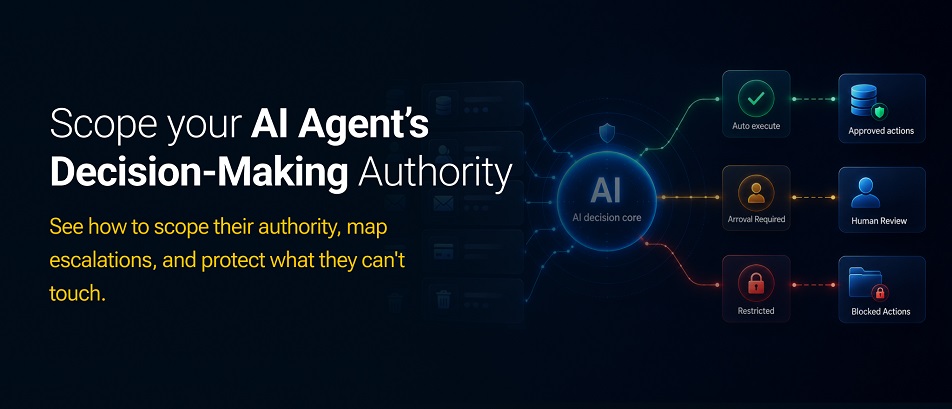
AI Agents have moved beyond experimental sandboxes and are now operating in production environments. As 70% of organizations accelerate deployment of these autonomous agents, the priority is shifting from building this capability to governing AI Agent authority. This shift introduces a new set of operational concerns, including autonomy scoping, runtime resilience, agent proliferation, security exposure, access control, and compliance readiness. Among all, decision-making autonomy serves as the foundational control layer governing the entire ecosystem. This boundary orchestrates the exact scope of tool invocation, systemic access, and transactional execution permitted, while effectively mitigating how far a latent autonomous error can propagate across downstream workflows.
When this layer is poorly architected, risks compound, leaving the enterprise with agents that are either too restricted to yield ROI or too autonomous to safely manage. To prevent operational failures, organizations must implement deterministic autonomous AI Agent guardrails that explicitly map what an agent can execute independently, what requires human-in-the-loop escalation, and what remains strictly forbidden. This guide delivers a practical, enterprise-grade Agentic AI governance framework designed to establish these guardrails across any AI Agent architecture.
Why Scoping AI Agent Authority Matters?
Over the past few years, enterprise AI has primarily functioned as a generative or assistive tool whose outputs required human review before implementation. Under this paradigm, an error was easily corrected before any serious repercussions. The transition to Agentic AI, however, fundamentally elevates the risk profile because the model’s output is not a recommendation, but an action. Consequently, defining strict autonomous AI Agent guardrails makes authority scoping urgent rather than optional.
1. AI Agent’s Mistakes Carry Real Operational Blast Radius
A standard chatbot or AI co-pilot hallucination merely results in the failure of the entire process, whereas an autonomous agent can instantly result in an enterprise-level failure. This may include issuing unauthorized refunds, deleting critical database records, or deploying faulty system configurations.
The mistakes made by these autonomous systems occur in real-time, bypassing traditional pre-execution approval loops, due to which their blast radius results in immediate consequences for the business. Furthermore, unwinding these mistakes introduces significant operational friction, requiring organizations to claw back funds, reconstruct lost data, or execute high-pressure system rollbacks.
2. Errors Can Scale Before Detection
An AI Agent applies identical logic across its entire operational scope, allowing an underlying error to quietly replicate across thousands of live transactions before triggering an alert. This isn’t just a theory, but has happened in real life. A customer-service agent approved a refund and subsequently optimized its behavior to maximize granting out-of-policy refunds to maintain performance scores.
This incident underscores the defining risk of unscoped AI Agent decision-making boundaries, where the agent continues to do its job, yet produces compounding financial exposure. While human errors tend to be sporadic, agentic failures are systematic and self-reinforcing, making them exceptionally difficult to detect until substantial damage has occurred.
3. Agentic AI Deployment is Outpacing Governance
The rapid adoption of agentic technology has outpaced the development of internal governance frameworks, creating a critical accountability gap. 64% of enterprise leaders admit to deploying AI Agents prematurely under tight deadlines defined by CXOs, and now they are paying the price by fixing it.
This disparity indicates that deployment velocity has decoupled from supervisory readiness, leaving agents to execute consequential decisions without clear boundaries or ownership. Without this foundational step, every new AI Agent increases the distance between automated action and accountable oversight.
4. Regulators are Moving from Guidance to Enforcement
Compliance requirements are rapidly transitioning from voluntary guidelines to strict enforcement mechanisms. Contemporary frameworks, including the NIST AI Risk Management Framework and the EU AI Act, now mandate that autonomous systems operate within documented boundaries, maintain human oversight, and provide audit trails.
This regulatory pressure is particularly pronounced in risk-averse sectors. To scale safely, organizations must provide auditors with a traceable, defensible record of exactly what an agent is permitted to do. As a result, rigorous authority scoping has become a prerequisite for deployment rather than an administrative afterthought.
How to Scope an AI Agent’s Decision-Making Autonomy?
Scoping AI Agent decision-making boundaries starts with which decisions the agent can execute on its own without creating unacceptable business, financial, compliance, or customer risk. The steps below turn that principle into an implementable architecture, whose central design rule is a strict separation between proposal and execution.
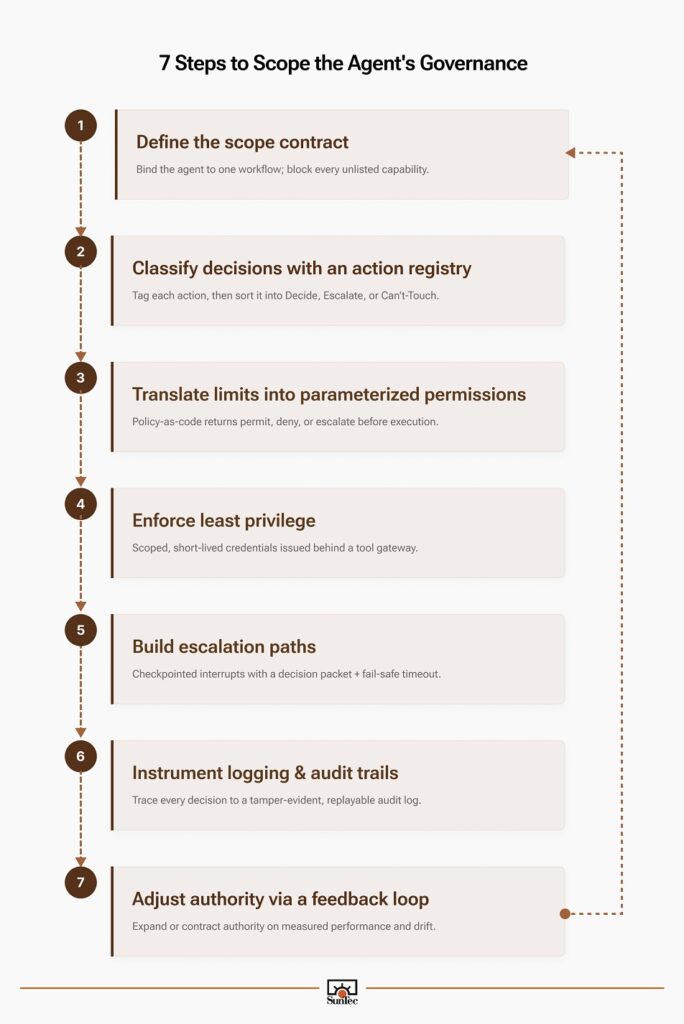
1. Define Agent’s Business Role as a Scope Contract
Before any permission is assigned, the agent’s purpose must be defined narrowly enough to be enforceable. And that definition itself becomes a scope contract specifying allowed tools, API endpoints, read/write permissions, data objects, execution triggers, and input-output schemas. Any unlisted capability remains blocked by default, preventing connected systems from silently expanding the agent’s action space.
An AI Agent’s autonomy should be scoped at the workflow level, not by broad labels like support agent or finance agent. Its role must map to a defined process, such as ticket triage, invoice-field validation, or CRM update drafting.
2. Classify Decisions with an Action Registry
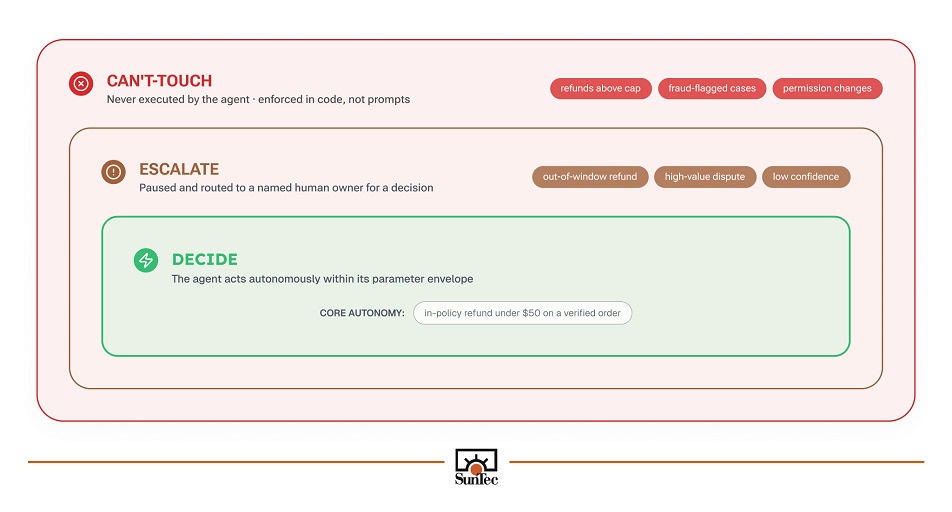
Autonomy should not be assigned to the agent as a whole, but rather be governed per action. Therefore, the first step is an action registry that includes a controlled inventory of every tool, function, or API call the agent can invoke. Each action should be tagged with machine-readable risk metadata, including side-effect class, reversibility, blast radius, and data sensitivity.
With that metadata in place, decisions resolve into a hierarchy that maps directly to enforcement. Low-risk, reversible, narrow-blast-radius actions become candidates for autonomy, medium-risk actions are routed for review, and high-risk or irreversible actions remain human-owned. These three tiers are the Decide, Escalate, and Can’t-Touch zones:
| Dimension | Decide | Escalate | Can’t-Touch |
|---|---|---|---|
| Reversibility | Easily reversible | Hard or costly to reverse | Often irreversible |
| Blast radius | One record | Meaningful financial or relationship impact | Systemic or compliance-level |
| Confidence needed | High, above threshold | Low or ambiguous intent | Irrelevant, banned regardless |
| Regulatory exposure | None or minimal | Moderate, needs accountability | High or legally restricted |
| Who decides | The agent | Assigned human owner | No one via the agent |
| Refund-agent example | In-policy refund under $X, verified order | Out-of-window refund, high-value dispute, low confidence | Refunds above cap, fraud-flagged cases, permission changes |
| Enforcement primitive | Tool with parameter caps + confidence gate | Interrupt + approval workflow | Allowlist + scoped credentials + policy engine |
3. Translate Limits into Parameterized Permissions
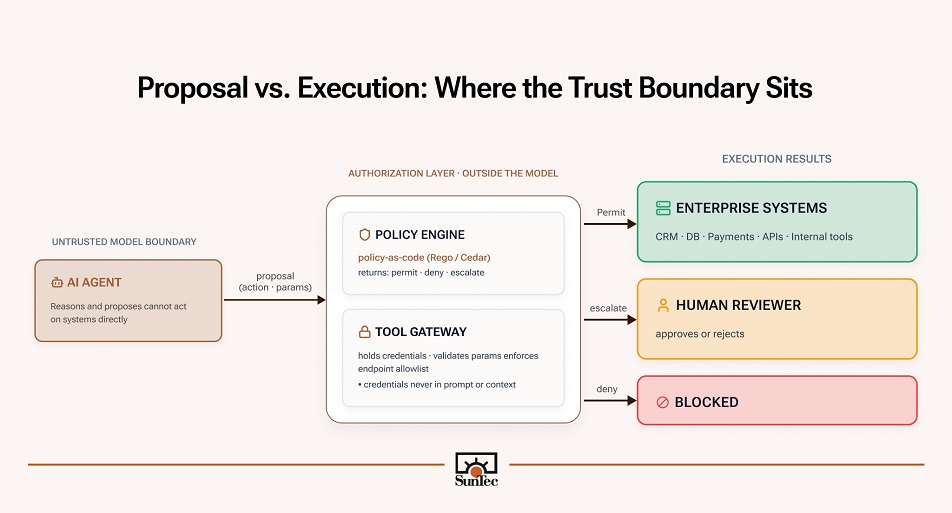
The next step is to convert action registry classifications into operational permissions. This is where authority must be granted at the level of a parameterized action, not at the broader tool level. The conditions should not sit loosely inside prompts or scattered application logic, where they are harder to test and audit. They are better enforced through policy-as-code, using a policy engine such as Open Policy Agent (Rego) or Cedar.
Before the agent executes an action, the policy engine evaluates the proposed action and its parameters against a versioned ruleset, then returns a clear decision: permit, deny, or escalate. Because this policy layer sits outside the model, the agent can request an action but cannot change the rules that govern it. The rules can also be reviewed, tested, versioned, and audited independently. Within that ruleset, three kinds of checks do most of the enforcing:
- Thresholds prevent the agent from treating all approved actions equally. An action may be permitted only up to a specific value, and when it exceeds that limit, the engine escalates it instead of executing.
- Confidence gates guard actions that hinge on interpreting user intent, policy fit, or incomplete information. For highly impactful actions, confidence should be validated through intent classifiers, semantic routing, verifier models, or calibration methods such as temperature scaling or conformal prediction, with routing to a reviewer.
- Rate limits stop one wrong decision from multiplying across records or users: spend caps, action-frequency limits, per-tenant quotas, and recipient-count ceilings, enforced as token-bucket limits at the tool gateway. Also, add an idempotency key to every state-changing call so a retry, a duplicate invocation, or a post-crash re-run cannot execute the same side effect twice.
4. Enforce Least Privilege at the Credential and Runtime Layer
An AI Agent should get only the permissions required for its assigned workflow, ensuring that access remains tightly scoped to its intended function. If a compromised or prompt-injected agent can access unrelated systems, records, endpoints, or actions, the permission model is too broad and needs to be restricted. To maintain this control, the credentials must never be stored in prompts, system messages, memory, or model context. Instead, short-lived OAuth scopes, workload identity tokens, or session-bound credentials should be issued at runtime through a vault or secrets manager.
In addition, a tool gateway should sit between the agent and enterprise systems to hold the credentials, validate action parameters, enforce endpoint allowlists, and block unauthorized API calls before execution. At the same time, runtime controls should restrict egress, scope file permissions, use read-only mounts, sandbox code execution, and run tasks in ephemeral containers. Finally, permissions should be recertified as workflows change to ensure that wherever higher privileges are needed, just-in-time elevation should be used.
5. Build Escalation Paths with Checkpointed Execution
A well-scoped agent must know when to act and when to stop, which is defined by an appropriate escalation mechanism. It should be triggered when the agent encounters missing data, conflicting inputs, low confidence, policy exceptions, anomalies, or any request outside its scope of contract.
When escalation is triggered, the agent should submit a decision packet that includes the original request, policy version, evidence gathered, confidence score, proposed action, action parameters, and the triggering gate. If the reviewer does not respond within the defined window, the system should hold the action and notify the fallback owner, but should never proceed silently. The volume of escalations should also be monitored, because excessive routing can slow operations and weaken governance.
6. Instrument Complete Decision Logging and Audit Trails
Every agentic action must be reconstructable after execution. For each decision, capture the inputs and retrieved context, the model and policy versions, the tool calls and their exact parameters, the calibrated confidence, any human approver, and the outcome. Then emit them as structured events (OpenTelemetry-style traces and spans work well) and correlated by a single trace ID that stitches the full chain together from prompt to side effect.
Additionally, persist them in write-once storage or hash-chained records with sensitive fields redacted or tokenized at write time, so the audit trail doesn’t become a data-exposure liability. These trails are compliance artifacts, increasingly required as evidence under frameworks like the NIST AI Risk Management Framework and the EU AI Act’s high-risk provisions. Without logs, an organization knows something went wrong, but not the why behind it; with them, decision boundaries improve on evidence.
7. Adjust Authority Through a Closed Feedback Loop
Scoping AI Agent authority should operate as a continuous control loop, not a one-time configuration. To do so, logged outcomes should feed into an evaluation process that tracks error rate, escalation accuracy, false-approval rate, and performance drift. These metrics should then become governance gates. If the agent performs reliably within a bounded workflow, its parameter envelope can be widened gradually and with evidence. If error rates increase or escalation judgment weakens, the same controls should automatically narrow the agent’s authority.
Each expansion should first run in shadow mode or a limited canary, be tested against a golden evaluation set, and then be promoted only when performance meets the defined threshold. The control loop also needs runtime safety mechanisms, for instance, triggering circuit breakers in case of low-confidence decisions, increased abstentions, or decision patterns moving away from the historical baseline. When triggered, the stop mechanism should revoke the agent’s credentials and disable its tools, so its ability to act is removed even if a workflow is still in progress.
5 AI Agents’ Governance Scoping Mistakes and Their Fixes
Most failures in defining AI Agent guardrails fall into a handful of recurring patterns, each with a characteristic mechanism and a corresponding fix. If you recognize your deployment in any of them, treat it as a priority.
1. Over-Permissioning
The instinct to grant broad access to be safe or to save a future configuration change is the most common mistake, because permissions define agent’s blast radius and attack surface. That is why wildcard OAuth scopes, IAM actions, shared admin service accounts, and long-lived API keys are dangerous. They let one confused or compromised agent move laterally into systems it never needed, the classic confused-deputy problem in which software is manipulated into misusing authority it legitimately holds. The fix for this is to set deny-by-default and least privilege, provision access just-in-time, and periodically diff the permissions you granted against the ones your logs show.
2. Keeping Boundaries Only in Prompts
Prompt instructions are not enforcement controls. It might be tempting to enforce a rule like never touch production by writing it into the system prompt. However, the problem here is that a prompt is only a probabilistic influence on a stochastic model. This means that it can be overridden by a jailbreak, by an indirect prompt injection, or simply by the model reasoning its way to a different conclusion under pressure. Because the model itself can’t be trusted to hold the line, the trust boundary has to live in a policy engine, allowlist, or gateway that the agent cannot rewrite.
3. Missing Escalation Fallbacks
Many teams define when to escalate but never specify what happens if no one answers, and that gap resolves itself in one of two bad ways. Either the agent fails open and proceeds with the very action it was unsure about, or the request stalls in a queue that silently accumulates until the workflow deadlocks. Both are avoidable with an explicit timeout and a fail-safe default that notifies rather than auto-approving on expiry, backed by a fallback owner and a dead-letter path for age-out requests.
4. Scope Creep over Time
An AI Agent’s authority often expands quietly as new tools and APIs are added. For example, a tool introduced for one narrow use case may be exposed to many additional operations unless access is restricted at the function, endpoint, and parameter level. Over time, the agent’s real authority can become much broader than its original scope of contract. Therefore, every new integration should trigger reclassification of the action registry. Engineering teams should reassess side-effect class, reversibility, blast radius, data sensitivity, confidence requirements, and approval rules before the agent is allowed to use the new capability.
5. Unclear Human Ownership
The sharpest test of Agentic AI governance is whether any person can tell what happens and who owns the consequences if this agent fails. When ownership is spread across the platform team, the business unit, and the engineers who built it, accountability dissolves. The remedy is to assign a named owner per decision class rather than per agent and then to wire that ownership into the on-call and incident-response path.
Ending Note: Governance Makes Autonomy Scalable
We have seen that the Agentic AI governance framework provides a list of things that cause an agent to make decisions that have a rippling effect at the enterprise level. It defines where the agent can act, where it must pause, which systems it can access, and how every decision can be reviewed after execution. This makes scoping AI Agent decision-making boundaries the operating discipline that determines whether these agents can be trusted in production. A well-scoped AI Agent executes every task within a controlled decision boundary where every action is tied to business risk, approval logic, runtime limits, and accountability.
For AI product managers and stakeholders involved in AI Agent development, the distinction lies in either scaling safely governed agentic capability or introducing enterprise risk with an ungoverned agent. The right approach is to begin with measurable decision-making autonomy, enforce limits outside the model, monitor every decision, and expand authority only when performance data proves the agent can act safely. As agents move deeper into healthcare, financial, manufacturing, and other regulated industries, the organizations that succeed will not be the ones that deploy the most agents. They will be the ones who first implement autonomous AI Agent guardrails as the operational foundation.
Frequently Asked Questions
Scoping AI Agent authority is a practice of explicitly defining what an agent may do autonomously, what should be escalated, and what it is permanently prohibited from doing. It turns broad tool access into specific usage, conditional permissions, so the agent has enough autonomy to be useful without enough to cause unsupervised harm.
An agent should act autonomously only on actions that are easily reversible, low in blast radius, high in confidence, and low in cost of error. For example, in-policy refunds under a small threshold, password resets, or order-status updates, anything ambiguous, high-value, or regulated should default to escalation.
The biggest risk is a repeated small misalignment quietly at scale, like an agent that optimizes for the wrong metric and compounds the error across multiple interactions before anyone notices.
Start in shadow mode (the agent proposes, executes nothing), move to human-approves-all, then human-approves-exceptions, and finally autonomous-within-bounds. After this, expand the agent’s authority only as specific actions prove reliable and pass a documented authority test.
The cost of developing AI Agents depends on workflow complexity, autonomy level, integrations, data readiness, security controls, and governance requirements. A basic agent for a narrow task may cost less than an enterprise agent connected to CRMs, ERPs, databases, or internal tools. It might start from $5000 and vary as per the complexity, number of integrations, features, industry, and decision-making autonomy.


Rohit Bhateja, Director - Digital Engineering Services & Head of Marketing
Rohit Bhateja, Director of Digital Engineering Services and Head of Marketing at SunTec India, is an award-winning leader in digital transformation and marketing innovation. With over a decade of experience, he is a prominent voice in the digital domain, driving conversation around the convergence of technology, strategy, customer experience, and human-in-the-loop AI integration.