
What if your healthcare organization could predict patient deterioration six hours before it happens, optimize surgical schedules in real-time, and identify cost-saving opportunities you never knew existed?
Healthcare generates 137 terabytes of data daily, from ICU monitors and genomic sequencers to billing systems and clinical notes. Today, the challenge is not collecting this data; it’s making it work for you. Agentic AI has emerged as a one-stop solution, not only gathering and compiling this data, but also processing and analyzing it in real-time. These AI systems don’t wait for human commands; they autonomously scan X-rays for early detection, review treatments to identify a suitable action plan, and adjust medication protocols based on genetic markers.
This blog will delve further into this area and examine how Agentic AI is utilizing this data in various aspects of healthcare.
Table of Contents
Sourcing Data for Healthcare AI Agents
Big data comes from various sources, each contributing uniquely toward healthcare intelligence and improved patient outcomes. These data streams include:
- EHRs: Detailed patient information, including demographics, treatment histories, and lab results.
- Medical Imaging: Data from X-rays, MRIs, and CT scans contribute massive, high-resolution datasets.
- Wearable Devices and IoT Sensors: Data from smartwatches, fitness trackers, and IoT-enabled devices.
- Genomic Data: Data from genomic sequencing practices.
- Clinical Trials: Data from clinical trials, including patient outcomes, medicine efficacy, and side effects.
Comprehensive healthcare datasets can also be sourced from open-source databases such as Observational Health Data Sciences and Informatics, the CDC, WHO, and data.gov.
However, accessing raw data is just the first step in building intelligent healthcare systems. This data must be extracted and compiled from diverse sources to fuel the development of Agentic AI. Moreover, this raw data must be engineered (cleaned, standardized, and compiled) to ensure it meets all quality standards required to achieve the desired outcomes. Without this foundational work, even advanced agentic systems cannot develop the pattern recognition and decision-making capabilities that enable them to be truly autonomous in healthcare environments.

How Agentic AI is Revolutionizing Healthcare Through Big Data?
Here are the most impactful areas where Agentic AI systems, trained on healthcare big data, are autonomously transforming patient care and operational efficiency.
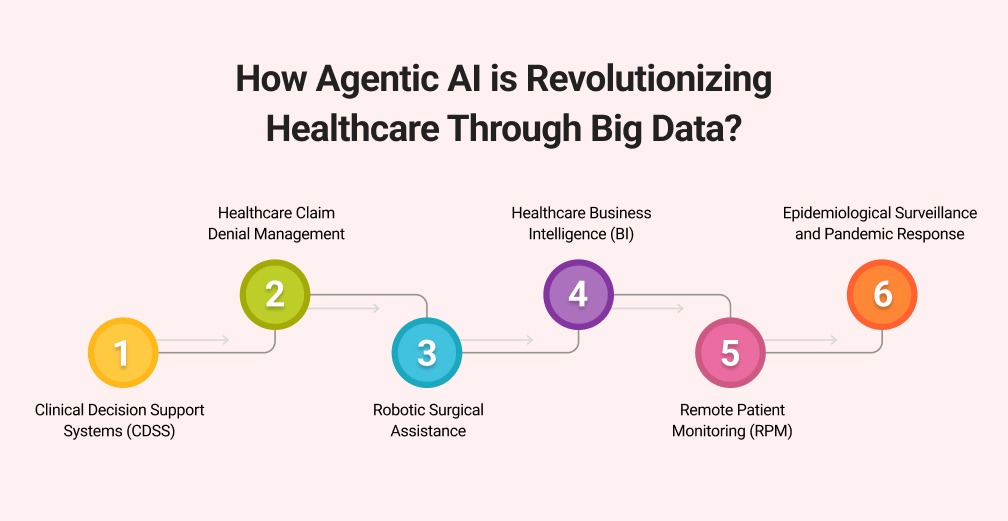
1. Clinical Decision Support Systems (CDSS)
Agentic AI-powered CDSS examines patient data against millions of similar cases, going beyond standard treatment guidelines to make autonomous recommendations. These healthcare AI Agents continuously analyze historical data from patient histories, imaging results, and lab reports, learning to identify patterns that human clinicians might miss.
Additionally, they don’t just provide suggestions but actively update treatment protocols based on real-time patient responses and emerging medical evidence, providing evidence-backed care delivery that evolves with each case.
2. Healthcare Claim Denial Management
According to a report published by the American Medical Association (AMA), healthcare claim denial rates reached an all-time high of 11% in 2022 (considering the 1700 hospitals that were evaluated). For patients, denied claims often mean delayed or unaffordable care, and for healthcare providers, they can result in lost revenue and administrative burdens.
The majority of these denials are largely due to manual processing gaps, including human data entry errors, inconsistent review protocols, and the inability to cross-reference complex policy requirements at scale. Agentic AI systems eliminate these bottlenecks by autonomously processing thousands of claims simultaneously, catching discrepancies that manual reviewers miss due to fatigue or time constraints. They can also fill in missing details by fetching accurate details from context-aware databases and fix policy mismatches and filing errors to maximize approval scope.
3. Robotic Surgical Assistance
Agentic AI is also transforming robotic surgery by creating autonomous surgical planning and execution frameworks. These AI Agents integrate patient-specific imaging scans, previous surgical outcomes, and anatomical details to not only plan procedures but also adapt in real-time during operations. When unexpected anatomical variations arise, the healthcare AI Agent instantly recalculates surgical approaches, adjusts robotic movements, and alerts surgeons to potential complications, all while learning from each procedure to improve future surgical precision.
4. Healthcare Business Intelligence (BI)
Agentic AI systems independently examine patient demand patterns, seasonal variations, and flow trends to optimize hospital operations without human oversight. For instance, these AI Agents can predict flu outbreak spikes and automatically trigger staff scheduling adjustments and resource allocation. They also continuously monitor patient flow across departments, identify bottlenecks in real-time, and reroute patients or reallocate resources to maintain optimal efficiency.
5. Remote Patient Monitoring (RPM)
Patient monitoring solutions have seen massive adoption, with over 70.6 million US patients now using RPM systems. Agentic AI elevates these systems by unifying the entire workflow, from passive data collection to autonomous intervention and alerting. These agents continuously analyze data from wearables and IoT devices, learning the unique health patterns of each patient.
In the event that a cardiac patient’s heart rhythm exhibits irregularities for a certain period, the healthcare AI Agent not only alerts caregivers but also autonomously adjusts medication reminders, schedules emergency consultations, and coordinates with nearby medical facilities, ensuring timely intervention without relying on human decision-making.
6. Epidemiological Surveillance and Pandemic Response
Agentic AI transforms epidemic surveillance by autonomously integrating data from EHRs, social media, and environmental sensors to track disease outbreaks in real-time. These healthcare AI Agents independently identify emerging hotspots, predict disease spread patterns, and automatically trigger public health interventions. Building on the CDC’s surveillance framework, they can autonomously issue health alerts, coordinate resource distribution, and adjust public health policies based on evolving outbreak patterns, enabling faster pandemic response than traditional human-led surveillance systems.
Making Agentic AI Work: Supporting Technologies and Systems
Agentic AI alone cannot improve medical research and overall healthcare outcomes. It must be used cohesively with the right technologies. Here are some of the enablers of data-driven Agentic AI solutions:
1. Machine Learning in Healthcare
Machine learning algorithms are central to the development of AI Agents. With these algorithms, agents can:
- Analyze imaging data, such as X-rays and MRIs, necessary to detect early signs of diseases like cancer or neurological disorders.
- Process historical EHR data to predict outcomes, such as patient readmissions, and enable preventive care.
- Convert unstructured data, like physician notes, into structured formats for analysis.
2. Cloud Computing
This technology provides the scalable infrastructure necessary to store, process, and securely share vast healthcare datasets. Additionally, cloud-based solutions for medical data management enable you to process data from multiple sources, such as wearable devices and imaging systems, in real-time. Another significant benefit is the guaranteed and prompt data backups and quick recovery in case of system failures, which is critical for maintaining continuity in patient care.
3. IoT (Internet of Things) and Wearable Technologies
In combination with IoT, wearable technologies ensure a consistent flow of real-time patient data, including heart rate, glucose levels, and blood pressure. When integrated with big data systems, they facilitate:
- Remote patient monitoring
- Population-level insights after analysis
- Early detection of potential health issues
- Better medication adherence
- Behavioral health tracking
4. Context-Aware Databases
Context-aware databases support agentic process automation by enabling healthcare AI Agents to understand the relationships and meaning behind diverse datasets rather than simply storing them. Unlike traditional databases that treat structured data (EHRs, lab results) and unstructured data (doctor notes, imaging data) as separate entities, context-aware systems automatically recognize connections between a patient’s symptoms, treatment history, and outcomes. This contextual understanding enables Agentic AI systems to make more informed autonomous decisions by accessing relevant data relationships without human intervention to establish those connections.
While the technologies mentioned above form the backbone of Agentic AI, effective implementation depends on coordinated efforts across all stakeholders, including hospitals, researchers, policymakers, technology providers, and even patients.
Enabling Agentic AI: A Unified Effort Toward Autonomous Healthcare
Here is how each stakeholder can contribute to the successful implementation of AI Agents in healthcare.
- Healthcare Institutions must establish governance frameworks for autonomous AI decision-making, invest in real-time data infrastructure that supports AI Agents, and develop protocols for human oversight.
- Medical Researchers and AI Agent Developers must collaborate to develop safe, reliable, and effective Agentic AI systems that can make autonomous healthcare decisions. This requires creating validation frameworks to test AI Agent performance and building fail-safe mechanisms for human intervention during critical care scenarios.
- Policymakers and Regulators must create legal frameworks that define liability and accountability for autonomous AI decisions in healthcare and establish safety standards for healthcare AI Agents in medical settings.
- Patients can contribute by providing informed consent for Agentic AI-driven autonomous care decisions, maintaining consistent use of monitoring devices to generate quality training data, and actively engaging with AI-powered agentic healthcare tools to improve system learning and personalization.
End Note
Agentic AI has the potential to redefine medical research, patient care, and healthcare delivery by moving beyond passive analysis to autonomous decision-making. However, realizing this potential requires more than just algorithms. It requires a robust infrastructure and the integration of multiple supporting technologies, such as real-time data processing, cloud computing, IoT networks, and context-aware databases, that can support truly autonomous operations.
Successfully implementing Agentic AI in healthcare also requires collaboration among stakeholders, including hospitals, researchers, policymakers, and technology providers. This is imperative to ensure that healthcare AI Agents operate ethically, safely, and with appropriate human oversight (wherever needed). With the right governance frameworks, validation protocols, and safeguards, Agentic AI can drive innovations that were once a far-reaching possibility.
If you’re looking for a reliable partner to start your Agentic AI journey, your search ends with us. We have helped several healthcare organizations build autonomous AI Agents that integrate with existing systems, such as EHRs, consumer apps, internal CRMs, and other medical devices. From patient monitoring to clinical decision support, our healthcare AI Agents have delivered tangible results. Reach out to learn more.