Outsourcing vs In-House App Development: What Makes More Sense for Your Business?
Table of Contents
- The Real Cost of App Development is the Team Behind It
- When In-House App Development is Worth the Investment
- Why Outsourcing App Development is Often the More Practical Choice
- App Development Outsourcing Models Businesses Can Choose From
- Best-Fit Scenarios for Outsourcing App Development
- How to Decide Between Outsourcing and In-House Development
- Final Takeaway: In-House Has Value, But Outsourcing Often Makes More Business Sense
- FAQs
Choosing between outsourcing and in-house app development is rarely a matter of preference. It is about which model best supports the product you are trying to build, the level of control you need, the infrastructure you can manage, and the cost structure your business can sustain.
The decision has become more complex, as mobile apps now depend on more than just development talent. Businesses must also account for cloud infrastructure, back-end scalability, security reviews, compliance needs, QA coverage, release management, product ownership, and long-term maintenance. Skill availability still matters. IDC predicts that by 2026, more than 90% of organizations worldwide will feel the impact of the IT skills crisis, with losses linked to product delays, reduced competitiveness, and lost business estimated at around $5.5 trillion. But the larger challenge is deciding whether those capabilities should be built and governed internally or supported through an external development partner.
For app teams, the impact is direct. The wrong delivery model can slow product planning, mobile development, back-end integration, QA cycles, security checks, infrastructure setup, and app store releases. It can also increase rework, stretch budgets, and create ownership gaps after launch.
This guide breaks down what each model actually costs, when in-house development is justified, and when outsourcing is the more practical call.
The Real Cost of App Development is the Team Behind It
An app’s budget is not shaped by development effort alone. It is influenced by the required team, the product’s infrastructure, the tools used throughout the lifecycle, and the operational overhead needed to keep everything moving after launch.
In the United States, the latest Bureau of Labor Statistics data puts the median annual wage for software developers at $133,080 as of May 2024, and that is only base pay. Benefits, payroll taxes, recruiting, equipment, software licenses, training, and management overhead can push the fully loaded cost well above salary alone, as a rule of thumb, roughly 1.25 to 1.4 times the base figure.
A working app team is also rarely one person. You may need mobile developers, backend developers, a UI/UX designer, a QA engineer, DevOps support, security input, and a project manager. Alongside that, businesses must also account for the infrastructure: cloud environments, testing devices, deployment pipelines, monitoring tools, security reviews, and post-launch maintenance.
This is where outsourcing can reduce the operational burden. Instead of building every capability, toolset, and infrastructure process internally from the start, businesses can access a ready development setup, flexible technical capacity, and managed delivery workflows. The cost benefit is not only lower hiring expense. It also comes from reduced infrastructure hassle, faster team mobilization, limited long-term overhead, and the ability to scale development capacity around the app’s actual stage of growth.
So the real question is not just “how much does an app cost?” It is “what does it cost to build, manage, support, and scale the entire delivery system behind the app?”
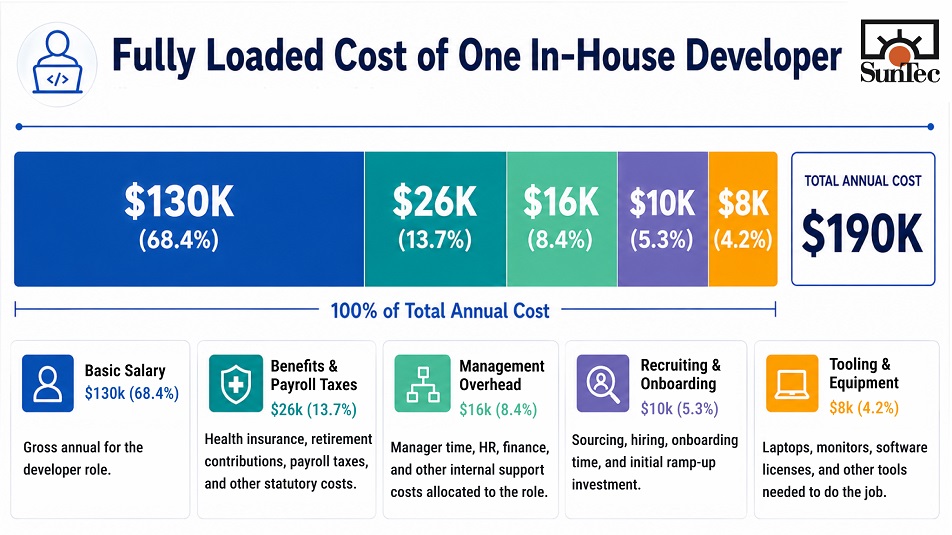
The true cost of an in-house developer goes beyond salary, with benefits, recruitment, tools, and management overhead adding to the total expense.
When In-House App Development is Worth the Investment
In-house development earns its premium when the app is the core of the business, not a supporting tool. If your hero is the app itself, keeping development close protects your roadmap, your data, and your intellectual property.
In-house also wins when you need deep, daily collaboration with other internal teams, when domain knowledge is hard to transfer, or when you operate under strict regulatory or security constraints that favor tight internal control.
Companies with a long product horizon and a steady, predictable workload get the most from a permanent team because the high fixed cost is spread over years of continuous output.
Why In-House Development Eventually Becomes Expensive to Sustain?
Despite offering several benefits, in-house development has certain challenges, and they’re not always related to the launch. It is the years after it.
App workloads are uneven. You may need a larger team during active builds and a much smaller one during maintenance, yet full-time commitments remain largely the same. Salaries continue, but so do benefits, payroll costs, equipment, software licenses, management time, training, HR processes, and retention efforts. That mismatch can turn reduced development activity into idle cost.
Hiring is also slow and competitive. Replacing a senior developer can take months, and every departure resets institutional knowledge. You also carry the ongoing burden of upskilling, since mobile platforms, frameworks, app store rules, and security standards change constantly.
For many companies, the in-house model quietly becomes a fixed operating cost that outlives the project that justified it.
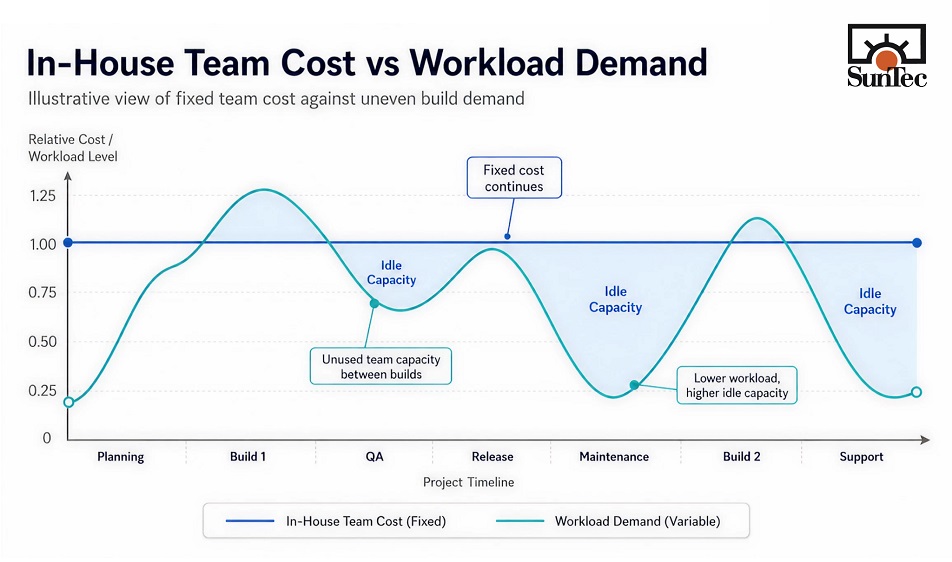
In-house team costs often remain fixed even when app development workload drops after major build phases.
Why Outsourcing App Development is Often the More Practical Choice
Outsourcing converts a fixed cost into a more flexible one. You can scale the team up for active development and scale it down for maintenance, instead of carrying every role as a permanent salary cost.
The market reflects this shift. Mordor Intelligence estimates the software development outsourcing market at $618.38 billion in 2026, growing to $977.04 billion by 2031 at a 9.6% CAGR.
Cost savings remain one of the strongest reasons businesses outsource app development, but the decision is now shaped by more than budget control. Businesses also outsource to access specialized skills, speed up delivery, support AI-enabled features, add platform-specific expertise, reduce infrastructure setup effort, and ease the pressure of hiring and retaining full-time technical teams.
A capable outsourcing partner brings an assembled team, delivery process, development infrastructure, and technical experience that can shorten the path from planning to launch.
What to Watch for When Outsourcing — And How to Manage It
Outsourcing is not risk-free, and a foundational decision deserves an honest look at the trade-offs. The good news is that each common concern is manageable with the right structure in place.
- Communication and Coordination Overhead: Distributed teams and time zone gaps can slow decision-making. Defined sprint checkpoints, a single point of accountability, and overlapping working hours keep delivery aligned.
- Quality Variance Between Vendors: Capability differs widely across providers. Code reviews, QA gates, a short paid trial or pilot, and reference checks protect against an uneven start.
- Security and IP Exposure: Sharing source code and data is a real concern, especially under compliance constraints. NDAs, scoped access controls, audit trails, secure environments, and clear IP-ownership clauses keep risk contained.
- Knowledge Continuity: Context can leave when an engagement ends. Maintained documentation, shared repositories, and a defined handover path are needed to ensure the work remains intact after the partner steps back.
- Vendor Lock-In: Overdependence on a single provider limits flexibility. Clean architecture, owned credentials and infrastructure, and a partner that builds for handover rather than dependency keep you in control.
Vetting for these upfront is the difference between outsourcing that scales with you and outsourcing that creates new problems. The sections below cover the models and scenarios where it works best.
App Development Outsourcing Models Businesses Can Choose From
Outsourcing is not one arrangement. The right model depends on how much control, flexibility, and accountability you need.
Project-Based Outsourcing
Project-based outsourcing works best when the app has a clearly defined scope, timeline, budget, and expected outcome. In this model, the outsourcing partner is responsible for delivering the app in accordance with the agreed requirements. The business shares the product brief, feature list, design expectations, and success criteria, while the service provider manages development, testing, and delivery.
This model is useful when there is a fixed endpoint, such as an MVP, customer portal, booking app, eCommerce app, internal workflow app, or standalone business tool. It provides companies with predictable costs and defined deliverables, making budgeting easier.
However, the trade-off is that day-to-day flexibility is limited. Once the scope is finalized, major changes may require additional tickets/requests, ultimately affecting cost and timeline. So, project-based outsourcing works best when requirements are stable, and the business can clearly explain what it wants before development begins.
Dedicated Development Team
Outsourcing a project to a dedicated development team gives businesses access to a long-term external team that works exclusively or primarily on their product. The team may include mobile developers, back-end engineers, UI/UX designers, QA testers, DevOps engineers, and a project manager, depending on the engagement.
This model is well-suited for companies building a product that will evolve over time. It works especially well when the roadmap is active, features need to be released regularly, and the business wants continuity without hiring a permanent in-house team. By embedding themselves into your product’s ecosystem, the dedicated team builds deep institutional knowledge of your codebase, workflows, and users, driving continuous improvements in delivery quality.
Compared to project-based outsourcing, this model offers more flexibility. The business can adjust priorities, add features, refine the roadmap, and continue development beyond the first release. It is a strong fit for SaaS products, marketplaces, customer-facing apps, and growing digital platforms that need ongoing development support.
Staff Augmentation
Staff augmentation is best for companies that already have an internal development team but need extra skills or capacity for a specific period. Instead of outsourcing the entire project, the business adds external developers, designers, QA engineers, or specialists to its existing team.
This model gives the company the highest level of control because internal managers still own the roadmap, development process, architecture, sprint planning, and delivery decisions. The external professionals simply extend the team’s capacity.
Staff augmentation is useful when the internal team is overloaded, when a project needs to move faster, or when a specific skill is missing internally. For example, a company may bring in Flutter developers to maintain its mobile applications or a few cloud engineers to develop a migration roadmap.
The main requirement is strong internal management. Since the company controls the work, it must have the technical leadership and project structure needed to guide external resources effectively.
Managed App Development Services
Managed app development services work best when a business wants the outsourcing partner to take broader responsibility for planning, development, coordination, testing, deployment, and ongoing support. Instead of managing individual developers, the business works with a service partner that owns the entire delivery process, with agreed-upon timelines, milestones, and service levels.
This model is useful for companies that lack internal technical leadership or do not want to manage the development process closely. The outsourcing partner may handle requirement analysis, solution architecture, UI/UX, coding, QA, release management, maintenance, and performance monitoring.
Managed services are especially practical for businesses that prioritize outcomes over headcount.
The main advantage is reduced management burden. The business stays involved in product direction and approvals, while the outsourcing partner manages execution and delivery accountability.
Hybrid Development Model
Not every app development decision has to be fully outsourced or fully in-house. A hybrid development model works when the business wants to maintain internal product governance while assigning specific parts of the app lifecycle to an external development partner.
In this model, the business retains ownership of product direction, business logic, user experience priorities, compliance expectations, and final approvals. The development partner is responsible for delivering specific outcomes, such as an MVP, a mobile app module, UI/UX redesign, API integration, QA automation, app modernization, performance improvement, or post-launch maintenance.
This is not just about adding more developers to an existing team. The focus is on outcome-based delivery. The partner manages the agreed scope, plans the technical workflow, coordinates the required roles, handles development and testing, maintains documentation, and supports deployment within defined timelines.
The model works well when the business needs stronger control than full outsourcing but does not want to build every capability, tool, process, and infrastructure layer internally. It is also useful when an app needs to change across the lifecycle. A company may need end-to-end delivery support for the first release, limited support after launch, and specialized help later for upgrades, integrations, or platform expansion.
The advantage is that product ownership remains with the business, while delivery responsibility is structured. That keeps app development scalable without turning every temporary technical need into a permanent internal function.
App Development Outsourcing Models at a Glance
| Outsourcing Model | Control Level | Flexibility | Accountability |
|---|---|---|---|
| Project-Based Outsourcing | Low to Medium | Medium | High for defined deliverables |
| Dedicated Development Team | High | High | Shared, with strong ongoing collaboration |
| Staff Augmentation | Very High | High | Internal team leads delivery |
| Managed App Development Services | Medium | Medium to High | Vendor-led, outcome-focused |
| Hybrid Development Model | High on core work, shared on outsourced work | Very High | Shared by internal and external teams |
Different outsourcing models offer different levels of control, flexibility, and delivery ownership depending on business needs.
Best-Fit Scenarios for Outsourcing App Development
Some situations favor outsourcing almost by default.
MVP Development
An MVP is one of the strongest cases for outsourcing because the goal is not a feature-heavy product but to validate the core idea quickly with the minimum needed to test demand, feasibility, and market response.
This calls for a different mindset than a mature product. In-house teams tend to think in terms of long-term architecture, technical debt, and how the codebase will scale over the years. This is valuable for a core product, but a drag on an MVP when the priority is learning fast. An external team can take a leaner, validation-first approach, building only what proves the concept: a usable interface, the critical user journey, essential backend logic, and enough security for a controlled launch.
That discipline guards against overengineering. Rather than perfecting infrastructure or adding features users may never want, the MVP ships fast, gathers real feedback, and limits upfront commitment. If the idea works, it can be hardened or rebuilt on a more scalable architecture later.
New Business App Development
Where the MVP question is about product approach, the new-business question is about timing the investment. A startup needs enough of the app to validate the business without draining a limited runway or committing to a permanent engineering team before the answers are in.
Early on, the idea is still moving: user behavior is unproven, monetization is uncertain, and priorities shift after the first round of feedback. Hiring a full in-house team before that makes the business slower and costlier to adjust. A partner offers stage-appropriate execution instead: translating the concept into a practical scope, defining what to build now versus later, and avoiding the two classic mistakes of underbuilding so the idea can’t be tested, or overbuilding before there is market evidence.
This keeps options open. The company can validate demand and refine the product before deciding whether to grow an internal team, rebuild parts of the system, or scale into a long-term product.
Feature Expansion
Once the core product is live, new features often stall, not for lack of importance, but because they compete with the internal team’s work on stability, customer feedback, and releases. Outsourcing lets a specific feature or module, such as a payment flow, a loyalty program, a reporting dashboard, or a CRM or analytics integration, move in parallel without pulling the core team off its priorities.
The internal team protects the core architecture and release standards, while the partner owns the agreed-upon feature scope, testing, documentation, and deployment. This works best when the work is cleanly separated through API contracts, access controls, Git workflows, and staging and review gates, so new functionality doesn’t muddy the main codebase.
It is especially useful when the feature needs expertise that the team doesn’t use daily. It could be AI features, native performance work, QA automation, or cloud scaling, where focused depth for a limited period beats stretching the core team.
App Modernization or Rebuilds
Modernization and rebuilds suit outsourcing because they are high-intensity, project-based efforts rather than steady work. A legacy app may still run, but dated frameworks, tangled code, weak documentation, and manual deployments make every release slower and riskier.
It also calls for a different lens. Before new code is written, the app needs an assessment of technical debt, architectural gaps, dependencies, security risks, and scalability limits. An outside view can determine whether it needs refactoring, re-platforming, cloud migration, or a full rebuild. The outsourced team can then run the migration roadmap, cleanup, testing, and phased rollout while the business keeps supporting the live product, so internal staff isn’t pulled off production work.
It fits, too, because modernization needs specialist skills, such as in cloud architecture, DevOps, API modernization, and security hardening, but for a limited window. Once the rebuild is done, that depth is no longer needed full-time. A good partner doesn’t just rebuild; it cuts technical debt, improves maintainability, and leaves a clean handover path.
Maintenance and Support
Maintenance is easy to underestimate, but every app needs ongoing care: operating systems shift, store rules change, security patches land, APIs break, and feedback surfaces bugs. The work is steady but rarely intense enough to justify a full in-house team, making it a natural fit for an external team that handles fixes, updates, monitoring, security patches, backups, and app store releases.
That keeps internal developers on product strategy and major features rather than routine upkeep. A strong arrangement is defined by service levels, response times, escalation rules, and reporting, shifting maintenance from reactive bug-fixing to structured support that protects the app after launch.
How to Decide Between Outsourcing and In-House Development
Use the following practical factors to guide the decision:
| Decision Factor | Lean In-House When | Lean Outsourcing When |
|---|---|---|
| Core Product Role | The app is central to your business model, revenue, or competitive advantage. | The app supports business operations, customer access, or a specific digital workflow. |
| Product Control | You need direct day-to-day control over product decisions, technical direction, release cycles, and long-term roadmap changes. | You want to retain ownership of product decisions while delegating execution to an external team through clearly defined requirements, milestones, and review processes. |
| Workload Pattern | Development needs are steady, continuous, and likely to remain active for years. | Workload is project-based, seasonal, and uncertain, with heavier periods during specific build phases. |
| Speed to Market | You can invest time in hiring, onboarding, tooling, and process setup before development begins. | You need faster execution through an already assembled design, development, QA, and delivery setup. |
| Skill Availability | The required mobile, backend, cloud, QA, and security skills are already available internally or easy to build. | The app needs specialized or short-term expertise that is difficult or costly to maintain permanently. |
| Cost Structure | You can sustain fixed costs such as salaries, benefits, tools, infrastructure, training, and management overhead. | You prefer a more flexible cost model tied to project scope, milestones, or defined delivery phases. |
| Infrastructure Readiness | You already have the development tools, cloud setup, testing environments, DevOps processes, and release workflows in place. | You want to avoid setting up every delivery, testing, deployment, and monitoring capability internally from the start. |
| Security and Compliance | The app handles highly sensitive data and requires close internal governance across every development decision. | Security requirements can be managed through access controls, NDAs, compliance checks, audit trails, and partner governance. |
| Long-Term Maintenance | The app will require frequent product changes, continuous experimentation, and deep internal product knowledge. | Maintenance needs are predictable, limited, or can be handled through defined support agreements after launch. |
Tip: If your project has a mix of these levers (e.g., it’s a core product but you need speed to market), a popular hybrid approach is to outsource the initial build to launch quickly, while simultaneously hiring an in-house team to handle the long-term maintenance and evolution.
Most companies land on a blend. They keep strategy and product ownership in-house, then source execution capacity externally through app development services.
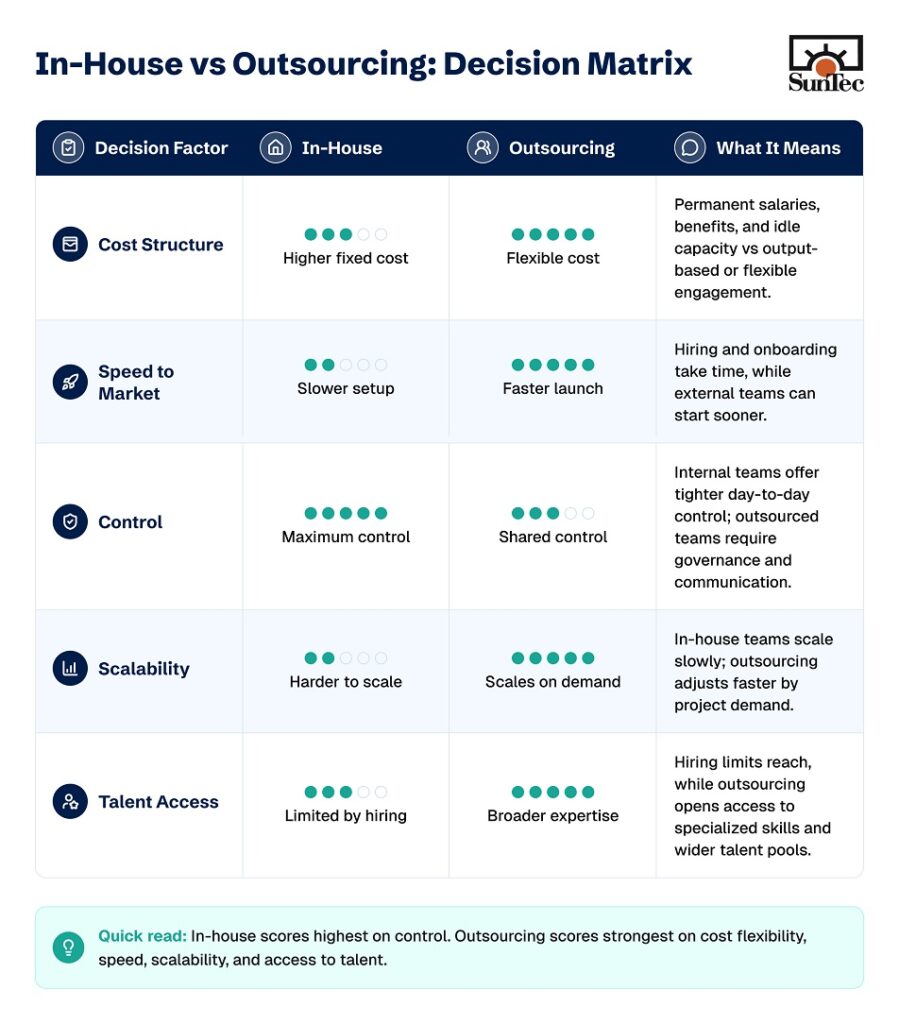
A decision matrix helps businesses compare outsourcing and in-house development based on cost, speed, control, scalability, and talent availability.
Final Takeaway: In-House Has Value, But Outsourcing Often Makes More Business Sense
In-house development is the right answer when the app is central to your business, and the workload is steady enough to justify a permanent team. It buys control, continuity, and deep institutional knowledge.
For most other cases, outsourcing is simply the more practical model. It turns a high fixed cost into flexible capacity, shortens time to market, and opens access to specialized talent without long hiring cycles.
The smartest approach is rarely all-or-nothing. Decide what must stay in-house, then outsource the rest to move faster and spend smarter.
FAQs
Yes. Outsourcing usually lowers total costs by eliminating fixed salaries, benefits, and idle capacity, and by offering flexible, output-based pricing. In-house can be more cost-effective only when the workload is steady, and the app is central to your business.
Most startups begin with project-based outsourcing or a dedicated development team to launch an MVP without building a permanent engineering function. As the product matures, many shift to a hybrid model.
Yes. A hybrid model is common. You keep core, sensitive, or strategic work in-house and outsource specialized features, testing, or maintenance to scale capacity as needed.
Define a clear scope and service levels, keep product ownership in-house, and choose an engagement model that matches the level of control you need. Staff augmentation and dedicated teams offer the most day-to-day control.

The SunTec India Blog
Brought to you by the Marketing & Communications Team at SunTec India. We love sharing interesting stories and informed opinions about data, eCommerce, digital marketing and analytics, app development and other technological advancements.