Follow Us





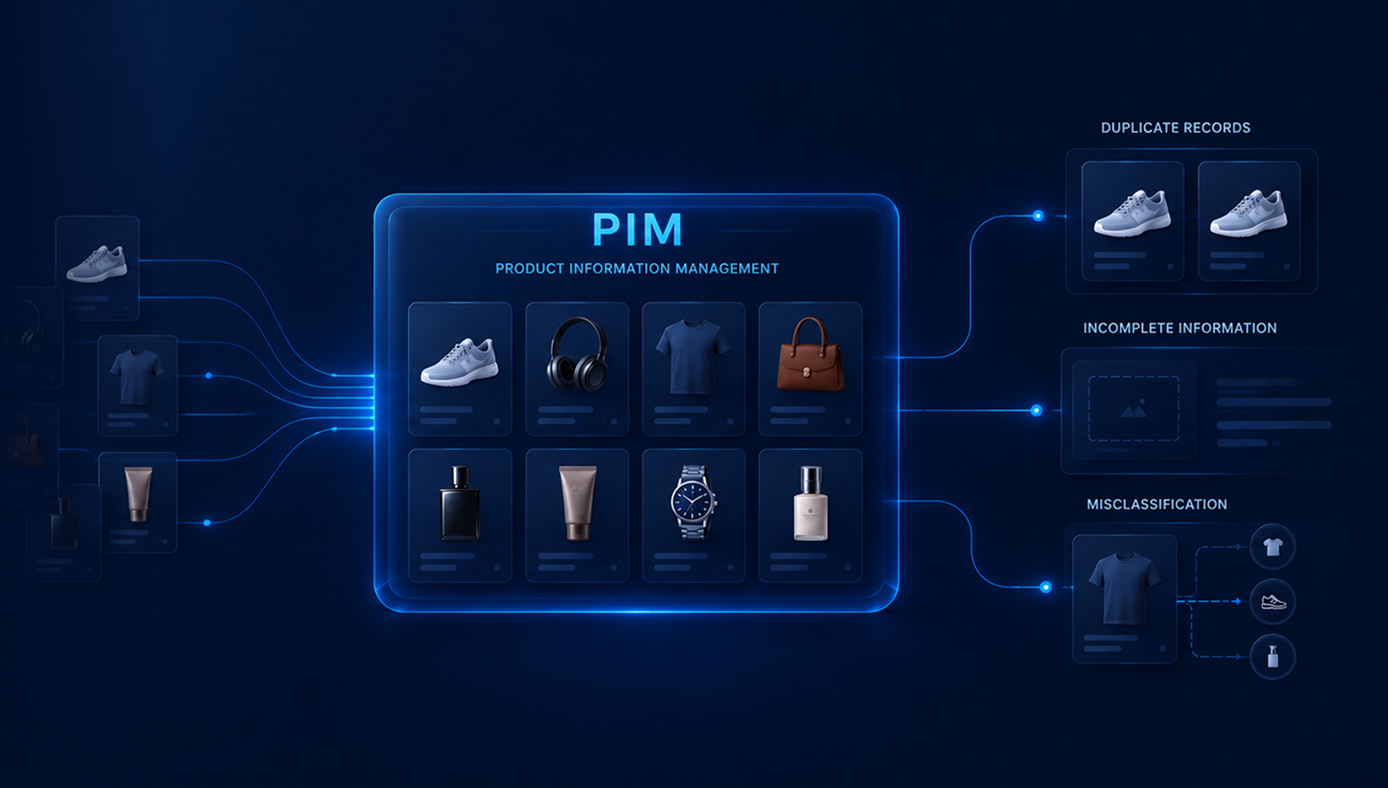
A PIM manages the flow and distribution of product data; it does not determine whether that data is accurate, complete, channel-compliant, or commercially optimized.
Brands are right to invest in stronger PIM platforms. In many cases, that investment is necessary and long overdue. The issue usually emerges after implementation, when a successful migration and cleaner dashboards create the impression that the product data problem has been resolved. In reality, that is often where the misjudgment begins.
The Dashboard Looks Clean. The Catalog Isn’t
A PIM system centralizes product data and digital assets, supports collaborative workflows, and enables the syndication of product content across customer touchpoints, sales channels, and marketing systems. However, infrastructure should not be mistaken for a data quality practice.
A PIM can manage and distribute product information, but it does not ensure accuracy, completeness, consistency, or governance. PIM organizes and operationalizes data, while product data management practices ensure its quality, integration, and governance, making it trustworthy and commercially usable.
The global PIM market is estimated at USD 19.95 billion in 2026 and is projected to reach USD 37.39 billion by 2031, growing at a 13.38% CAGR. That level of investment makes PIM a clear enterprise priority. Yet the product data issues driving that investment still remain unresolved.
The PIM Paradox: Better Software, Same Bad Data
To be clear, this isn’t an argument against PIM. A modern PIM is essential for managing product data across marketplaces, eCommerce sites, and distributor networks. It structures operations through taxonomy management, attribute modeling, localization, digital assets, channel templates, workflows, and audit trails—without it, multichannel commerce quickly becomes difficult to control.
The problem begins when that structure is mistaken for data quality. A PIM can organize and distribute product information, but it cannot independently verify whether that information is accurate, enriched, compliant, or commercially useful.
A PIM distributes data quickly and consistently, but also propagates its quality issues at scale. Incorrect specifications, weak categorization, or inconsistent attributes spread across filters, feeds, and product pages. In other words, the PIM does not create the problem, but it does make the consequences of weak data more operationally visible and more commercially expensive.
The Market Keeps Confusing Centralization with Quality
- Go-live is often treated as proof of progress when it is only the start of accountability. Once the system is implemented, leadership assumes the data issue is under control. In reality, the most important work begins after implementation, when the business has to define standards, resolve inconsistencies, and maintain quality at scale.
- Many organizations are still measuring the wrong thing. They look at field completion, workflow movement, and syndication readiness as signs of maturity. Those are system metrics. They do not tell you whether the product data is accurate enough to support discovery, compliant enough for channels, or strong enough to convert.
- Supplier-provided data is still being treated as if it were publishable data. In most categories, it is not. It is raw input. Without cleansing, normalization, categorization, and validation, supplier data carries too much inconsistency to support reliable commerce execution.
- The real cost appears only after weak data enters commercial workflows. By that point, the issue is no longer confined to product operations. It starts affecting search performance, marketplace compliance, paid media efficiency, PDP quality, returns, and customer trust.
What a PIM Strengthens and What Still Depends on Product Data Management
PIM is not a data quality tool. It is a data management infrastructure. The two serve different functions, require different capabilities, and cannot be substituted for one another.
| Where a PIM strengthens operations | Where data quality work still has to happen |
|---|---|
| It centralizes product information and assets across systems and channels. | It does not verify whether incoming data is accurate, complete, or fit for commerce. |
| It creates structure through workflows, approvals, and version control. | It does not correct poor supplier data, missing specs, or inconsistent attribute values. |
| It supports taxonomy models and attribute frameworks at scale. | Taxonomy has to be built, governed, and maintained by category specialists - the PIM only houses it. |
| It enables faster syndication across marketplaces and storefronts. | It does not ensure the content being syndicated is channel-compliant or commercially optimized. |
| It improves visibility into catalog status and publishing readiness. | It does not ensure complete or enriched data - long descriptions, feature benefits, use cases, and more. |
| It makes product data easier to manage at scale. | It does not replace cleansing, enrichment, validation, governance, or ongoing catalog maintenance. |
Six Data Quality Failures That Often Surface After PIM Go-Live
I’ve reviewed dozens of PIM implementations—sometimes during RFP, sometimes post-go-live when the promised ROI hasn’t materialized. The underlying issue is usually not the tool, but the assumptions baked into how product data is sourced, structured, and governed. The patterns are remarkably consistent:
1. Supplier data is accepted at face value
Supplier or manufacturer data is often assumed to be commerce-ready, but it rarely is. Suppliers optimize for their own catalogs, not your channels or customers. A PIM can store either version, but cannot determine commercial sufficiency. Without validation and source reconciliation, raw supplier data gets published as-is.
2. Taxonomy is modeled around the system, not the customer
Taxonomy is frequently designed for platform convenience rather than customer search and buying behavior. This impacts navigation, filtering, search visibility, and merchandising across channels. When taxonomy is built around the system rather than customer behavior and commercial intent, performance issues become embedded into the catalog and are difficult to correct later.
3. Attributes are mapped but not enriched
Many programs stop at field mapping, treating structural alignment as completion. Mapping only moves data; enrichment adds clarity, specificity, and channel relevance. Without it, product data remains technically organized but commercially weak.
A Field That Is Populated Is Not the Same as a Field That Converts
4. Channel rules are documented but not enforced
Channels like Amazon, Walmart, Google Shopping, and eBay each have evolving rules and standards. A PIM can store channel-specific templates, but it doesn’t replace ongoing monitoring and validation. Without it, issues often surface only after suppression, rejection, or poor performance.
5. No one owns “Is this commercially viable?”
Data completeness dashboards are easy to build. But “complete” is not the same as “converts.” Who owns the question of whether the bullet points actually sell the product? Does the primary image actually work on a search results page? Do the A+ content modules align with the buying persona? In many organizations, that responsibility remains unclear, fragmented, or entirely absent.
6. No feedback loop from downstream signals
PIM systems primarily distribute data rather than learn from their performance. Signals such as returns, suppressions, search failures, zero-result queries, low engagement, and weak conversion rates are rarely fed back into improvement cycles. As a result, high-visibility SKUs continue to get attention, while larger groups of underperforming products continue to lose traffic & sales.
The Hidden Cost of Confusing Repository with Quality
You Won’t See It on the PIM Report. You’ll See It on Returns and Suppression Notices.
The cost of this misjudgment is real, but it rarely shows up under “product data quality” on a report. Instead, it appears across channel performance, returns, paid media efficiency, operational accuracy, and launch timelines.
Brands see the operational fallout but often attribute it to channel strategy, campaign execution, or platform limits, when the core issue is simpler: the product data was never accurate, complete, or channel-ready to begin with.
Where Product Data Gaps Cost Brands Money:
1. Channel rejection and suppression: Incomplete or non-compliant product data gets rejected by retail partner feeds or suppressed from marketplace search results — directly reducing buyable inventory and revenue availability.
2. Elevated return rates: Products purchased on the basis of inaccurate or incomplete attribute data are returned at significantly higher rates. In categories like apparel, consumer electronics, and home improvement, this is a multi-point margin erosion driver.
Inaccurate or incomplete product attributes directly increase return risk. Salsify's 2025 Consumer Research, found that 71% of shoppers have returned a product because it did not match the online listing.
3. Ad spend waste: Search and PPC performance depend on product feed quality. Thin, inaccurate, or poorly attributed product data weakens ad relevance, limits feed eligibility, reduces campaign efficiency, and increases acquisition costs.
The impact is not hypothetical. In one of our engagements with a consumer electronics retailer with 1M+ products, fixing categorization and data quality led to a 38% increase in site search conversions and a 40% boost in campaign performance.
4. Procurement inefficiency: In B2B and MRO contexts, incorrect product data creates duplicate ordering, wrong-part procurement, and downstream operational disruption.
Weak product data doesn’t just hurt discovery; it impacts execution. In one case, cleansing and classifying 196,000 MRO items improved inventory visibility by 15% and cut procurement lead time by 25%, showing how poor data creates avoidable operational drag.
5. Delayed time-to-market: Without a clean, enriched product data pipeline, new product launches require manual remediation cycles that delay marketplace availability by weeks.
How PIM and Product Data Management Work Together to Improve Accuracy, Control, and Ecosystem Visibility
So, What Brands Should Do Instead?
The answer is not to avoid better PIMs, but to stop expecting them to replace product data quality functions. A PIM is essential for structuring records, workflows, and syndication, but structure alone does not ensure reliable data; that requires disciplined product data management.
This distinction becomes critical when product data flows across eCommerce, marketplaces, ERP, analytics, merchandising, and customer experience. The challenge is not just managing content efficiently, but ensuring the business operates on trusted data.
In practice, strong product data management involves:
- Product data cleansing and normalization: Source data has to be corrected before it becomes reliable. That means fixing inconsistent formats, standardizing units, correcting incomplete specifications, and removing obsolete or conflicting values.
- Deduplication and record control: Product data often enters the business from multiple sources in slightly different forms. Without deduplication and matching discipline, duplicate records create listing conflicts, reporting distortion, and fragmented product history.
- Supplier data validation: Supplier data should be treated as source input, not publish-ready content. It has to be cross-checked, normalized, and validated against business requirements before it can support commerce.
- Product categorization and taxonomy discipline: Brands should treat categorization as an ongoing, governed process, not a one-time setup, ensuring it stays aligned with how products are discovered and sold across channels. When maintained, it improves searchability, filtering accuracy, and merchandising performance.
- Attribute standardization: Product data becomes more dependable when attribute names, accepted values, and category-specific rules are consistently defined and enforced.
- Product data enrichment: Attribute enrichment makes product data more usable by adding specifications, compatibility details, materials, dimensions, usage context, and descriptive depth needed to support discovery and decision-making.
- Validation and quality assurance: Product records should not be judged only by field completion. They need to be checked for correctness, consistency, and readiness to support channel requirements and customer-facing use.
- Ongoing maintenance: Product data quality is not fixed at go-live. It has to be maintained continuously as assortments expand, supplier content changes, and marketplace expectations shift. This is the operational gap that dedicated PIM managed services solve by treating the catalog as a system that is administered, monitored, and governed continuously, rather than configured once and left to drift.
- Human-in-the-loop quality assurance: Automation improves efficiency in product data cleansing and management, while human QA is applied where context, ambiguity, and category judgment matter.

Data Cleansing
Deduplication, normalization, error correction, UOM standardization, and removal of legacy inconsistencies across SKUs

Taxonomy & Categorization
Category-accurate classification against UNSPSC, GS1, retailer-specific or internal hierarchies — requiring category domain expertise

Data Enrichment
Multi-source attribute population — manufacturer specs, channel requirements, competitive benchmarking — to fill gaps in supplier data

Supplier Validation
Cross-verification of supplier-provided data against authoritative sources; MPN validation, spec accuracy, and compliance checking

Channel Compliance
Ongoing alignment of product data against retailer-specific requirements: Amazon item types, Walmart content scores, Google Shopping feed specs
Automation in Product Data Management Improves Speed, Not Product Data Judgment
Bad Data + AI = Bad Data, Faster. AI Is a Force Multiplier— And That Works in Both Directions
AI can support enrichment, identify patterns, and accelerate parts of the workflow. But if the source data is fragmented, the taxonomy is unstable, and the business rules are weak, AI will scale ambiguity faster than people can catch it.
That is why I do not see AI as a replacement for the product data management discipline. I see it as a force multiplier that makes good governance more valuable and weak governance more dangerous.
- Automation improves speed by standardizing formats, applying rules, flagging missing fields, and routing product records through workflows.
- Automation supports scale by helping teams process large catalogs more consistently across systems and channels.
- Automation does not validate source trustworthiness. It cannot reliably determine whether supplier-provided data is accurate enough to publish.
- Automation does not replace categorization judgment. Strong taxonomy still depends on category logic, channel requirements, and buyer behavior.
- Automation does not guarantee enrichment quality. A populated field is not always a useful or commercially effective field.
- Automation does not remove the need for QA. Records still need review where context, ambiguity, and business rules matter.
Category Expertise Is What Makes Human-in-the-Loop Effective
Human-in-the-loop review is most important where product data requires judgment, not just processing, such as resolving supplier inputs, refining taxonomy, improving attributes, and assessing channel readiness.
Its effectiveness depends on expertise: in product data management, these decisions are best governed by category specialists, not generalist reviewers. Classification, enrichment, and validation only improve catalog quality when guided by SMEs who understand the category, channel rules, and buyer behavior.
The challenge isn’t choosing between automation and human oversight, but knowing where each fits. Our engagement with a client managing over 2M+ SKUs demonstrates what that balance looks like in practice: automation handled scale and consistency, while human QA managed classification, edge cases, and enrichment, achieving 99.8% accuracy.
Why This Matters Even More in an AI and Omnichannel Environment
Product data quality matters more today because it influences site performance, marketplace visibility, recommendation engines, paid media feeds, analytics, and AI-driven discovery experiences.
Weak data no longer stays localized; it spreads across touchpoints, affecting discoverability, indexing, conversion, returns, and trust. As reliance on product data grows, so does the cost of inconsistency.
It is no longer a one-time cleanup exercise, but an ongoing business discipline.
Gartner's February 2025 research, based on a survey of 1,203 data management leaders across industries, predicts that organizations will abandon 60% of AI projects through 2026 due to a lack of AI-ready data. The implication for product data is direct: the same structural deficit that is killing enterprise AI programs — ungoverned, inconsistent, enrichment-poor data — is exactly what most PIM implementations are sitting on top of. The problem is not the model. It is the catalog.
Also Read: How to Prepare Your Product Catalog for AI Shopping Assistants and Answer Engines
Software Helps. Accountability Decides the Outcome.
If brands want better outcomes from eCommerce websites, marketplaces, and AI-driven discovery, they need to look past software selection. They must also prioritize accountability.
Better catalog performance depends on more than centralization. It depends on clear ownership of supplier data, stronger taxonomy discipline, better attribute quality, and a consistent feedback loop between downstream performance and catalog improvement. Without that structure, the same issues keep resurfacing, no matter how advanced the system looks.
That is why the strongest catalogs are rarely the most automated. They are the most governed.
Your PIM Investment Deserves Better Inputs
SunTec India provides dedicated product data management services — data cleansing, categorization, enrichment, supplier validation, and channel compliance — for brands operating complex catalogs across multiple channels.

Rohit Bhateja
Rohit Bhateja, Director of Digital Engineering Services and Head of Marketing at SunTec India, is an award-winning leader in digital transformation and marketing innovation. With over a decade of experience, he is a prominent voice in the digital domain, driving conversation around the convergence of technology, strategy, customer experience, and human-in-the-loop AI integration.
