What if an eCommerce website crashes during a flash sale, or even worse, a crowdfunding app freezes in the middle of a transaction, causing panic among the users? You’ll likely miss out on several future sales opportunities, losing the hard-earned trust of your consumers.
Naturally, traditional testing or quality assurance (QA) approaches would offer little to no comfort in such scenarios, as you would have to wait for technical support or assistance. Adding to the gravity of this situation, it may even take a few more days for them to resolve the glitch. Unsurprisingly, traditional testing and QA approaches are inherently reactive; they catch issues after they have already impacted users, damaged reputation, and cost revenue.
However, today, the integration of AI in software testing and QA is rewriting this narrative. It is helping organizations predict these failures days, and even weeks, in advance, and automatically prevents them by fixing the issue. This blog post will explore this shift from reactive firefighting to predictive, AI-powered software testing.
Table of Contents
Where AI Fits in Overall Development Workflows?
Before exploring the primary benefits of AI in software testing and deployment, let’s go over a broad overview of how and where it currently fits into software development workflows.
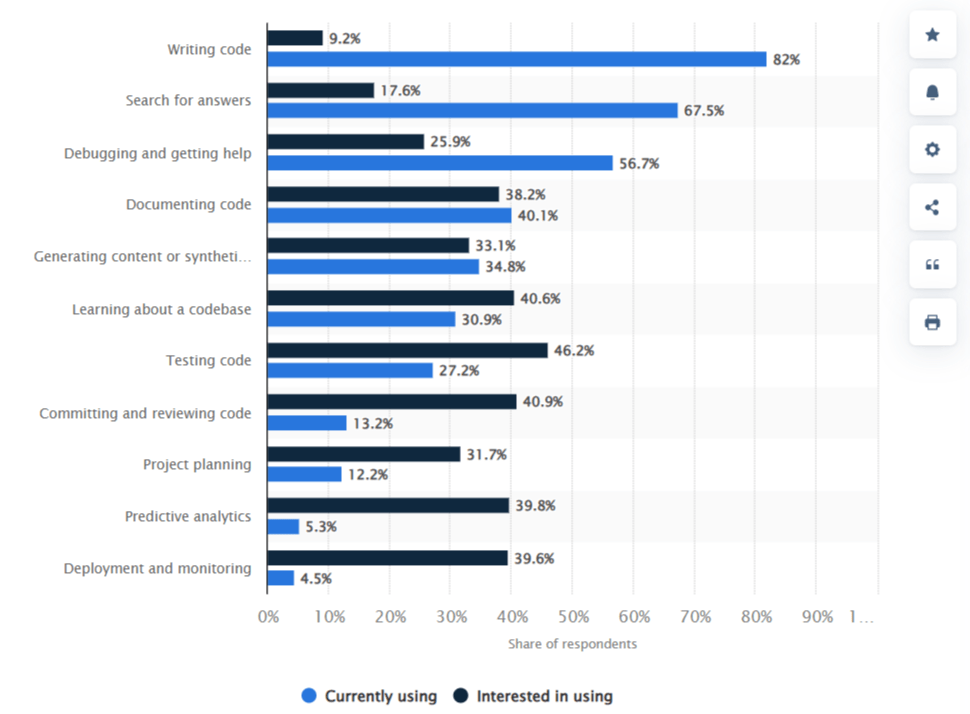
The graph above outlines the key use cases of AI within a software development life cycle (SDLC), highlighting areas where developers are currently leveraging AI and where there is growing interest. Writing code, searching for solutions, and debugging are the most prominent applications that developers rely on today. Additionally, there is a strong desire among developers to integrate AI tools into areas like software testing, code documentation, and predictive analytics to enhance productivity and streamline processes.
How AI is Transforming Testing and QA?
AI has already redefined the way testing and QA are approached, automating tier 1 QA tasks like test case generation, defect or bug detection, and performance analysis. Let’s go deeper into how this automation not only accelerates the process but also enhances accuracy, enabling teams to deliver higher-quality software more quickly.
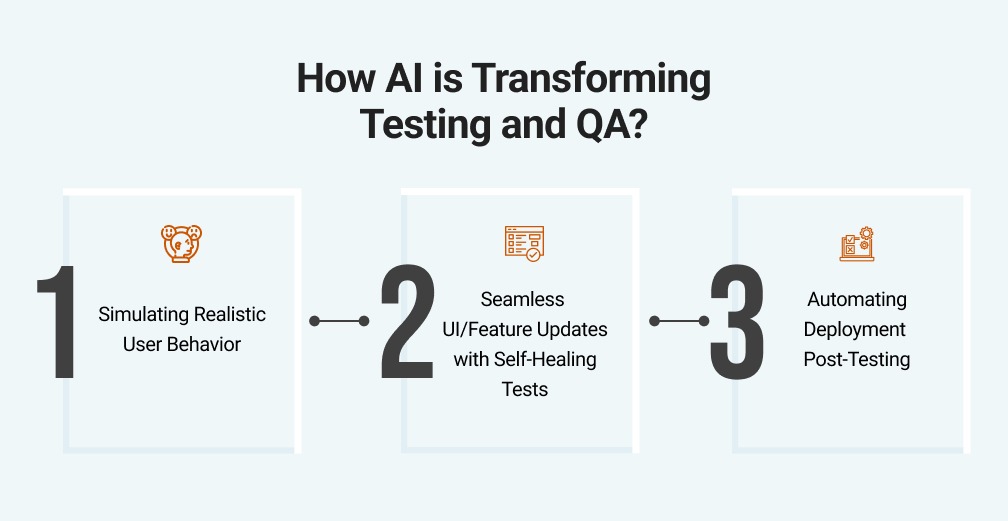
1. Predicting System Failure or Performance Glitches
Modern AI-powered software testing tools collect and analyze both historical data and real-time performance metrics to predict potential system failures, performance bottlenecks, or glitches. This data includes resource utilization, response times, and transaction volumes, allowing tools to learn patterns and anomalies that precede failures.
2. Simulating Realistic User Behavior Patterns
Many organizations are leveraging AI-driven testing tools within their DevOps pipelines to gather data from realistic usage patterns. These include key metrics like session duration, clickstreams, and transactional volume. By analyzing this information, these tools identify hidden scalability bottlenecks that traditional load testing or stress testing might miss, providing deeper insights into system performance under varied conditions.
3. Seamless UI/Feature Updates with AI-Driven Test Creation and Self-Healing
AI-powered testing tools analyze real-time code commits at scale, quickly identifying areas most likely to be impacted by new changes. Instead of running generic tests, they automatically generate targeted test cases focused on these critical areas, ensuring more accurate issue detection and optimizing test efficiency.
Additionally, these tools support the development of self-healing tests that automatically adapt to UI or feature updates. When UI elements change (such as a button being moved or renamed), the tests update their scripts accordingly, ensuring continuous performance without manual intervention and speeding up the testing cycle.
4. Automating Deployment Post-Testing: CI/CD Pipelines
AI-based software testing has not only helped in testing and fixing bugs, but it has also streamlined deployment workflows by making intelligent, autonomous decisions about release readiness. These tools can also examine test results, code coverage metrics, previous failures & crashes, and other performance benchmarks to calculate a deployment confidence score. Based on this, they can hold back risky changes and even select optimal deployment windows.
Integrating AI in Software Testing and QA: Things to Plan for
While AI’s technical capabilities in software testing and QA are impressive, caution is necessary when implementing AI-powered testing for solutions handling sensitive data, such as in banking apps, or critical functionalities, like those in vital monitoring devices. Below are a few key aspects to consider before integrating AI into your QA workflows.
1. The Edge Cases Problem
We all know that AI-powered software testing tools are perfect for pattern recognition. But they still struggle with truly novel real-world scenarios, unanticipated edge cases, and contextual business logic. For example, an AI tool can easily test basic checkout flows for an eCommerce application, but may fail to work through a rare payment timeout set by only a few specific regional regulations.
Workaround: To account for such edge cases and subtle gaps, many organizations hire software testing experts to benefit from human intuition and understanding. They move forward with a human-in-the-loop approach, where AI-powered software testing tools automate routine testing, while human experts focus on exploratory testing, user experience validation, and training AI systems on new edge cases.
2. Cost-Benefit Trade-Off
Implementing AI in software testing and deployment is a considerable investment. AI-powered testing tools typically follow a SaaS-based pricing model, ranging from $2,000 to $5,000 per month. These costs increase with the complexity of your project and the features you avail of. While more affordable than maintaining a testing and QA infrastructure, this approach offers limited customization and testing coverage compared to fully tailored solutions.
Workaround: To achieve greater flexibility and tailored test coverage, many organizations choose to outsource their testing and QA to professional service providers on a project basis. This approach enables businesses to implement a comprehensive, project-specific QA process while managing costs through a single, upfront payment.
For long-term ROI and testing efficiency, enterprises should also invest in developing internal AI-enhanced testing frameworks. While this approach has significant cost implications, ranging from US$30,000 to US$80,000 and potentially higher, the benefits ultimately outweigh the costs.
3. Cultural and Process Transformation
The integration of AI in software testing is not just a technical change; it is a fundamental enhancement that alters team dynamics and QA workflows. With AI-powered software testing tools in the picture, SDETs (Software Development Engineers in Test) must evolve from manual test executors to experts who can train AI models and interpret their results. This cultural transformation necessitates specialized training programs, revised job descriptions, and new collaboration patterns among development, QA, and DevOps teams.
Workaround: To effectively navigate this shift, organizations should focus on hiring testers and QA professionals who are skilled in integrating automated testing from the initial stages of the SDLC. These professionals should not only be proficient in traditional testing methods but also well-versed in embedding AI-driven testing tools into development pipelines.
The Road Ahead
This AI-driven transformation in typical software testing and QA workflows is just the beginning–automating test script generation, monitoring, and debugging. However, as AI becomes more sophisticated, we are all reaching another interesting inflection point: What will the results be when AI-powered software testing tools start testing AI-generated code? Will these tools begin ratting out their own code and predict the unpredictable?
And with AI evolving each day, this isn’t the most intriguing possibility or concern. The most widely asked question remains: In a world where AI handles testing and quality assurance tasks, what uniquely can SDETs and QA specialists offer?
As you seek answers to the above and navigate your QA automation journey, we can help guide your existing internal teams past roadblocks and recommend suitable upskilling areas to stay relevant in an increasingly automated era within software development and testing. Our QA specialists will closely work with you to ensure your QA workflows remain agile, up-to-date with the latest tools, and equipped with the skills to handle the evolving demands of the software development lifecycle.