The Rise of AI-Enabled SDLCs: How to Build Smarter, Faster Software
Table of Contents
Some 50-60 years ago, software products used to take years to build and decades to evolve. Since then, software development has long faced this dilemma: ship fast or ship perfectly. However, today, successful products are built within weeks and iterated within days. And in the next few years, it’ll come down to a few hours and even minutes.
AI-driven software development life cycles (SDLCs) have been the driving force behind this shift. Instead of taking the place of human judgment, these SDLCs free developers from tedious, preparatory work so they can concentrate on solving more important problems. Instead of fewer people working in software development, the outcome is more meaningful work being done by people.
This blog post will share insights into how AI-enabled SDLCs are shaping innovations in this industry.
The Traditional SDLCs: Where we’ve Been
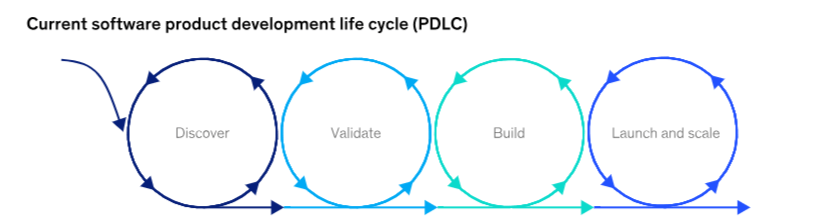
For decades, software development followed a predictable four-stage journey, and here is what it broadly looked it:
- Discovery or the Foundation Stage: This is when software teams looked at the competition, conducted in-depth market research, and had stakeholder discussions to ascertain the technical requirements and product vision.
- Validation or Eviden Stage: Teams developed wireframes and prototypes, and conducted preliminary user testing to get input on key features.
- Development Stage: Up until now, most of the work was previously completed here. It took hundreds of hours for software developers to code every feature from the ground up, test it, and then release it after several iterations.
- Deployment or Launching Stage: Once the software product is put together, this is the stage at which it reaches end users and reveals realistic gaps. Support tickets, user behavior data, and adoption metrics provided the first real validation, but by then, significant time and resources had already been invested in potentially misguided directions.
Why are these development cycles hitting their limits?
This structured approach had been working well for the industry until the involvement of AI. Despite being methodical, it was unable to catch up with the agility and customer-centricity required in today’s time.
How AI is Impacting SDLCs?
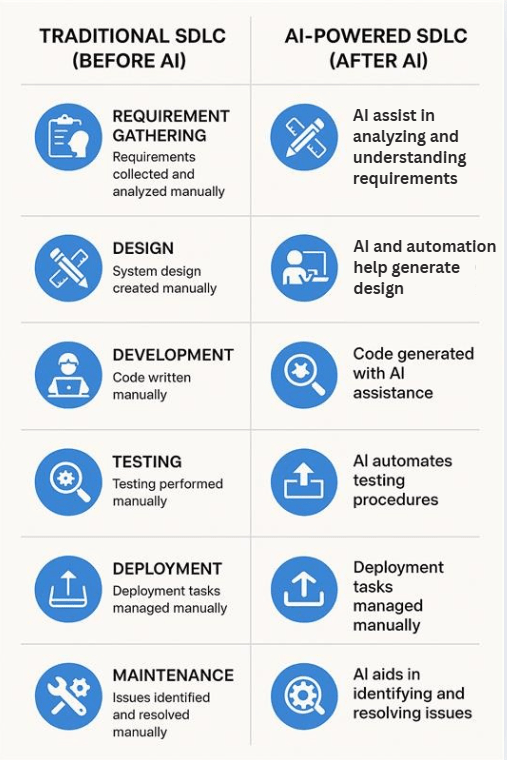
AI in software development has shifted the entire narrative, moving SDLCs from a reactive to a predictive approach. Where traditional cycles wait for problems to surface before addressing them, AI-enabled software development life cycles anticipate challenges, identify bottlenecks, and optimize decisions in real-time.
The above is now achievable through two main phases:
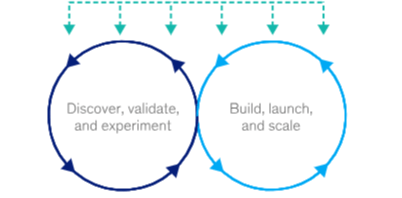
- Discover, Validate, and Experiment: AI-driven automation in SDLCs allows developers to quickly navigate through the first phases, which include low-fidelity wireframing, high-fidelity prototyping, and competitor and market research.
- Build, Launch, and Scale: AI in the software development lifecycle streamlines the development and deployment phases, following the incredibly effective and instructive first few stages. It facilitates deployment, integrates testing through CI/CD pipelines from the beginning, and automates boilerplate code generation.
The Strategic Advantages of AI-Enabled SDLCs
For most people, automation is the first thing that comes to mind when someone asks about the benefits of integrating AI into software development life cycles. And that’s also correct, at least for starters.
Automated code generation, bug detection, testing, and documentation are among the most common advantages. However, today, AI-enabled SDLCs offer much more than that.
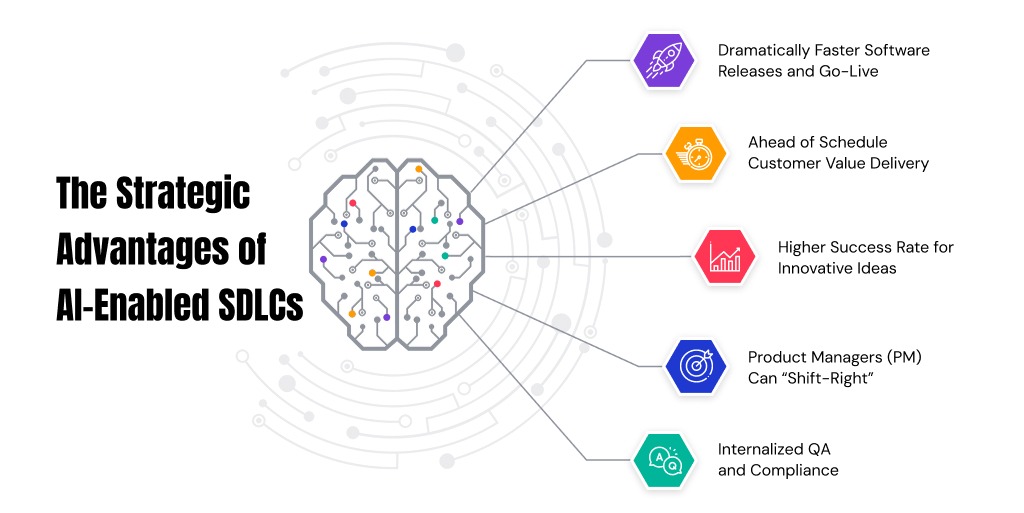
Dramatically Faster Software Releases and Go-Live
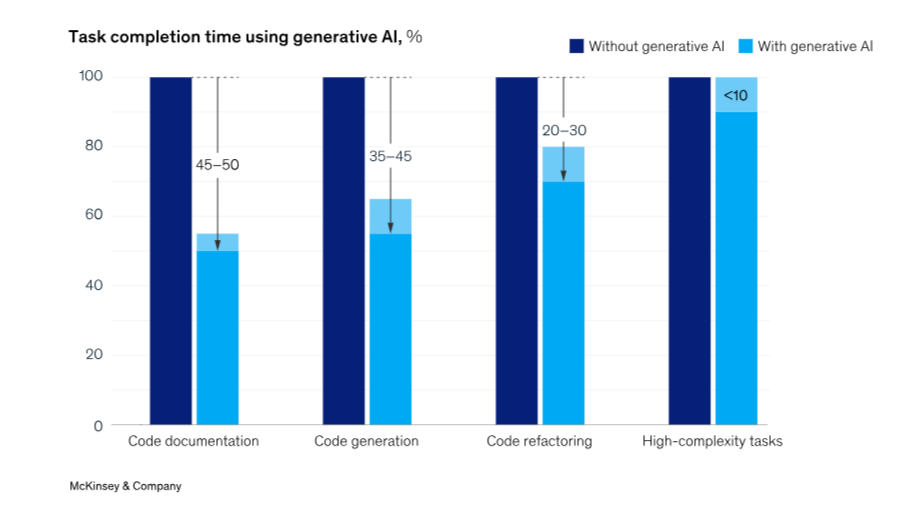
Generative AI is accelerating every stage of the SDLC, enabling teams to release applications faster and more efficiently. Routine tasks like writing basic documentation and drafting test cases can now be completed up to 2x faster. Development time for standard coding tasks can be reduced by 35–45%, while refactoring efforts see a 20–30% time savings.
This enhanced velocity not only shortens your time-to-market but also empowers your teams to iterate, test, and deploy at scale without compromising quality.
Ahead of Schedule Customer Value Delivery
You may have a great idea, but it would be of no use if it isn’t market-relevant and fails to deliver customer value. However, with AI-driven requirement analysis in SDLCs, you can combine insights from initial customer research during the discovery phases, along with real-time service ticket data and support feedback. This augmented data will give you a clearer picture of how people perceive your software product.
Stack Overflow, the renowned developer platform, often utilizes AI in its software development life cycles to review user feedback and identify areas for improvement.
Higher Success Rate for Innovative Ideas
By freeing up software developers from some of the most time-consuming and costly phases of development—discovering market opportunities and validating the idea, AI-driven SDLCs have streamlined both. With AI in prototyping, developers can test more ideas and functionalities to determine which ones work best. In fact, as per an IBM developer, this could lead to an estimated 15–20% increase in the number of new products or features developed.
Product Managers (PM) Can “Shift-Right”
PMs will be able to take on more responsibility for the entire value delivery process and go beyond traditional coordination roles with AI-powered automation in SDLCs. They will now have the bandwidth to maintain strategic oversight through deployment, adoption, and performance optimization, as opposed to handing off projects after the main development phase.
Internalized QA and Compliance
In traditional SDLCs, QA and compliance are often treated as late-stage activities that are typically addressed after development is complete. Usually, this increases the cost of defect resolution, as the entire software product has now been built.
On the other hand, QA and compliance can be integrated into each step of the SDLCs with AI-powered automation:
- Comparing requirements to regulatory frameworks (such as GDPR, HIPAA, and PCI-DSS) – discovery phase
- Simulating how different design choices affect performance, scalability, and fault tolerance – UI/UX design & architecture phase
- Suggesting standard-compliant code segments – development phase
- Generates test cases to predict high-risk areas – testing phase
Organizational Impact: What AI-Enabled SDLCs Mean for your Business
The benefits of AI-enabled SDLCs are clear. However, getting there also means changing how your organization works at its core. Before implementing AI in their software development life cycles, you need to rethink everything, from pricing models to team structures.
Business Model Evolution
As AI-powered SDLCs significantly shorten the traditional value delivery timeline and create continuous feedback loops that were previously impossible, businesses will need to explore new ways to monetize their software products.
Traditional pricing was based on selling potential value; customers pay upfront, hoping your software will deliver results. However, with AI-enabled SDLCs, this guesswork is eliminated. Integrating AI-based analytical tools will provide you with access to real-time data, showing precisely which features attract customers, how quickly users achieve their goals, and what outcomes your software enables for them. With these insights, you can begin charging for value rather than usage.
Validate Features That Truly Deliver Value
Not sure which features will resonate with your users or drive ROI? Our AI-driven MVP (Minimum Viable Product) and prototype development experts can help you build, test, and validate core functionalities based on real-time user feedback and usage insights.
Platform and Tooling Strategy
To embed AI into the SDLC, organizations will need to rebuild their tech infrastructure. And by this, we don’t only mean integrating coding assistants, we imply creating an entire ecosystem of AI tools for everything—UI/UX and prototyping to development, testing, and deployment.
Moreover, the market today is flooded with specialized AI tools, each promising to solve a niche problem. While many deliver on what they promise, adopting too many disconnected tools can introduce complexity rather than reduce it.
Data Quality and Accessibility
To feed precise, real-time data to various AI models throughout the pipeline, these transformations also require a centralized and unified data infrastructure. Continuous learning loops and context-aware model training will be nearly impossible to accomplish without this data foundation.
Talent and Organizational Structure
AI-driven SDLCs also alter your organization’s team structure, including who you need to hire and the way people work. As AI automates specific low- and mid-level tasks, many junior roles may become obsolete, and organizations will likely prefer hiring senior software developers who are familiar with AI. There may be an increased need for senior/staff (L2/L3) engineers who can review and audit AI-generated outcomes.
Moreover, you may also need to hire dedicated AI developers to optimize AI-enabled SDLCs or build custom AI workflows as per your specific goals.
Model Explainability and Trust
Unlike traditional software systems, AI-enabled systems, particularly those using deep learning (DL), can act like black boxes. In other words, they may generate an outcome, but you’ll not have a reason as to why or how it has reached that outcome. And in the software space, all stakeholders must be able to understand why.
The adoption of AI-powered automation in SDLCs may be constrained in the absence of this transparency, as development teams may mistrust or disregard AI decisions. Organizations can prevent this by investing in explainable AI (XAI) methods and promoting feedback loops that enable developers to mark, verify, or improve model outputs.
The Future of AI-Enabled SDLCs is Now: Making the Strategic Shift
AI-powered automation in SDLCs is more than just a technical advancement; it’s a paradigm shift. It is the practical embodiment of Alan Kay’s insight: “The best way to predict the future is to invent it.” Forward-looking organizations are not passively waiting for AI to reshape software development; they are actively designing AI-enabled SDLCs that learn, adapt, and evolve, accelerating how quickly products can deliver real value to end users.
In the years ahead, the standard development timeline will shrink from years to months, and traditional processes will no longer be competitive. The real question is no longer “what can AI do for SDLCs?”—but rather, “how fast can you evolve your development model to stay ahead?”
At SunTec India, we specialize in helping businesses transition to AI-enabled SDLCs, from designing intelligent automation workflows to building AI-first development strategies. Whether you need to augment your team, validate product-market fit faster, or completely rethink your software engineering pipeline, our digital engineering experts are here to make that future a reality.


Rohit Bhateja, Director - Digital Engineering Services & Head of Marketing
Rohit Bhateja, Director of Digital Engineering Services and Head of Marketing at SunTec India, is an award-winning leader in digital transformation and marketing innovation. With over a decade of experience, he is a prominent voice in the digital domain, driving conversation around the convergence of technology, strategy, customer experience, and human-in-the-loop AI integration.