Legacy Systems and the Hidden Cost of Operational Drag That Enterprises Often Miss
Table of Contents
- Why “If It Ain’t Broke” is an Expensive Enterprise IT Mindset?
- Where the Hidden Operational Cost Actually Builds Up?
- Why The Shift Towards Agentic AI Makes Legacy Limitations Harder to Ignore
- How Enterprises Should Prioritize Legacy Modernization
- The Takeaway: Legacy Modernization is Now an Operational Priority
Legacy systems rarely fail outright. They keep processing transactions, generating reports, supporting approvals, and passing audits. That operational continuity, however, is also why they remain embedded in enterprise operations for years. One 2025 enterprise survey found that 63% of organizations use up to 10 legacy applications daily. Another 29% depend on as many as 20. The problem is that their cost rarely appears as downtime, failed releases, or urgent incidents. More often, it shows up through slower workflows and workarounds that become daily operating practice.
But a system that still runs is not the same as a system that still serves the business well. As enterprises push toward automation, real-time decision-making, and Agentic AI, legacy limitations become harder to ignore. McKinsey’s 2025 global AI survey found that 62% of respondents say their organizations are already experimenting with AI Agents. That shift raises the bar for enterprises. The real question executives should ask now is not whether the system is broken. It is how much friction the system creates, how long the business can keep absorbing it, and how long they can delay Agentic AI adoption.
Why “If It Ain’t Broke” is an Expensive Enterprise IT Mindset?
The reason this issue stays unresolved is financial perception. Keeping the legacy system feels safer because the platform is already paid for, maintenance is budgeted, and teams know how to keep daily operations moving. Modernization, on the other hand, appears as a large and visible investment with a delivery risk attached.
But that comparison is incomplete. Modernization costs are easy to identify in a budget review, while the cost of standing still is spread across departments, delays, rework, integration fixes, and exception handling. This is why legacy application modernization should be assessed against the operational cost of inaction, not only the upfront cost of change.
Where the Hidden Operational Cost Actually Builds Up?
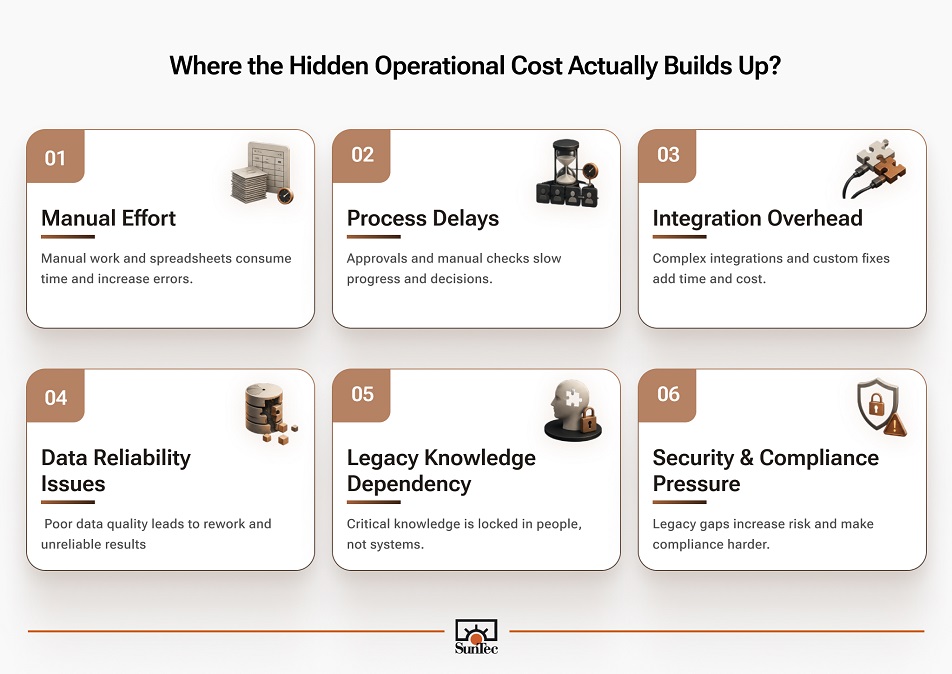
Legacy system costs often appear through daily operational friction, from manual work and delayed processes to fragile integrations, unreliable data, knowledge dependency, and compliance risk.
The hidden cost becomes visible when teams change how they work because the system cannot adapt. Workarounds start replacing standard workflows. Extra checks, file exports, manual uploads, and offline corrections become part of daily execution. These are not isolated inefficiencies. They are signals that the legacy system is shaping the business around its limits.
Manual Effort
Manual effort increases when a legacy system cannot move work from one step to the next without human handling. Teams begin exporting data, correcting records, uploading files, and checking transactions outside the system. An invoice may require manual three-way matching because procurement, inventory, and accounts payable do not share real-time data. Customer updates may require repeated entry across CRM, billing, and support systems when no unified data model exists. These tasks look small in isolation. Over time, they add recurring labor, increase error risk, and make operations dependent on manual intervention.
Process Delays
Delays build when legacy systems move data in batches instead of in real-time. A workflow that should pass cleanly from one system to another often pauses until the next sync cycle, export, or job run. For example, a CRM update may not reach ERP, finance, or BI dashboards soon enough for teams to act on current information. Exceptions then sit in shared inboxes, spreadsheets, or ticket queues before they are resolved. This slows decisions, extends cycle times, and creates unnecessary lag between departments.
Integration Overhead
Every new CRM, ERP, analytics platform, automation tool, marketplace connector, or customer-facing application needs access to the legacy core. Without documented APIs, message queues, API gateways, or middleware, teams are forced to build point-to-point integrations and custom scripts. They may also have to depend on SOAP connectors or file-based exchanges.
These fixes become harder to test, monitor, secure, and maintain with every new system. Over time, the integration layer becomes fragile and difficult to change without risking downstream failures.
Data Reliability Issues
Data reliability weakens when legacy systems operate with fragmented schemas and inconsistent data models. The same business entity may carry different identifiers, field structures, and update rules across applications. As systems age, schema drift and stale replication weaken referential integrity. Validation logic also becomes harder to enforce across disconnected platforms. Without a defined system of record and traceable data flow, reporting becomes harder to defend. Teams then spend more time verifying data than using it for decisions.
Legacy Knowledge Dependency
Legacy knowledge dependency grows when critical system behavior exists outside documented architecture and controlled engineering artifacts. The issue is not only undocumented code. It is undocumented execution behavior. Teams may know what the system does, but not why certain jobs run in sequence or fail under specific conditions. Business logic often remains buried inside the application layer, database procedures, schedulers, and integration flows. Over time, production support teams become the only source of truth for impact analysis and release risk. When this behavior is not captured in runbooks, architecture diagrams, change records, or source control, every modification requires human interpretation. If that knowledge leaves, troubleshooting slows down, and modernization becomes riskier.
Security and Compliance Pressure
When a platform relies on end-of-life operating systems and outdated middleware, the security gaps compound rapidly. It is rarely because of a single factor, but a collection of lacking security features like identity and access management (IAM), single sign-on, multi-factor authentication (MFA), and role-based access controls (RBACs). The lack of real-time monitoring further complicates security and vulnerability management. As a result, every compliance review and security audit becomes a heavier remediation exercise.
These costs add a slow, compounding drag on productivity, and that is precisely why they get underestimated. The true cost of a legacy system is not limited to IT maintenance. It is a daily operational tax on the rest of the business.

Why The Shift Towards Agentic AI Makes Legacy Limitations Harder to Ignore
Agentic AI adoption is moving faster than many enterprise systems can support. 70% of organizations have deployed Agentic AI in at least one core business function. Adoption crossed from 28% in 2024 to 70% by May 2026. This changes the modernization discussion. Enterprises now have to assess whether legacy systems can support machine-led execution, not just human-led operations.
That is where legacy architecture becomes a constraint. AI Agents do not operate through screens built for employees. They need business functions exposed through APIs, controlled integration layers, or standards such as the Model Context Protocol. A system with undocumented APIs, inconsistent schemas, and no machine-readable data model cannot be safely exposed without an abstraction layer.
Connectivity alone does not make a system agent-ready. The agent also needs current context, narrow permissions, traceable actions, and clear approval boundaries. Weak data foundations can lead to actions based on stale or incomplete information. Broad access models can let agents operate beyond the intended workflow. Poor logging can make it difficult to prove what the agent accessed, changed, or escalated.
The security risk is already visible. IBM’s 2025 Cost of a Data Breach Report found that 13% of organizations reported breaches involving AI models or applications. Among those organizations, 97% lacked proper AI access controls. This matters because legacy access models were built for occasional human logins, not continuously running AI Agents or service identities.
That is why enterprise IT modernization and AI-ready infrastructure now belong on the same roadmap. Legacy systems do not just slow current operations. They define how far Agentic AI can be used safely, governed properly, and scaled across the business.
How Enterprises Should Prioritize Legacy Modernization
A sound legacy modernization strategy does not start with replacing every old system at once. It starts with a disciplined, staged approach that treats modernization as an ongoing operating discipline rather than a one-time project.
That staged approach also requires a clear view of the practical legacy application modernization challenges that can slow execution. Outdated dependencies, skill gaps, data migration risk, integration complexity, stakeholder resistance, and budget constraints can all affect how modernization priorities are sequenced, funded, and delivered.
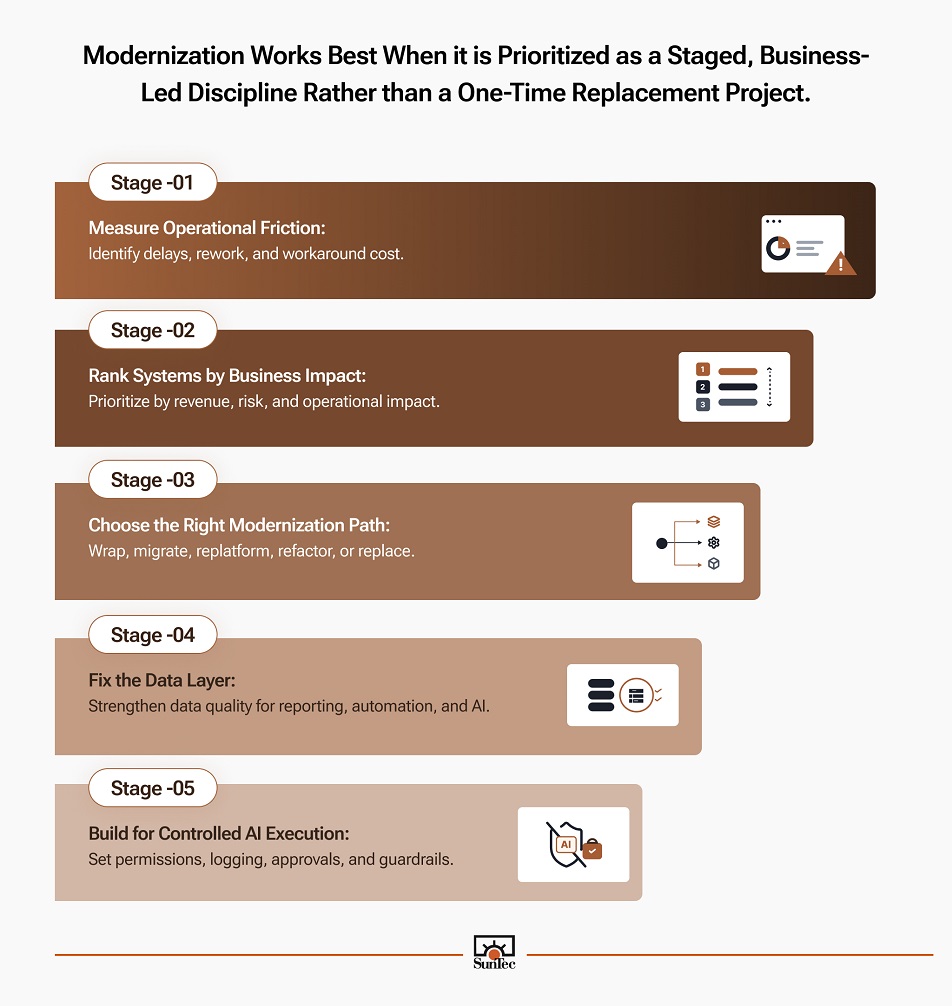
A structured modernization roadmap helps enterprises prioritize legacy systems by business impact, data readiness, architectural risk, and AI execution requirements.
Step 1: Measure Operational Friction
Measuring operational friction starts with finding where legacy systems slow workflows, create rework, or block straight-through processing. And that means looking beyond IT tickets to see how disparate teams are actually using those systems day-to-day. To identify granular friction points, you can assess the day-to-day insights alongside ITSM records and APM metrics. Try to collate all details: batch delays, failed jobs, manual reconciliations, etc., on specific employees. From there, your teams can start putting in the numbers around hours lost, SLA breaches, error rates, exception volumes, and workaround costs. This will turn vague frustration into modernization priorities backed by operational evidence.
Step 2: Rank Systems by Business Impact
Once friction is visible, systems should be ranked by their effect on revenue, customer experience, compliance, reporting, and operational continuity. The priority should rise when poor architecture directly limits a business-critical process. An older platform may be stable enough if it exposes documented APIs, maintains reliable data access, and supports predictable integration behavior. A newer platform may deserve earlier modernization if its architecture creates latency, weakens data trust, or forces teams to keep work outside governed workflows. Systems with weak controls or limited AI readiness should also move higher on the roadmap. This keeps modernization tied to business impact, not system age, vendor pressure, or internal preference.
Step 3: Choose the Right Modernization Path
Choosing the right path does not always mean replacing the full system. Some systems can be wrapped with REST, GraphQL, or gRPC APIs through an API gateway. Others may need iPaaS, ESB modernization, event streaming, or message queues to reduce point-to-point dependency. The strangler fig pattern can also be used to move functionality gradually while the legacy core remains active. Replatforming can shift workloads to cloud infrastructure, containers, Kubernetes, or managed services with limited code changes. Refactoring or rebuilding becomes necessary when monolithic architecture, outdated logic, or technical debt limit future change. The decision should reflect business criticality, risk, integration needs, and remaining logic value.
Step 4: Fix the Data Layer
Modernization will not hold if the data foundation remains fragmented, duplicated, or poorly governed. The first requirement is a trusted source for every core business record. Each record should be validated, deduplicated, and tied to its original source. Teams should also know how the data changed and what each field means. This gives reporting systems and downstream applications a stronger base to work from. For analytics and AI, raw and unstructured data must be prepared for governed retrieval. A retrieval system can only perform well when content is searchable, current, and properly indexed. Once the data layer is stable, automation and AI Agents have a dependable foundation to act on.
Step 5: Build for Controlled AI Execution
Controlled AI execution starts by defining the exact system boundaries within which an AI Agent can operate. Avoid broad service accounts and scope all permissions using RBACs and ABACs. For maximum security, log each agent action and secure their access with OAuth and token-based authentication. To be able to do this, you need complete visibility into the workflows. Use observability tools like OpenTelemetry to audit logs and monitor all exceptions. Make sure all high-risk actions are passed through human-in-the-loop (HITL) checkpoints before final execution.
Modernization should be prioritized by operational cost and future readiness, not by system age alone. A ten-year-old system supporting a low-risk function may not need urgent attention. A five-year-old system sitting at the center of revenue operations might. Executive teams that apply this lens consistently tend to modernize faster, spend less on emergency fixes, and build a stronger foundation for digital transformation across the enterprise.
The Takeaway: Legacy Modernization is Now an Operational Priority
Legacy systems are no longer just a maintenance concern. They are becoming a constraint on operational speed, data trust, secure automation, and, more importantly, Agentic AI adoption. The longer enterprises treat them as “working systems,” the longer they keep funding the workarounds built around them. As Agentic AI becomes part of everyday enterprise operations, the need for connected systems, clean data, defined workflows, and strong governance will only become harder to postpone.
The priority is not modernization for its own sake. The priority is to stop paying for systems that still run but no longer help the business move forward.


Rohit Bhateja, Director - Digital Engineering Services & Head of Marketing
Rohit Bhateja, Director of Digital Engineering Services and Head of Marketing at SunTec India, is an award-winning leader in digital transformation and marketing innovation. With over a decade of experience, he is a prominent voice in the digital domain, driving conversation around the convergence of technology, strategy, customer experience, and human-in-the-loop AI integration.