Detailed Report Of Survey
01
The Anatomy of Delaying AI Adoption: Measurable Business Impact
Survey Question:
From your experience, what measurable business impact can result from delaying AI-driven digital transformation?
Our Findings
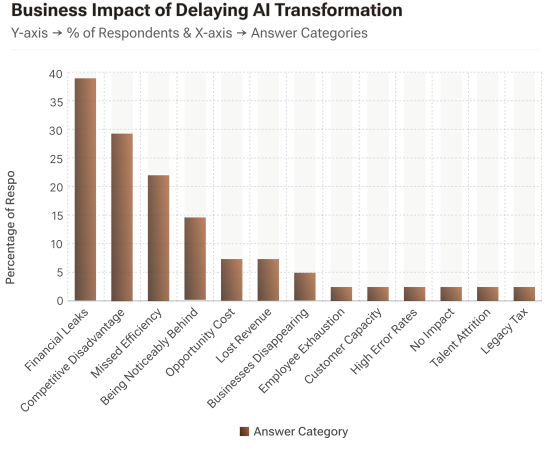
As per a consensus among all survey respondents, the "wait-and-see" approach to AI adoption is no longer a low-risk strategy. It has become a direct drain on capital and a catalyst for organizational obsolescence. Even though the benefits of AI-driven digital transformations are often touted in terms of future innovation, the penalties for delaying adoption are felt in the present.
Based on our findings, most of the impact of delaying AI transformation manifests in the following critical areas:
- Immediate Financial Leaks (39.0%): The most cited impact is bleeding capital through manual inefficiencies, bloated operational costs, and the inability to automate routine tasks.
- Competitive Disadvantage (29.3%): Respondents noted that the "AI gap" is widening. Companies failing to adopt AI are not just slower; they are becoming fundamentally uncompetitive.
- Missed Efficiency & Productivity Gains (22.0%): Delayed AI adoption translates to a "hidden tax" on productivity and operational efficiency. By sticking to legacy workflows, teams are forced to spend disproportionate time on low-value tasks that AI could resolve in seconds. These missed gains were equivalent to 100K EUR.
- Being Slow, and Noticeably Behind (14.6%): Besides the efficiency cost, delaying an AI-powered digital transformation also results in an “organizational learning lag.” As competitors iterate and learn, laggard organizations remain stuck in the loop of "catching up," where their learning speed is often outpaced by the market.
- Opportunity Cost (7.3%): Beyond the immediate financial implications, there is the cost of what is not being done – new product features, market expansion, or customer segments that remain inaccessible without AI augmentation.
- Lost Revenue (7.3%): Inefficiency and competitive dispositioning converge into lost sales. Whether through lost churn to competitors or the inability to capture demand quickly enough, revenue erosion is the ultimate result of inertia.
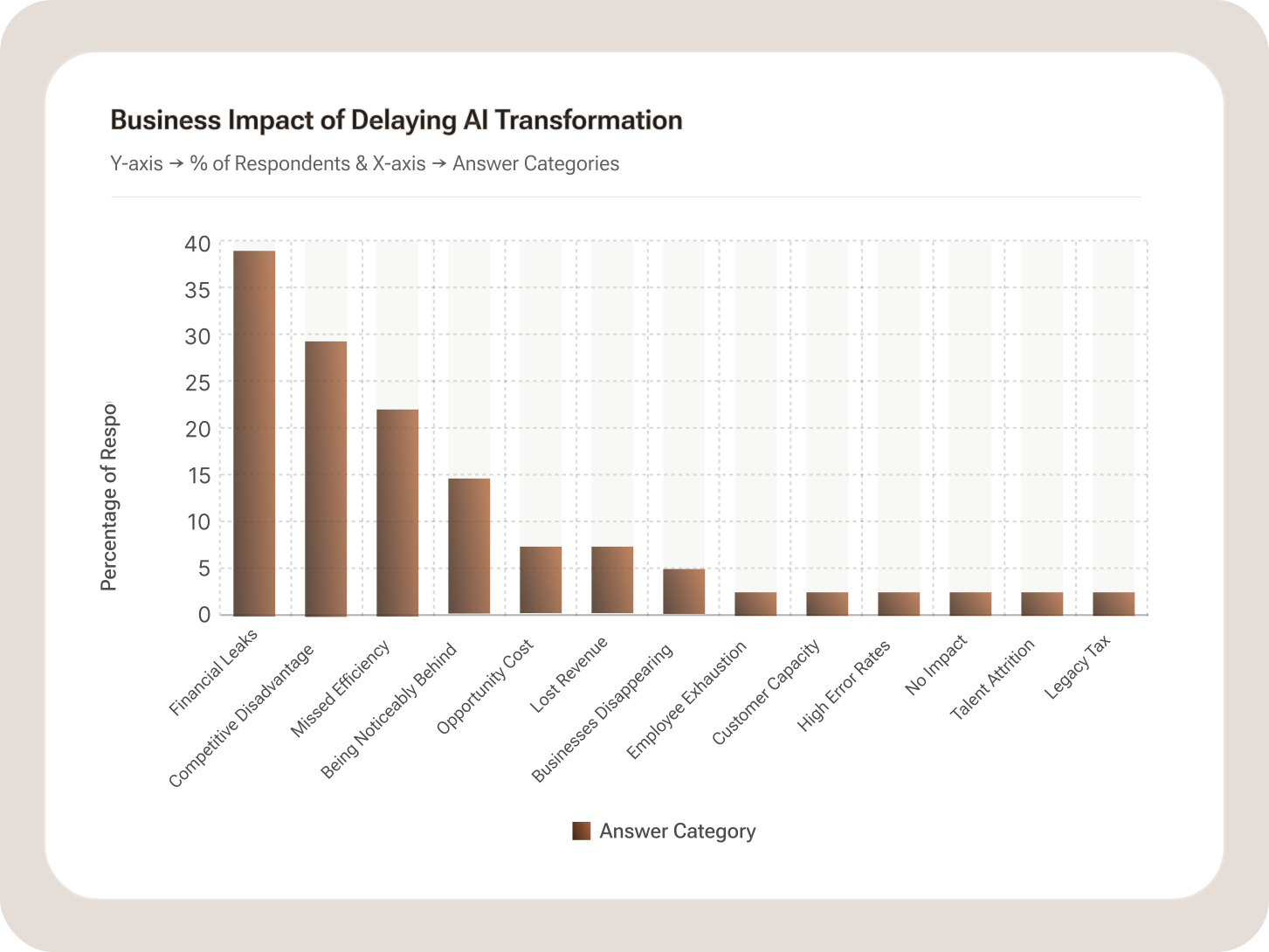
While the primary concerns of delayed AI adoption focus on financial and competitive positioning, some leaders were rather concerned about a deeper, systemic degradation of their organizational health. A few highlighted how the lack of AI automation could result in years of process debt, particularly resulting in operational inertia stemming from employee exhaustion.

“We have witnessed years of postponed investment in AI translate manual processes into embedded process debt, which fuels claims leakage, employee exhaustion, and operational inertia that is difficult to overcome.”

To combat employee burnout, organizations will either have to hire more staff or compromise on the number of tasks they do and the customers they can serve.
So those who are late to similar forms of support automation either require more staff or fewer customers.
A few responses also highlighted the risk of businesses "disappearing" entirely due to an "internet search fade," as AI is now the primary point of how consumers discover a brand. Moreover, delaying AI adoption puts you at serious risk of betting on your entire "digital footprint." It is a major threat to a firm's long-term financial health and goes beyond efficiency/productivity deficits.
Interestingly, there is also an isolated mention of "No Impact." An organization that still feels this way about AI adoption is a vital diagnostic red flag. In my opinion, it comes from an "innovation blind spot" still prevalent among some leaders. Many are currently unaware that their legacy operations are no longer just a "status quo." Instead, they have become active liabilities. Over time, these liabilities will prevent the organization from scaling effectively.
This makes us conclude that the AI adoption gap is still wide. While organizations are increasingly feeling the pain of inefficiency, they have yet to link that pain to a structured AI-driven digital transformation strategy. It is particularly telling that only one respondent mentioned an AI Readiness Assessment as a necessary investment, suggesting that businesses are still attempting to "bolt on" AI solutions without first auditing their underlying data architecture, skill sets, or operational maturity.
02
Vulnerability Mapping: Where The Impact Hits Hardest
Survey Question:
Which industries or business models are most vulnerable to disruption in 2026 if AI adoption is postponed, and why?
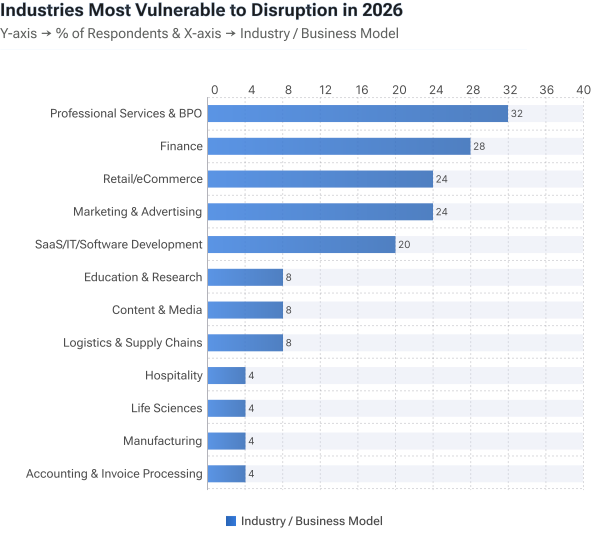
Our analysis of industry vulnerability insights highlights a clear trend: the industries most at risk are those where value is primarily derived from information processing, customer interaction, and repetitive analytical tasks.
The data below represents the findings from respondents who identified specific sectors facing immediate disruption in 2026.
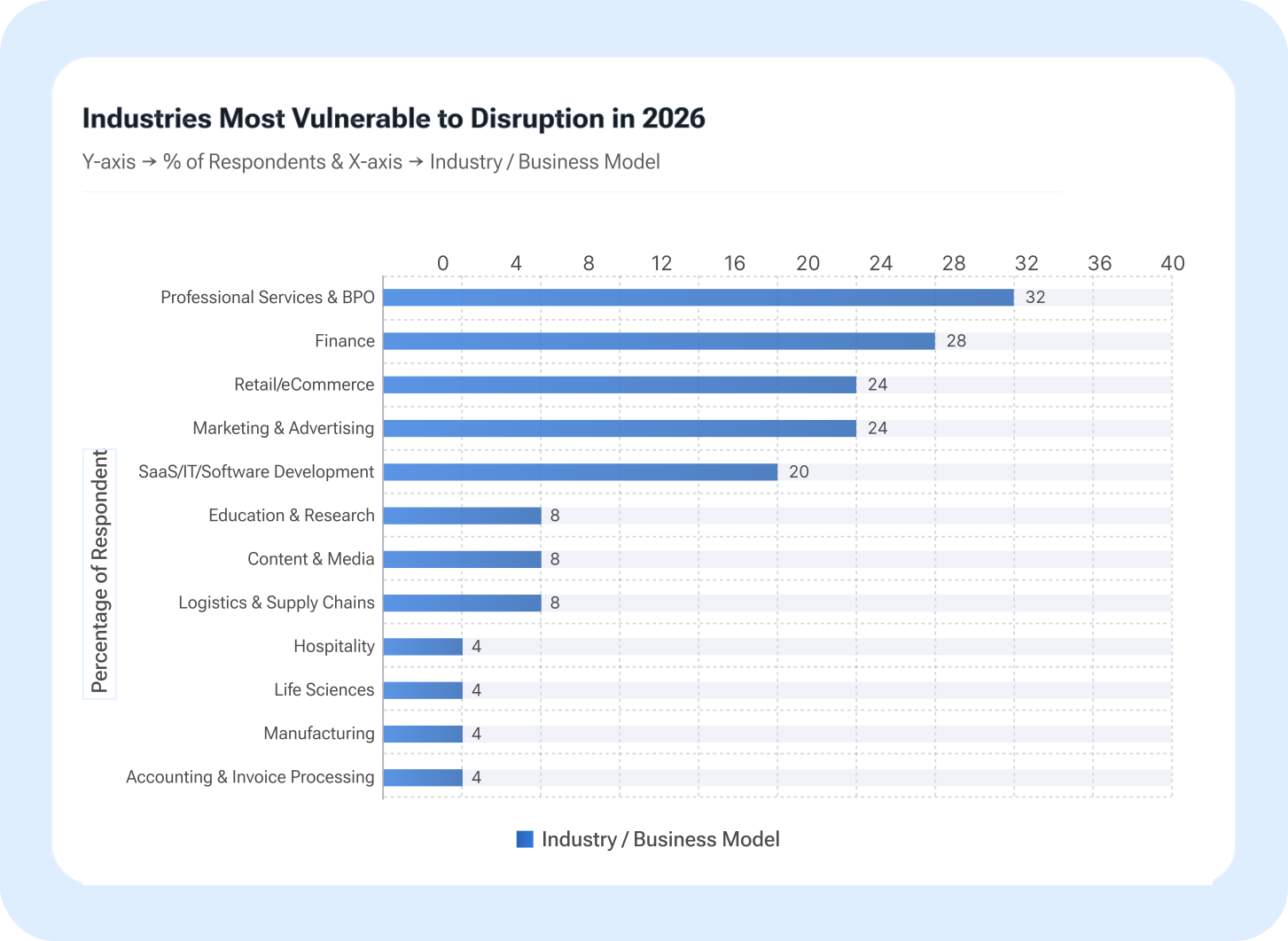
While AI will eventually touch every sector, our survey identifies a "Frontline of Disruption." The industries mentioned above are not just facing incremental change; they are experiencing a complete shift in their operating models. Let’s see how.
- Professional Services & BPO (32%): Being entirely labor-intensive and knowledge-based, this sector is highly vulnerable to AI automation. Firms relying on manual data handling, report generation, and basic analytical tasks are seeing their traditional margins eroded by those who have redesigned these services using AI to deliver higher output at a fraction of the cost.
- Finance (28%): Businesses in the financial sector are facing "algorithmic competition," not just from other institutions. With AI now executing real-time credit analysis, fraud detection, and personalized investment advisory at scale, legacy financial services are being outpaced.
- Retail/eCommerce (24%): We are living in the AI commerce era. Consumers expect you to use predictive insights to determine what they want, manage inventory, personalize experiences, and adjust prices dynamically. Failing to do so = losing market share.
- Healthcare, Wellness, & Pharma (24%): The stakes here are the highest, and as of today, the vulnerability lies in the administrative and diagnostic lag. AI can diagnose defects years before they take a physical shape, clear years' worth of data processing backlog, and test hundreds of combinations to aid drug discovery.
- Marketing & Advertising (20%): This sector is facing the "content explosion." Agencies and departments still relying on manual campaign development and non-AI-assisted ad targeting are struggling to keep up with the volume and personalization requirements of the modern media landscape.
A common thread among all these vulnerable sectors is the "Knowledge-Work Paradox." Businesses in these sectors have mostly relied on human-centric processes to manage their data. However, in 2026, the volume of data is too large for humans to process effectively, and the speed of market reaction is too fast for manual decision-making.

“The industries and businesses that are most susceptible to losing business by waiting to implement AI are those where speed-to-response directly impacts the sale, so trade and service industries are at the top of the list.“
The isolated mentions of the Research sector also build on the speed-volume narrative, where the speed of innovation and volume of data are becoming the primary drivers of AI adoption.
Traditional research industries run the risk of huge efficiency gaps.
Many respondents also noted that sectors like Hospitality are reaching a tipping point where physical operational efficiency is resulting in delayed service
If you're a specialty retail or hospitality business in 2026 and still counting on staff gut-check and foot traffic, you're in a difficult position.
What is required is the integration of AI for predictive insights so that businesses have prior and actionable knowledge required to overcome friction and maximize throughput.
03
Quantifying the "Cost of Inaction"
Survey Question:
How do you evaluate or quantify the “cost of inaction” when assessing AI investments?
Our Findings
The survey revealed that the most critical challenge for leaders in 2026 is moving beyond traditional AI ROI (Return on Investment) and beginning to measure COI (Cost of Inaction). And that’s why forward-thinking leaders are no longer just looking at what they gain from AI, but precisely what they are losing by delaying an AI-powered digital transformation.
For many, the estimate began with this question: “If we do nothing, what gets worse, and how expensive is that?”
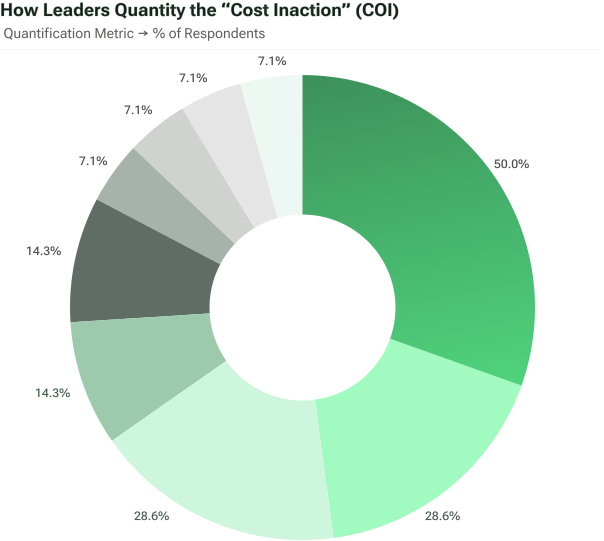
Here’s what the survey revealed:
How Leaders Quantity the “Cost Inaction” (COI)
Quantification Metric → % of Respondents
Let’s understand each.
- The Opportunity Cost Dominates (50%): Over half of the respondents prioritize measuring the revenue left on the table. This includes the "hidden tax" of manual labor in terms of the money still being spent on human tasks (that could very well be automated), in addition to the direct loss of potential revenue.
Every day of delay costs the equivalent of 100K.
- Performance Metrics (28.6%): A significant number of responses focused on measuring the cost of inaction using key performance indicators (KPIs) like Customer Lifetime Value (CLV), Customer Acquisition Cost (CAC), and Response Times.
a) CLV ↓ - Without AI-powered predictive insights, organizations fail to retain customers for longer.
b) CAC ↑ - Without AI-driven targeting and automated lead nurturing, manual outreach becomes significantly more expensive and less effective.
c) Response Times ↑ - As consumers demand instant support and issue resolution, manual response times become a glaring liability and lead to higher abandonment rates.
d) Repeat Purchase Rates ↓ - Perhaps the most sensitive indicator of inaction. Without AI, it is nearly impossible to implement perfectly timed "next-best-action" triggers and re-engagement offers.
e) Time to Conversion ↑ - Friction in the sales funnel, caused by manual data entry or slow follow-ups, stretches the sales cycle.
- The Competitive Gap (28.6%): Losing competitive positioning is a structural risk. It is measured by the ability to serve more customers with fewer resources. If a competitor can handle 10x the volume with the same headcount, the cost of inaction is the literal erosion of your market share.
- Operational Decay (14.3% each): For many, COI is as simple as looking at the Total Monthly Operational Cost (labor + delays + leakage) or the financial impact of Higher Error Rates that human-only processes inevitably produce.
Beyond these direct costs of inaction, other findings reveal a Market Expectation Gap. It suggests that COI isn't just a line item; it is the difference between your current operational state and where the market expects you to be in 18 months.
Moreover, as AI becomes the standard, "baseline" performance levels are rising, for both employers as well as employees. Organizations are facing challenges in recruiting people who are familiar with AI and their respective domain knowledge.
The most difficult profiles to recruit are the ones of translation leaders who are proficient in AI and the reality of the messy field.
On the other hand, many are investing millions of dollars in training and upskilling their existing staff. The cost of training is also experiencing growth with each passing day of inaction.

“Companies pushing off these technical updates, for instance, end up facing a 30% steeper climb in training costs when they finally try to bridge the skill gap.”
This rising Talent & Salary Pressure also indicates that, as the pool of qualified AI specialists is still limited, the cost of human-only labor will continue to climb, making the financial leak of delaying AI even more severe over time.