How to Decide Which Workloads Belong in Public Cloud, Private Cloud, or Sovereign Infrastructure
Table of Contents
- Why Workload Placement Has Become a Board-Level Decision in 2026
- Public Cloud vs. Private Cloud vs. Sovereign Cloud Infrastructure
- 7 Factors that Decide Where a Workload Belongs
- Step-by-Step Workload Placement Framework
- Cloud Infrastructure Decision Framework to Determine the Right Workload Placement
- When Should Enterprises Choose Hybrid or Multi-Cloud Infrastructure?
- Common Workload Placement Mistakes and How to Avoid Them
- Strong Cloud Infrastructure Foundation Starts with a Smarter Deployment Strategy
According to Gartner’s February 2026 forecast, worldwide sovereign cloud IaaS spending is expected to reach $80 billion in 2026. This growing investment reflects how organizations are reassessing infrastructure choices to meet evolving requirements for control, compliance, and operational flexibility.
The reassessment extends beyond sovereign infrastructure. Broadcom’s Private Cloud Outlook 2026 found that 50% of surveyed enterprises have already moved workloads from public to private cloud, while 83% are considering cloud repatriation. Together, these developments show why cloud workload placement requires a more selective approach. Rather than favoring one cloud model, organizations must evaluate each workload’s performance, cost, dependencies, and governance requirements before choosing its infrastructure.
To provide a cloud infrastructure decision framework, this guide compares public, private, and sovereign infrastructure, examines 7 workload placement factors, and offers a practical decision framework. It also covers workload suitability, hybrid cloud approaches, and common placement mistakes. Let’s dig in.
Why Workload Placement Has Become a Board-Level Decision in 2026
The cloud data sovereignty question is only one reason placement has reached the boardroom. Three forces are now pushing it there together.
1. AI is Rewriting Cloud Economics
While public cloud offers flexible GPU access, continuous AI workloads can become expensive at production scale. As organizations seek more predictable infrastructure costs, some are moving AI workloads to private environments. This trend is reflected in Broadcom’s 2026 study, which found that 43% of organizations repatriating workloads included AI training, LLMs, or inference.
2. Regulation Now Shapes Architecture
Apart from technical suitability, organizations must ensure their infrastructure meets applicable regulatory requirements. Frameworks such as GDPR, DORA, NIS2, and the EU AI Act introduce obligations concerning data protection, cybersecurity, and operational resilience. These requirements can influence where workloads operate and which providers organizations select.
3. Cost Predictability and Vendor Dependence are Driving Reassessment
While public cloud managed services offer operational flexibility, increasing resource consumption and proprietary dependencies can make long-term costs difficult to predict. As a result, organizations are reassessing workload placement.
Public Cloud vs. Private Cloud vs. Sovereign Cloud Infrastructure
Choosing public cloud vs. private cloud vs. sovereign cloud infrastructure offers different levels of scalability, operational control, and infrastructure management responsibility. Understanding these differences helps organizations choose environments that support their cloud workload placement without adding unnecessary costs, compliance risks, or operational complexity.
1. Public Cloud
Public cloud provides computing, storage, networking, and managed services through third-party providers such as AWS, Microsoft Azure, and Google Cloud. Organizations can access these resources on demand without purchasing or maintaining the underlying physical infrastructure. These environments are best suited for customer-facing applications, development and testing environments, intermittent analytics, AI experimentation, and workloads with fluctuating resource demands.
Advantages of Public Cloud Infrastructure
- Computing resources can scale up during traffic spikes and scale down afterward, reducing the need for permanently provisioned capacity.
- Organizations can deploy applications without substantial upfront investments in physical servers and supporting infrastructure.
- Access to managed databases, analytics platforms, AI services, and security tools reduces routine infrastructure management responsibilities.
- Automated provisioning and preconfigured services help development teams accelerate application deployment and testing.
Disadvantages of Public Cloud Infrastructure
- Consumption-based pricing can make operating costs difficult to predict as resource utilization, storage, and data transfers increase.
- Applications relying heavily on proprietary cloud services may require significant modifications when migrating to another provider.
- Organizations have limited control over the underlying physical infrastructure, even though they remain responsible for securing applications and configurations.
- Provider jurisdiction, administrative access arrangements, and applicable laws may introduce additional compliance considerations for sensitive workloads.
2. Private Cloud
Private cloud provides computing infrastructure dedicated to a single organization, either within its own data center or through a third-party hosting provider. The organization can manage the infrastructure using its internal IT team or outsource management to a vendor, depending on its operational capabilities and preferred level of control.
In both arrangements, the infrastructure remains dedicated to the organization, allowing greater customization of resource allocation, security configurations, and operational policies. It is best suited for predictable high-utilization workloads, core ERP systems, latency-sensitive applications, continuous AI inference, and applications requiring dedicated infrastructure control.
Advantages of Private Cloud
- Organizations can customize networking, security configurations, resource allocation, and infrastructure operations according to specific business requirements.
- Dedicated infrastructure can provide more predictable operating costs for workloads with consistently high resource utilization.
- Applications can operate closer to legacy databases, manufacturing systems, and internal networks, reducing certain integration and latency challenges.
- Organizations can implement customized access controls, monitoring arrangements, and security policies suited to their operational requirements.
Disadvantages of Private Cloud
- Infrastructure procurement, maintenance, upgrades, and capacity planning introduce additional operational responsibilities and expenses.
- Expanding computing capacity may require additional hardware, infrastructure provisioning, and longer implementation timelines.
- Excess computing capacity can remain underutilized when actual demand falls below provisioned resources, increasing infrastructure costs.
- Managing private environments requires specialized expertise in virtualization, networking, infrastructure automation, and security.
3. Sovereign Infrastructure
Sovereign infrastructure provides computing environments where data, administrative access, and operations are governed by specific jurisdictional requirements. It can operate through public or private cloud, managed by authorized providers under defined legal controls. It best suits government, defense, and regulated workloads that require greater control over data and infrastructure operations.
Advantages of Sovereign Infrastructure
- Organizations can establish jurisdiction-specific controls over where information is processed and which legal authorities govern infrastructure operations.
- Administrative access can be restricted to authorized personnel under defined operational and jurisdictional requirements.
- Documented sovereignty controls can govern infrastructure operations, encryption key management, and third-party access.
- Sovereign environments can support workloads subject to national security, public-sector procurement, or sector-specific jurisdictional restrictions.
Disadvantages of Sovereign Infrastructure
- Specialized infrastructure arrangements and compliance requirements may increase costs compared with conventional cloud deployments.
- Certain managed services, AI capabilities, and infrastructure configurations may be unavailable within approved sovereign environments.
- Access to specialized computing resources, particularly GPUs, may be constrained by infrastructure availability within permitted jurisdictions.
- Verifying sovereignty requires detailed assessments of provider ownership, applicable laws, administrative access, subcontractors, and operating arrangements.
| Evaluation Criteria | Public Cloud | Private Cloud | Sovereign Infrastructure |
|---|---|---|---|
| Infrastructure ownership | Third-party cloud provider | Dedicated to one organization; internally or externally hosted | Depends on the underlying public or private deployment |
| Operational management | Provider manages underlying infrastructure | Internal IT team or managed service provider | Authorized operators under defined jurisdictional controls |
| Scalability | Rapid, on-demand scaling | Depends on provisioned capacity | Depends on approved services and regional capacity |
| Cost model | Primarily consumption-based | Dedicated capacity, capital investment, or managed service fees | Depends on deployment model and sovereignty requirements |
| Infrastructure control | Customer controls workloads; provider manages the platform | Greater control over infrastructure configuration and operations | Emphasis on jurisdictional, administrative, and operational control |
| Compliance considerations | Shared responsibility with provider-supported compliance capabilities | Customizable security and compliance controls | Specific legal, jurisdictional, and sovereignty requirements |
7 Factors that Decide Where a Workload Belongs
A reliable cloud workload assessment requires organizations to evaluate each application against its operational, regulatory, and financial requirements. The following seven workload placement criteria help determine which infrastructure environment best balances performance, control, and cost.
1. Data Sensitivity and Classification
The type of data a workload processes directly influences its security requirements. Public information can generally run in a public cloud, but confidential or sensitive data requires stronger safeguards. Therefore, organizations should evaluate whether existing cloud controls provide sufficient protection or whether private or sovereign infrastructure offers necessary isolation.
2. Regulatory and Jurisdictional Exposure
Beyond data sensitivity, organizations must consider the regulations governing how and where information is processed. Frameworks such as GDPR, DORA, and NIS2 impose different compliance obligations. Where jurisdictional or operational restrictions exceed standard cloud controls, qualifying sovereign infrastructure may be necessary.
3. Workload Behavior and Demand Patterns
Infrastructure requirements also depend on how frequently workloads operate and how much their demand fluctuates. Public cloud suits applications experiencing unpredictable traffic because resources can scale with demand. Conversely, consistently high utilization may justify private cloud infrastructure when dedicated capacity offers better long-term economics.
4. Latency and Data Gravity
Workloads involving frequent data transfers or real-time processing require careful evaluation of network latency and data proximity. Moving large datasets between distant environments can increase transfer costs and response times. Consequently, private or edge infrastructure may suit latency-sensitive systems, while public cloud remains viable when performance requirements are met.
5. Total Cost of Ownership at Production Scale
Infrastructure costs must be evaluated beyond initial deployment expenses, particularly as workloads reach production scale. Organizations should compare compute, storage, data transfers, licensing, maintenance, and staffing costs over several years. This helps determine whether public cloud flexibility or dedicated private capacity provides better long-term cloud cost optimization.
6. Integration Dependencies and Portability
Workloads often depend on interconnected databases, APIs, authentication systems, and legacy applications, making independent migration difficult. By mapping application portfolio infrastructure dependencies, organizations can identify these connections before selecting an environment. Where separating components creates latency or integration challenges, keeping them together or adopting hybrid infrastructure may be more practical.
7. In-House Skills and Operational Capacity
Infrastructure selection must also account for the team’s ability to manage the chosen environment. Each deployment model demands different expertise in security, networking, automation, and governance.
Step-by-Step Workload Placement Framework
The following cloud infrastructure decision framework provides a practical workload placement strategy for migration planning, infrastructure reassessment, and sovereignty audits.
1. Build a Workload Inventory or Sovereignty Registry
Begin by creating an inventory of all production applications and data stores, including their owners, hosting locations, data types, dependencies, and monthly costs. This provides the visibility needed for a cloud migration assessment and helps identify workloads requiring further evaluation.
2. Classify Data Based on Sensitivity
Once the workloads are identified, classify the information they process as public, internal, confidential, or regulated. Base each classification on the most sensitive data involved to determine the required security controls and suitable cloud infrastructure environments.
3. Map Regulatory and Jurisdictional Requirements
With data classifications established, identify the regulations governing each workload, including GDPR, DORA, the DPDP Act, or HIPAA, where applicable. Also, involve legal and compliance teams to determine whether specific residency, operational control, or jurisdictional requirements restrict the available hosting options.
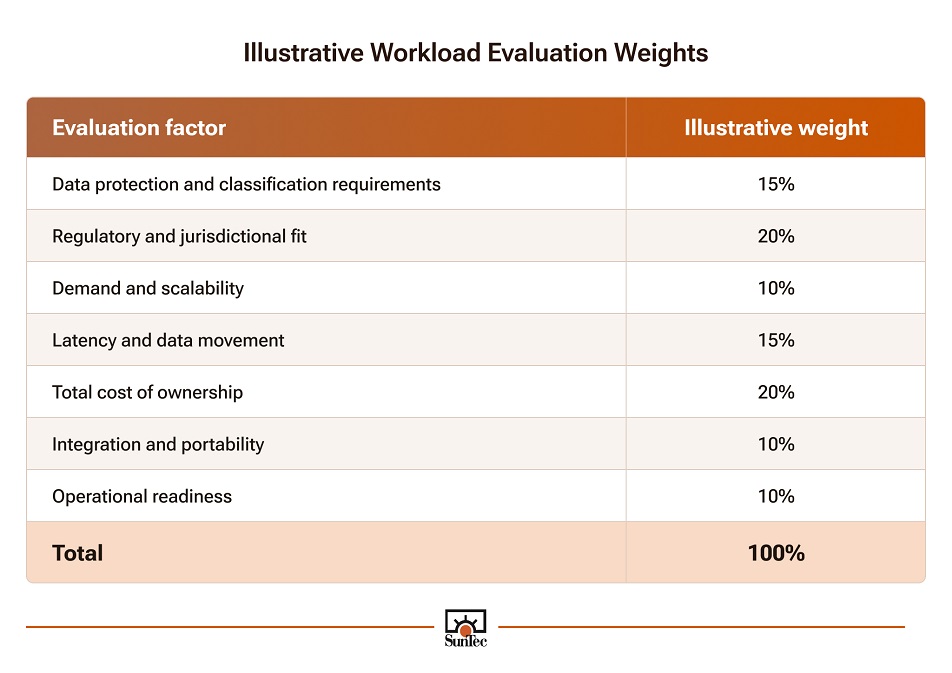
4. Score Workloads Against the Seven Placement Factors
After identifying mandatory restrictions, evaluate the remaining infrastructure options against the seven workload placement factors. Use a consistent 1-to-5 scoring scale to compare suitability across applications, and apply weights based on business priorities.
5. Assign the Most Suitable Infrastructure Environment
Use the assessment results to select public, private, sovereign, or hybrid cloud architecture. For instance, predictable resource consumption may favor private cloud, while strict jurisdictional controls may require sovereign cloud infrastructure. Document each decision and its supporting rationale for future reviews.
6. Design for Portability and Future Migration
Once placement is determined, plan how applications can move between environments without unnecessary dependencies. Containers, Kubernetes, and infrastructure as code can support portability. To implement these capabilities, organizations may hire Kubernetes developers or hire DevOps engineers. For Azure deployments, Microsoft’s landing zone guidance provides a foundation for governed infrastructure.
7. Review and Optimize Workload Placement Regularly
As application demand, infrastructure pricing, and regulatory requirements change, environments that were once suitable may no longer meet business needs. Review placement quarterly and after significant changes to identify opportunities for cloud workload optimization, including cloud repatriation or migration to another suitable environment.
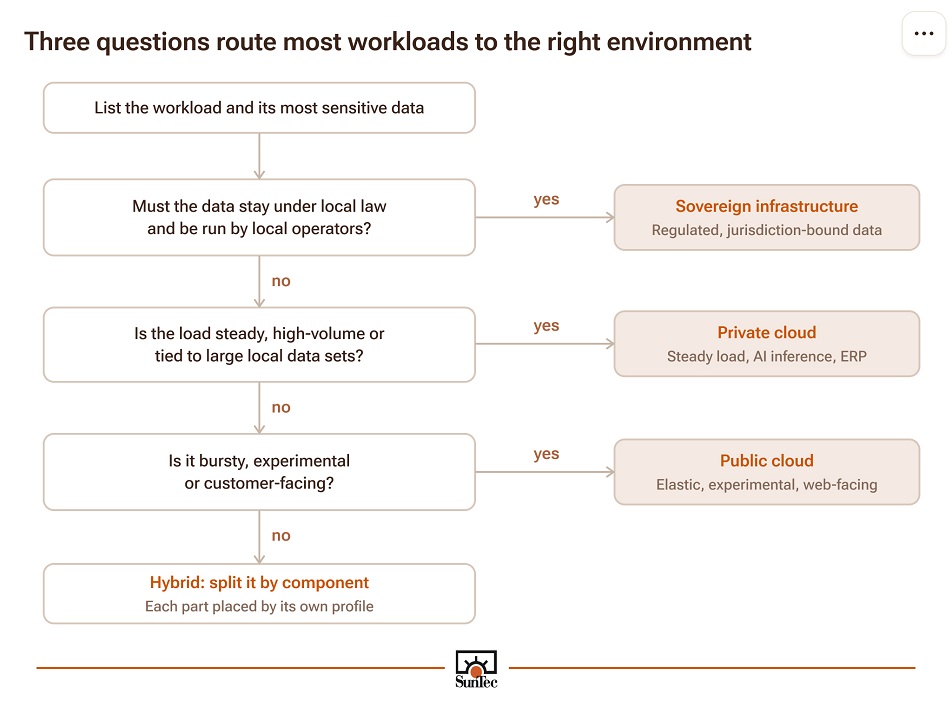
Cloud Infrastructure Decision Framework to Determine the Right Workload Placement
Which Cloud Environment Is Best for Your Workloads?
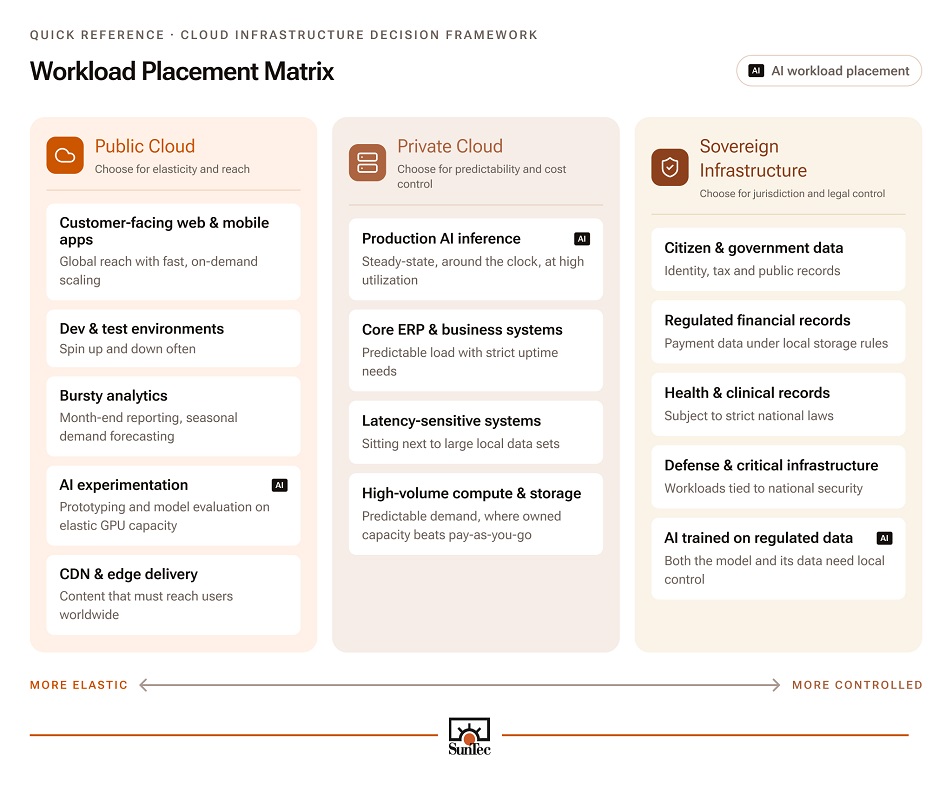
The cloud infrastructure decision framework produces a placement for each workload, but common patterns repeat across most enterprises. Use the matrix below as a starting point, including for AI workload placement:
Workloads Best Suited to Public Cloud
- Customer-facing web and mobile apps that need global reach and fast scaling
- Development and test environments that are spun up and torn down often
- Bursty analytics such as month-end reporting or seasonal demand forecasting
- AI experimentation, prototyping, and model evaluation on elastic GPU capacity
- CDN and edge delivery for content that must reach users worldwide.
Workloads Best Suited to Private Cloud
- Steady-state production AI inference that runs around the clock at high utilization
- Core ERP and core business systems with predictable load and strict uptime needs
- Latency-sensitive systems that sit next to large local data sets
- Predictable high-volume compute and storage, where owned capacity beats pay-as-you-go.
Workloads that Need Sovereign Infrastructure
- Citizen and government data, including identity, tax, and public records
- Regulated financial records, such as payment data under local storage rules
- Health records and clinical data subject to strict national laws
- Defense and critical infrastructure workloads tied to national security
- AI models trained on regulated data, where both the model and its data need local control.
When Should Enterprises Choose Hybrid or Multi-Cloud Infrastructure?
Once enterprises place workloads in suitable locations, they must plan how the entire workload portfolio should run. Run the matrix discussed above across your portfolio; you’ll likely end up with a mix. That’s where hybrid and multi-cloud strategy comes in.
Some enterprises need public cloud scalability while keeping sensitive information or critical processing systems under tighter control. This is where a hybrid cloud architecture helps organizations distribute application components based on their individual requirements. Multi-cloud, meanwhile, involves using multiple cloud providers to meet different business or technical needs.
1. Separate Sensitive Data from Scalable Processing
Keeping an entire application in private cloud provides greater infrastructure control but may limit access to elastic processing resources. Hybrid cloud architecture addresses this by retaining sensitive records privately while using public cloud computing for permitted analytics, without requiring wholesale data migration.
2. Scale Application Components Independently
Customer-facing applications often experience sudden traffic increases, while their underlying databases have relatively stable resource requirements. Instead of scaling both together, hybrid cloud allows public-facing services to expand on demand while private back-end systems maintain consistent operations.
3. Optimize Infrastructure for Different AI Workloads
AI training and production AI inference rarely have identical resource demands. While public cloud provides temporary GPU capacity for training, private infrastructure may better accommodate predictable, high-utilization inference. Hybrid deployment enables organizations to use each cloud environment according to its workload economics and data requirements.
4. Extend Computing Capacity During Demand Peaks
Maintaining enough private infrastructure for occasional demand spikes can leave expensive resources idle during normal operations. Hybrid cloud addresses this through cloud bursting, temporarily extending workloads into public cloud capacity instead of permanently expanding the private environment.
5. Reduce Dependence on a Single Cloud Provider
A public cloud deployment built around one provider’s proprietary services can create long-term dependencies. Multi-cloud infrastructure offers an alternative by distributing suitable workloads across providers, improving sourcing flexibility and access to specialized capabilities without relying on a single ecosystem.
6. Maintain Consistent Operations Across Environments
Managing public and private environments separately can lead to fragmented security policies, monitoring systems, and deployment processes. Hybrid and multi-cloud architectures can address these inconsistencies through shared identity management, centralized observability, and infrastructure automation, provided suitable cross-platform tools and engineering expertise are available.
Common Workload Placement Mistakes and How to Avoid Them
Even with a structured assessment framework, workload placement decisions can fall short when organizations overlook practical implementation requirements. The following mistakes can increase costs, create compliance risks, and complicate future infrastructure changes.
1. Treating Sovereignty as a Label Rather Than an Operating Model
Hosting data within national borders does not automatically establish sovereignty, as infrastructure operators may still fall under foreign jurisdiction. Decision makers must therefore examine provider ownership, administrative access, and legal exposure to determine whether the environment satisfies their specific sovereignty requirements.
2. Evaluating Costs Based on Pilot-Stage Usage
A workload that appears economical during testing may become considerably more expensive as processing volumes and infrastructure requirements increase. To avoid misleading comparisons, organizations should evaluate total cost of ownership (TCO) over three years, factoring in production utilization, data transfers, licensing, maintenance, and staffing expenses.
3. Repatriating Workloads without Re-Architecting
Migrating applications from public to private cloud requires careful assessment of their existing architecture and dependencies. Even when both environments support similar capabilities, differences in managed services, configurations, and integrations can complicate migration. Cloud development engineers should evaluate these differences and make necessary architectural adjustments to ensure compatibility and performance.
4. Overlooking Exit and Portability Requirements
Cloud infrastructure decisions should account for future changes in business requirements, pricing, and provider arrangements. Without suitable data export provisions and portable application designs, switching environments can become costly and disruptive. Hence, reviewing contractual exit terms alongside technical dependencies helps organizations retain greater flexibility.
5. Underestimating the Engineering Skills Required
Even after an appropriate cloud workload placement strategy, successful implementation depends on the team’s ability to configure, secure, and maintain it. Since each deployment model requires different technical capabilities, stakeholders should assess internal expertise early and address skill gaps through specialist hiring, offshore development teams, or IT staff augmentation services.
Strong Cloud Infrastructure Foundation Starts with a Smarter Deployment Strategy
Organizations that succeed in the evolving cloud landscape will focus on the long-term value of infrastructure and cloud workload optimization decisions. They will establish clear accountability for cloud workload performance, define acceptable cost and risk thresholds, and identify architectural changes before existing deployments become business constraints.
Achieving these outcomes will require strong technical governance and the engineering expertise to maintain, optimize, and modernize workloads within their chosen environments. Whether through internal teams, specialized cloud development services, or a decision to hire cloud developers, organizations must ensure their technical capabilities align with infrastructure responsibilities. Ultimately, future-ready enterprises will distinguish themselves through well-governed infrastructure decisions that deliver sustained business value without compromising operational control or compliance.


Rohit Bhateja, Director - Digital Engineering Services & Head of Marketing
Rohit Bhateja, Director of Digital Engineering Services and Head of Marketing at SunTec India, is an award-winning leader in digital transformation and marketing innovation. With over a decade of experience, he is a prominent voice in the digital domain, driving conversation around the convergence of technology, strategy, customer experience, and human-in-the-loop AI integration.