Choosing the Right IT Delivery Model: IT Outsourcing vs Staff Augmentation vs Managed Services
Table of Contents
- IT Outsourcing vs IT Staff Augmentation vs Managed Services: At a Glance
- What is IT Outsourcing and its Pros and Cons?
- What is IT Staff Augmentation and its Pros and Cons?
- What are Managed Services and their Pros and Cons?
- Decision Framework for Choosing the Right IT Sourcing Model
- How to Choose the Right Technology Partner?
- Choosing the Right IT Sourcing Model for your Business Needs
- Frequently Asked Questions (FAQs)
72% of organizations globally struggle to fill roles, highlighting the widening gap between technology demand and available expertise. For organizations trying to scale engineering capacity, this shortage makes it increasingly difficult to find the right skills within required timelines. As this talent gap continues to expand, engineering leaders are looking beyond traditional hiring approaches to access the capabilities needed for growth and innovation.
However, engaging external resources is not simply a matter of adding more people to a project. The sourcing model you choose directly influences who manages the team, who owns delivery outcomes, how costs scale, and how much operational responsibility shifts to the provider.
This makes selecting the right IT outsourcing model a strategic decision, not just a procurement exercise. While IT staff augmentation helps organizations extend existing teams, project-based outsourcing supports defined initiatives, and managed services provide ongoing operational ownership. This guide compares some of the most widely used models: IT outsourcing vs staff augmentation vs managed services. We will also explain their differences, advantages, limitations, and when each model works best.
IT Outsourcing vs IT Staff Augmentation vs Managed Services: At a Glance
| Factor | IT Outsourcing | IT Staff Augmentation Services | Managed Services |
|---|---|---|---|
| What you’re buying | An outcome/deliverable | Extra hands under your management | Ongoing operational responsibility |
| Who manages the team | The vendor | You (the client) | The provider (MSP), per SLA |
| Best for | Discrete projects, new builds | Short-term skill/capacity gaps | Continuous infrastructure, support, security |
| Contract style | Project-based, fixed scope | Time-and-materials, hourly/monthly | Retainer, governed by SLA |
| Scalability | Moderate (project-bound) | High and fast | High, built into the service |
What is IT Outsourcing and its Pros and Cons?
IT outsourcing is a technology delivery model where an organization transfers responsibility for specific IT functions, projects, or capabilities to an external service provider. Instead of building every capability internally, organizations partner with specialized providers to access engineering expertise, delivery infrastructure, operational processes, and technical resources required to achieve a defined business outcome.
The scope of IT outsourcing can range from a focused engagement, such as developing a mobile application, modernizing a legacy system, or migrating workloads to the cloud. It might also include implementing an enterprise platform or broader technology functions such as application maintenance, infrastructure management, cybersecurity operations, or data engineering.
For example, a company building an AI-powered application may need to hire machine learning engineers, data engineers, cloud architects, DevOps specialists, and QA automation experts. Hiring each role internally may take months, while outsourcing the project means offloading full responsibility for execution. In this model, the outsourcing partner is responsible for assembling the team, selecting the technical approach, managing execution, meeting agreed milestones, and delivering outcomes defined in the contract or statement of work (SOW).
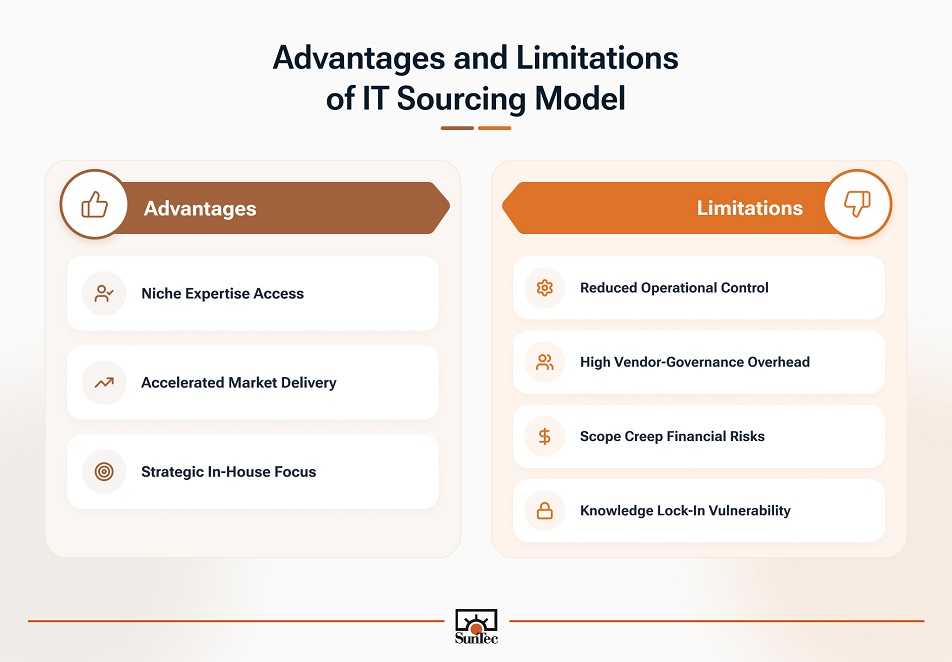
Advantages of the IT Outsourcing Model
1. Access to Specialized Technology Expertise
One of the biggest advantages of IT outsourcing is access to skills that may be difficult to build internally. Organizations can engage providers with expertise in niche areas and emerging technologies without investing years in hiring and training.
2. Faster Project Execution and Market Delivery
IT outsourcing lets organizations start projects with an existing delivery structure, established processes, and experienced specialists. This can reduce the time from planning to execution.
3. Focus Internal Teams on Strategic Work
By transferring execution-heavy activities to an external provider, internal teams can focus on higher-value responsibilities. This approach is especially useful for organizations that want to retain ownership of strategic technology decisions while using external expertise for implementation and execution.
Limitations of IT Outsourcing Model
1. Less Direct Control over Daily Execution
Because the provider manages the delivery team, organizations have less involvement in daily execution decisions than with internal teams. To stay aligned in this setup, businesses need clear governance structures, communication channels, technical standards, progress reviews, and escalation processes throughout the engagement.
2. Requires Strong Vendor Management
IT outsourcing shifts management responsibility from individual contributors to the overall provider relationship. Organizations must define expectations for scope, security, quality, timelines, and performance metrics, and hold regular reviews to keep the vendor aligned with business objectives and delivery requirements.
3. Scope Changes Can Impact Timelines and Costs
Project-based outsourcing depends on clearly defined requirements, deliverables, dependencies, and acceptance criteria. However, evolving business needs or technical challenges can require scope adjustments, potentially affecting timelines, resources, architecture decisions, and project costs without an effective change management process.
4. Knowledge Transfer Requires Deliberate Planning
External teams often gain deep knowledge of applications, infrastructure, and workflows during an engagement. Without proper documentation, code ownership, technical handover processes, and transition planning, organizations may develop dependency on the provider for future maintenance, updates, and operational decisions.
What is IT Staff Augmentation and its Pros and Cons?
IT staff augmentation is a flexible sourcing model where organizations add external technology professionals to their existing in-house teams to address temporary skill shortages or accelerate delivery without expanding permanent headcount. These professionals can work as individual specialists or as a dedicated development team while following the organization’s existing tools, workflows, engineering standards, and reporting structure.
Unlike project-based IT outsourcing, the organization continues to control product priorities, technical architecture, sprint planning, code reviews, development practices, and release decisions, while the augmentation partner provides pre-vetted talent. For example, an organization developing a cloud-native application may already have product managers, architects, and senior engineers but require additional expertise in Kubernetes or DevOps automation. Instead of waiting months to hire these specialists permanently, the company can integrate external experts directly into its engineering workflow.
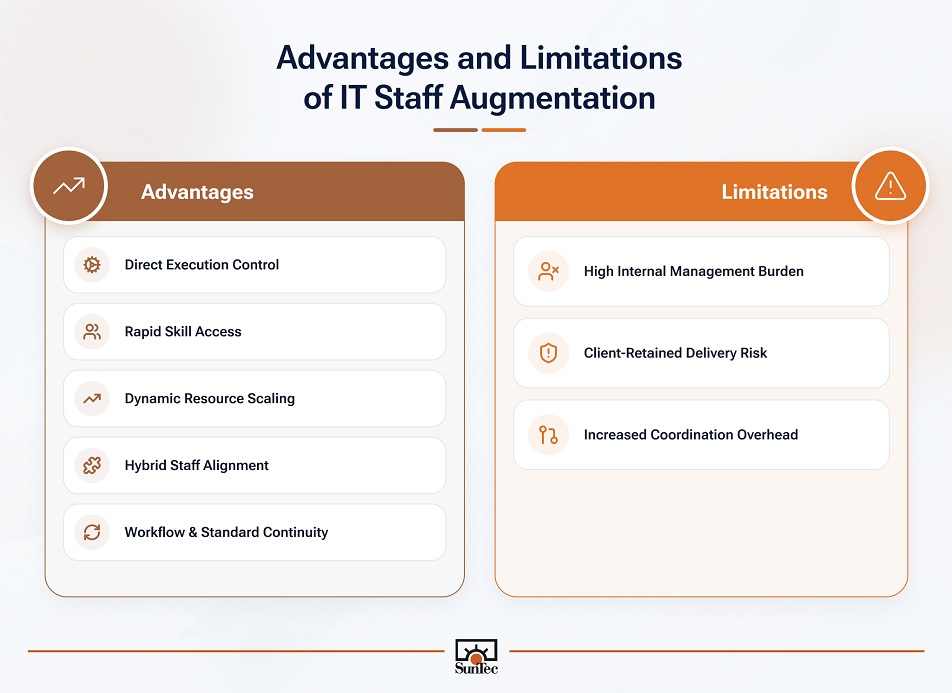
Advantages of IT Staff Augmentation
1. Direct Control Over Team Management and Delivery
Organizations retain control over priorities, workflows, architecture decisions, and execution processes. Augmented professionals work as an extension of internal teams, participating in existing development cycles, meetings, and collaboration processes without changing the organization’s delivery ownership.
2. Faster Access to Specialized Technology Skills
Staff augmentation helps organizations quickly access specialized professionals. It reduces dependency on lengthy hiring processes while enabling teams to address immediate skill shortages and accelerate critical initiatives.
3. Flexible Scaling Based on Project Requirements
Organizations can adjust technical capacity as project demands change. Augmented experts can be added during development, testing, migration, or deployment phases and reduced when requirements decrease, providing greater workforce flexibility without permanent hiring commitments.
4. Supports a Hybrid IT Staffing Model
Staff augmentation enables companies to combine internal employees with external specialists to build a blended squad. In this mode, organizations can retain strategic capabilities internally while using external expertise to strengthen engineering, cloud, data, or application development teams.
5. Maintains Existing Engineering Processes and Standards
External professionals integrate into existing tools, workflows, security practices, and engineering standards. This lets organizations maintain established development methodologies, collaboration models, and quality processes while extending delivery capacity with additional technical expertise.
Limitations of IT Staff Augmentation Model
1. Requires Strong Internal Management Capability
Staff augmentation requires internal teams to manage priorities, assign tasks, review deliverables, and provide technical direction. Organizations without mature engineering processes, leadership, or product ownership may struggle to use augmented professionals effectively.
2. Delivery Accountability Remains with the Client
Unlike outsourcing models, IT staff augmentation does not transfer delivery ownership to the provider. The client remains responsible for defining requirements, managing execution, resolving dependencies, and ensuring the project achieves its intended outcomes.
3. Coordination Effort Can Increase with Larger Teams
Hiring augmented professionals can increase communication and coordination requirements, especially across distributed teams. Organizations need effective onboarding, documentation, collaboration practices, and technical governance to ensure augmented resources integrate smoothly with existing teams.

What are Managed Services and their Pros and Cons?
Managed services are an IT delivery model where an MSP takes responsibility for managing, monitoring, maintaining, and optimizing specific technology functions. Instead of handling these operations internally, organizations rely on the MSP for continuous service delivery, proactive management, and performance accountability under predefined service levels.
The defining characteristic of managed services is proactive ownership. Rather than responding only when issues occur, an MSP continuously monitors systems, identifies potential risks, applies updates, manages performance, and implements operational improvements. For example, a cloud managed services engagement may include infrastructure monitoring, resource optimization, security patching, cost management, incident response, and performance reporting across AWS, Azure, or other cloud environments.
A service level agreement (SLA) typically governs all the managed services responsibilities and defines measurable expectations, including system availability, incident response times, resolution targets, security requirements, maintenance schedules, reporting standards, and escalation procedures.
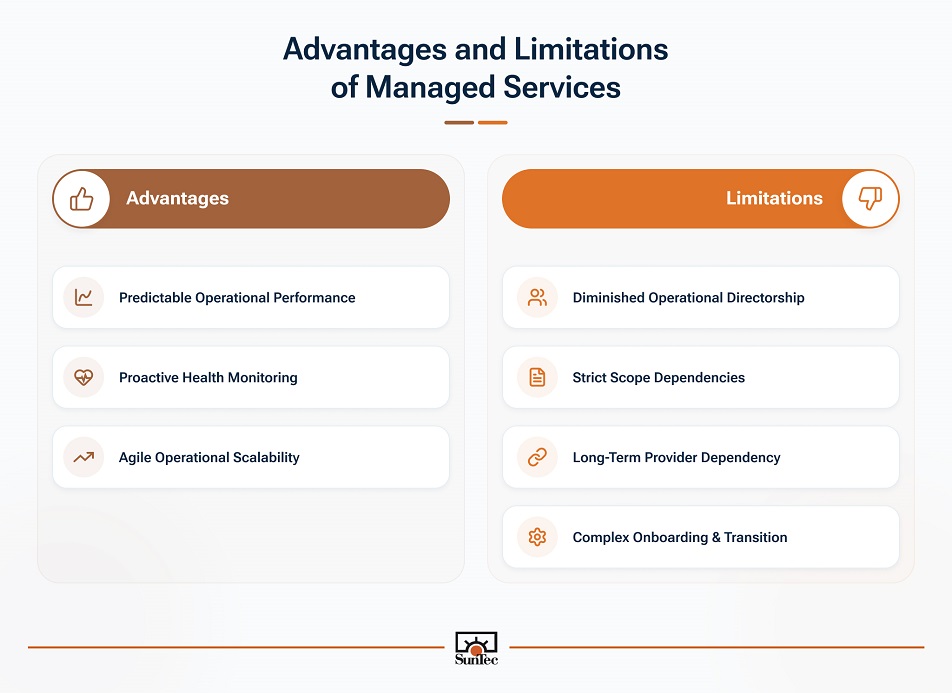
Advantages of Managed Services
1. Predictable IT Operations and Service Performance
Managed services provide structured operational management through defined processes, monitoring systems, and performance metrics. Organizations gain greater visibility into service health through SLA reporting, incident tracking, uptime monitoring, and continuous performance reviews.
2. Proactive Monitoring and Issue Prevention
Unlike reactive support models, MSPs continuously monitor infrastructure, applications, and security environments to identify potential issues before they impact business operations. It may include automated alerts, analytics, patch management, and preventive maintenance help improve reliability and reduce operational disruptions.
3. Improved Scalability and Operational Flexibility
Managed services allow organizations to scale IT operations as business requirements change. MSPs can adjust monitoring coverage, infrastructure support, security capabilities, and operational resources based on workload growth, new applications, or evolving technology requirements.
Limitations of Managed Services
1. Reduced Day-to-Day Control Over Operations
Since the MSP manages the delivery process, organizations have less direct involvement in daily operational decisions. Therefore, organizations must rely on defined governance structures, reporting mechanisms, and SLA reviews to maintain visibility and ensure service expectations are being met.
2. Requires Clearly Defined Service Scope
Managed services depend heavily on well-defined responsibilities, performance metrics, and service boundaries. If expectations around supported systems, response requirements, exclusions, or escalation processes are unclear, disagreements may arise over accountability and additional costs.
3. Provider Dependency Can Increase over Time
As MSPs manage critical systems and develop operational knowledge, organizations may become dependent on the provider for specific processes and technical expertise. To avoid such cases, strong documentation, knowledge transfer, and exit planning help reduce long-term dependency risks.
4. Transition Requires Significant Planning
Moving an IT function to an MSP requires careful transition planning, including infrastructure assessment, documentation, access management, security reviews, monitoring setup, and process alignment. Poorly managed transitions can affect service continuity and operational stability.
Decision Framework for Choosing the Right IT Sourcing Model
There is no single best choice among IT outsourcing, IT staff augmentation, and managed services. Each model addresses a different business need based on the level of control, delivery ownership, technical expertise, and operational responsibility an organization wants to retain or transfer. The following decision framework helps you choose what is right for your organization.
IT Outsourcing for Defined Projects and Delivery Ownership
Project-based IT outsourcing suits organizations with a specific technology initiative that don’t want to manage every aspect of execution internally. It should be considered when:
- The project has defined objectives, scope, timelines, and delivery milestones.
- You need specialized expertise for initiatives such as application development, cloud migration, system modernization, or enterprise integrations.
- You want the provider to manage delivery teams, technical execution, and project coordination.
- You need access to offshore development teams, nearshore outsourcing, or onshore delivery models based on cost, collaboration, compliance, or time-zone requirements.
IT Staff Augmentation to Extend Internal Capabilities
IT staff augmentation works best when an organization has established technical leadership and delivery processes but requires additional expertise or engineering capacity. This model can be considered when:
- Your internal team owns the product roadmap but needs additional resources to accelerate execution.
- You require temporary access to specialized skills such as cloud engineering, AI, DevOps, cybersecurity, data engineering, or QA automation.
- You want external professionals to work within your existing tools, workflows, and engineering standards.
- You need a dedicated development team or individual specialists that can scale based on project requirements.
Managed Services for Ongoing IT Operations
Managed services are designed for organizations that need continuous management, monitoring, and optimization of critical technology functions. Choose this model when:
- You require ongoing support for cloud infrastructure, applications, networks, cybersecurity, databases, or IT operations.
- You need service performance governed through a service level agreement (SLA) covering availability, response times, resolution targets, and reporting.
- Your internal teams need to focus on strategic initiatives instead of routine maintenance and operational activities.
- Reliability, security, compliance, or system availability are ongoing business requirements.
Hybrid IT Staffing Model for Complex Technology Needs
Many organizations combine multiple IT outsourcing models rather than relying on a single approach. A hybrid model lets organizations retain strategic capabilities internally while using external expertise for specialized delivery and operational needs. For example, an organization may:
- Engage a managed IT services provider (MSP) for cloud operations, security monitoring, and infrastructure management;
- Use IT staff augmentation to extend an internal engineering team during product development;
- Leverage project-based outsourcing for application modernization or large-scale transformation initiatives.
How to Choose the Right Technology Partner?
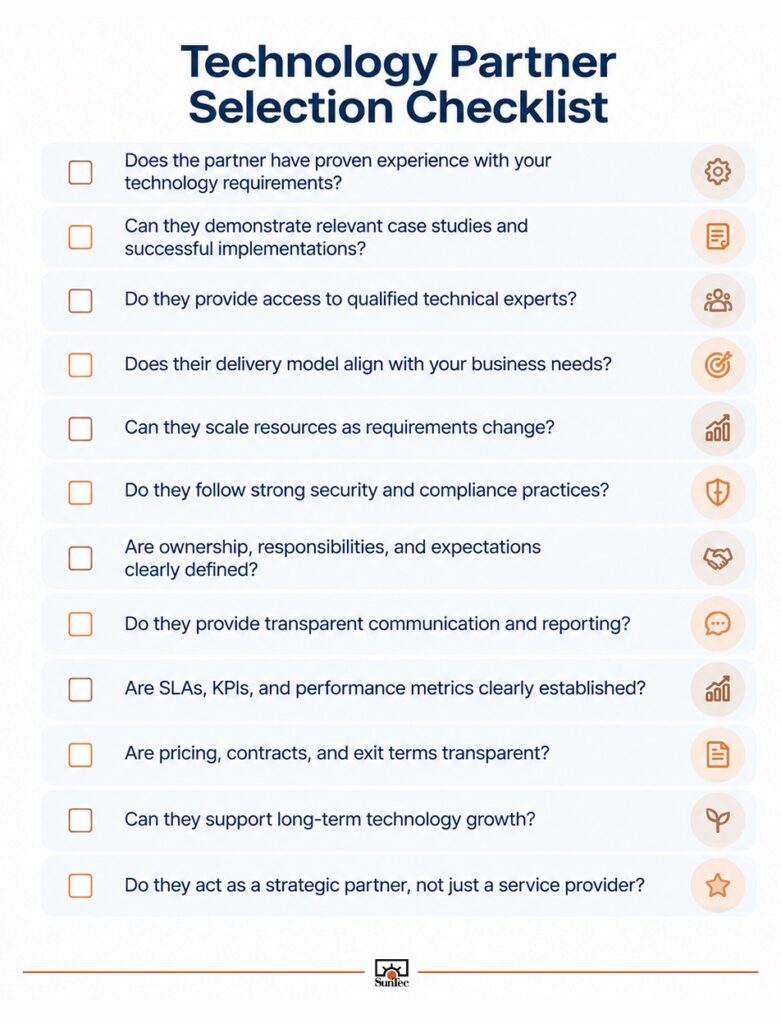
Selecting the right delivery model is only the first step. The success of an IT outsourcing, staff augmentation, or managed services engagement depends heavily on the provider’s technical capabilities, operational maturity, security practices, and ability to integrate with your organization.
1. Evaluate Technical Capability Through Evidence
Look beyond service claims and marketing materials. Assess relevant case studies, technical assessments, architecture expertise, engineering practices, and proof-of-concept engagements aligned with your technology stack and business requirements.
2. Assess Communication and Delivery Model Fit
For offshore development teams or nearshore outsourcing engagements, evaluate collaboration practices, time-zone overlap, communication workflows, and the actual delivery team’s availability rather than relying only on account-level interactions.
3. Validate Security and Compliance Readiness
Review the service provider’s approach to data protection, access controls, intellectual property security, and compliance requirements. Assess certifications and frameworks such as ISO 27001, SOC 2, HIPAA, or industry-specific security standards.
4. Define Measurable Service Expectations
For managed services engagements, evaluate the service level agreement (SLA) in detail. Ensure it clearly defines availability targets, response and resolution timelines, escalation procedures, reporting requirements, and performance accountability.
5. Review Contract Structure and Exit Planning
Understand key contractual elements before engagement begins, including intellectual property ownership, knowledge-transfer responsibilities, termination conditions, pricing models, resource-replacement terms, and transition-support requirements.
6. Assess Relevant Experience and Client References
Prioritize providers with experience handling similar technology environments, business models, project complexity, and operational requirements. References from comparable organizations provide better insight into delivery capabilities and engagement maturity.
7. Evaluate Cultural and Process Compatibility
Technical expertise alone does not ensure successful collaboration. Assess how well the provider’s engineers align with your team’s communication style, development practices, documentation standards, and agile or operational workflows.
Choosing the Right IT Sourcing Model for your Business Needs
The main difference between IT outsourcing, IT staff augmentation, and managed services ultimately comes down to what your organization needs to achieve and how much control it wants to retain internally. As we’ve shown in the blog, each model serves a different purpose, and the right choice depends on factors such as project complexity, internal capabilities, operational requirements, and long-term technology goals.
While some organizations may need to augment their internal team to accelerate development, others may require ongoing operational support or complete ownership of a defined technology initiative. In many cases, the most effective approach is not choosing a single model but creating a balanced sourcing strategy that combines internal capabilities with external expertise where it delivers the greatest value.
As technology requirements continue to evolve, organizations should regularly reassess their sourcing approach to ensure it aligns with changing business priorities, technical demands, and growth objectives. By evaluating the right engagement model, governance structure, and technology partner, organizations can create a sustainable approach to IT delivery that supports both immediate initiatives and long-term innovation.
Frequently Asked Questions (FAQs)
The decision depends on what responsibility you want to retain or transfer. Choose IT staff augmentation services when you need additional expertise under your management; choose project-based IT outsourcing when you need a provider to deliver a defined outcome. Managed services should be chosen when you need ongoing operational ownership.
Not necessarily. A well-designed sourcing strategy allows organizations to retain strategic capabilities internally while using external partners for specialized expertise, delivery capacity, or operational support. The goal is to create the right balance between internal ownership and external capabilities.
IT staff augmentation services enable organizations to quickly hire dedicated experts without committing to lengthy recruitment cycles or permanent hiring. Organizations can bring in experts with specific technical skills, such as cloud, AI Agent development, DevOps, or full-stack software development, to support critical initiatives while maintaining control over delivery.
Yes. Many organizations use a hybrid approach by combining multiple models based on business requirements. For example, they may use staff augmentation to expand engineering teams, project outsourcing for modernization initiatives, and managed services for infrastructure or security operations.
Yes, but organizations should evaluate whether the model still aligns with their operational goals. Staff augmentation services are effective for extended capacity requirements, specialized expertise, or flexible scaling. However, long-term dependency on external resources requires proper documentation, knowledge sharing, and workforce planning.


Murli Pawar, VP - Technology
Murli Pawar is the Vice President of TechnoScore (the dedicated Digital Engineering Division of SunTec India), leading enterprise-wide technology innovation and solution delivery. With over 20 years of experience, he specializes in software architecture, automation, AI integration, and digital modernization, helping global enterprises enhance agility, scalability, and business value through advanced technology solutions.