AI Trends Reshaping Industries in 2025: From Autonomous Agents to Sentiment-Aware AI
Table of Contents
- AI's Current State: Technologies Driving Today's Transformation
- Top AI Trends Transforming Industries
- The Business Reality: Implementation Challenges and Success Strategies
- Struggling with Data Preparation or AI Implementation Challenges?
- The Future of AI: Navigating Tomorrow's Intelligent Landscape
The euphoria of ChatGPT’s November 2022 launch today feels like a distant memory. What began as experimentation with AI chatbots has evolved into something far more sophisticated—and consequential. Today, we live in a post-GPT reality, where AI has progressed from the novelty of the generative phase into an operational necessity.
It has branched far beyond simple conversational interfaces and text generation. Today’s AI landscape encompasses revolutionary technologies that are reshaping entire industries:
- Autonomous AI agents that execute complex, multi-step business processes independently
- Sentiment-aware AI systems that understand and respond to human emotions in real-time
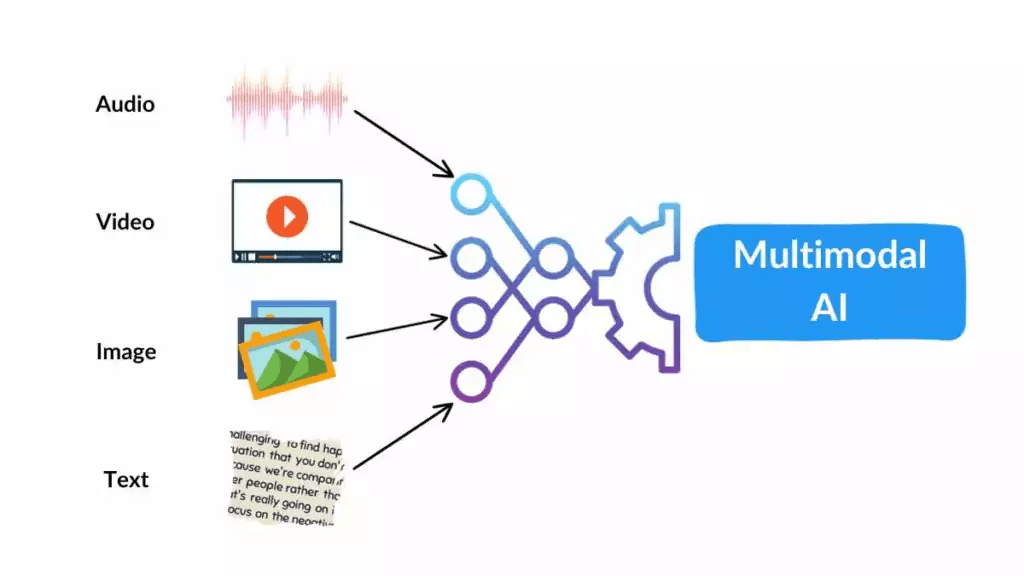
- Multimodal AI solutions that simultaneously process text, images, audio, and video for comprehensive analysis
- Post-transformer architectures that promise greater efficiency and lower computational costs
While these innovations drive business transformations, emerging challenges like Shadow AI—where employees use unauthorized AI tools—highlight the complexities of this technological shift. Understanding these trends isn’t just about staying current; it’s about strategic survival. In this blog post, we examine the top AI trends of 2025 and their practical applications across various industries, highlighting how AI is fundamentally reshaping the rules of business.
AI’s Current State: Technologies Driving Today’s Transformation
The AI landscape in 2025 is characterized by several mature technologies achieving widespread adoption, alongside emerging innovations that are gaining significant traction across various industries.
What we’ve Seen Till Now: Established AI Technologies and Their Adoption
- Machine Learning (ML) & Deep Learning (DL): Technologies that enable systems to learn from data and improve performance without explicit programming. While specific enterprise adoption varies by study, ML/DL technologies have become foundational across all industries, with significant growth in implementation for predictive analytics and rule-based automation.
- Natural Language Processing (NLP): AI systems that understand, interpret, and generate human language, enabling machines to process text and speech for applications like chatbots, translation, and content analysis. The global NLP market reached $29.1 billion in 2023 and is projected to grow to $92.7 billion by 2028 at a CAGR of 26.1%.
- Computer Vision (CV): AI technology that enables machines to interpret and understand visual information from images and videos, allowing automated inspection, object recognition, and visual analysis. The global computer vision market was valued at $19.82 billion in 2024 and is projected to reach $58.29 billion by 2030, growing at a CAGR of 19.8%, with manufacturing accounting for the largest industry share.
- Generative AI: Advanced AI that creates new content, code, visuals, and other solutions by learning from vast datasets, enabling automated content generation, intelligent code completion, and personalized user experiences. Its market is projected to reach $71.36 billion by the end of 2025.
What we’ll See More of in the Future: Emerging AI Technologies Gaining Traction
- Multimodal AI: Early adoption phase for advanced AI systems that can simultaneously process and understand multiple types of data inputs.
- Sentimental AI: Systems that can recognize, interpret, and respond to human emotions and sentiment by analyzing facial expressions, voice tone, text patterns, and behavioral cues.

Top AI Trends Transforming Industries
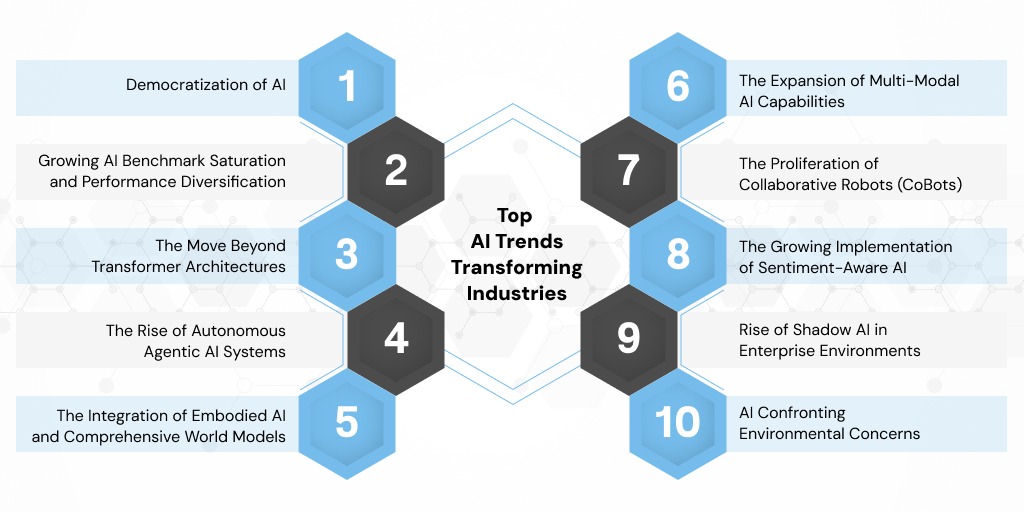
1. Democratization of AI
AI has shifted from exclusive enterprise solutions to accessible tools for businesses of all sizes. No-code and low-code AI platforms are enabling even non-technical users to build sophisticated AI applications, resulting in a global market expected to reach $24.8 billion by 2029.
This democratization also extends to breaking down the dominance of Big Tech AI monopolies. Companies like China’s DeepSeek have disrupted this AI landscape by releasing competent models at a fraction of the cost of Western competitors, proving that AI innovation isn’t limited to Silicon Valley giants.
Industrial Impact:
- AI in Education and eLearning – AI tutoring platforms like Khan Academy’s Khanmigo and Duolingo’s AI-powered language lessons.
- AI in Retail and eCommerce – Automated customer service like that offered by Shopify’s AI chatbots and Sephora’s virtual beauty assistants.
- AI in Finance – Robo-advisors for small investors such as Betterment, Wealthfront, and Robinhood.
2. Growing AI Benchmark Saturation and Performance Diversification
The industry is undergoing a shift beyond traditional benchmarks, as AI models are increasingly achieving near-perfect scores on standard tests, such as MMLU (Massive Multitask Language Understanding), HellaSwag, and ARC (AI2 Reasoning Challenge), with leading models now scoring above 90%. Companies are now focusing on specialized, domain-specific evaluation metrics rather than general intelligence measures.
Industrial Impact:
- AI in Healthcare – Clinical accuracy metrics and image reconstruction precision assessed by tools like Google’s DeepMind or IBM’s Watson for Oncology, etc.
- AI in Manufacturing – Quality control standards, such as those reviewed by General Electric’s Predix platform.
- AI in Education – Learning outcome measurements through Carnegie Learning’s MATHia.
3. The Move Beyond Transformer Architectures
Meta’s chief AI scientist, Yann LeCun, stated that “The future of AI, I tell you, is non-generative” and that there’s “absolutely no way” that transformer-based LLMs will reach human-level intelligence. Which is why, to achieve the latter, many companies are shifting toward post-transformer AI architectures to seek more efficient and capable models. Linear RNNs (Recurrent Neural Networks), Liquid Networks, and State Space Models are gaining traction, with several new AI research papers exploring alternatives to transformers.
Industrial Impact:
- AI in Banking and Finance – For apps with ultra-low latency, where transformer processing speed is insufficient.
- AI in Automotive – Where transformer models are too resource-intensive for deployment.
- AI in Healthcare – For continuous patient monitoring systems.
4. The Rise of Autonomous Agentic AI Systems
OpenAI’s Sam Altman said, “AI agents are like junior employees. You just have to assign the work, look at the quality, and give feedback.” As these agents perform complex, multi-step tasks without human intervention, many businesses are adopting them, resulting in a rapidly expanding market expected to grow at 45.8% CAGR from 2025 to 2030. These systems can plan, execute, and adapt their strategies in response to changing conditions, moving beyond simple prompt-response interactions.
Industrial Impact:
- AI in Finance – Automated compliance reporting through RegTech solutions like AyasdiAI for anti-money laundering and Thomson Reuters’ regulatory intelligence.
- AI in Manufacturing – Autonomous quality assurance via Cognex’s machine vision systems and Keyence’s AI-powered inspection tools.
- AI in Real Estate – Property management workflows using AppFolio’s AI leasing assistant Lisa and Buildium’s automated tenant screening.
5. The Integration of Embodied AI and Comprehensive World Models
Sector-wise AI adoption trends also show a growing trend toward AI systems that understand and interact with the physical world through embodied intelligence. Several companies are developing AI that can navigate, manipulate, and reason about three-dimensional environments. These systems combine perception, reasoning, and action to gather “spatial understanding.”
Industrial Impact:
- AI in Manufacturing – Collaborative robotics with robotic AI, such as Boston Dynamics’ Spot robot for multi-terrain mobility.
- AI in Healthcare – Surgical assistance robots like Intuitive Surgical’s da Vinci system.
- AI in eCommerce and Retail – Automated warehouse operations like those handled by Amazon’s Kiva robots.
6. The Expansion of Multi-Modal AI Capabilities
Several other AI trends in 2025 indicate that organizations are rapidly adopting AI systems capable of processing and understanding multiple types of data simultaneously, including text, images, audio, and video. This has led to a growing market for multimodal AI, which is expected to surpass $4.5 billion by 2028. These models eliminate the need for separate AI tools for different data types, creating more seamless and intelligent workflows.
Industrial Impact:
- AI in Healthcare – Combining medical imaging with patient records.
- AI in Retail – Visual search combined with natural language through tools like Pinterest’s Lens.
- AI in Finance – Document analysis with multimedia fraud detection using tools like DataSnipper’s audit automation tool.
7. The Proliferation of Collaborative Robots (CoBots)
Many businesses are experimenting with co-working environments where collaborative robots are designed to work alongside humans rather than replace them. Unlike traditional industry-grade robots, cobots are designed for safe, day-to-day human interaction and can adapt to dynamic work environments, thereby decreasing their installation and integration costs. While beneficial, the global CoBots market is expected to experience modest growth, projected to reach $3.38 billion by 2030.
Industrial Impact:
- AI in Manufacturing – Assembly line collaboration through Universal Robots’ UR series.
- AI in Healthcare – Patient care assistance via Toyota’s Human Support Robot.
- AI in Retail – Inventory management support through solutions such as Bossa Nova’s shelf-scanning robots.
8. The Growing Implementation of Sentiment-Aware AI
Organizations are increasingly deploying AI systems that can recognize, interpret, and respond to human emotions and sentiment, representing a significant shift in how AI is changing industries. Unlike traditional AI that processes data without emotional context, sentiment-aware AI can detect frustration in a customer’s voice during a support call or identify engagement levels in students’ facial expressions during online learning.
Industrial Impact:
- AI in Healthcare – Mental health monitoring via Ellipsis Health’s speech analysis.
- AI in Hospitality – Guest sentiment analysis in hotels and restaurants to improve service delivery.
- AI in BPO/BPM – Real-time agent coaching based on customer emotional state detection.
9. Rise of Shadow AI in Enterprise Environments
Organizations are witnessing an unprecedented surge in unauthorized AI tool adoption by employees, creating both opportunities and challenges for business transformations being powered by AI. Shadow AI refers to the informal, unmanaged use of AI applications by workers without IT department oversight or approval. This practice is commonly done to solve immediate problems and enhance one’s own productivity.
While this demonstrates the democratization of AI capabilities, it creates substantial risks, including data security breaches, compliance violations, and inconsistent AI governance. Nearly 80% of businesses have experienced some form of negative result due to unauthorized AI usage, particularly generative AI.
Industrial Impact:
- Shadow AI in Finance – Employees using ChatGPT for financial modeling and risk analysis without data governance oversight.
- Shadow AI in Healthcare – Medical staff utilizing AI diagnostic tools and research assistants that haven’t undergone a HIPAA compliance review.
- Shadow AI in Legal – Attorneys employing AI for contract drafting and case research without confidentiality safeguards.
10. AI Confronting Environmental Concerns
The integration of AI is also increasingly shaped by environmental considerations, creating a complex paradox that defines how AI is changing industries in 2025 and beyond. On one hand, AI applications are driving significant sustainability improvements through intelligent energy management, optimized supply chains, and predictive maintenance that reduces waste.
However, the computational infrastructure required for AI training and deployment consumes enormous amounts of energy, with large language models requiring thousands of megawatt-hours for training cycles.
Industrial Impact:
- AI in Energy and Resource Management – Optimizing renewable energy grids while requiring massive data center power consumption.
- AI in Transportation – Autonomous vehicles are improving fuel efficiency while requiring energy-intensive AI processing.
- AI in Agriculture – Precision farming reducing resource usage while deploying IoT sensors requiring constant AI processing.
The Business Reality: Implementation Challenges and Success Strategies
While the above AI trends promise transformative benefits, the reality of implementation presents significant challenges that organizations must navigate carefully to overcome.
Common Implementation Challenges
- One of the most pressing challenges in implementing AI is ensuring data quality and infrastructure readiness. Many organizations discover their data isn’t clean, consistent, or comprehensive enough to develop and train AI systems.
- Technical integration challenges also plague many initiatives. Legacy systems weren’t designed to work with modern AI tools, creating compatibility issues that can derail projects.
- AI hallucinations and reliability concerns are also common, especially in high-stakes industries such as finance, automotive, and healthcare.
- For those who work with an external solution or service provider, vendor lock-in and interoperability challenges often plague many implementations, as many AI platforms don’t integrate well with other systems.
Proven Success Strategies
- Data Foundation First: Establish robust data governance frameworks before AI deployment. Implement data cleaning pipelines, standardize formats, and create comprehensive data quality monitoring systems to ensure AI models have reliable training material.
- API-First Integration Strategy: Implement AI solutions with custom APIs and a microservices architecture. Gradually modernize legacy systems through middleware solutions that bridge old and new technologies without requiring complete system overhauls.
- Human-in-the-Loop Validation: Implement multi-layer QA processes with human oversight for critical decisions. Establish confidence thresholds, fallback mechanisms, and regular model performance audits to maintain reliability in high-stakes applications.
- Multi-Vendor Architecture: Avoid single-vendor dependency by adopting open-source frameworks and cloud-agnostic solutions. Prioritize platforms with strong integration capabilities and maintain flexibility through containerized deployments that enable easy migration between providers.
Struggling with Data Preparation or AI Implementation Challenges?
Our specialized data engineering and AI/ML development services help you overcome implementation hurdles, from preparing AI-ready datasets and setting up infrastructure to developing custom AI solutions that integrate seamlessly with your existing systems.
The Future of AI: Navigating Tomorrow’s Intelligent Landscape
The 2025 AI trends we’ve explored—from the democratization of AI access and the rise of autonomous agents to the emergence of sentiment-aware systems—collectively represent the most significant transformations in the history of AI. They have altered how businesses operate, compete, and innovate, while simultaneously creating new challenges around reliability, implementation, and environmental sustainability.
As we approach 2026 and beyond, you can expect to see the emergence of truly autonomous AI ecosystems, the integration of AI with edge computing reaching practical applications, and AI systems with genuine reasoning capabilities that go far beyond today’s pattern recognition. This convergence of multiple AI technologies will create entirely new categories of business solutions we haven’t yet imagined.
So, the answer to how AI is changing industries is: It is just the beginning. The next wave will see AI becoming so deeply integrated into business operations that the distinction between human and artificial intelligence contributions will become increasingly blurred.
Navigating this transition can be naturally challenging due to the uncertainty associated with AI technologies. It demands a strategic partner who can be there and guide you through every step of your AI journey. Whether you’re looking to implement your first AI solution, upgrade existing systems, or build complex AI ecosystems, we are there to help.


Murli Pawar, VP - Technology
Murli Pawar is the Vice President of TechnoScore (the dedicated Digital Engineering Division of SunTec India), leading enterprise-wide technology innovation and solution delivery. With over 20 years of experience, he specializes in software architecture, automation, AI integration, and digital modernization, helping global enterprises enhance agility, scalability, and business value through advanced technology solutions.