The Unavoidable Cost Line Item – How AI Resource Consumption is Moving from a Hidden Cost to Mandatory Disclosure

Table of Contents
- AI as a Financial Line Item: Compute and Scale Costs
- AI’s Carbon Footprint and Energy Demand
- AI Also Has a Hidden Water Cost
- From Abstract Overhead to Auditable Risk: Why AI Resource Tracking and Reporting is Non-Negotiable
- Global Mandates Around Reporting and Disclosing AI's Environmental Impact
- How SunTec India Can Help You Mitigate AI’s Carbon Footprint?
Exploring how AI is no longer just an innovation but also a cost and a carbon event.
The rapid scaling of AI and ML is fundamentally changing corporate cost structures. Once obscured within general cloud or infrastructure budgets, the current demands of developing, training, and running sophisticated AI models are now emerging as a distinct, substantial cost line item. And they are visible not only on balance sheets but increasingly in public environmental disclosures.
Let’s look at this in greater detail.
AI as a Financial Line Item: Compute and Scale Costs
The cost of developing and deploying AI is experiencing hyper-growth, moving from a marginal IT expense to a strategic (and risky) corporate investment.
- Data centers globally are projected to require nearly $7 trillion in capital expenditures by 2030 to meet demand for computing power, with AI workloads as the principal driver, accounting for roughly 70% of new demand and around $5.2 trillion of spending. [Source: McKinsey]
- The cost of training single-frontier models runs from tens to hundreds of millions of dollars. OpenAI’s GPT-4 was estimated at roughly $78 million in compute, while Google reportedly spent close to $200 million on Gemini 1.0 Ultra. And that’s just one model…
Moreover, the ongoing cost of serving user queries and applications (inference) is often projected to exceed the initial training costs over the model’s entire lifespan.
AI’s Carbon Footprint and Energy Demand
The financial investments mentioned above also directly translate into an equally immense demand for resources and energy. This is because high-performance GPUs and CPUs, vector databases, and high-throughput inference services required for AI are placing an unprecedented strain on data center capacity. Furthermore, these demands are drawing global attention toward AI’s environmental footprint.
- Data centers used approximately 1.5% of global electricity in 2024 (~460 TWh) and, driven largely by AI, are forecast to roughly double to over 1,000 TWh by 2030, climbing toward 3% of total global electricity demand. [Source: IEA]
- The expansion of the AI sector could contribute to an annual increase of 24-44 million metric tons of carbon dioxide in the US alone by 2030. That’s equivalent to adding 5 to 10 million cars to U.S. roadways! [Source: Cornell University Research]
- Training a single large NLP model with neural architecture search was estimated to emit more than 626,000 pounds of CO₂ equivalents into the atmosphere. That’s the same as 5 cars over their lifetimes, underscoring the environmental impact of AI data training. [Source: MIT Technology Review]
- A single request made through an AI-based virtual assistant such as ChatGPT consumes approximately 10 times as much electricity as a traditional Google Search. [Source: UNEP]
AI Also Has a Hidden Water Cost
There are 2 main streams through which AI development utilizes water.
The first option is on-site cooling. Water is required to cool high-performance AI hardware in data centers, exposing companies to significant water-management challenges and community scrutiny.
- Corporate disclosures show a significant surge: Microsoft’s global water use rose to 7.8 million cubic meters in 2023, up from 6.4 million the previous year, primarily driven by the cooling demands of its cloud data centers supporting AI. [Source: GOV.UK disclosures]
- Each 100-word AI prompt is estimated to use roughly one bottle of water (about 519 milliliters) due to the energy-intensive calculations that require liquid-cooled systems. [Source: Washington Post]
The second channel is power plant consumption—water used by the plant/data center that powers AI models. Across both channels, AI development consumes substantial volumes of water.
The rising costs and environmental impact of AI development have made one thing clear: AI projects can no longer be treated as open-ended experiments.
From Abstract Overhead to Auditable Risk: Why AI Resource Tracking and Reporting is Non-Negotiable
The magnitude of these figures also establishes an unequivocal link between AI development and the need for an immediate, standardized mandate for tracking and reporting. If AI operations are driving billions in CapEx, significant carbon emissions, and millions of cubic meters in water consumption, these metrics must be treated as auditable business data.
The failure to account for these environmental costs introduces two significant risks:
- Financial Risk: Ignoring rising energy and infrastructure costs can affect profitability and violate green procurement policies.
- Reputational and Regulatory Risk: A lack of transparency in resource utilization can expose companies to scrutiny from investors and regulators concerned about
Global Mandates Around Reporting and Disclosing AI’s Environmental Impact
Currently, most legally binding reporting obligations remain part of broader sustainability and environmental disclosure (ESG) frameworks rather than AI‑specific regimes. However, several international initiatives and regional regulations already require, or are moving toward, mandatory disclosure of energy use and emissions related to AI systems.
AI‑Focused Regulatory Requirements
The EU (European Union) AI Act, which is phasing in over 2025-2027 (with full application due in 2027), includes provisions addressing the documentation of AI’s energy consumption, most notably for general-purpose AI models. Even though they currently cater to regulatory bodies and not all organizations, and may not yet be 100% mandated, they mark a crucial step toward AI accountability and sustainability.
This act classifies AI according to the following risk levels:
- Unacceptable Risk (Prohibited)
- High-Risk AI (Deeply Regulated)
- Limited-Risk AI (Lighter Transparency Obligations)
- Minimal-Risk AI (Unregulated)
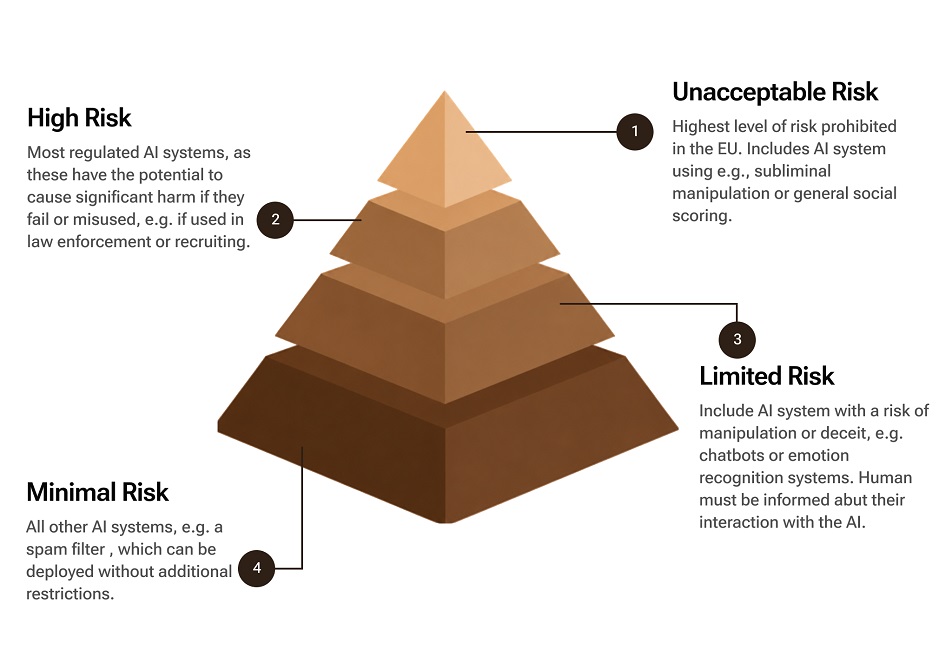
Based on the above categorization, the act imposed specific disclosure obligations, especially on those developing and deploying high-risk AI. Non-compliance or inability to disclose can result in penalties as much as:
- €35M or 7% global turnover for deploying prohibited (unacceptable-risk) AI practices
- €15M or 3% global turnover for high-risk AI non-compliance
- €7.5M or 1% global turnover for providing incorrect or misleading information
[Source: Article 99 | EU AI Act | Penalties]
Broader Sustainability Reporting Frameworks (Indirect Mandates)
- The Global Reporting Initiative (GRI) is a widely used framework for disclosing environmental impacts, including emissions, water use, resource & energy utilization, and waste generation.
While it does not have provisions specific to AI alone, companies that use or deploy AI must include their environmental impacts in their overall sustainability reports if those impacts are material to the business. This is reported through:
- GRI 302 (Energy): Disclosure of AI systems’ energy consumption within + outside the organization.
- GRI 303 (Water & Effluents): Disclosure of water used for cooling AI systems.
- GRI 305 (Emissions): Disclosure of GHG emissions resulting from AI’s energy consumption, categorized under Scope 1, 2, and 3 (if cloud services are used).
- GRI 301 and 306 (E-Waste & Materials): Disclosure of electronic waste generated by AI hardware.
- The International Sustainability Standards Board (ISSB) has developed global baseline standards (S1 and S2) for sustainability reporting that many jurisdictions are integrating into law. These standards emphasize the disclosure of climate‑related risks and greenhouse gas emissions that may be linked to AI use and data center operations, among other activities.
While the existing standards focus on the material impact (outcome) of an organization’s sustainability risks and opportunities, they do not account for the internal technology used. However, as AI’s carbon footprint and water consumption become growing environmental and climate concerns, companies may be required to disclose their AI resource use in the future.
Emerging Policies and Regulatory Discussions
- The UNEP (United Nations Environment Program) has called for governments to require companies to disclose the direct environmental consequences of AI products and services.
While it hasn’t issued legally binding regulations, it has provided recommendations and guidance.
Recommendations for regulators and governments:
- Mandatory Disclosure Laws
- Standardized Impact & Environmental Footprint Measurement Frameworks
- Better AI Environmental Data Quality & Accessibility
Recommendations for companies and developers:
- Comprehensive Environmental Assessment of AI Development Lifecycle
- Algorithmic Transparency by Design
- Frequent Risk & Impact Evaluations
- Responsible Sourcing and Circularity in AI Components
- Green Data Centers
- The Organization for Economic Co‑operation and Development (OECD) has recommended better measurement standards and expanded data collection for AI’s environmental impacts. These recommendations include:
- Standardized Metrics
- Expanded Data Collection
- Upstream and Downstream Impacts Beyond Operational Ones
- Separate AI’s Impact from General ICT
ESG and TCFD/Climate‑Related Disclosures
Companies in many jurisdictions are already reporting climate‑related information under frameworks such as:
- ESG (Environmental, Social, and Governance): In the context of AI, ESG reporting focuses on the Environmental impact of AI systems—energy use, emissions, and resource consumption. The Social and Governance aspects disclosed may also address how AI systems affect communities and raise ethical considerations (e.g., data privacy and security).
- Task Force on Climate‑related Financial Disclosures (TCFD) frameworks: Under TCFD, AI-related disclosures typically include –
- Governance Metrics: Describing how companies oversee and manage the environmental impact of AI initiatives.
- Strategy: Reporting on how AI-related energy consumption impacts long-term climate goals and business strategy.
- Risk Management Approach: Identifying risks related to AI’s environmental footprint.
Although there is no specific legal mandate yet, these frameworks are increasingly incorporating data on how companies are using AI.
In regions such as the European Union, ESG and climate-related reporting requirements have been expanding, though their scope is now being recalibrated. The Non-Financial Reporting Directive (NFRD) applied to roughly 11,000 companies, and its successor, the Corporate Sustainability Reporting Directive (CSRD), was originally expected to cover around 50,000. However, the EU’s “Omnibus” simplification package, approved in December 2025, has narrowed the CSRD’s scope by roughly 90%, limiting mandatory reporting to large companies with more than 1,000 employees and over €450 million in turnover, with phased application running into 2028.
In the coming years, this trend is expected to extend beyond the EU. These directives are driving AI transparency and environmental impact reporting toward becoming mandatory standards, with more comprehensive mandates anticipated.

How SunTec India Can Help You Mitigate AI’s Carbon Footprint?
The industry’s growing emphasis on responsible resource consumption and mandatory reporting demonstrates that AI is no longer purely a technological consideration; it is a critical environmental and compliance challenge.
Having recognized the profound implications of AI’s resource consumption early on, we at SunTec India have engineered our workflows and operational philosophy to minimize AI’s environmental footprint. Here’s why you should choose us as your resource-smart AI partner:
1. Human-in-the-Loop Advantage
We integrate human expertise with AI’s computational resources, utilizing human capabilities for tasks that require high cognitive precision or are highly resource-intensive for AI. Complex data annotation, nuanced AI-enabled QA and testing, and iterative refinement are left to our experts to reduce reliance on AI for repetitive, high-carbon-footprint tasks.
Data centers, hardware, and compute resources (including high-powered GPUs) are utilized only for the most critical, resource-justified computational tasks. All typical processing occurs either in optimized cloud environments or at the edge.
2. Strategic Resource Optimization in a High-Grid Environment
Operating from India, a region characterized by significant energy demand (a grid carbon intensity of roughly 0.71 tCO2e per MWh, i.e. ~710 kg CO2e per MWh) and resource constraints, we have taken early action to mitigate AI’s environmental footprint stemming from our operations: [Source: Consumer Ecology]
- We adhere to circular-economy principles and prioritize the use of reusable components, pre-trained AI models, optimized databases, and existing infrastructure.
- We focus on model compression, performance tuning, and strategic deployment to ensure that every AI workload consumes the minimum necessary energy.
3. Assured Compliance in the Evolving AI-Regulation Space
As global mandates such as the EU’s AI Act and CSRD/NFRD take effect and more are being developed worldwide, organizations need partners who understand not only AI development but also the importance of accountability.
Our proven track record in resource-efficient AI deployment and deep familiarity with data governance and reporting standards position us to help clients navigate this space. To date, we have helped several clients ensure their AI projects are not only practical but also compliant, auditable, and sustainable by taking over their tracking and regulatory burden.
Does your AI strategy account for mandatory environmental disclosure? Contact us at info@suntecindia.com to transition from managing the overhead of abstract AI to securing a compliant AI deployment.


Rohit Bhateja, Director - Digital Engineering Services & Head of Marketing
Rohit Bhateja, Director of Digital Engineering Services and Head of Marketing at SunTec India, is an award-winning leader in digital transformation and marketing innovation. With over a decade of experience, he is a prominent voice in the digital domain, driving conversation around the convergence of technology, strategy, customer experience, and human-in-the-loop AI integration.