
AI Training Data for Customer Service

Production-Grade Training Data for High-Stakes Customer Service AI

  • We convert fragmented support interactions — chats, call logs, email threads, and ticket histories — into structured training datasets.
  • We annotate, fine-tune, and validate training datasets for customer support AI that performs reliably under any volume, complexity, and scrutiny.
Get Your Customer Support AI Training Dataset Proposal

Success Stories

...it's all about results

Content Recommendation

Content Recommendation

Text and Video Labeling for Predictive Content Intelligence Platform

Read More
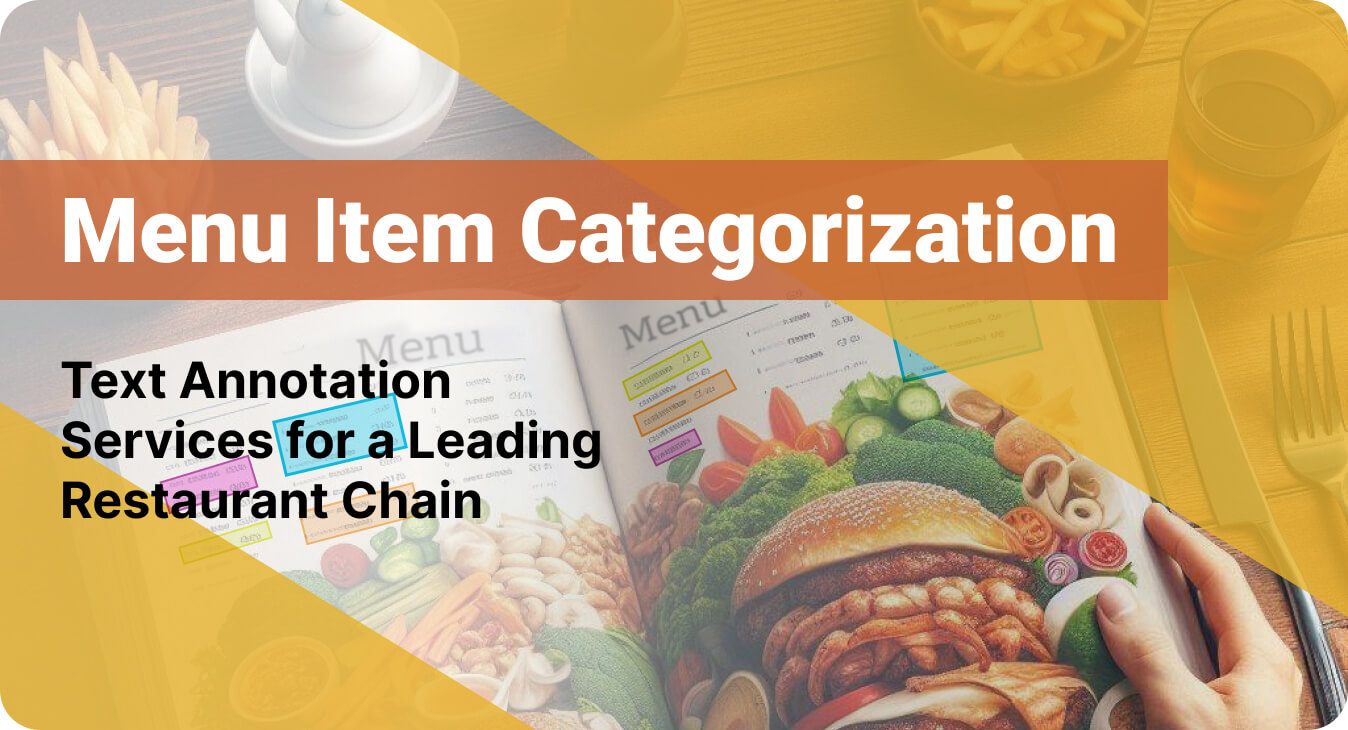
Menu Item Categorization

Menu Item Categorization

Helping a leading restaurant chain classify 50k+ menu items to ensure customer satisfaction and legal compliance, with 100% accuracy rates

Read More
RETAIL COMPETITIVE INTELLIGENCE

RETAIL COMPETITIVE INTELLIGENCE

Retail image annotation delivering 98.5% accuracy across 250K+ monthly annotations.

Read More
Food Delivery Technology

Food Delivery Technology

Image Annotation for AI Agents: Preparing Training Data for Automated Food Order Verification Model

Read More
Environmental Monitoring

Environmental Monitoring

Enabling AI-Powered River Monitoring through Image Annotation Services

Read More
Agriculture

Agriculture

Drone Image Annotation: Powering Smarter Livestock Detection with Precise AI Training Data

Read More

AI TRAINING DATA SERVICES FOR CUSTOMER SERVICE & SUPPORT

Optimizing Customer Service AI with Custom Training Data

Customer service AI is expected to improve efficiency by ensuring faster resolution times, cleaner routing, stronger self-service, shorter handling times, and fewer avoidable escalations. When those gains stall, the issue is often the quality and structure of the data that the model learns from. Our AI training data services for customer service solutions are designed to close that gap.

Through a single connected workflow, we aggregate unstructured data (chats, call transcripts, ticket histories, email threads, QA notes, CRM records, etc.) from your disconnected systems, structure, enrich, and annotate training datasets, and fine-tune and validate AI models, so they perform better in production. Whether you require conversational AI data labeling or chatbot training data services, our approach ensures your use case-specific training data is built for accuracy, consistency, and operational impact.

Proven Domain Expertise

Hands-on experience with customer service AI training data preparation — including chat transcripts datasets, support conversation annotation, ticket data processing, and customer interaction labeling.

Scale without Sacrificing Quality

Established operational workflows, in-house subject matter experts, and a large workforce with the flexibility to scale teams up or down based on your project’s volume demands.

Security & Compliance

Your support data and proprietary datasets are protected at every stage with NDAs, strict internal access governance, data encryption, ISO, HIPAA, and GDPR compliance.

Flexible Engagement Models

Whether you need a short-term pilot (free sample available), a dedicated annotation team for an ongoing program, or burst capacity for a seasonal project, we configure the engagement to your requirements.

AI DATA PREPARATION FOR CUSTOMER SUPPORT AUTOMATION: SERVICES

Purpose-Built, Precision-Mapped AI Training Data Services for Customer Service & Support

Customer support AI loses performance when the data workflow breaks between stages. For instance, inconsistent labels or data coverage gaps prevent the model from seeing the full picture or understanding the service context. In support operations, those failures show up as misrouted tickets, unstable responses, weaker summaries, poor decision-making logic, and higher review effort. We solve that execution risk with our enterprise customer service AI data services — a connected delivery model built around continuity, control, and operational fit. Each stage is aligned to the support logic, quality standards, and business goals your AI systems are expected to handle across customer-facing and agent-facing workflows.

AI Data Collection Services

  • Gather high-quality chat logs, email threads, ticket histories, CRM notes, customer feedback, and knowledge-base content from publicly available and client-provided sources.
  • Aggregate and organize support interaction data across channels, teams, and markets to build training datasets aligned to routing, automation, sentiment, and agent-assist use cases.
View MoreAI Data Collection Services

Data Preprocessing Services

  • Clean, normalize, and transform raw support data into machine learning-ready formats.
  • Includes deduplication, format conversion (JSON, CSV, XML, COCO, YOLO, Pascal VOC), PII masking where applicable, and enrichment with metadata such as channel type, issue category, language, escalation status, and resolution outcome.
View MoreData Preprocessing Services

Data Annotation Services

  • AI-assisted pre-annotation with expert human review across chat, ticket, voice, and feedback datasets to reduce turnaround while maintaining annotation accuracy up to 99%.
  • Teams that can work across prominent data labeling tools, such as CVAT, Labelbox, Label Studio, and V7, as well as proprietary annotation platforms.
View MoreData Annotation Services

LLM Fine-Tuning Services

  • Supervised fine-tuning (SFT) data (prompt-response pairs grounded in customer service & support domain knowledge).
  • RLHF annotation to align model outputs with domain-specific expectations.
  • Adversarial red-team testing to catch hallucinated responses, weak summaries, and unsafe or off-policy outputs before deployment.
View MoreLLM Fine-Tuning Services

AI Model Validation Services

  • Human-in-the-loop validation of your customer support AI model’s outputs.
  • Subject matter expert review to catch edge cases (wrong routing decisions, missed escalation cues, inconsistent responses across channels).
  • Bias audits to ensure your model performs across real-world support conditions. Consensus-based accuracy checks with multi-annotator agreement protocols.
View MoreAI Model Validation Services

CLIENT SUCCESS STORIES

It's all about results.

The Proof is in the Pipeline

Discover how we’ve helped businesses across 50+ nations bridge the gap between "lab-ready" and "market-ready" AI/ML applications by solving their most complex training data challenges.

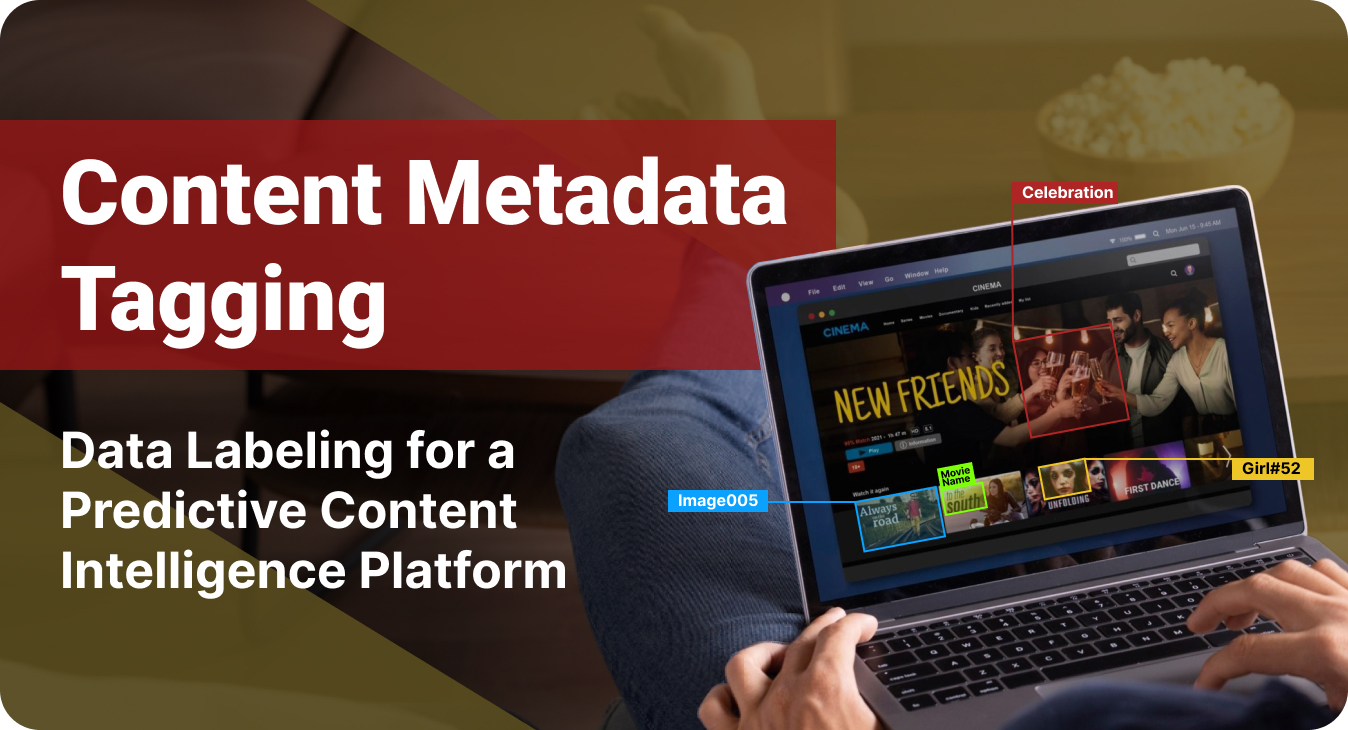
Data Labeling for a Predictive Content Intelligence Platform

Labeled over 2500 entertainment content (Movies, TV Series, Trailers) monthly to enable the accurate prediction of the target audience engagement rates and response.
65%

Improved AI Model Accuracy

60%

Less Content Categorization Errors

4-Month

Faster Model Development
menu item categorization

Helping a leading restaurant chain classify 50k+ menu items to ensure customer satisfaction and legal compliance, with 100% accuracy rates

100%

Accuracy in Menu Items Categorization

50K+

Items Classified in Menu Categorization

Enhanced

Regulatory Compliance and Customer Experience
Retail Image Annotation

Bounding box annotation and metadata tagging across retail promotional images, powering competitive intelligence solutions for a US-based company.

250K+

Annotations Delivered Monthly

98.5%

Annotation Accuracy
Image Annotation for Restaurant AI Agents

Prepared production-ready training data for a restaurant operations management AI agent through specialized polygon segmentation of food items, enabling multi-chain deployment without client-specific retraining.

20,000+

Annotated Images Delivered

98%

Annotation Accuracy Maintained
  • Service Image Annotation
  • Platform CVAT
  • Industry F&B (Food Delivery Technology)
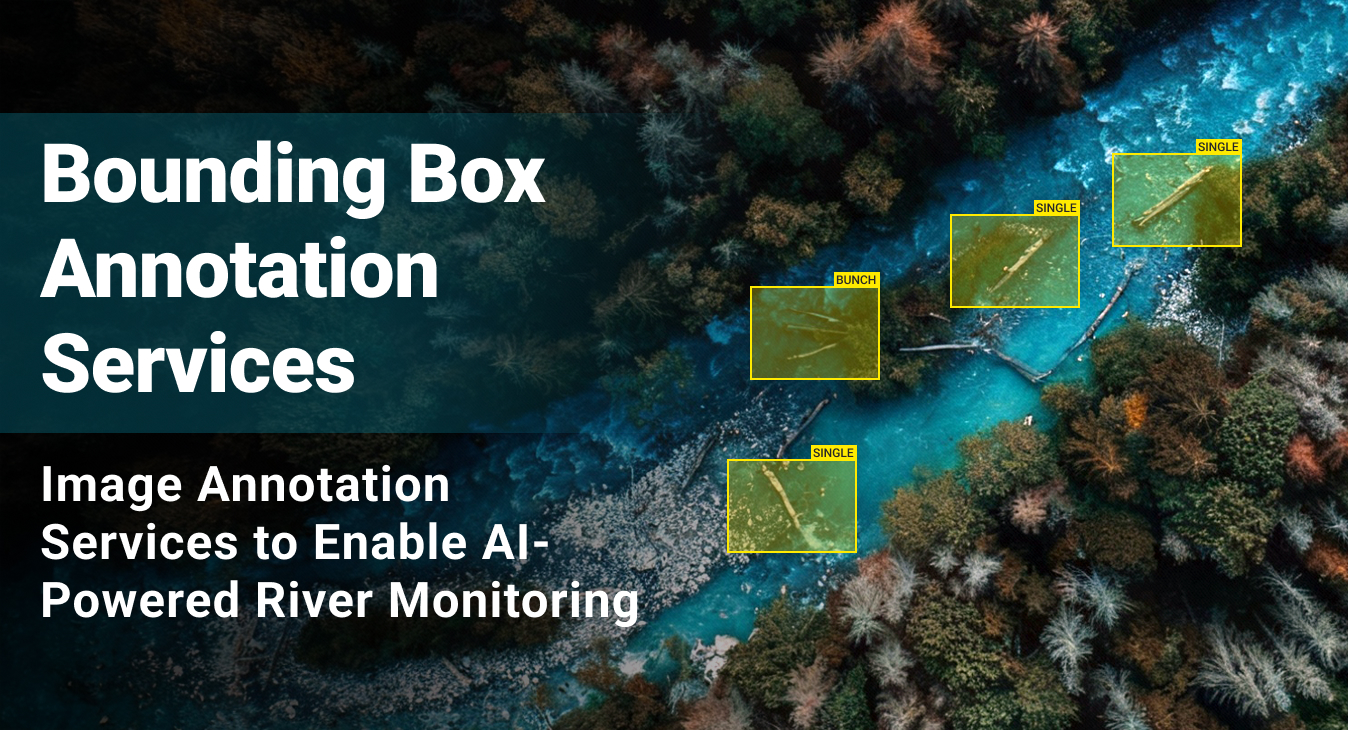
Bounding Box Annotation Services

Precise bounding box annotation for high-resolution aerial river images to train an AI-powered river flow obstruction detection system using the client’s proprietary data annotation tool.

1,500 to 2,000

Images Labeled per Week

98%

Labeling Accuracy Rate Maintained

<1%

Revision/Rework Rate
  • Service Image Annotation
  • Platform Client’s Proprietary Annotation Platform
  • Industry Environmental Monitoring / Forestry

Drone Image Annotation

Labeled and validated over 10,000 high-resolution drone images monthly using QuPath to train an AI-powered livestock detection model, delivering 95%+ annotation accuracy.

10K+

Images Annotated Monthly

95%+

Labeling Accuracy

View All

DATA ANNOTATION TYPES WE SUPPORT

The Annotation Foundation behind Reliable Customer-Facing AI

AI in customer service takes many forms. Chatbots resolve routine queries across hundreds of intents. Sentiment models flag conversations heading south. Routing systems triage tickets by urgency and topic. Voice assistants transcribe and resolve calls in real time. Every model trains on different data and holds to a different accuracy bar — here's how our customer service data annotation services deliver across the range.

Text Classification

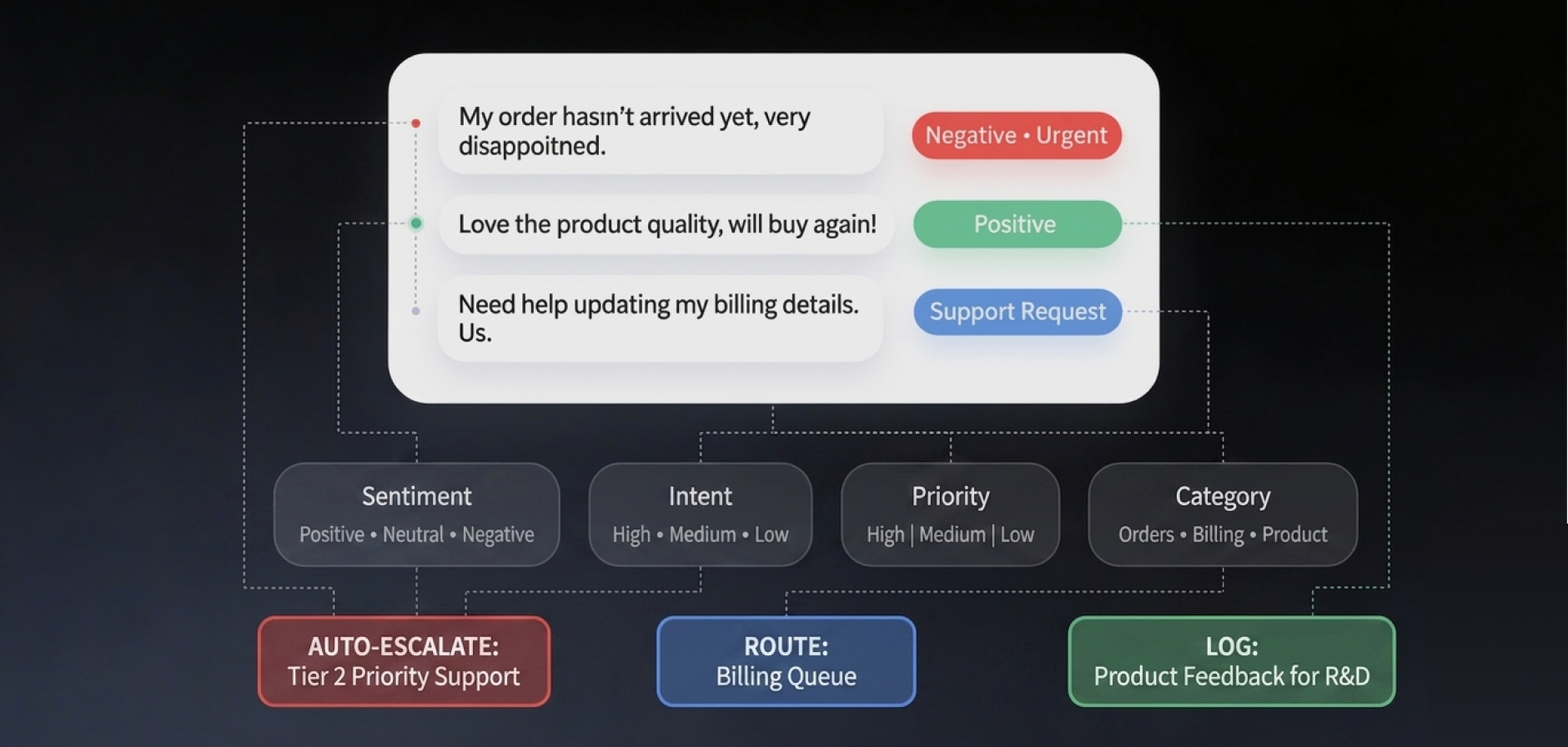
Categorizing feedback, support tickets, or in-app reviews by topic, intent, urgency, or sentiment to power routing and escalation models.

Span Annotation

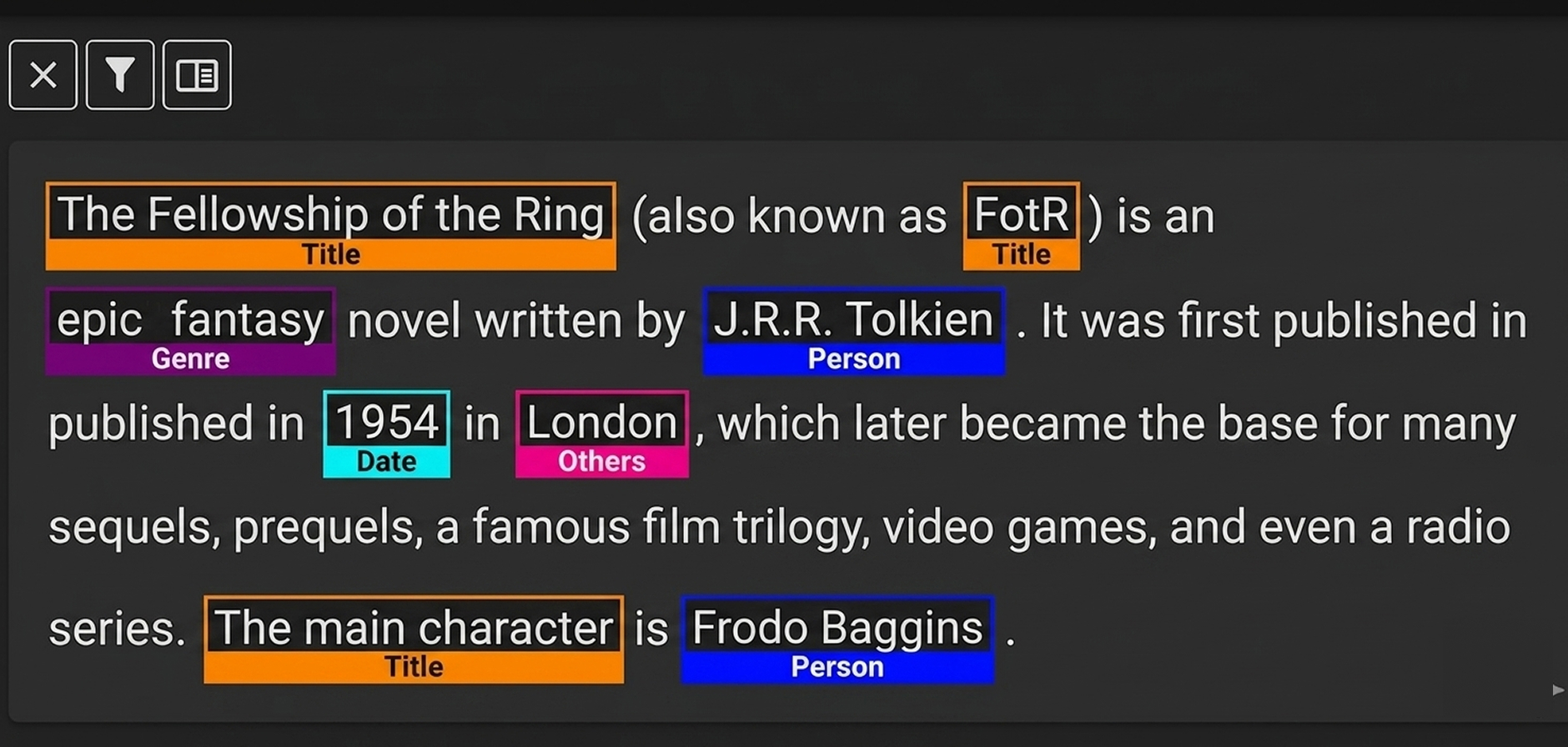
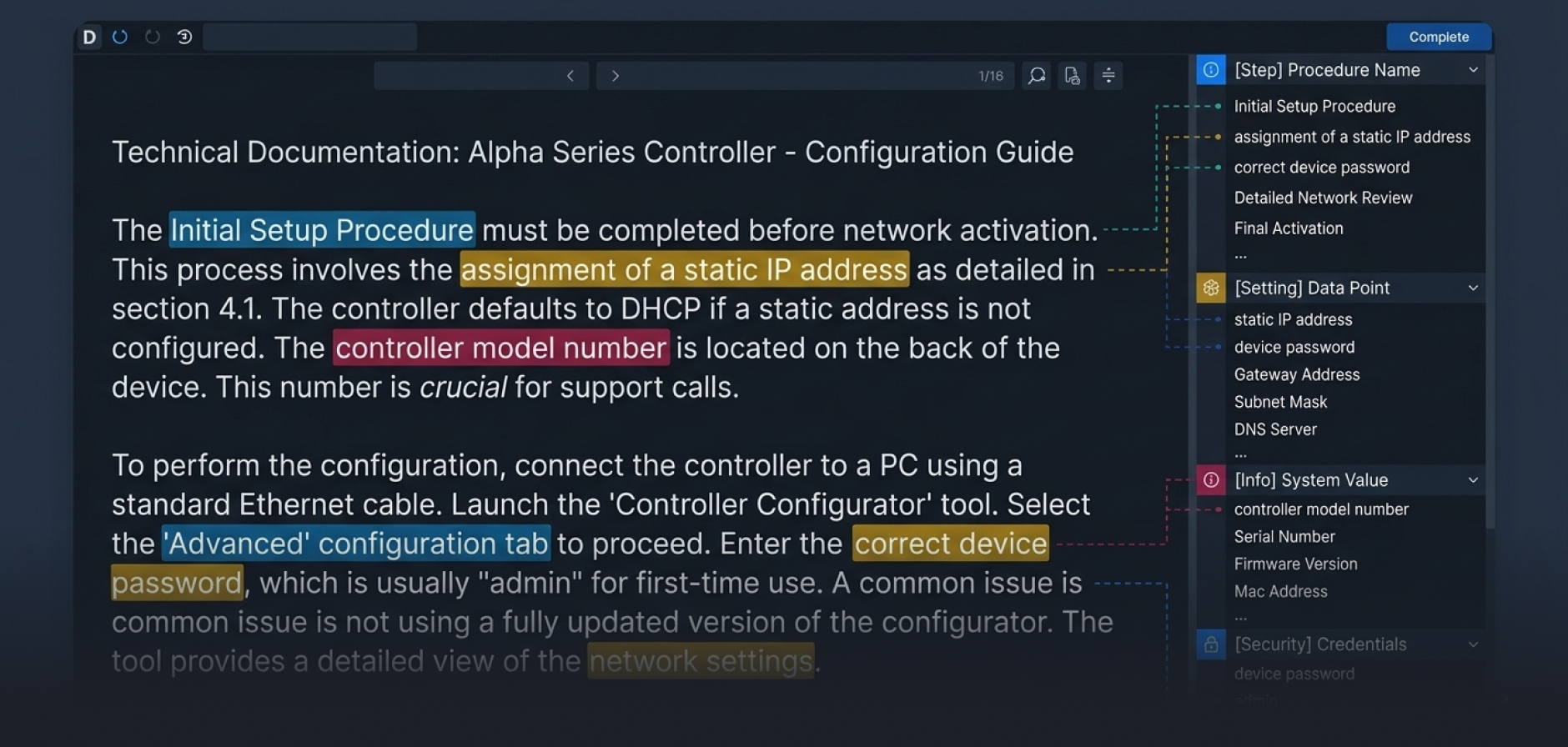
Highlighting specific contiguous text segments and tagging them — extracting answer spans, entity mentions, or sentiment targets with exact start and end positions.

Named Entity Recognition (NER)

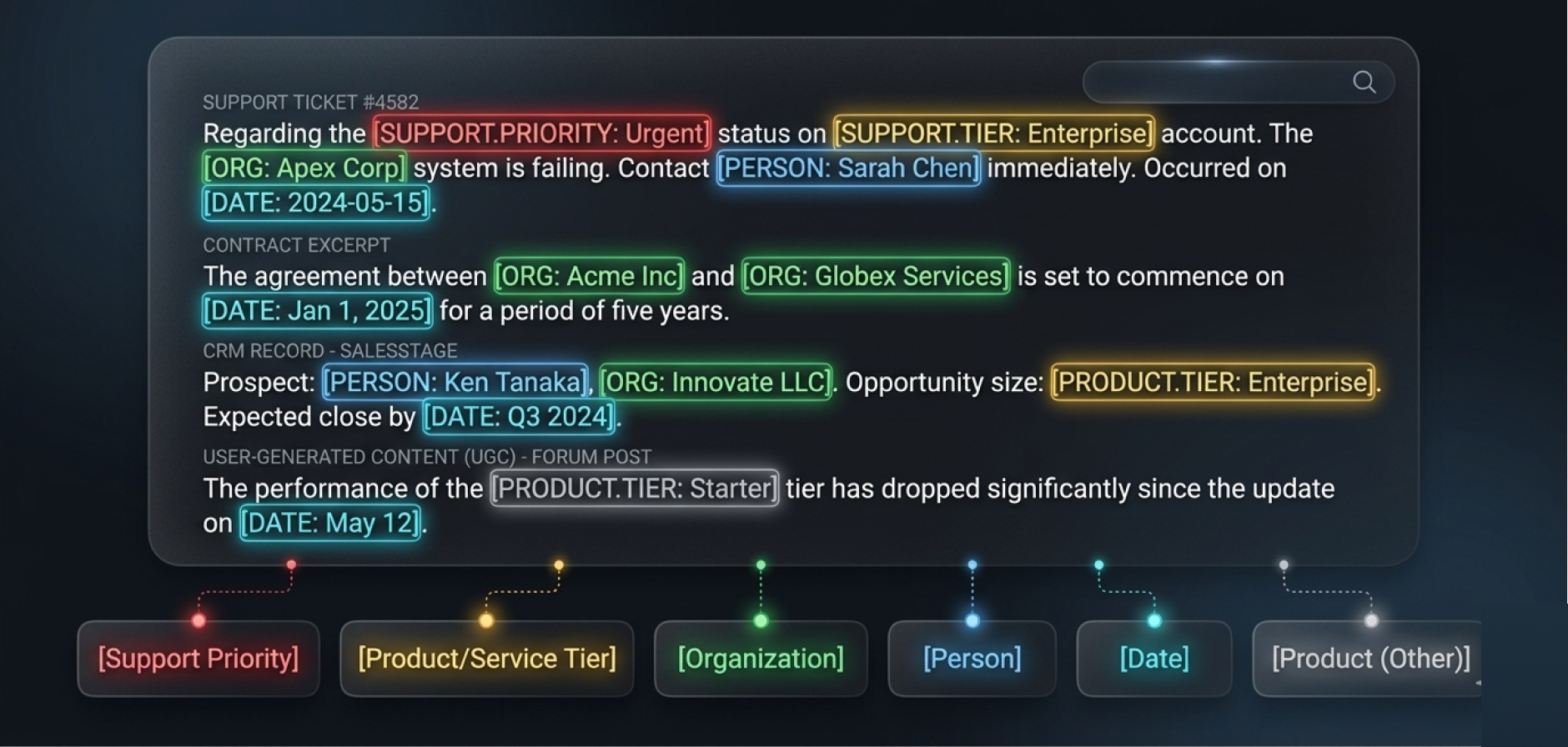
Tagging names, dates, product tiers, and organization names within support tickets, contracts, CRM records, and user-generated content.

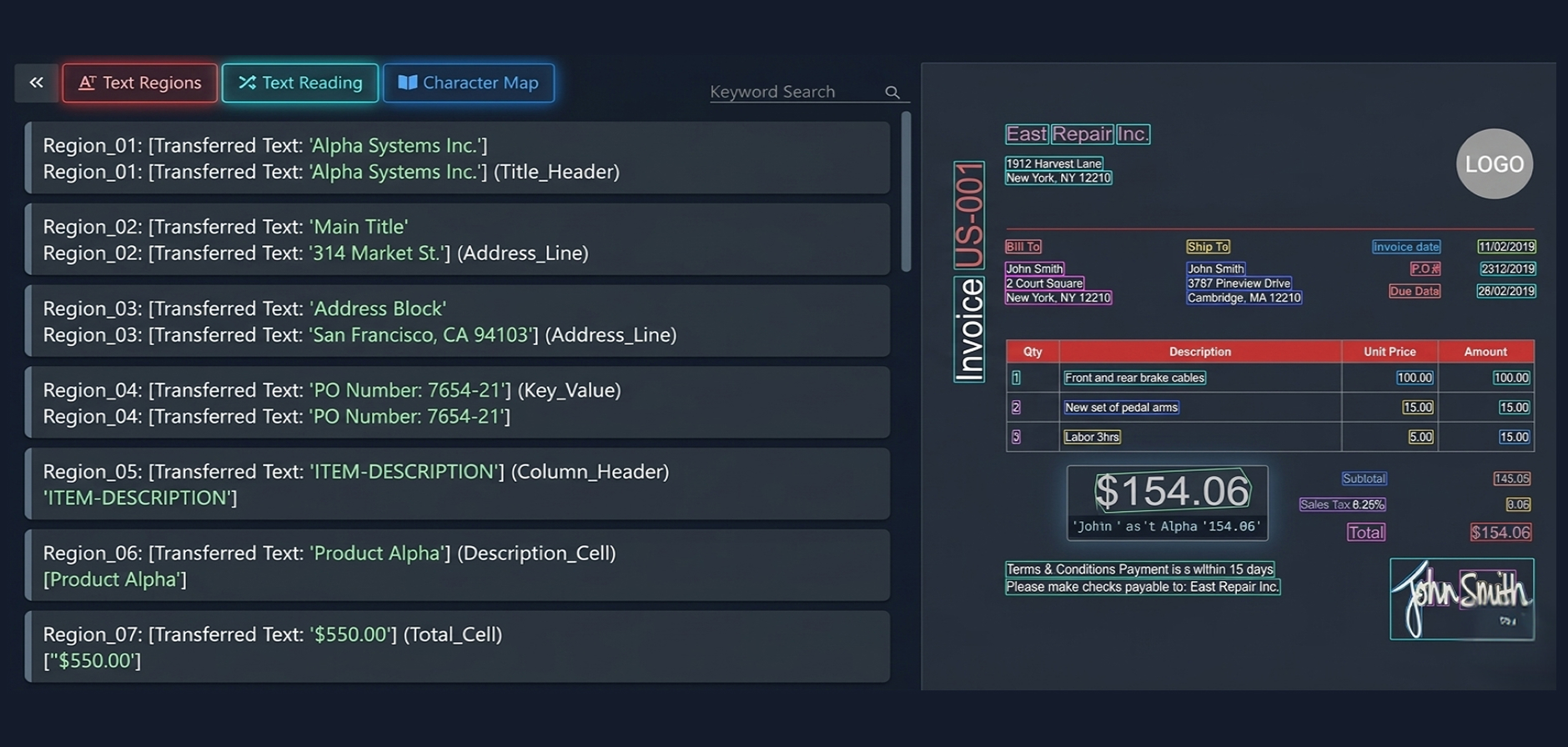
OCR Annotation

Localizing text regions with bounding boxes or polygons and transcribing the character sequence inside each — training models to detect and read text simultaneously.

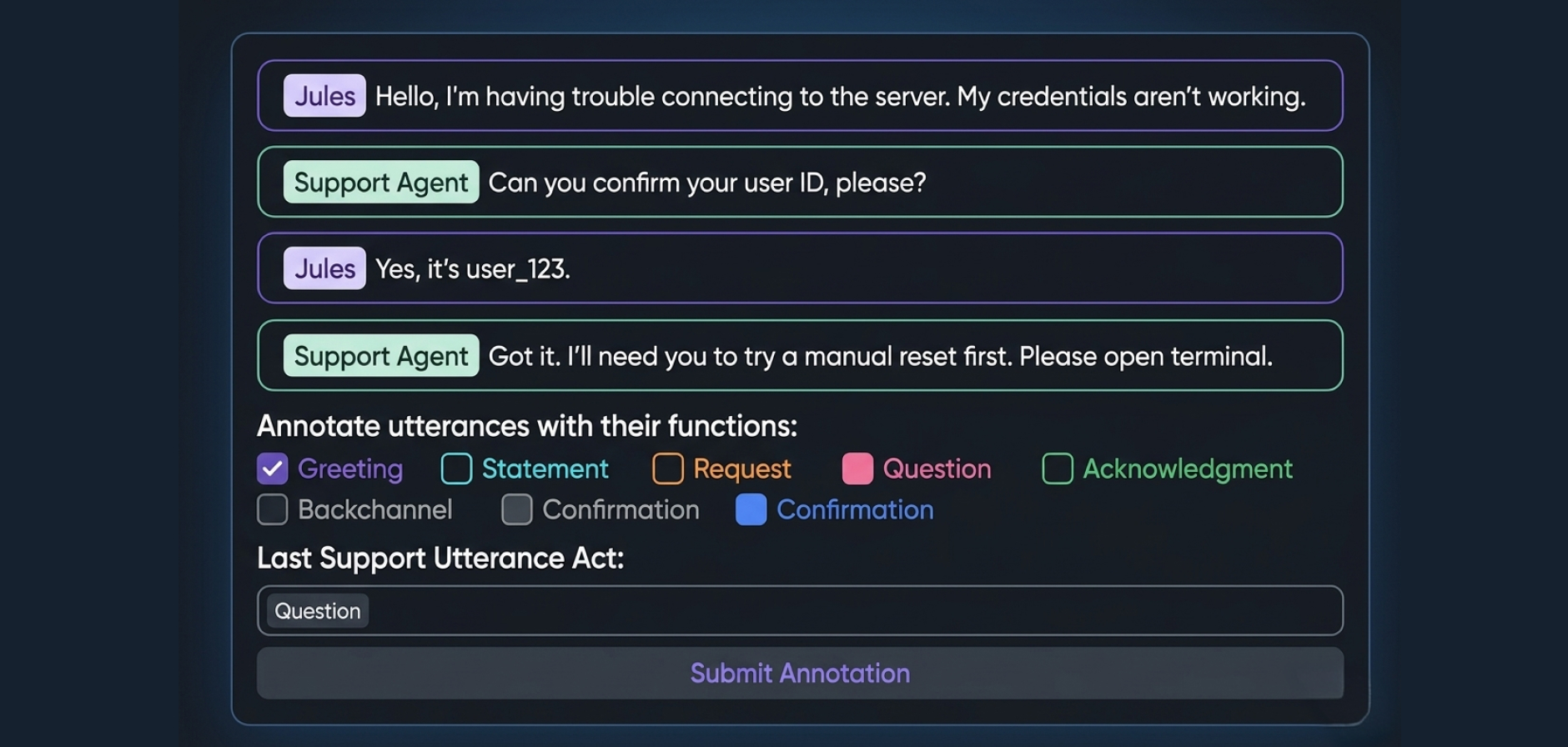
Dialogue Act Annotation

Labeling each utterance in a conversation with its communicative function — e.g., Question, Statement, Acknowledgment, Request, Confirmation, Greeting, Backchannel.

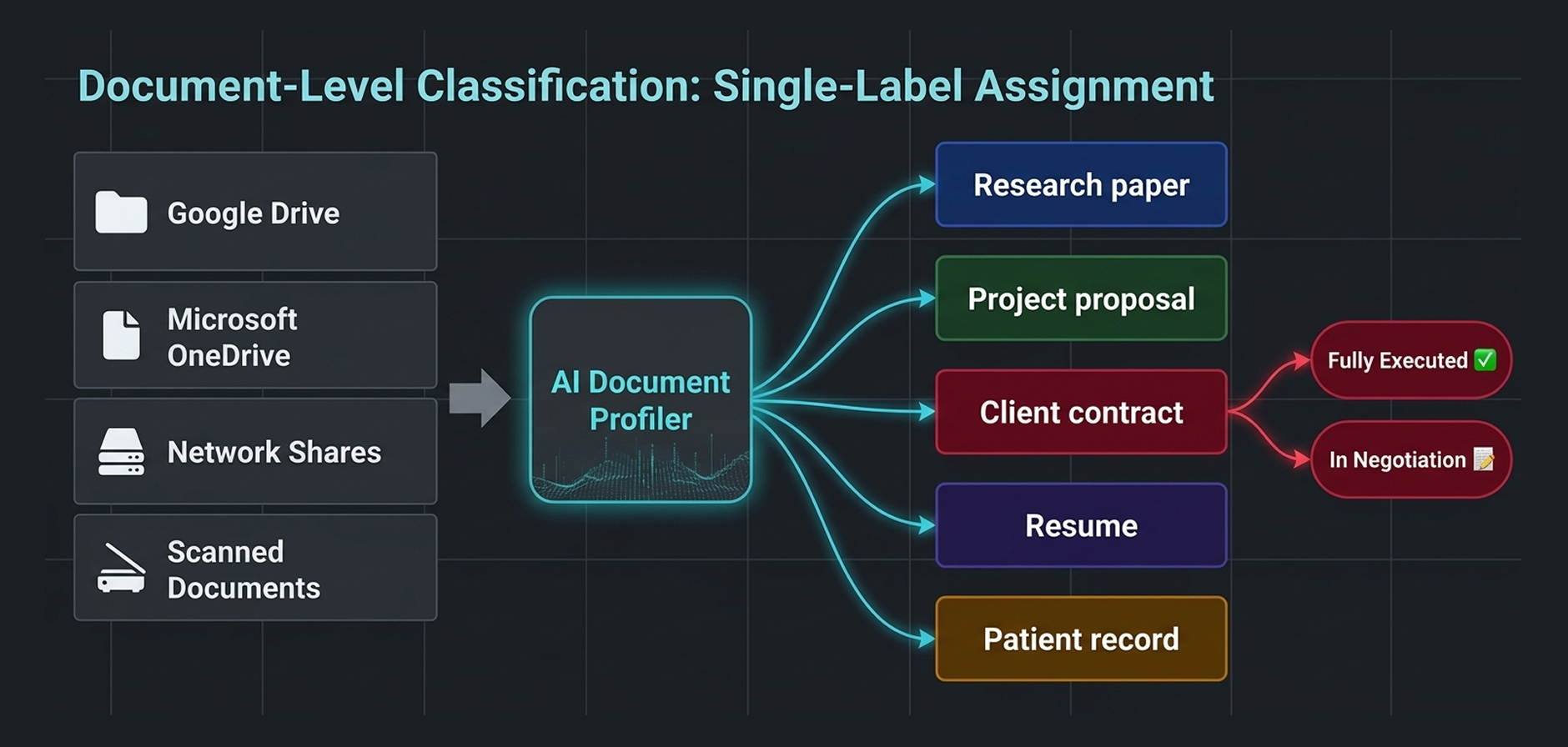
Document-Level Classification

Assigning a single label (or small label set) to an entire document based on its overall content — e.g., "spam / not spam," "positive/negative," "legal contract/invoice/resume."

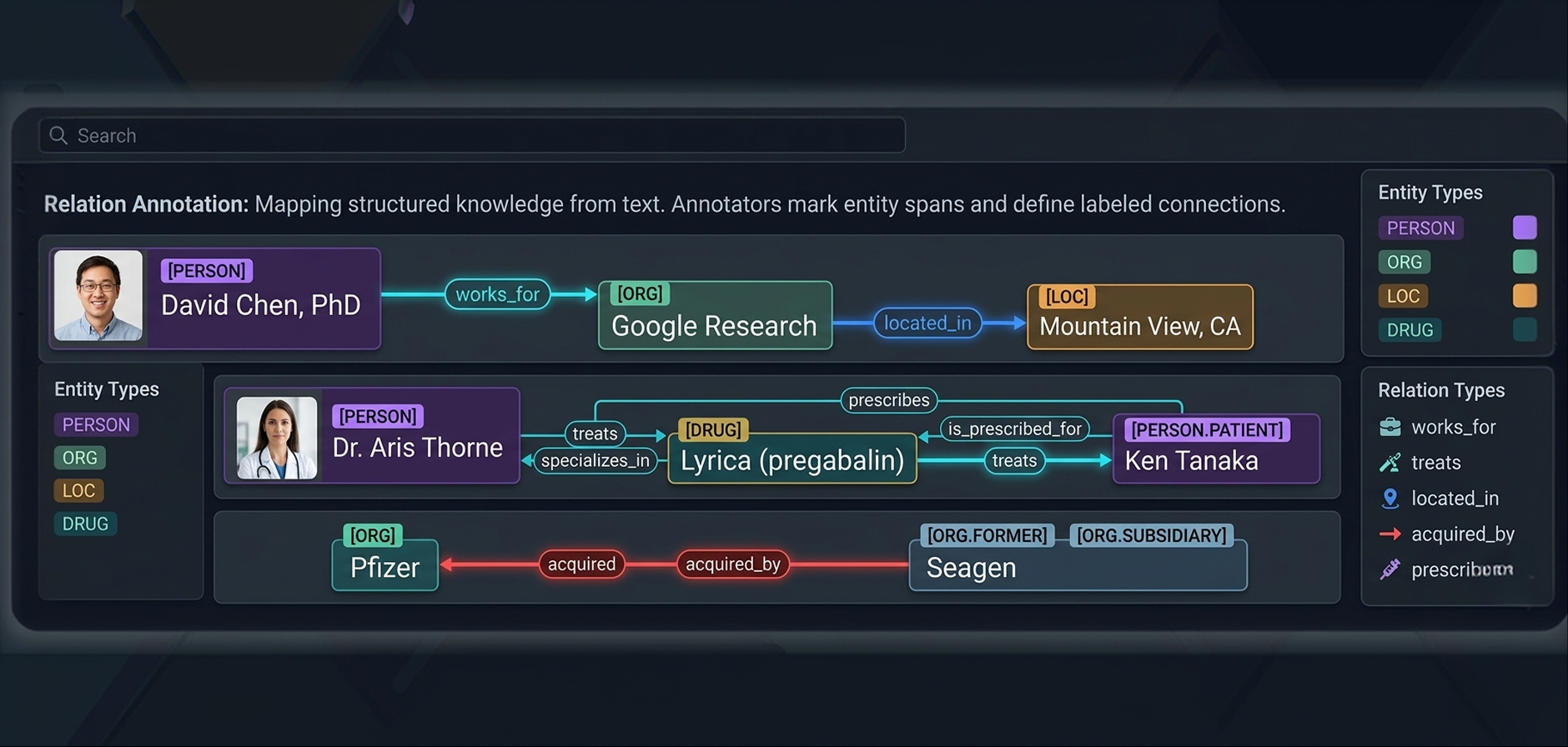
Relation Annotation

Marking how two or more entities in a text are linked. Annotators identify entity spans (people, drugs, companies) and then draw labeled connections between them — "works_for," "treats," "located_in," "acquired_by."

Extractive Annotation

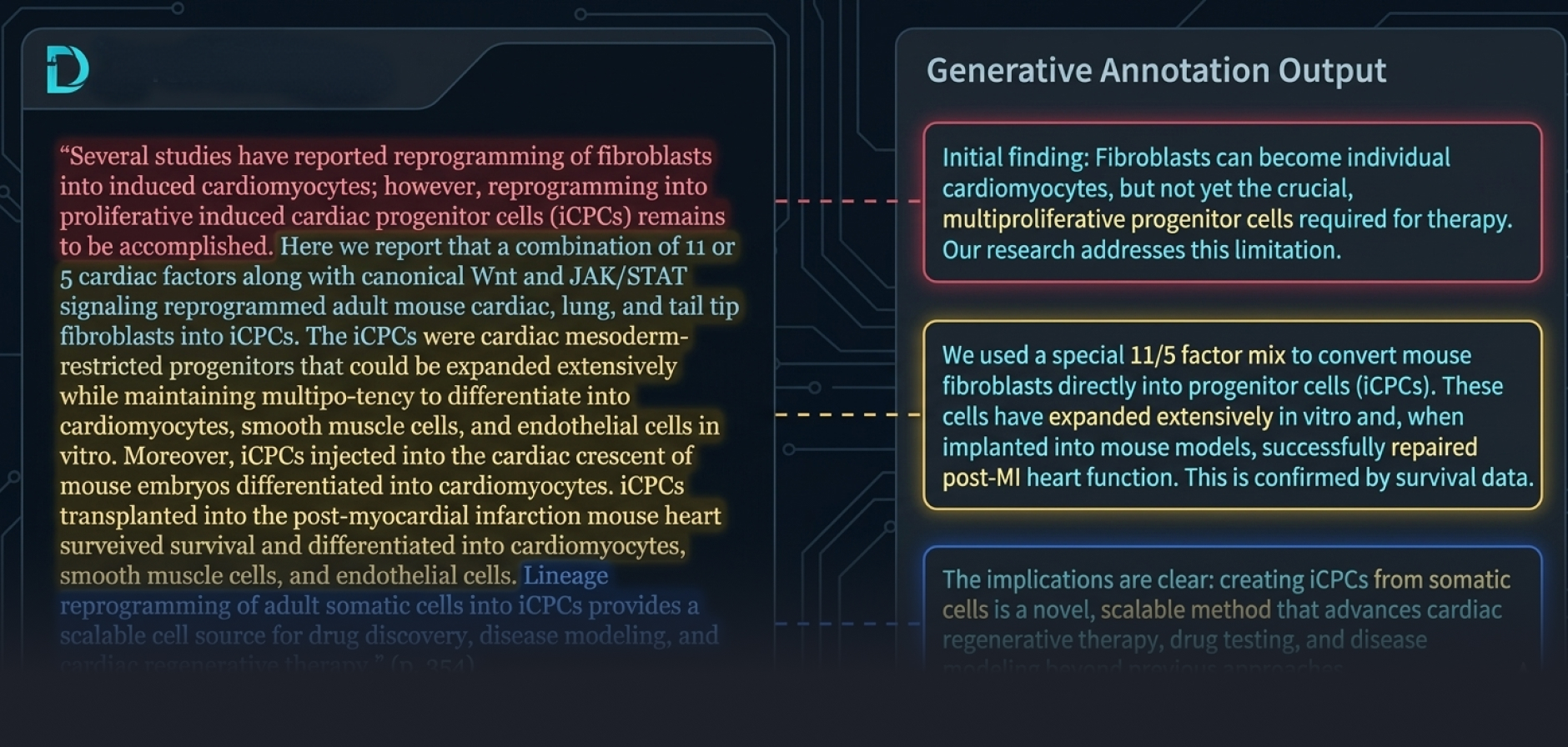
Marking verbatim spans from the source text that represent the answer, summary, or key information. Nothing is rewritten — annotators simply highlight what's important.

Abstractive Annotation

Generating a new, rephrased version of the source — usually a shorter summary, paraphrase, or simplification. Unlike extractive annotation, words and phrases in the abstract do not need to appear as in the original.

Categorizing feedback, support tickets, or in-app reviews by topic, intent, urgency, or sentiment to power routing and escalation models.

Highlighting specific contiguous text segments and tagging them — extracting answer spans, entity mentions, or sentiment targets with exact start and end positions.

Tagging names, dates, product tiers, and organization names within support tickets, contracts, CRM records, and user-generated content.

Localizing text regions with bounding boxes or polygons and transcribing the character sequence inside each — training models to detect and read text simultaneously.

Labeling each utterance in a conversation with its communicative function — e.g., Question, Statement, Acknowledgment, Request, Confirmation, Greeting, Backchannel.

Assigning a single label (or small label set) to an entire document based on its overall content — e.g., "spam / not spam," "positive/negative," "legal contract/invoice/resume."

Marking how two or more entities in a text are linked. Annotators identify entity spans (people, drugs, companies) and then draw labeled connections between them — "works_for," "treats," "located_in," "acquired_by."

Marking verbatim spans from the source text that represent the answer, summary, or key information. Nothing is rewritten — annotators simply highlight what's important.

Generating a new, rephrased version of the source — usually a shorter summary, paraphrase, or simplification. Unlike extractive annotation, words and phrases in the abstract do not need to appear as in the original.

TECH STACK

AI Data Services: Technology Stack

The Operational Stack Supporting Large-Scale AI Data Collection & Labeling

The infrastructure behind our AI data solutions is optimized for control and speed. This tech stack, implemented within our AI data preparation workflow, enables our AI training data services to remain predictable at scale, auditable under scrutiny, and dependable when models encounter real-world variability.

CONVERSATIONAL AI DATA LABELING SERVICES: USE CASES

Get Training Data Mapped to Your Customer Support AI Solution

Your customer support AI performs when the training dataset matches the job it is designed to perform—not when it trains on generic coverage. Complaint detection, call summarization, intent classification, or multilingual support — different tasks depend on different signals, context depth, label logic, and review criteria. When those use cases are treated as one shared NLP problem, supervision weakens, and model behavior drifts in production. SunTec’s AI training data services for customer service address it by aligning each dataset to the specific support decision the model must classify, detect, summarize, rank, or generate. This gives you cleaner learning signals, stronger operational fit, and more dependable outcomes across customer-facing support workflows.

Conversational AI & Support Chatbots

What Your AI Needs to Do

Handle multi-turn support conversations, understand intent in context, capture key entities, manage handoffs, and generate grounded responses across chat, messaging, self-service, and screenshot-assisted support journeys.

The Operational Challenge

Customer conversations rarely arrive in a training-ready state. Similar requests are phrased differently, context drops between turns, handoff moments go unlabeled, and screenshot evidence sits outside the labeled record. That leaves the product with partial signals when it needs to answer precisely, stay coherent, and know when not to guess.

How We Solve It

For chatbot products, the core job is not “understanding chat” in the abstract. It is recognizing the right request, carrying forward the right context, and responding from the right evidence. We annotate those signals across conversations and screenshots so the model can interpret intent more reliably, hold context across turns, and produce grounded responses in real support interactions.

Customer Sentiment & Experience Intelligence

What Your AI Needs to Do

Read customer sentiment with greater precision, detect early signs of experience deterioration, and distinguish mild frustration from meaningful dissatisfaction across support interactions, surveys, reviews, and post-resolution feedback.

The Operational Challenge

Most support datasets reduce sentiment to simple polarity labels. That hides nuanced sarcasm, mixed reactions, service-specific dissatisfaction, and the exact issue behind the emotion. The product may detect negative language, but still miss what is actually breaking the customer experience and where the service journey is starting to fail.

How We Solve It

We annotate polarity, emotion intensity, complaint severity, service aspects, and linked opinion spans across support text. That produces richer sentiment analysis datasets for support platforms and improves the interpretation of customer feedback. It also helps customer experience models detect dissatisfaction patterns before they surface as churn, escalation, or repeat contact.

AI Agents & Support Copilots

What Your AI Needs to Do

Support agents with next-step guidance, knowledge retrieval, action suggestions, and controlled decision support while staying within escalation logic, policy boundaries, and service rules.

The Operational Challenge

These products break when the data captures what was said, but not what should happen next. Action triggers, knowledge references, escalation conditions, and decision boundaries are often buried inside messy support records. Without those signals, copilots sound capable but behave inconsistently when real workflows become more complex.

How We Solve It

We annotate customer-agent turns, support entities, knowledge references, escalation triggers, and visual evidence, including screenshots, that affect handling quality. That gives agentic AI systems cleaner learning signals for live guidance, knowledge surfacing, and monitoring use cases, while supporting enterprise customer service AI data services with stronger operational fit and review precision.

Call Center Speech & Voice Analytics

What Your AI Needs to Do

Turn support-call transcripts into structured records that surface issue patterns, escalation moments, sentiment shifts, and resolution signals for analytics, QA review, and performance monitoring.

The Operational Challenge

Support-call data often reaches model teams as inconsistent transcripts with weak issue tagging, unclear turn-level context, and poorly marked escalation moments. That makes it harder for analytics products to separate one-off frustration from repeatable patterns and weakens the quality of downstream coaching, monitoring, and conversation intelligence built on transcript data.

How We Solve It

We begin by annotating issue entities, escalation spans, complaint moments, and transcript-level outcomes around the exact questions the product must answer. That improves call transcript labeling and gives support analytics products cleaner signals for trend analysis, QA insight, and performance visibility.

Compliance & Fraud Detection in Support

What Your AI Needs to Do

Detect policy breaches, verification failures, suspicious behavior patterns, and fraud signals during ongoing customer support before they create regulatory, financial, or trust-related exposure.

The Operational Challenge

Fraud and compliance datasets are rare, and older customer support records are often messy, making it difficult to identify signs of fraud or policy violations. Risk signals are usually spread across conversation history, identity checks, supporting documents, and earlier actions rather than clearly marked in one place.

How We Solve It

We identify what counts as risk (customer failed ID check, request looks like account takeover, possible refund abuse, PII exposed) before customer interaction data annotation. Then we annotate those signals across conversations and supporting documents, using context from linked interactions where needed. That makes training data for customer support chatbots more accurate to detect real support risk, not just suspicious wording in isolation.

Product Issue Trend Detection & Topic Clustering

What Your AI Needs to Do

Detect recurring product issues early and group related customer interactions into meaningful clusters so support and product teams can spot patterns, prioritize action, and reduce diagnosis time.

The Operational Challenge

Customers describe the same issue in different languages. Product names are shortened, versions are omitted, symptoms are vague, and screenshot evidence often sits outside the labeled record. That delays trend detection and makes clustering noisy, even when the underlying issue is already spreading across the support queue.

How We Solve It

The product here is identifying the issue and recognizing when related interactions belong to the same pattern. We annotate issue categories, symptom spans, product and version entities, and screenshot text around that exact need. That produces cleaner conversation analytics and topic classification datasets for products that detect patterns before volume alone makes them obvious.

Automated Email Support Response Generation

What Your AI Needs to Do

Generate draft email responses that preserve context, follow policy, stay on-brand, and help agents resolve complex support cases faster with less rewrite effort.

The Operational Challenge

Email threads are rarely clean training pairs. Context gets buried in quoted chains, commitments are easy to miss, and attachments often contain the detail that changes the right response. Without that structure, the product drafts polished emails that still fail to clearly and completely address the actual support issue.

How We Solve It

We annotate email threads for carry-forward context, policy references, customer commitments, support entities, and attachment text where it affects resolution quality. That gives the model cleaner supervision for replies that agents can review quickly instead of rewriting from scratch.

Automated Ticket Classification & Routing

What Your AI Needs to Do

Classify tickets by issue type, urgency, product area, language, and required skill so cases reach the right queue faster and manual triage drops significantly.

The Operational Challenge

Legacy ticket archives usually carry inconsistent taxonomies, duplicated issue groups, weak urgency markers, and incomplete resolution context. When screenshots or attached evidence change the correct label but stay unstructured, routing models learn partial logic and create the same reassignment loops they were meant to reduce.

How We Solve It

We annotate issue hierarchies, urgency signals, ownership cues, and attachment text against that logic. That gives routing models cleaner supervision for issue classification, urgency detection, and queue assignment, helping reduce manual triage and improve routing accuracy in production.

Multilingual Customer Support AI

What Your AI Needs to Do

Support customers across languages, dialects, and localized service contexts without losing intent accuracy, escalation sensitivity, knowledge relevance, or response consistency across markets.

The Operational Challenge

Multilingual support data often exhibits direct translation bias, inconsistent labels, weak language metadata, and poor handling of localized phrasing. The result is familiar: the product performs well in one market, then loses precision when customers switch language, script, or region-specific support vocabulary inside real interactions.

How We Solve It

We start by annotating localized intents, support entities, language metadata, and screenshot text against market-specific phrasing and terminology. That strengthens multilingual support datasets, helping AI behave more consistently across languages, markets, and localized support contexts.

Conversation Quality Monitoring & Summarization

What Your AI Needs to Do

Evaluate interaction quality consistently and generate faithful summaries that supervisors, agents, and downstream systems can use for coaching, QA, documentation, and handoff workflows.

The Operational Challenge

Quality-assurance scores are often applied unevenly, while summary datasets miss key actions, unsupported claims, or resolution details. That leaves the product learning two bad habits at once: inconsistent quality judgment and summaries that sound complete but drop the information support teams need later.

How We Solve It

We mark critical conversation spans, annotate source-grounded summary content, identify coaching moments, and label resolution markers with calibrated review guidelines. This dataset helps train better quality-monitoring and summarization models that score interactions consistently and generate reliable support summaries without context loss or unsupported claims.

Customer Complaint Detection

What Your AI Needs to Do

Identify complaints, assess their severity, and surface cases that require regulated handling, escalation, or faster customer recovery before they escalate into larger service problems.

The Operational Challenge

Complaint data is rarely labeled cleanly. Routine dissatisfaction, emotional feedback, formal grievances, and escalation-worthy complaints often sit in the same pool, especially in older support records. That makes it hard for the product to decide what counts as a complaint and what requires stronger downstream action.

How We Solve It

To provide a complaint-detection AI with a clear threshold rather than a generic negative-sentiment signal, we annotate complaint spans, seriousness cues, target attribution, and escalation relationships. That gives the model cleaner supervision for prioritization, regulated handling, and customer recovery planning, helping support teams separate ordinary friction from the cases that need faster, more controlled action.

Knowledge Base Optimization AI

What Your AI Needs to Do

Match customer questions to the right “Help” content, identify topic coverage gaps, and improve self-service performance by strengthening retrieval, improving answer precision, and increasing article relevance.

The Operational Challenge

Support queries and knowledge assets are rarely mapped in the same language that customers actually use. Low-relevance matches, outdated articles, zero-result searches, and screenshot-heavy content degrade retrieval quality by failing to surface the right content.

How We Solve It

We annotate query-to-article relevance, relevant answer sections, content gaps, and screenshot-based help content around that exact retrieval problem. That helps retrieval models surface better answers, rank content more accurately, and improve self-service quality.

Customer Journey & Behavior Analytics

What Your AI Needs to Do

Reconstruct cross-channel customer journeys and identify friction, repeat effort, churn signals, and next-step opportunities across support, CRM, product, and retention touchpoints.

The Operational Challenge

Journey data is usually fragmented across chats, tickets, emails, CRM events, and feedback records. That makes it difficult to see where effort accumulates, where a customer repeats the same request, or where an interaction changes the next outcome. The product gets events, but not a usable journey story.

How We Solve It

We aggregate support-related data from disparate sources, link data for the same customer across all touchpoints, and annotate journey stages, interaction outcomes, channel transitions, repeat-contact patterns, and touchpoint relationships. That produces stronger customer behavior datasets and cleaner training inputs for models that need to detect friction and forecast escalation.

What Your AI Needs to Do

Handle multi-turn support conversations, understand intent in context, capture key entities, manage handoffs, and generate grounded responses across chat, messaging, self-service, and screenshot-assisted support journeys.

The Operational Challenge

Customer conversations rarely arrive in a training-ready state. Similar requests are phrased differently, context drops between turns, handoff moments go unlabeled, and screenshot evidence sits outside the labeled record. That leaves the product with partial signals when it needs to answer precisely, stay coherent, and know when not to guess.

How We Solve It

For chatbot products, the core job is not “understanding chat” in the abstract. It is recognizing the right request, carrying forward the right context, and responding from the right evidence. We annotate those signals across conversations and screenshots so the model can interpret intent more reliably, hold context across turns, and produce grounded responses in real support interactions.

What Your AI Needs to Do

Read customer sentiment with greater precision, detect early signs of experience deterioration, and distinguish mild frustration from meaningful dissatisfaction across support interactions, surveys, reviews, and post-resolution feedback.

The Operational Challenge

Most support datasets reduce sentiment to simple polarity labels. That hides nuanced sarcasm, mixed reactions, service-specific dissatisfaction, and the exact issue behind the emotion. The product may detect negative language, but still miss what is actually breaking the customer experience and where the service journey is starting to fail.

How We Solve It

We annotate polarity, emotion intensity, complaint severity, service aspects, and linked opinion spans across support text. That produces richer sentiment analysis datasets for support platforms and improves the interpretation of customer feedback. It also helps customer experience models detect dissatisfaction patterns before they surface as churn, escalation, or repeat contact.

What Your AI Needs to Do

Support agents with next-step guidance, knowledge retrieval, action suggestions, and controlled decision support while staying within escalation logic, policy boundaries, and service rules.

The Operational Challenge

These products break when the data captures what was said, but not what should happen next. Action triggers, knowledge references, escalation conditions, and decision boundaries are often buried inside messy support records. Without those signals, copilots sound capable but behave inconsistently when real workflows become more complex.

How We Solve It

We annotate customer-agent turns, support entities, knowledge references, escalation triggers, and visual evidence, including screenshots, that affect handling quality. That gives agentic AI systems cleaner learning signals for live guidance, knowledge surfacing, and monitoring use cases, while supporting enterprise customer service AI data services with stronger operational fit and review precision.

What Your AI Needs to Do

Turn support-call transcripts into structured records that surface issue patterns, escalation moments, sentiment shifts, and resolution signals for analytics, QA review, and performance monitoring.

The Operational Challenge

Support-call data often reaches model teams as inconsistent transcripts with weak issue tagging, unclear turn-level context, and poorly marked escalation moments. That makes it harder for analytics products to separate one-off frustration from repeatable patterns and weakens the quality of downstream coaching, monitoring, and conversation intelligence built on transcript data.

How We Solve It

We begin by annotating issue entities, escalation spans, complaint moments, and transcript-level outcomes around the exact questions the product must answer. That improves call transcript labeling and gives support analytics products cleaner signals for trend analysis, QA insight, and performance visibility.

What Your AI Needs to Do

Detect policy breaches, verification failures, suspicious behavior patterns, and fraud signals during ongoing customer support before they create regulatory, financial, or trust-related exposure.

The Operational Challenge

Fraud and compliance datasets are rare, and older customer support records are often messy, making it difficult to identify signs of fraud or policy violations. Risk signals are usually spread across conversation history, identity checks, supporting documents, and earlier actions rather than clearly marked in one place.

How We Solve It

We identify what counts as risk (customer failed ID check, request looks like account takeover, possible refund abuse, PII exposed) before customer interaction data annotation. Then we annotate those signals across conversations and supporting documents, using context from linked interactions where needed. That makes training data for customer support chatbots more accurate to detect real support risk, not just suspicious wording in isolation.

What Your AI Needs to Do

Detect recurring product issues early and group related customer interactions into meaningful clusters so support and product teams can spot patterns, prioritize action, and reduce diagnosis time.

The Operational Challenge

Customers describe the same issue in different languages. Product names are shortened, versions are omitted, symptoms are vague, and screenshot evidence often sits outside the labeled record. That delays trend detection and makes clustering noisy, even when the underlying issue is already spreading across the support queue.

How We Solve It

The product here is identifying the issue and recognizing when related interactions belong to the same pattern. We annotate issue categories, symptom spans, product and version entities, and screenshot text around that exact need. That produces cleaner conversation analytics and topic classification datasets for products that detect patterns before volume alone makes them obvious.

What Your AI Needs to Do

Generate draft email responses that preserve context, follow policy, stay on-brand, and help agents resolve complex support cases faster with less rewrite effort.

The Operational Challenge

Email threads are rarely clean training pairs. Context gets buried in quoted chains, commitments are easy to miss, and attachments often contain the detail that changes the right response. Without that structure, the product drafts polished emails that still fail to clearly and completely address the actual support issue.

How We Solve It

We annotate email threads for carry-forward context, policy references, customer commitments, support entities, and attachment text where it affects resolution quality. That gives the model cleaner supervision for replies that agents can review quickly instead of rewriting from scratch.

What Your AI Needs to Do

Classify tickets by issue type, urgency, product area, language, and required skill so cases reach the right queue faster and manual triage drops significantly.

The Operational Challenge

Legacy ticket archives usually carry inconsistent taxonomies, duplicated issue groups, weak urgency markers, and incomplete resolution context. When screenshots or attached evidence change the correct label but stay unstructured, routing models learn partial logic and create the same reassignment loops they were meant to reduce.

How We Solve It

We annotate issue hierarchies, urgency signals, ownership cues, and attachment text against that logic. That gives routing models cleaner supervision for issue classification, urgency detection, and queue assignment, helping reduce manual triage and improve routing accuracy in production.

What Your AI Needs to Do

Support customers across languages, dialects, and localized service contexts without losing intent accuracy, escalation sensitivity, knowledge relevance, or response consistency across markets.

The Operational Challenge

Multilingual support data often exhibits direct translation bias, inconsistent labels, weak language metadata, and poor handling of localized phrasing. The result is familiar: the product performs well in one market, then loses precision when customers switch language, script, or region-specific support vocabulary inside real interactions.

How We Solve It

We start by annotating localized intents, support entities, language metadata, and screenshot text against market-specific phrasing and terminology. That strengthens multilingual support datasets, helping AI behave more consistently across languages, markets, and localized support contexts.

What Your AI Needs to Do

Evaluate interaction quality consistently and generate faithful summaries that supervisors, agents, and downstream systems can use for coaching, QA, documentation, and handoff workflows.

The Operational Challenge

Quality-assurance scores are often applied unevenly, while summary datasets miss key actions, unsupported claims, or resolution details. That leaves the product learning two bad habits at once: inconsistent quality judgment and summaries that sound complete but drop the information support teams need later.

How We Solve It

We mark critical conversation spans, annotate source-grounded summary content, identify coaching moments, and label resolution markers with calibrated review guidelines. This dataset helps train better quality-monitoring and summarization models that score interactions consistently and generate reliable support summaries without context loss or unsupported claims.

What Your AI Needs to Do

Identify complaints, assess their severity, and surface cases that require regulated handling, escalation, or faster customer recovery before they escalate into larger service problems.

The Operational Challenge

Complaint data is rarely labeled cleanly. Routine dissatisfaction, emotional feedback, formal grievances, and escalation-worthy complaints often sit in the same pool, especially in older support records. That makes it hard for the product to decide what counts as a complaint and what requires stronger downstream action.

How We Solve It

To provide a complaint-detection AI with a clear threshold rather than a generic negative-sentiment signal, we annotate complaint spans, seriousness cues, target attribution, and escalation relationships. That gives the model cleaner supervision for prioritization, regulated handling, and customer recovery planning, helping support teams separate ordinary friction from the cases that need faster, more controlled action.

What Your AI Needs to Do

Match customer questions to the right “Help” content, identify topic coverage gaps, and improve self-service performance by strengthening retrieval, improving answer precision, and increasing article relevance.

The Operational Challenge

Support queries and knowledge assets are rarely mapped in the same language that customers actually use. Low-relevance matches, outdated articles, zero-result searches, and screenshot-heavy content degrade retrieval quality by failing to surface the right content.

How We Solve It

We annotate query-to-article relevance, relevant answer sections, content gaps, and screenshot-based help content around that exact retrieval problem. That helps retrieval models surface better answers, rank content more accurately, and improve self-service quality.

What Your AI Needs to Do

Reconstruct cross-channel customer journeys and identify friction, repeat effort, churn signals, and next-step opportunities across support, CRM, product, and retention touchpoints.

The Operational Challenge

Journey data is usually fragmented across chats, tickets, emails, CRM events, and feedback records. That makes it difficult to see where effort accumulates, where a customer repeats the same request, or where an interaction changes the next outcome. The product gets events, but not a usable journey story.

How We Solve It

We aggregate support-related data from disparate sources, link data for the same customer across all touchpoints, and annotate journey stages, interaction outcomes, channel transitions, repeat-contact patterns, and touchpoint relationships. That produces stronger customer behavior datasets and cleaner training inputs for models that need to detect friction and forecast escalation.

Security and Compliance

Your data security is our priority

ISO
Certified

HIPAA
compliance

GDPR

GDPR
adherence

Regular
security audits

Encrypted data
transmission

Secure
cloud storage

CONTACT US

Start with a Pilot on Your Actual Data

Send us the sample that is blocking model performance—misrouted tickets, overlapping intents, weak summaries, or multilingual support data that your current workflow cannot label cleanly. We will run it through our delivery process so you can assess annotation quality, QA rigor, and support-domain fit on your own dataset. Reach out to know more.

FAQ - Frequently Asked Questions

AI Training Data Services for Customer Service

When creating AI training data for customer support, we begin with a structured onboarding and calibration process. We develop project-specific annotation guidelines with your team, covering intent taxonomy, escalation criteria, sentiment definitions, resolution outcomes, complaint signals, entity classes, and edge cases unique to your support environment.

Our annotators then complete calibration exercises on sample datasets such as chat transcripts, support tickets, call logs, email threads, or CRM-linked interactions. Their outputs are benchmarked against expert-reviewed ground truth before production begins. Only annotators who meet accuracy thresholds move into live production.

Once the project is underway, our QA leads run ongoing quality reviews, inter-annotator agreement checks, and periodic recalibration as your customer support machine learning datasets evolve. This helps maintain annotation accuracy across the full delivery lifecycle.

Yes. We offer both a free sample and a paid pilot, depending on how much validation you need before moving forward. If you want a quick assessment of output quality, annotation style, and taxonomy alignment, request a free sample, and we will process a small batch of your support data.

If you want to validate the full workflow, including tooling compatibility, delivery format, turnaround, and quality at scale, we can run a paid pilot in your actual environment. That may include customer service data annotation services, chatbot training data services, LLM fine-tuning support, or AI model validation, depending on what your support AI pipeline requires. Contact us at info@suntecindia.com to get started.

Taxonomy changes can occur mid-project for several reasons, including new product lines, updated routing logic, revised escalation rules, shifts in support volume, or changes in how your teams classify issues. We handle such changes through a structured recalibration process:

  • Update the annotation guidelines
  • Retrain affected annotators on the revised taxonomy
  • Run a fresh calibration exercise on sample data to verify consistency
  • Audit previously labeled data to determine whether re-annotation is needed or whether existing labels can be mapped to the new schema

Our goal is to absorb change without restarting the project and without letting revised labels introduce inconsistency into your conversational AI model training data.

Data volumes can increase mid-project for several reasons, including product launches, seasonal spikes, support backlogs, policy changes, channel expansion, or sudden shifts in customer inquiry patterns. When you need additional capacity, we onboard and calibrate new annotators within one to two weeks. That includes project-specific training, guideline review, sample annotation exercises, and benchmarking against your existing ground truth. This allows new team members to enter production at the same quality level as your current team, whether the work involves customer feedback annotation, dialogue dataset labeling, or large-scale conversational AI data annotation services.

All annotated datasets, raw data, and project-specific annotation guidelines developed during the engagement remain the client’s intellectual property upon project completion. That includes support tickets, chat transcripts, customer support ticket datasets, CRM-linked records, large language model training datasets, and any custom taxonomy or labeling framework created for your project. We do not retain copies, reuse client data for other accounts, or repurpose your annotation guidelines for external projects.

Turnaround depends on dataset volume, annotation complexity, number of label classes, and your QA requirements. For example, straightforward intent detection datasets move faster than multi-turn dialogue labeling, complaint detection, or speech-to-text training datasets for call center AI. Before work begins, we share a detailed project plan with milestone-level delivery dates so you know what to expect and when. If you need a faster turnaround, we can structure the team and workflow accordingly without compromising quality.

Our annotators are trained to flag ambiguous cases instead of guessing. In customer support datasets, those edge cases may include mixed-intent conversations, unresolved escalation cues, sarcasm in customer feedback, overlapping issue categories, multilingual interactions, or support tickets with incomplete resolution context. Flagged cases are escalated to the project’s QA lead. If the issue can be resolved using the existing guidelines, the lead makes the decision. If it falls outside guideline coverage, it is routed to your team for a final ruling. That ruling is then documented, added to the guideline set as a reference example, and shared back with the full annotation team.

Yes. We regularly work within client-provided annotation environments, whether that is your own CVAT or Labelbox instance, or any proprietary internal tool your team has standardized on. We also deliver datasets in the format your ML pipeline requires — JSON, CSV, TXT, XML, or custom specifications — so your engineering and data science teams can ingest the output without extra conversion steps.

Yes. We help close training-data gaps by sourcing, filtering, and assembling datasets around the exact support use case your model is being built for, from publicly available sources. Depending on fit, that may include conversation samples, product review datasets, customer feedback datasets, multilingual support corpora, and open NLP datasets for customer support. We can also combine those inputs with your proprietary support data, then clean, standardize, and structure the final dataset for annotation, fine-tuning, or validation.

Building in-house can work when the scope is narrow, the taxonomy is stable, and your team already has the time, tooling, QA capacity, and annotation management discipline in place. In most customer support AI programs, that is not the reality. Taxonomies evolve, edge cases increase, volumes fluctuate, and the cost of weak labels shows up later in routing errors, unreliable summaries, lower AI agent quality, and more review effort.

When you outsource conversational AI data labeling services to a customer support data labeling company, it gives you a delivery model built for that complexity. You get trained teams, project-specific guideline design, calibration workflows, QA oversight, inter-annotator agreement checks, and the flexibility to scale without building fixed internal capacity around every new use case. The advantage you get is stronger process control, faster ramp-up, and better-quality datasets that help your models perform more reliably in production.

We protect PII and sensitive business data through controlled annotation workflows. Based on project requirements, we implement role-based access controls, encrypted transfers, restricted work environments, NDA-backed access controls, and data minimization. Where needed, we also support pre-annotation PII detection, masking, and redaction, so annotators work only on the fields required for the task. This protects customer records, account-linked data, internal notes, and regulated support interactions while maintaining annotation quality and audit readiness.

Yes. Our scope goes well beyond chatbot training data services. We prepare training data for AI agents, AI copilots, agent-assist tools, summarization systems, routing models, and knowledge-guided support workflows. Depending on the use case, we annotate context windows, action triggers, escalation conditions, policy boundaries, retrieval cues, support entities, and resolution signals across chats, tickets, transcripts, and email threads. That makes our customer service data annotation services suitable for both customer-facing AI and internal support copilots that assist human agents in real time.