The client is a German technology company specializing in digital solutions for asset management across multiple industries. Leveraging advanced drone technology, artificial intelligence, and proprietary software platforms, they offer rapid and secure aerial data collection, helping to address critical challenges in environmental monitoring, forestry management, infrastructure maintenance, and similar domains.
The client was developing an AI-powered solution to automatically detect and monitor obstructions in river-flow paths, supporting proactive environmental monitoring and water resource management for municipal authorities and environmental agencies.
To train this machine learning model to accurately identify the obstructions (fallen trees, accumulated debris, overgrown vegetation, etc.) that impede water flow, leading to increased flooding risks, ecosystem disruption, and navigation hazards, the client had collected aerial images of river paths using their drone fleet and required precise and fast image annotation on this growing dataset.
The client required image annotation services for approximately 75,000 high-resolution aerial images captured across multiple river systems under varying environmental conditions. The annotation work needed to be performed exclusively within the client's proprietary annotation platform to ensure seamless integration with their existing data pipeline.
Specific requirements included:
The scale and complexity of image labeling for aerial river monitoring presented unique obstacles. From deciphering what constitutes an actual obstruction in overhead imagery to ensuring that all the team maintained identical classification standards across thousands of images, the project demanded systematic problem-solving at every stage.
It was challenging to distinguish actual obstructions from non-obstructive debris (logs on riverbanks or branches in shallow areas away from the main flow) that visually resembled blockages but didn't impede water movement. Water reflections, changing seasons, and varying lighting added complexity, requiring annotators to understand water flow patterns and object positioning to accurately identify genuine obstructions in the river’s path.
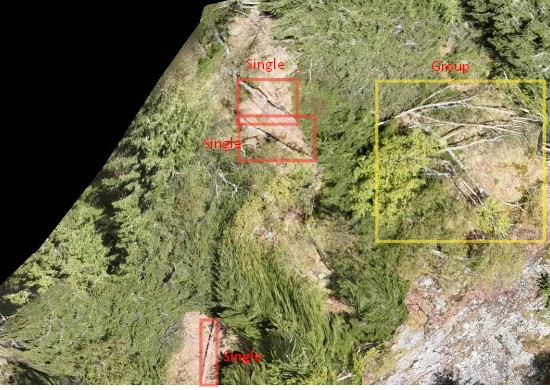
With 75,000 images spanning different river systems, weather conditions, and seasons, ensuring annotation consistency across multiple annotators was critical. Edge cases, such as partially submerged objects or debris clusters, required clear guidelines and regular team discussions to ensure everyone applied the same standards when classifying obstructions as "Single" or "Group."
Fallen trees and scattered debris have irregular shapes that don't fit neatly into rectangular bounding boxes. Annotators had to decide how tightly or loosely to draw each box, carefully capturing the entire object without including too much unnecessary background, especially for long branches, partially visible objects, or items at the edges of the image (where an annotator had limited context to judge by).
The client's proprietary image and video annotation platform had unique interface elements, keyboard shortcuts, and workflow requirements that differed from standard annotation tools like CVAT or LabelStudio. Our team needed to master these platform-specific features while simultaneously maintaining productivity targets and quality benchmarks during the initial project phase.
Meeting the dual demands of high volume and exceptional accuracy required more than standard annotation practices. Our solution combined dedicated resources, specialized training, systematic quality controls, and adaptive workflows to deliver the accuracy, consistency, and reliability the client's AI model required.
We aligned a dedicated team of six full-time data annotators and one full-time Quality Assurance Lead, all with proven expertise in high-volume image annotation. This team worked exclusively on the client's project, gaining a deep familiarity with the annotation guidelines, consistently interpreting edge cases, and maintaining sustained productivity. The dedicated QA Lead provided real-time oversight, immediate feedback, and served as the primary liaison with the client's technical team.
Our team received training on the client's proprietary annotation platform for image labeling to ensure proficiency before production began. This onboarding included hands-on practice with the platform's unique interface, keyboard shortcuts, and workflow requirements, as well as a detailed review of the client's annotation taxonomy and guidelines. By investing in thorough platform familiarization upfront, we minimized errors and maintained productivity targets from the project's early stages.
To tackle the challenge of distinguishing genuine obstructions from non-obstructive debris, we created a reference document. Our team identified key visual indicators (such as water flow patterns, object positioning relative to the main channel, and contextual clues) that differentiate flow-blocking obstacles from harmless debris and documented them, allowing each team member to annotate images consistently and accurately.
The QA Lead also held bi-weekly calibration meetings with the client to review challenging edge cases and establish methods for handling them in this drone-based image annotation project.
Images were distributed in manageable daily batches to each annotator. This approach enabled focused annotation sessions, allowing the QA Lead to review completed batches systematically before delivery. The batching structure also facilitated better tracking of progress, identification of recurring challenges, and timely adjustments to our strategy for this high‑volume image annotation project.
Since the client expected 96% accuracy from our bounding box annotation services, we implemented additional internal quality measures to exceed expectations:
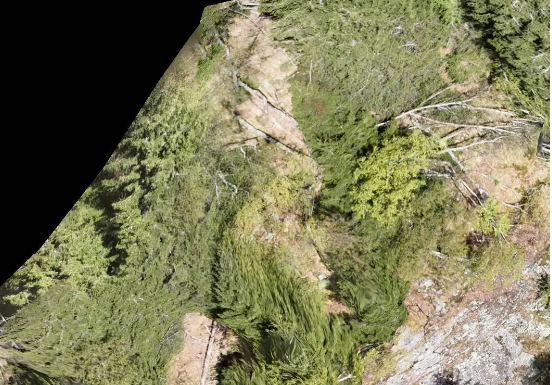
Raw image
Annotated image
We delivered a high-quality training dataset that met the client's demanding timeline and exceeded their accuracy benchmarks. Based on the quality and reliability demonstrated throughout this project, the client has engaged our data annotation services for ongoing work as they continue developing AI solutions for environmental monitoring and infrastructure management applications.
Consistent delivery at scale, with the ability to adjust speed based on the client’s needs.
Consistently exceeding the client’s quality expectations while ensuring on-time delivery.
Enabling the client to uphold their AI model development standards without delays.
They took the time to understand our specific requirements and built processes that actually worked. We barely had to send anything back for revision.
- Project Manager, AI Development Team
From aerial drone surveillance (improving object detection accuracy by 30%) to solar panel defect detection (35% AI accuracy improvement), urban traffic monitoring (35% increase in model accuracy), and vehicle damage assessment (40% improved object detection accuracy)—SunTec India has delivered measurable results for diverse AI/ML applications.
Our comprehensive image, video, and text annotation services are scalable and can be adapted to meet your specific training data needs. Try it out with a free data annotation sample.