Image Annotation Services for Computer Vision

AI-Assisted Pre-Labeling. Domain Expert Validation. Production-Ready Datasets.

  • Using Prominent Data Labeling Tools Like CVAT, V7, Labelbox, and Supervisely
  • Multi-Pass Human QA Conducted by Subject Matter Experts
  • Dedicated In-House Project Teams with Domain Expertise in AV, Agriculture, etc.
Get Your Image Annotation Proposal

Success Stories

...it's all about results

AUTOMATED COMPETITOR INTELLIGENCE

AUTOMATED COMPETITOR INTELLIGENCE

250K+ Retail Image Annotation Delivered per Month with 98.5% Annotation Accuracy

Read More
LIVESTOCK DETECTION

LIVESTOCK DETECTION

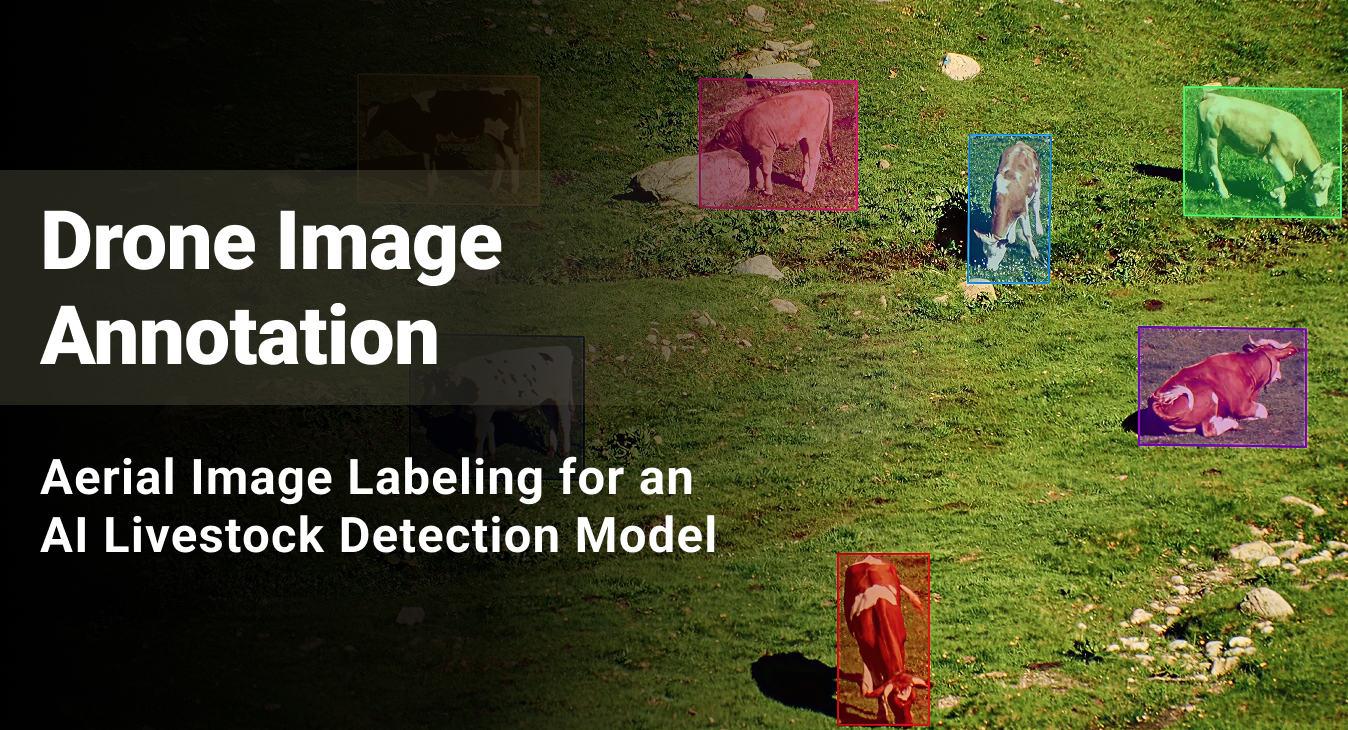
10K+ Drone Images Annotated per Month with 95%+ Labeling Accuracy

Read More

AUDIENCE RESPONSE PREDICTION

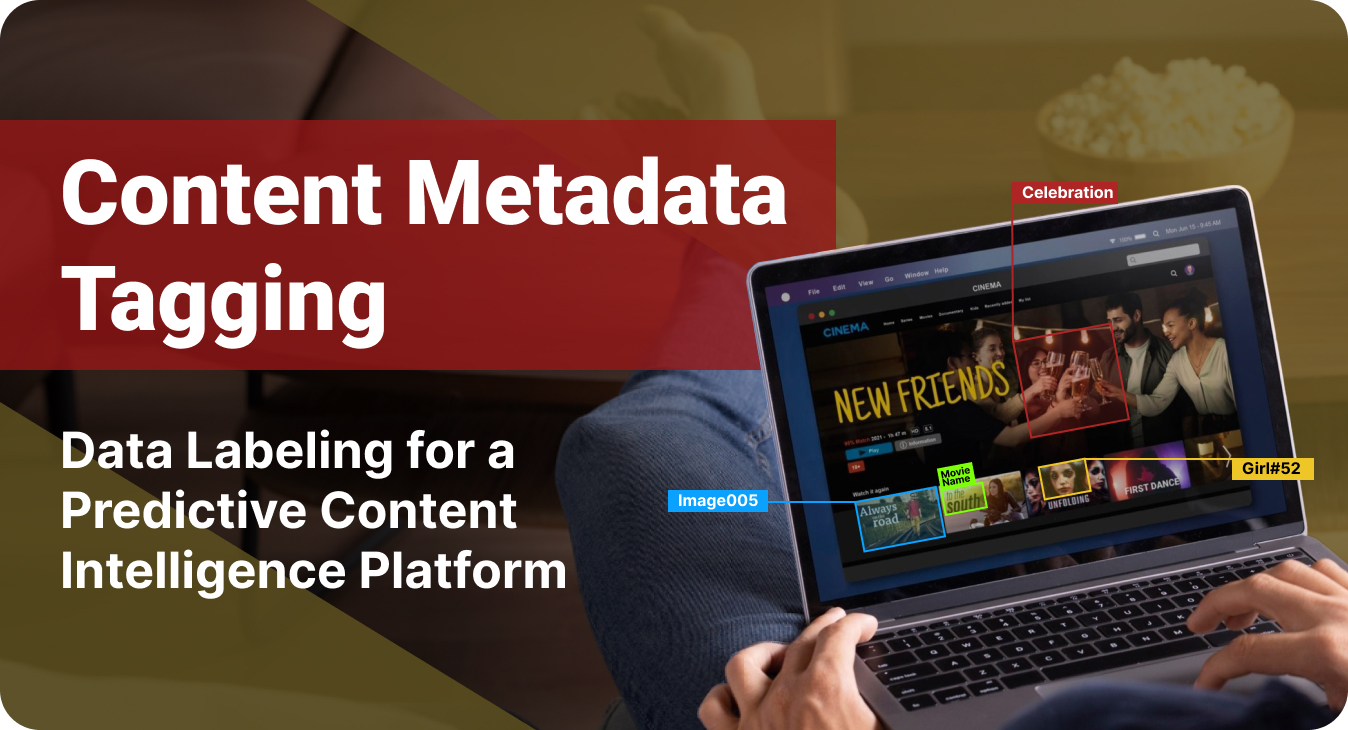
65% Improved AI Model Accuracy with Multilingual Content Metadata Tagging

Read More
Environmental Monitoring

Environmental Monitoring

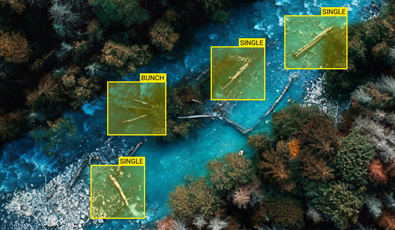
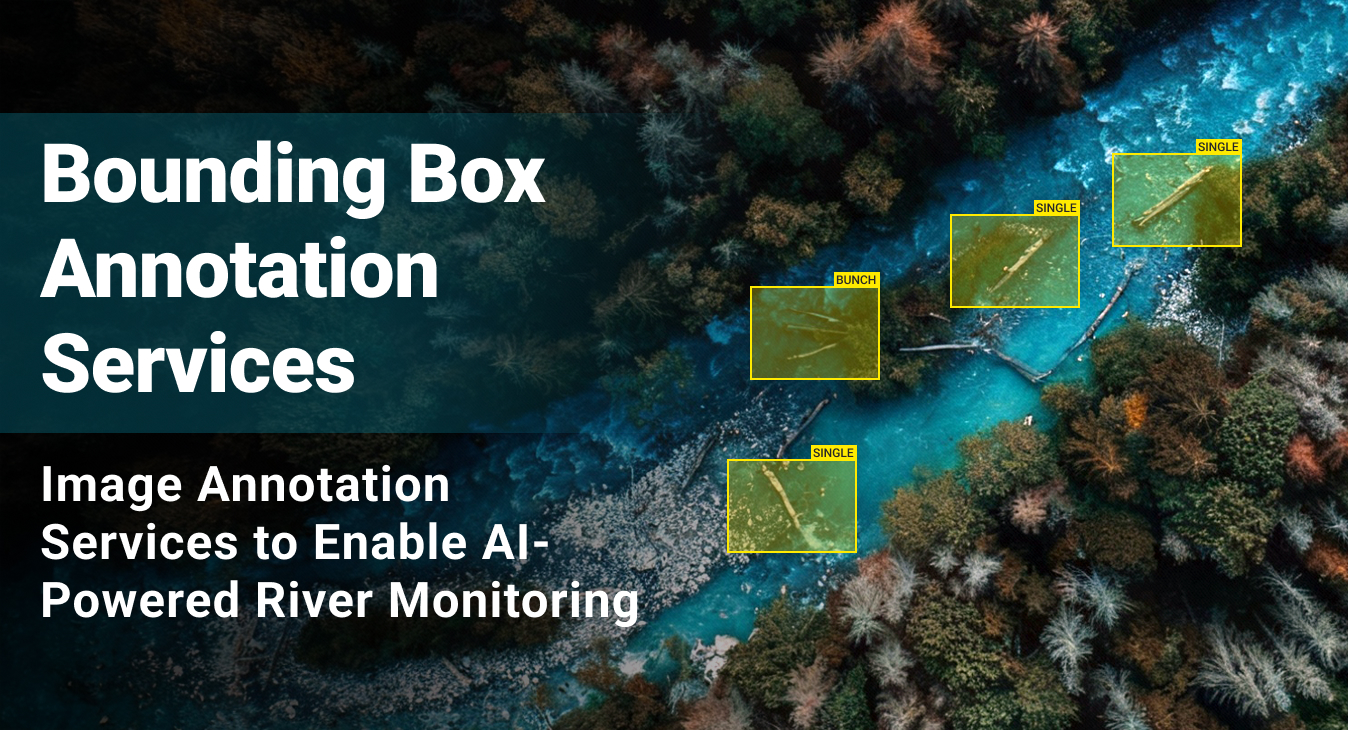
Bounding Box Image Annotation for AI-Powered River Monitoring — 1.5K-2K Images Labeled per Week

Read More

OUTSOURCE IMAGE ANNOTATION SERVICES

Get Production-Ready Accuracy in AI Training Datasets

With Domain-Specific Labels and SME Validation

Most annotation projects fail silently. The labels look clean in review, but the model underperforms in production because edge cases were guessed, ontologies were ambiguous, and inter-annotator agreement was never measured. We have engineered our image annotation services to prevent that — across projects ranging from 1000-image pilots to enterprise-scale programs with millions of labels.

Before image labeling can begin, our domain specialists define your annotation guidelines, edge case playbooks, and quality thresholds collaboratively with your ML team. Then we run AI-assisted pre-labeling in CVAT, V7, LabelBox, or your proprietary data annotation tool, followed by human review from annotators trained on your specific taxonomy. The result: 95-99% data labeling accuracy, validated through inter-annotator agreement metrics, implemented across varying enterprise scales with consistent outcomes.

SERVICES

Image Annotation Services: Our Techniques and Capabilities

Every Annotation Method Your Computer Vision Pipeline Demands

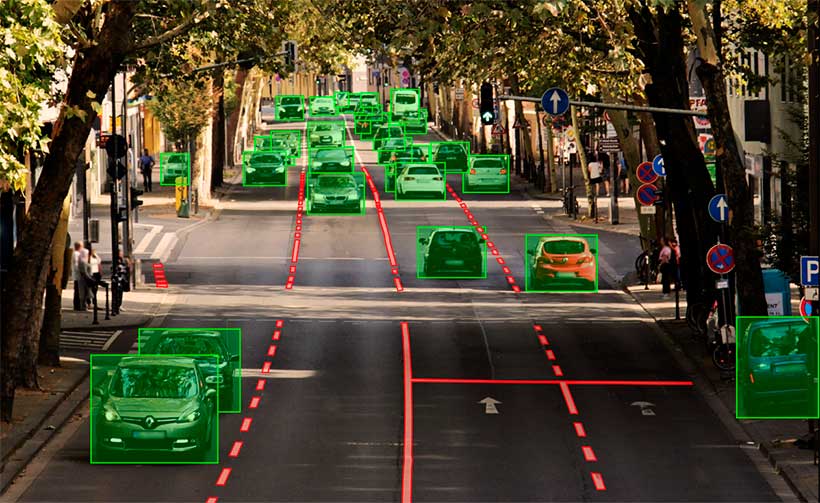
A retail shelf detection model needs tight bounding boxes, whereas an autonomous vehicle's perception stack requires pixel-level semantic segmentation synchronized with LiDAR point clouds. As an image annotation company with cross-industry execution, we configure the right annotation approach for your model architecture and data pipeline across 2D and 3D images.

2D/3D Bounding Box Annotation

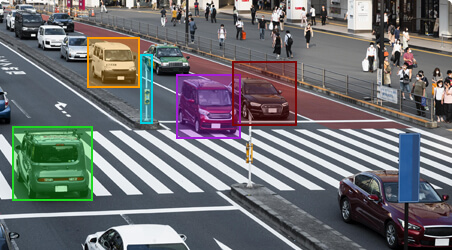
Loose boxes, inconsistent tightness, and dead space around objects are the fastest way to degrade your object detection model’s IoU scores. Our annotators follow documented tightness standards with attribute-level tagging (occluded, truncated, difficult), so your model trains on edge-aware data.

  • Tight-fit bounding boxes with consistent margin standards across annotators
  • Occlusion, truncation, and overlap tagging for robust object detection (YOLO, SSD, Faster R-CNN)
  • 3D cuboid annotation for depth-aware perception in robotics, autonomous vehicles, and AR/VR
Semantic Segmentation

Pixel-level classification fails when annotators are inconsistent at class boundaries — especially where road meets sidewalk, where tumor meets healthy tissue, or where crop meets soil. Our segmentation workflow uses AI-generated masks, refined by annotators trained on your boundary definitions.

  • Full-scene pixel-level classification with consistent class palettes across datasets
  • AI-assisted mask generation via SAM-based pre-labeling, refined by trained annotators
  • Panoptic segmentation support: combined stuff + thing labels in COCO panoptic format
Polygon Annotation
Polygon Annotation

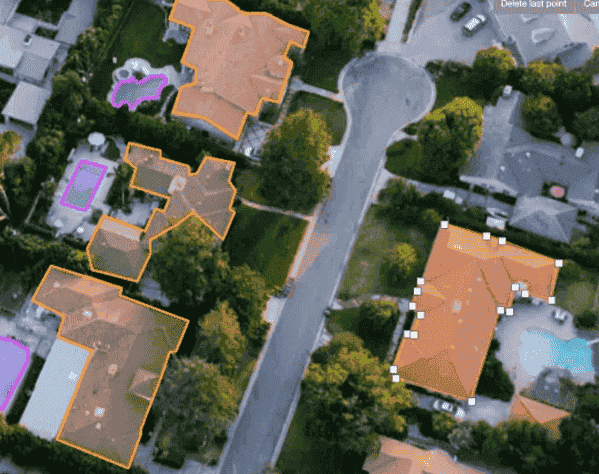
The real difficulty with polygon annotation is vertex density: too few vertices miss contours, too many slow throughput and introduce noise. Our annotators follow adaptive vertex density guidelines calibrated to object curvature, not arbitrary point counts. This matters when you need AI model training data to detect road signs at varied angles, building footprints in satellite imagery, or irregular defects in manufacturing.

  • Multi-point polygon tracing with vertex-level precision on irregular object boundaries
  • Nested and multi-region support for objects with holes or internal structures
  • Export-ready formats: COCO polygons, GeoJSON for geospatial, and custom schemas
Keypoint and Landmark Annotation
Keypoint Annotation

Keypoint schemas vary dramatically across use cases — COCO 17-point human pose, 68-point facial landmarks, custom hand-joint models. Annotators who are not trained on your specific schema produce inconsistent joint placements that cascade into pose estimation errors. Our teams are calibrated on your exact keypoint definitions, with visibility flags (visible, occluded, out-of-frame) enforced per joint.

  • Custom keypoint schemas: body pose (COCO 17-point), facial landmarks (68/98-point), hand tracking
  • Visibility flags: visible, occluded, and out-of-frame markers per point
  • Applications: sports analytics, physical therapy AI, gesture-controlled interfaces, driver monitoring
Instance Segmentation

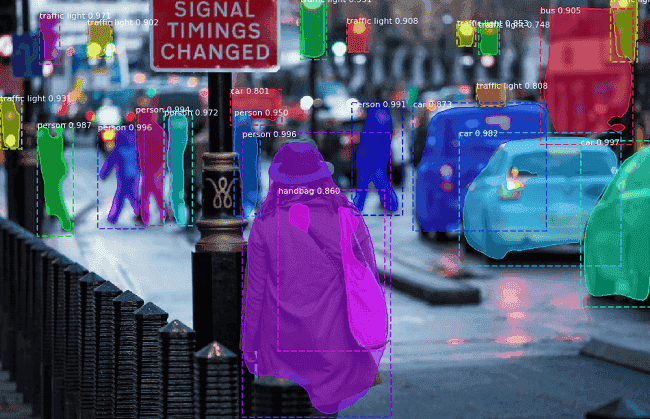
When your model needs to count, track, or differentiate individual objects of the same class — cells in a pathology slide, cars in a lot, products on a shelf — overlapping masks and missed instances compound into production failures. Our annotators handle heavy occlusion through layered masking with annotator-defined occlusion flags.

  • Per-instance mask generation with unique IDs for each object occurrence
  • Cross-frame instance consistency for video-derived image datasets
  • Dense scene support: warehouse inventory, crowd analysis, cell counting in pathology
Line and Polyline Annotation

Lane markings, power lines, pipelines, and conveyor boundaries require ordered vertex sequencing with directional awareness. Misordered vertices break downstream HD map generation and flow detection. Our annotators follow directional annotation protocols with spline-based smoothing for curved structures.

  • Lane marking and road boundary annotation for HD map creation and ADAS training
  • Utility and pipeline tracing for infrastructure inspection and GIS mapping
  • Directional polylines with consistent start/end conventions
3D Point Cloud and LiDAR Annotation
LiDAR Annotation

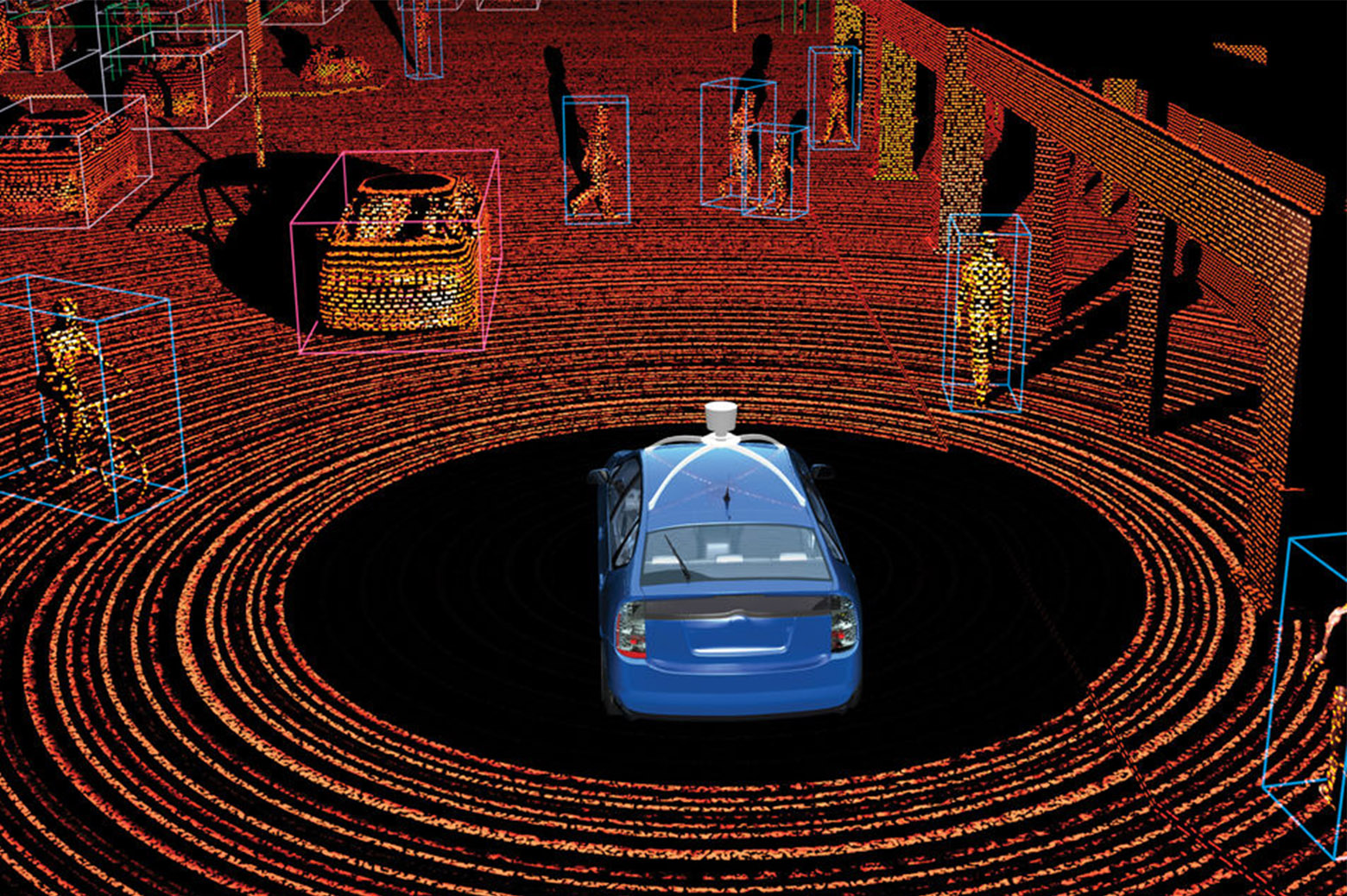
Safety-critical applications in autonomous transport, robotics, and industrial automation demand spatially accurate 3D labels. We annotate LiDAR point clouds with 3D cuboids, semantic labels, and temporal tracking across frames.

  • 3D bounding cuboids with orientation, heading, and velocity attributes
  • Semantic point-level labeling: ground, vegetation, vehicle, pedestrian, infrastructure
  • Camera-LiDAR alignment: synchronized 2D image annotation and 3D point cloud annotation
  • Temporal tracking: consistent object IDs across sequential scans
OCR Verification and Correction

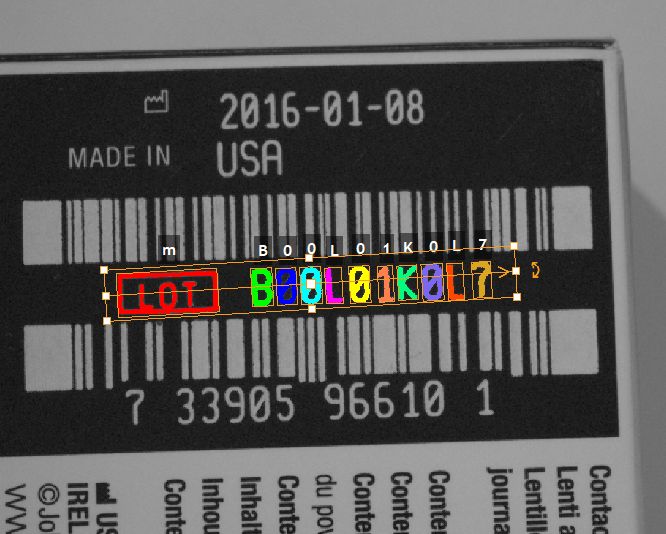
We verify and correct machine-extracted text from documents, signage, labels, and receipts, ensuring that your document understanding and text detection models are trained on clean ground truth. This is critical for invoices, IDs, and medical documents, where a single misread can have severe downstream consequences.

  • Character-level validation of OCR engine outputs across document types
  • Bounding box alignment correction for text detection AI model training
  • Multilingual OCR support: Latin, CJK, Arabic, Devanagari scripts

2D/3D Bounding Box Annotation

Loose boxes, inconsistent tightness, and dead space around objects are the fastest way to degrade your object detection model’s IoU scores. Our annotators follow documented tightness standards with attribute-level tagging (occluded, truncated, difficult), so your model trains on edge-aware data.

  • Tight-fit bounding boxes with consistent margin standards across annotators
  • Occlusion, truncation, and overlap tagging for robust object detection (YOLO, SSD, Faster R-CNN)
  • 3D cuboid annotation for depth-aware perception in robotics, autonomous vehicles, and AR/VR
Semantic Segmentation

Pixel-level classification fails when annotators are inconsistent at class boundaries — especially where road meets sidewalk, where tumor meets healthy tissue, or where crop meets soil. Our segmentation workflow uses AI-generated masks, refined by annotators trained on your boundary definitions.

  • Full-scene pixel-level classification with consistent class palettes across datasets
  • AI-assisted mask generation via SAM-based pre-labeling, refined by trained annotators
  • Panoptic segmentation support: combined stuff + thing labels in COCO panoptic format
Polygon Annotation

The real difficulty with polygon annotation is vertex density: too few vertices miss contours, too many slow throughput and introduce noise. Our annotators follow adaptive vertex density guidelines calibrated to object curvature, not arbitrary point counts. This matters when you need AI model training data to detect road signs at varied angles, building footprints in satellite imagery, or irregular defects in manufacturing.

  • Multi-point polygon tracing with vertex-level precision on irregular object boundaries
  • Nested and multi-region support for objects with holes or internal structures
  • Export-ready formats: COCO polygons, GeoJSON for geospatial, and custom schemas
Keypoint Annotation

Keypoint schemas vary dramatically across use cases — COCO 17-point human pose, 68-point facial landmarks, custom hand-joint models. Annotators who are not trained on your specific schema produce inconsistent joint placements that cascade into pose estimation errors. Our teams are calibrated on your exact keypoint definitions, with visibility flags (visible, occluded, out-of-frame) enforced per joint.

  • Custom keypoint schemas: body pose (COCO 17-point), facial landmarks (68/98-point), hand tracking
  • Visibility flags: visible, occluded, and out-of-frame markers per point
  • Applications: sports analytics, physical therapy AI, gesture-controlled interfaces, driver monitoring
Instance Segmentation

When your model needs to count, track, or differentiate individual objects of the same class — cells in a pathology slide, cars in a lot, products on a shelf — overlapping masks and missed instances compound into production failures. Our annotators handle heavy occlusion through layered masking with annotator-defined occlusion flags.

  • Per-instance mask generation with unique IDs for each object occurrence
  • Cross-frame instance consistency for video-derived image datasets
  • Dense scene support: warehouse inventory, crowd analysis, cell counting in pathology
Polyline Annotation

Lane markings, power lines, pipelines, and conveyor boundaries require ordered vertex sequencing with directional awareness. Misordered vertices break downstream HD map generation and flow detection. Our annotators follow directional annotation protocols with spline-based smoothing for curved structures.

  • Lane marking and road boundary annotation for HD map creation and ADAS training
  • Utility and pipeline tracing for infrastructure inspection and GIS mapping
  • Directional polylines with consistent start/end conventions
LiDAR Annotation

Safety-critical applications in autonomous transport, robotics, and industrial automation demand spatially accurate 3D labels. We annotate LiDAR point clouds with 3D cuboids, semantic labels, and temporal tracking across frames.

  • 3D bounding cuboids with orientation, heading, and velocity attributes
  • Semantic point-level labeling: ground, vegetation, vehicle, pedestrian, infrastructure
  • Camera-LiDAR alignment: synchronized 2D image annotation and 3D point cloud annotation
  • Temporal tracking: consistent object IDs across sequential scans
OCR Verification and Correction

We verify and correct machine-extracted text from documents, signage, labels, and receipts, ensuring that your document understanding and text detection models are trained on clean ground truth. This is critical for invoices, IDs, and medical documents, where a single misread can have severe downstream consequences.

  • Character-level validation of OCR engine outputs across document types
  • Bounding box alignment correction for text detection AI model training
  • Multilingual OCR support: Latin, CJK, Arabic, Devanagari scripts
PROCESS

How We Deliver Labeled Image Datasets at Expected Scale & Accuracy

From Ontology Design to Production-Ready Delivery in Controlled Stages

To handle enterprise-scale volumes without sacrificing label accuracy, our image annotation outsourcing workflow combines tool-based pre-labeling with structured multi-stage human review. Each stage has defined ownership, documented acceptance criteria, and measurable quality gates.

01

Our team collaborates with your ML engineers to define annotation guidelines that minimize inter-annotator disagreement. We establish class hierarchies, edge case protocols, attribute taxonomies, and acceptance criteria before a single image is labeled. This schema becomes the governing document for the entire project lifecycle.

02

We select the right labeling tool — CVAT, V7, Labelbox, or Supervisely — based on your data type and annotation complexity. Foundation model-based pre-labeling (including SAM-family models for segmentation tasks) generates initial annotations, considerably accelerating throughput on routine patterns while reducing annotator fatigue on repetitive tasks.

03

Every AI-generated label undergoes review by trained annotators with subject-matter expertise relevant to your vertical. Edge cases, ambiguous instances, and subjective judgments are escalated to project QA leads. Flagged cases that fall outside existing guidelines are routed to your team for definitive rulings, which are then documented and incorporated into the annotation schema.

04

We implement inter-annotator agreement (IAA) metrics, consensus adjudication for disputed labels, and automated validation checks before delivery. Production-ready annotations are exported in your required format — COCO, YOLO, Pascal VOC, Parquet, or custom specifications — to S3, GCS, Azure Blob, or directly into your annotation platform.

CLIENT SUCCESS STORIES

It's all about results.

The Proof is in the Pipeline

Discover how we’ve helped businesses across 50+ nations bridge the gap between "lab-ready" and "market-ready" AI/ML applications by solving their most complex training data challenges.

Retail Image Annotation

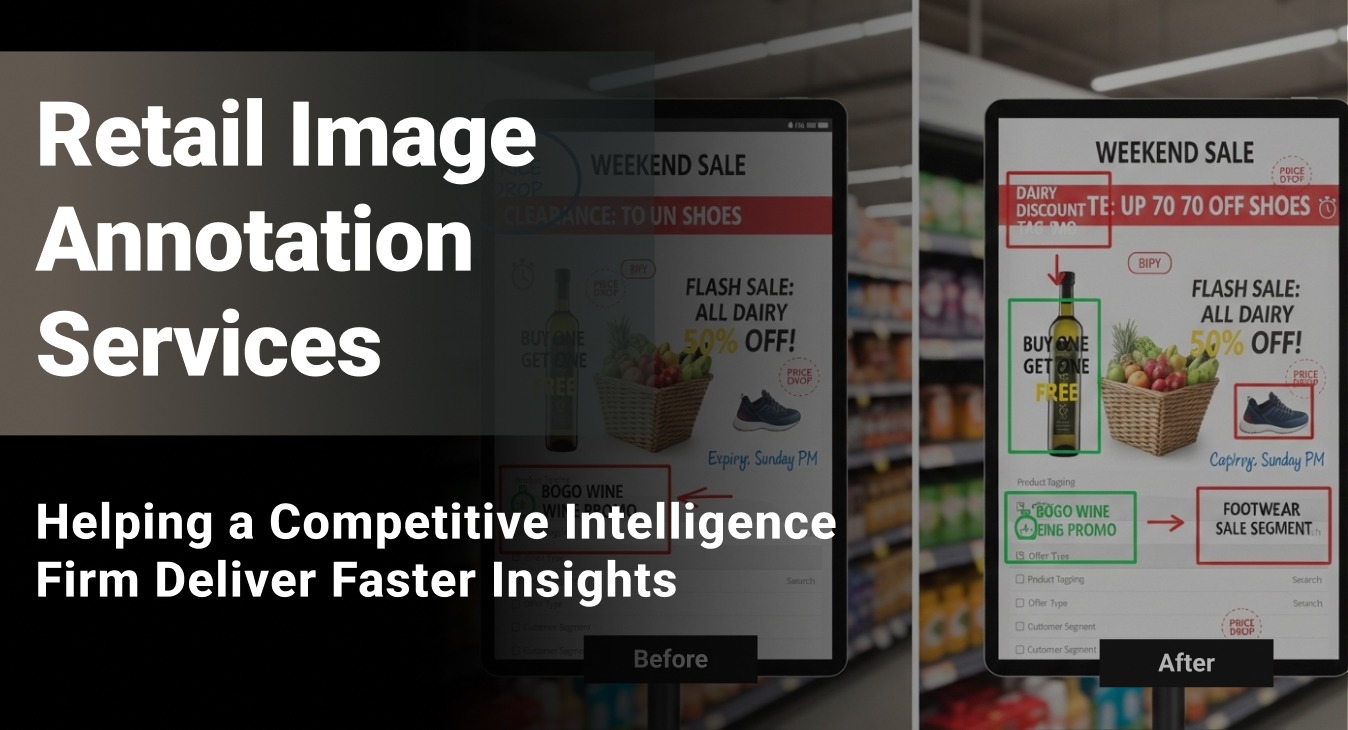
Bounding box annotation and metadata tagging across retail promotional images, powering competitive intelligence solutions for a US-based company.

250K+

Annotations Delivered Monthly

98.5%

Annotation Accuracy
Bounding Box Annotation Services

Precise bounding box annotation for high-resolution aerial river images to train an AI-powered river flow obstruction detection system using the client’s proprietary data annotation tool.

1,500 to 2,000

Images Labeled per Week

98%

Labeling Accuracy Rate Maintained

<1%

Revision/Rework Rate
  • Service Image Annotation
  • Platform Client’s Proprietary Annotation Platform
  • Industry Environmental Monitoring / Forestry
Drone Image Annotation

Labeled and validated over 10,000 high-resolution drone images monthly using QuPath to train an AI-powered livestock detection model, delivering 95%+ annotation accuracy.

10K+

Images Annotated Monthly

95%+

Labeling Accuracy
Data Labeling for a Predictive Content Intelligence Platform

Labeled over 2500 entertainment content (Movies, TV Series, Trailers) monthly to enable the accurate prediction of the target audience engagement rates and response.

65%

Improved AI Model Accuracy

60%

Less Content Categorization Errors

4-Month

Faster Model Development

View All

TECH STACK

Image Annotation Tools We Work With

Platform-Agnostic Execution across the Tools Your Pipeline Already Uses

The annotation toolstack behind our image labeling service is configured for three outcomes: throughput predictability at scale, audit-ready traceability on every label, and zero-friction integration with your existing ML pipeline. Whether you bring your own platform or need us to configure one, our annotators operate across the tools that enterprise computer vision teams standardize on.

Labelbox
SuperAnnotate AI
CVAT
Dataloop
Scale AI
V7
Keylabs
Label Studio
labelImg
Segments.ai
CloudCompare
Supervisely

HUMAN-IN-THE-LOOP IMAGE ANNOTATION OUTSOURCING

AI-Accelerated Image Annotation Services: Precise Labels, Produced at Scale

The Data Annotation Infrastructure behind High-Performance Vision Models

SunTec India combines prominent industry-standard image labeling tools and technology with a specialist annotation workforce to deliver training data that is accurate, consistent, and scalable. Our human-in-the-loop model uses AI to eliminate low-value manual image labeling effort — but every AI-generated output is reviewed, corrected, and validated by a qualified annotator before it enters your dataset. Here's how the technology works across your annotation pipeline:

AI-Assisted Pre-Labeling

Object detection and classification models generate initial annotations — bounding boxes, polygon outlines, or instance labels — that annotators refine. On well-suited projects, this reduces per-image annotation time considerably without compromising label quality or boundary precision.

Model-Assisted Segmentation (SAM Integration)

For pixel-level tasks, we use segment-anything-style (SAM) models to generate initial segmentation masks from minimal annotator input — typically a single click or rough bounding box. Annotators validate and correct mask boundaries, dramatically reducing effort on complex silhouettes, irregular shapes, and fine-grained instance segmentation.

Semantic & Instance Conflict Detection

Automated checks flag labeling conflicts that are unique to image annotation at scale, such as overlapping instance masks assigned the same class, semantic regions with inconsistent boundary treatment across similar images, or attribute tags that contradict the visual evidence. These are surfaced for QA review before they propagate through your dataset.

Active Learning Integration

For clients running active learning pipelines, our workflow integrates with your model's per-image confidence scores to prioritize annotating images where your model is least certain. This ensures human effort is concentrated on the examples that confuse the model the most, rather than being uniformly distributed across a batch.

Automated Edge Case Flagging

Images with occlusion, low contrast, unusual lighting, dense object clusters, or ambiguous class boundaries are automatically flagged for specialist review before entering the general annotation queue. This addresses the most common source of ground-truth errors: visually difficult images that confuse generalist annotators.

Inter-Annotator Agreement (IAA) Scoring

Labeling consistency is tracked in real time across annotators working on the same image set. When IAA scores fall below the threshold, QA leads are alerted and can intervene before inconsistency scales across the batch. We also use model performance data to update annotation guidelines, tighten edge-case handling instructions, and recalibrate annotator focus.

INDUSTRIES WE SERVE

Image Annotation Services Engineered for Domain-Specific Accuracy

Custom Ontologies, Sector Logic, and Edge Cases Handled by Subject Matter Experts

Annotation pipelines built without domain expertise produce labels that fail at the class boundary level. We build annotation ontologies and labeling schemas from scratch for each industry we serve — incorporating domain terminology, failure scenarios, and compliance requirements that off-the-shelf solutions miss.

Autonomous Vehicles & ADAS

  • 2D/3D bounding boxes and cuboids for pedestrian, vehicle, and road infrastructure detection
  • Semantic segmentation for drivable area, lane markings, and traffic sign recognition
  • Camera-LiDAR-radar alignment and annotation for 3D scene perception
  • Temporal tracking across sequential frames for safe navigation and collision avoidance
  • Drone and satellite image annotation for crop health monitoring and pest detection
  • Multi-spectral image labeling for soil analysis and vegetation index mapping
  • Image Categorization for Livestock Management
  • Polygonal Annotation for Field Mapping
  • Multi-spectral image labeling for soil health detection
  • 3D point cloud/LiDAR annotation for robotics, AI/VR
  • Keypoint & landmark tagging
  • Semantic segmentation
  • Visual Question-answer pairs for LLMs
  • AI agent workflow logic validation
  • Multi-modal data labeling (image, video, & text)
  • Image-text pair annotation and visual QA labeling for vision-language model (VLM) fine-tuning and RLHF

Robotics

  • 3D Point Cloud/LiDAR semantic segmentation for robotic navigation
  • Cuboid annotation for depth perception models
  • Skeletal & keypoint tagging for human interactions
  • Bounding boxes for object detection and localization
  • Human-in-the-Loop auditing of robotic navigation paths
  • Bounding boxes and semantic segmentation for better object detection & visual search
  • Product attribute annotation for visual search and recommendation engines
  • Product & pricing-related web data collection for AI training

Retail

  • CCTV/Security camera image labeling
  • Product categorization for smarter product retrieval
  • Image classification and multi-label tagging for product recommendation engines
  • Attribute annotation & hierarchy labeling for visual search
  • Shelf analytics via bounding box annotation
  • Delivery route image annotation for field service management

Aviation

  • Polygonal and bounding box annotation of CCTV images
  • Semantic and instance segmentation for FOD (Foreign Object Debris) detection
  • Sensor and flight data annotation for route optimization
  • Multimodal audio-to-image syncing, transcribing cockpit interactions, and mapping them to visual flight data for comprehensive pilot behavior analysis

Energy, Oil & Gas Companies

  • Semantic segmentation for infrastructure mapping, land use monitoring & environmental impact assessment
  • Bounding boxes for equipment & anomaly detection
  • Polygonal annotation for geological feature extraction
  • Image categorization for thermal & infrared analysis
  • Keypoint annotation for facility condition monitoring
  • Satellite image annotation for land-use & environmental impact analysis
  • Object detection for infrastructure inspection & surveillance monitoring
  • Semantic segmentation & bounding boxes for precise mapping
  • Drone image annotation for pipeline & facility inspection
  • Thermal & infrared labeling for leak & failure detection

Finance

  • Bounding box and key-value pair annotation for invoices, tax forms, and KYC documents
  • Image categorization and spatial tagging of physical transaction artifacts (checks, IDs, receipts) for fraud detection
  • Visual document segmentation to create high-quality training pairs for VQA (Visual Question Answering)
  • Instance segmentation of security watermarks, holograms, and handwritten signatures for document verification
  • Image classification and tagging for customer-submitted photos
  • Visual sentiment tagging for video-based feedback and avatar-led interactions
  • Image segmentation and OCR for support-related documents like warranties and receipts
  • Visual UI/UX RLHF for chatbot interfaces and self-service portals
  • Frame-level temporal annotation of screen-recordings and "how-to" clips to generate automated, visual-first dialogue summaries

Geospatial

  • Satellite image segmentation for land cover & infrastructure mapping
  • Polygonal annotation for precise geographic feature detection & mapping
  • 3D LiDAR point cloud labeling for terrain & urban modeling
  • Image categorization for vegetation health & land use analysis
  • Drone image annotation for infrastructure inspection & change detection
  • Content metadata tagging for predictive media tools
  • Human-in-the-loop image ranking and selection (visual RLHF) to fine-tune generative models
  • Image-based red teaming to identify brand-safety violations in generated content
  • Image-to-text auditing to detect hallucinations in AI-generated graphics

Security and Compliance

Your data security is our priority

ISO
Certified

HIPAA
compliance

GDPR

GDPR
adherence

Regular
security audits

Encrypted data
transmission

Secure
cloud storage

RELATED SERVICES

Beyond Image Annotation Services: Consistent Labels across Every Data Modality

Eliminate Cross-Vendor Schema Drift with Unified Multi-Modal Data Annotation Services

CONTACT US

Stop Training/Retraining Models on Inconsistent Labels

Partner with an Image Annotation Company that Delivers Production-Ready Accuracy

Get a detailed annotation proposal with accuracy benchmarks, turnaround commitments, and pricing tailored to your volume and complexity.

FAQ - Frequently Asked Questions

Image Annotation Services for AI Model Training

We have delivered projects with an average annotation accuracy of 95-99%, validated through inter-annotator agreement metrics and consensus adjudication. Every delivery includes a quality report with IAA (Inter-Annotator Agreement) scores, sampling audit results, and revision rates. In safety-critical domains (autonomous driving, medical imaging), we add subject-matter expert review as an additional QA layer.

Our image annotation company defines turnaround expectations based on dataset volume, annotation complexity (e.g., bounding boxes are faster than pixel-level segmentation), the number of label categories, and your QA requirements. We share a detailed project plan with milestone-level delivery dates before work begins, so you know exactly what to expect and when. We can also handle expedited timelines by structuring the team and workflow accordingly.

Our image annotation team flags ambiguous instances rather than guessing the label. All such highlighted cases are escalated to the QA lead, who either resolves them using the existing image labeling guidelines or routes them to your team for a ruling. Your decision and logic are documented, added to the annotation guidelines as a reference example, and communicated to the full team for future cases.

Yes. We regularly operate inside client-managed CVAT, LabelBox, V7, Scale AI, and proprietary annotation environments. We preserve your data schema, ontology definitions, and workflow configurations and export results in COCO, YOLO, Pascal VOC, or custom formats for direct pipeline ingestion.

It happens often. We re-calibrate without restarting: update the guidelines, retrain affected annotators, run a fresh calibration exercise, and audit prior labels to determine whether re-annotation or schema remapping is needed. The goal is to achieve zero inconsistency in training data labeling regardless of the changing guidelines.

SunTec India is an ISO 27001:2022-certified, HIPAA-compliant, and GDPR-compliant image annotation company. All annotators operate under NDAs within access-controlled environments. All data is protected via encrypted transmission and secure cloud storage, with role-based access controls. Client data is never retained or repurposed.

The cost of image labeling for machine learning is project-specific and depends on annotation type, dataset volume, label complexity, QA requirements, and domain-specific expertise. Contact us at info@suntecindia.com for a quote tailored to your needs.

Yes. You can request a free sample for quality assessment on a small batch or a paid pilot to validate the full workflow — tool compatibility, delivery format, turnaround, and accuracy at your actual scale. Write to info@suntecindia.com with your requirements for a free sample of our image labeling services.

Yes. In our experience as a data labeling service provider, we’ve found that specialized AI applications rarely have linear training data requirements. So, when you need additional capacity, we onboard and calibrate new annotators within one to two weeks — including project-specific training, guideline review, sample annotation exercises, and accuracy benchmarking against your existing ground truth. This means new annotators enter production at the same quality standard as your current team.

We deliver annotated images in all industry-standard formats compatible with major training frameworks like PyTorch and TensorFlow:

  • Object Detection: COCO, Pascal VOC, YOLO (all versions), and CSV.
  • Segmentation: Binary Masks, Polygonal JSON/JSONL, and RLE.
  • Classification & Tabular Labeling: Parquet, CSV, and custom XML.

We also support secure, automated data transfers to cloud infrastructure (Amazon S3, Google Cloud Storage (GCS), and Azure Blob Storage) or direct API export within your internal labeling platform or proprietary databases.

All annotated datasets, raw data, and project-specific annotation guidelines developed during the engagement are the client’s intellectual property upon project completion. We do not retain copies, reuse client data to serve other clients, or repurpose your annotation guidelines for other projects.

Yes. If you have a dataset that was partially labeled by a previous vendor, an in-house team, or an automated pre-labeling pipeline, we can

  • Audit the existing labels against your current annotation guidelines to assess consistency and accuracy
  • Identify systematic labeling errors or schema drift introduced by prior annotators
  • Determine whether existing labels can be preserved, remapped to an updated taxonomy, or need selective re-annotation
  • Deploy our annotators to complete the unlabeled portion while maintaining consistency with the validated existing labels.

Yes. For enterprise ML teams that iterate on training data across multiple annotation cycles, we maintain versioned label histories so your engineering team can trace exactly what changed between dataset versions — which labels were added, corrected, or reclassified, by whom, and against which version of the annotation guidelines.