Video Annotation Services for AI/ML

Delivering Precise Video Datasets so Your Computer Vision Models Train Faster and Perform Better — at Any Scale

  • AI-Assisted Pre-Labeling via Tools like CVAT, V7, Labelbox, and Supervisely
  • Multi-Pass Human QA Conducted by Subject Matter Experts
  • Dedicated In-House Project Teams with Domain Expertise in AV, Agriculture, etc.
Get Your Video Annotation Proposal

Success Stories

...it's all about results

AUDIENCE RESPONSE PREDICTION

AUDIENCE RESPONSE PREDICTION

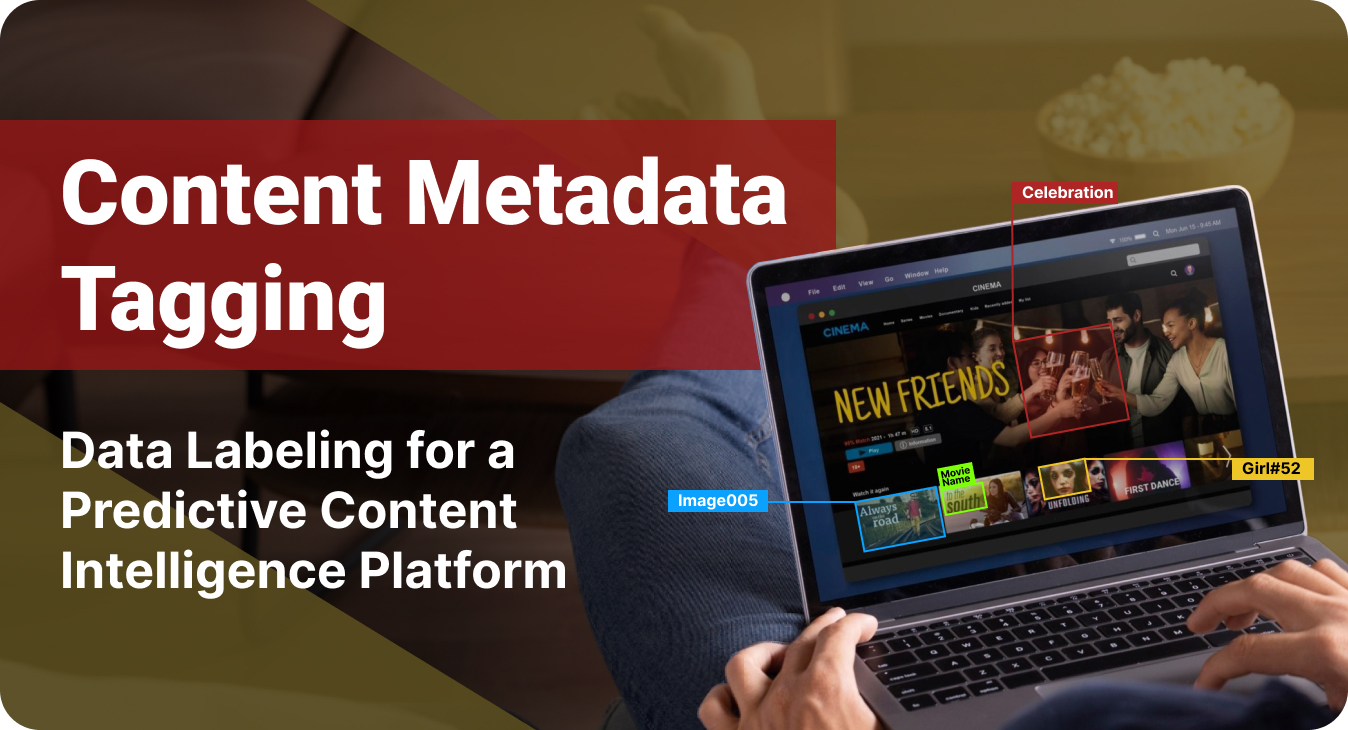
65% Improved AI Model Accuracy with Multilingual Content Metadata Tagging

Read More
DRONE SURVEILLANCE

DRONE SURVEILLANCE

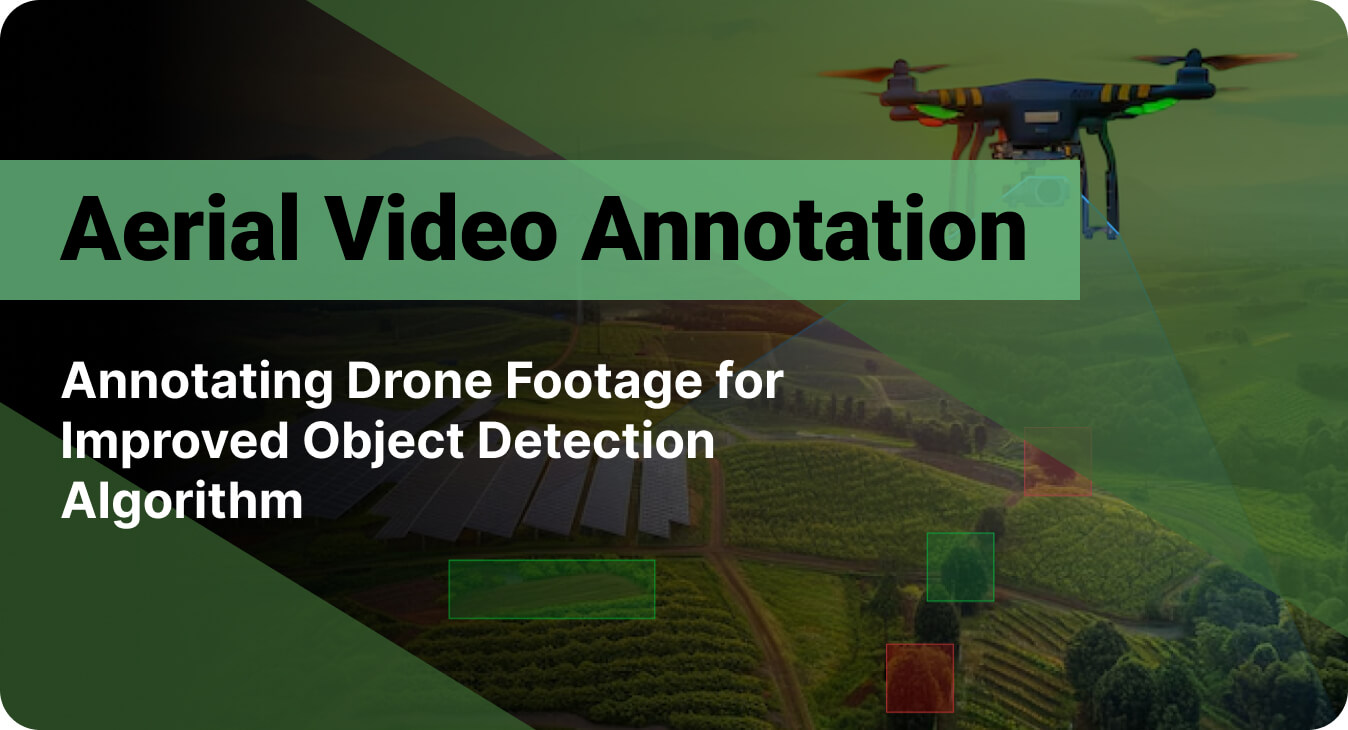
100K Frames (55 Hours of Video) Labeled with 30% Object Detection Accuracy Improvement

Read More
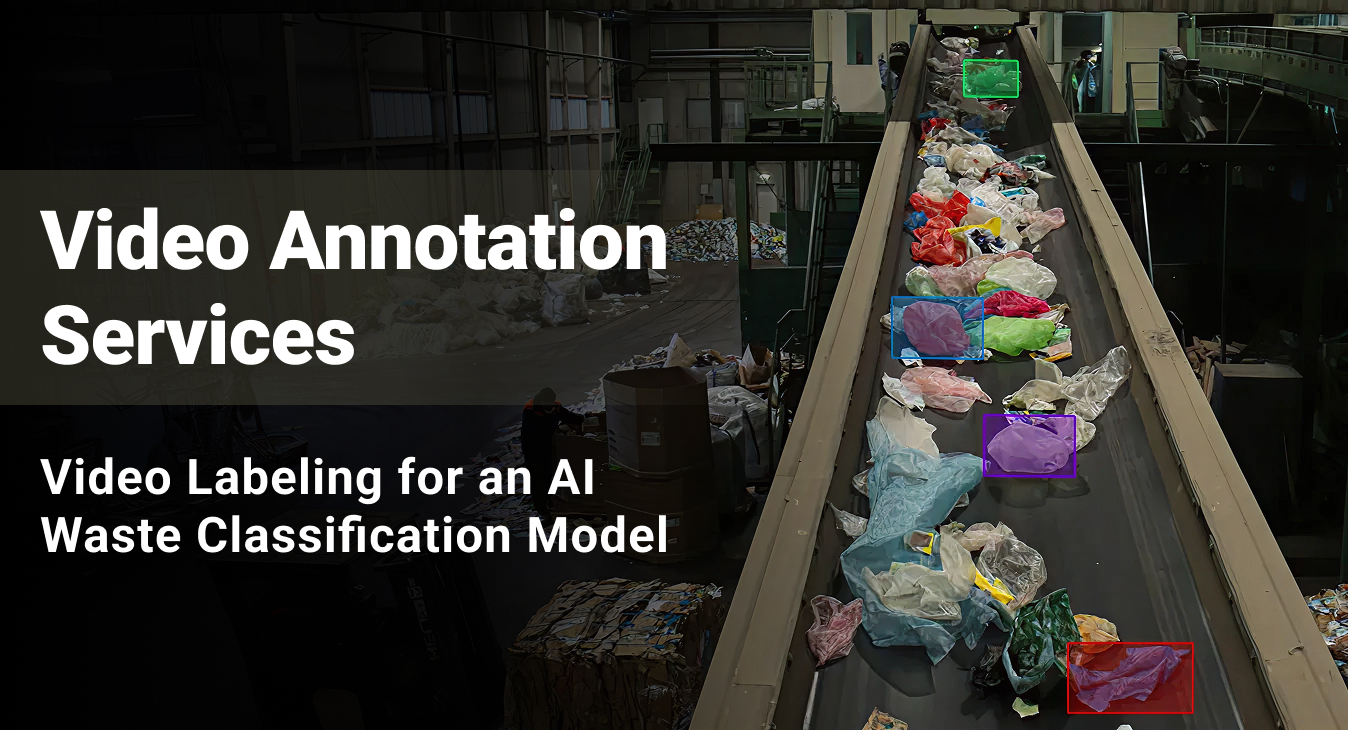
WASTE CLASSIFICATION

WASTE CLASSIFICATION

Video Labeling with 98-99% Labeling Accuracy and 21% Model Efficiency Improvement

Read More
ENVIRONMENTAL MONITORING

ENVIRONMENTAL MONITORING

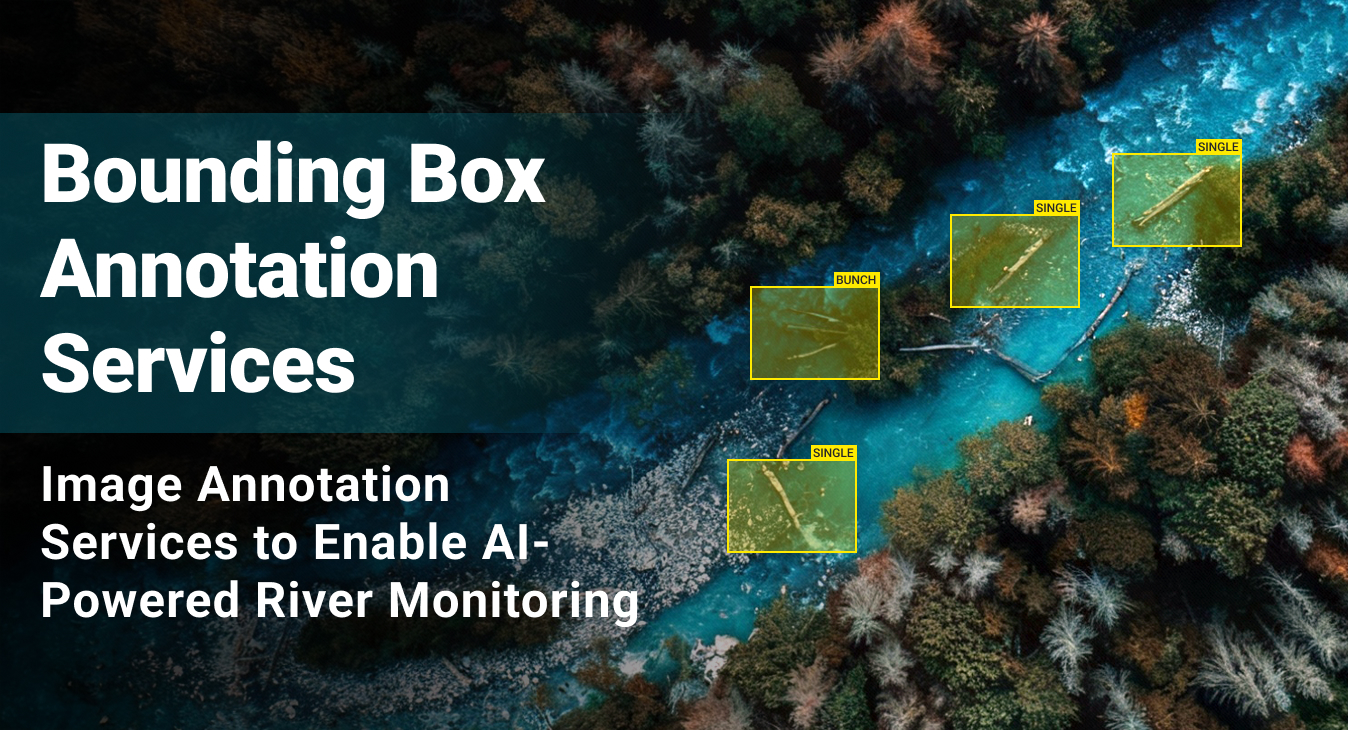
Bounding Box Image Annotation for AI-Powered River Monitoring — 1.5K-2K Images Labeled per Week

Read More

OUTSOURCE VIDEO ANNOTATION SERVICES

Eliminate Drift and Inconsistencies from AI Training Datasets

Human-in-the-Loop Video Annotation Services for Consistent, Production-Ready Training Datasets

A bounding box that shifts by 2 pixels per frame is invisible at Frame 10, but by Frame 500, your model is learning from labels that no longer correspond to the object they represent. Our video annotation services address this at the pipeline level.

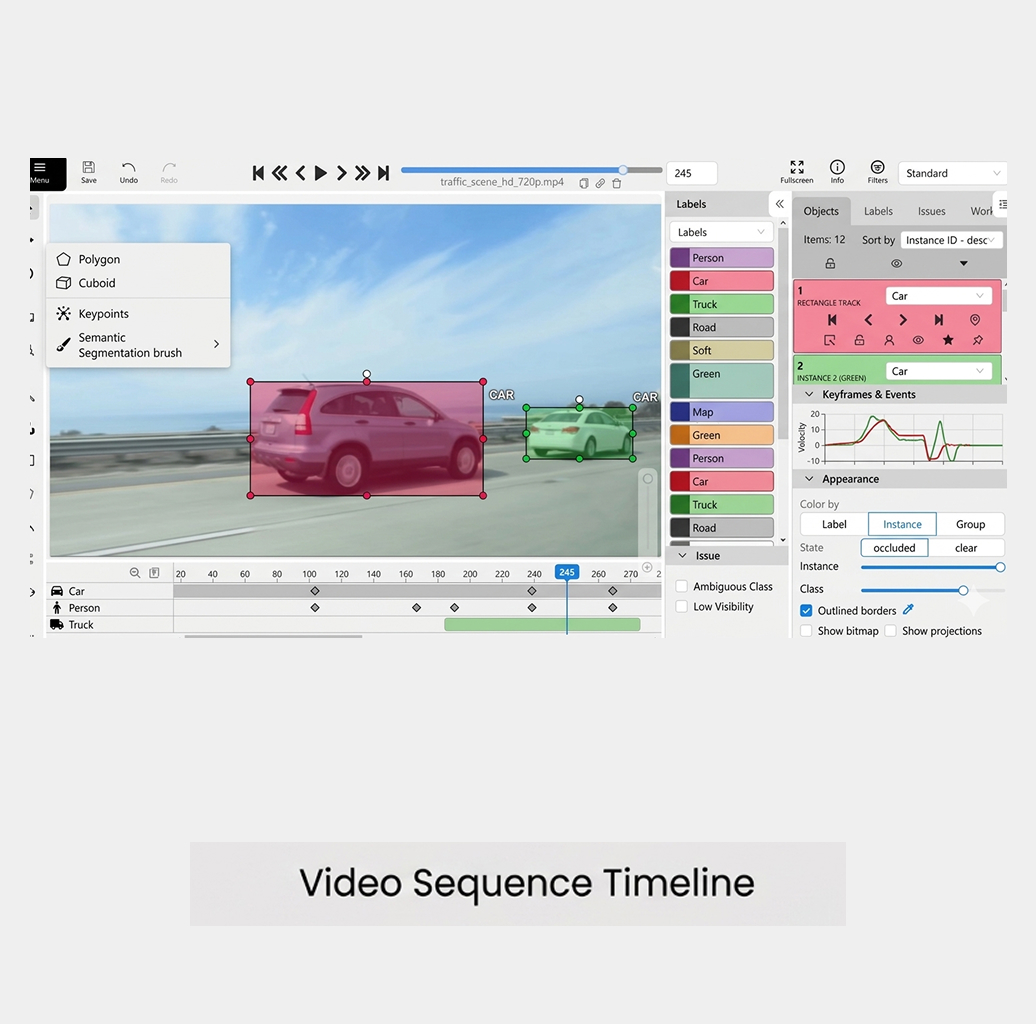
We configure AI-assisted pre-labeling using video annotation tools such as CVAT, V7, Labelbox, or Supervisely to handle large volumes of data. Flagged instances, such as occlusion boundaries, identity-switching events, and edge-case frames, are routed to domain specialists who correct what automation gets wrong. You get temporally consistent, ID-stable video datasets delivered in COCO, YOLO, Pascal VOC, nuScenes, or custom formats — built for the specific computer vision architecture consuming them.

SERVICES

Video Annotation Services Designed around Your Model’s Specific Failure Modes

Covering the Full Spectrum of Video Data Annotation Techniques

Every production failure in a video-based model can be traced back to one of these problems: objects that lose their identity across frames, events without precise temporal boundaries, pixel-level bleed between overlapping objects, skeletal tracking that breaks during complex motion, scenes that change faster than classifiers can follow, or spatial data that does not align between sensors. Our video tagging services are structured around the specific failure mode(s) your AI/ML solution needs to handle.

The “Identity Switching” Problem:

An object enters the frame, gets occluded, and re-emerges with a new ID. The model now registers two entities where one exists.

Our Solution:

  • Persistent object IDs assigned at sequence initialization and maintained throughout
  • Automated tracking with bounding box annotation to generate initial object trajectories across frames
  • Domain specialists to verify ID continuity at specific frames where identity switches occur
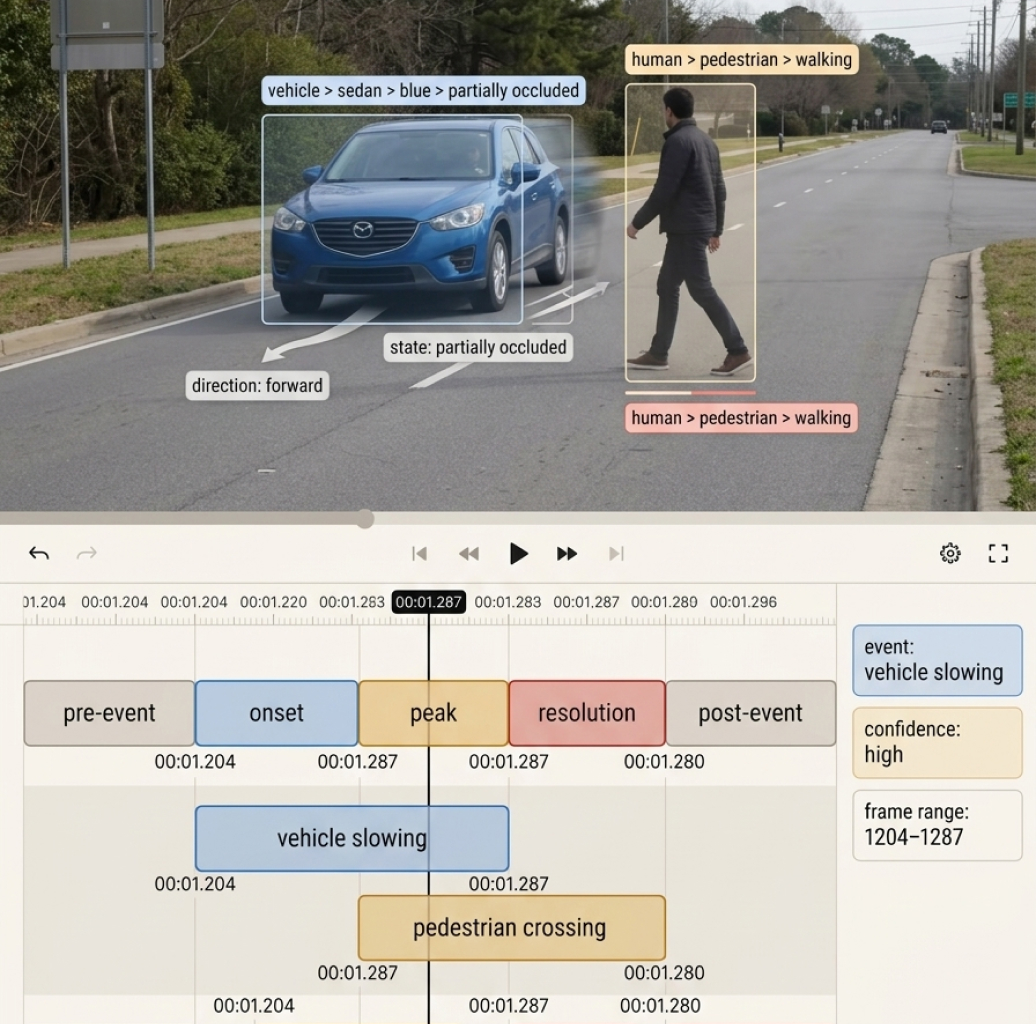
  • Hierarchical attribute taxonomies per tracked object (e.g., vehicle > sedan > blue > partially occluded) to capture the state transitions that help models disambiguate visually similar instances
Object Tracking Annotation

The “Imprecise Event Boundaries” Problem:

An event’s start and end frames are labeled loosely (marking frames 1,210–1,280 for an event actually spanning 1,204–1,287), and the model learns inaccurate triggers.

Our Solution:

  • Millisecond-level start/end timestamps at event boundaries
  • Concurrent labels for overlapping events (e.g., speech and gestures) within the same temporal window
  • Sequential event-chain annotation for cases where the sequence of steps is critical
  • Temporal metadata tagging for every object (such as speed, direction, and state changes)
  • Custom video labeling taxonomies ranging from binary (event / no-event) to multi-tier (pre-event, onset, peak, resolution, post-event) flags
Temporal Annotation and Event Detection

The “Overlapping Objects” Problem:

Two objects overlap, and their outlines are labeled incorrectly. This causes the segmentation model to learn incorrect object edges in exactly the dense-scene conditions where boundary precision is most critical.

Our Solution:

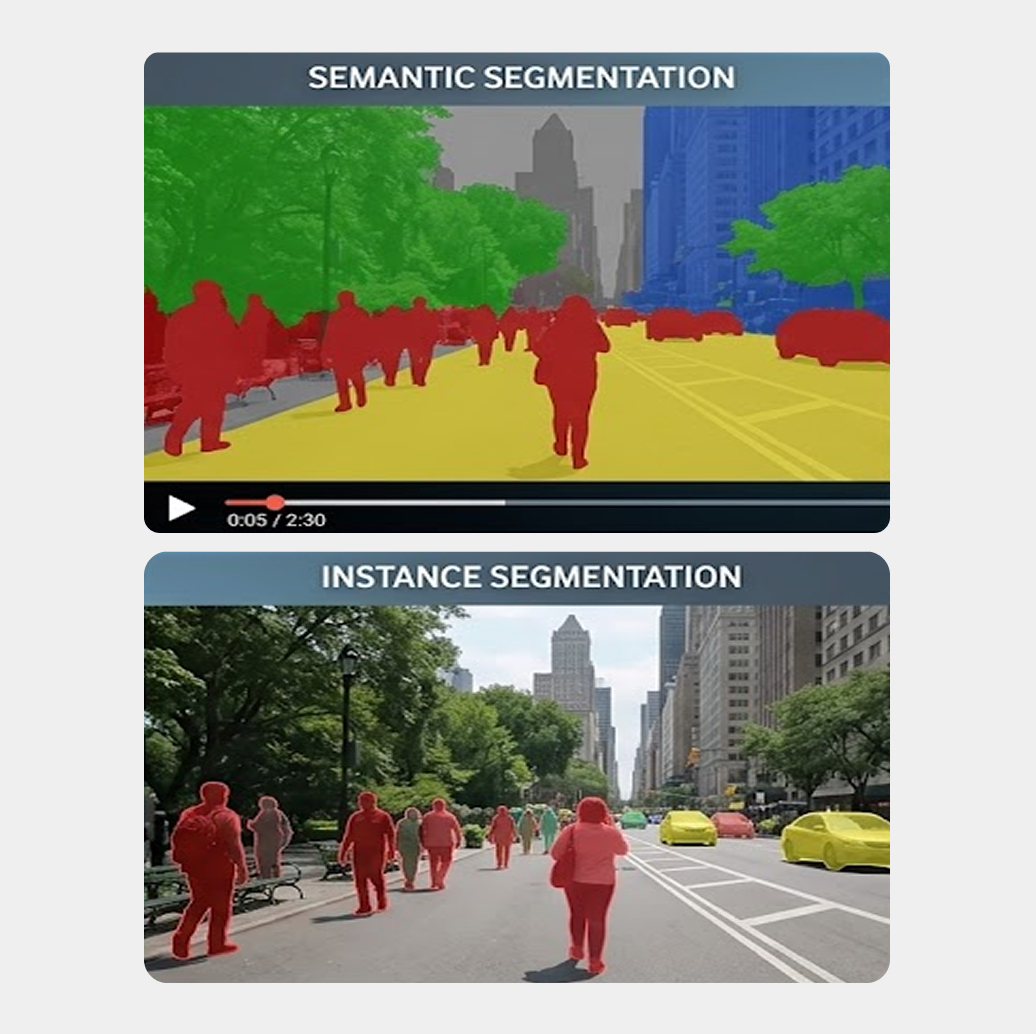
  • Instance segmentation with unique masks that hold through overlaps, splits, and merges across frames
  • Human review at every frame where objects overlap or boundaries shift
  • Panoptic segmentation combining stuff classes (road, sky, vegetation) and thing classes (vehicle, pedestrian, cyclist) in a single annotation pass
  • Polygon annotation for objects that bounding box annotations cannot capture — smoke, water, fabric, shadow
  • Class labels and instance IDs cross-checked against adjacent frames to catch drift early
Semantic and Instance Segmentation in Video

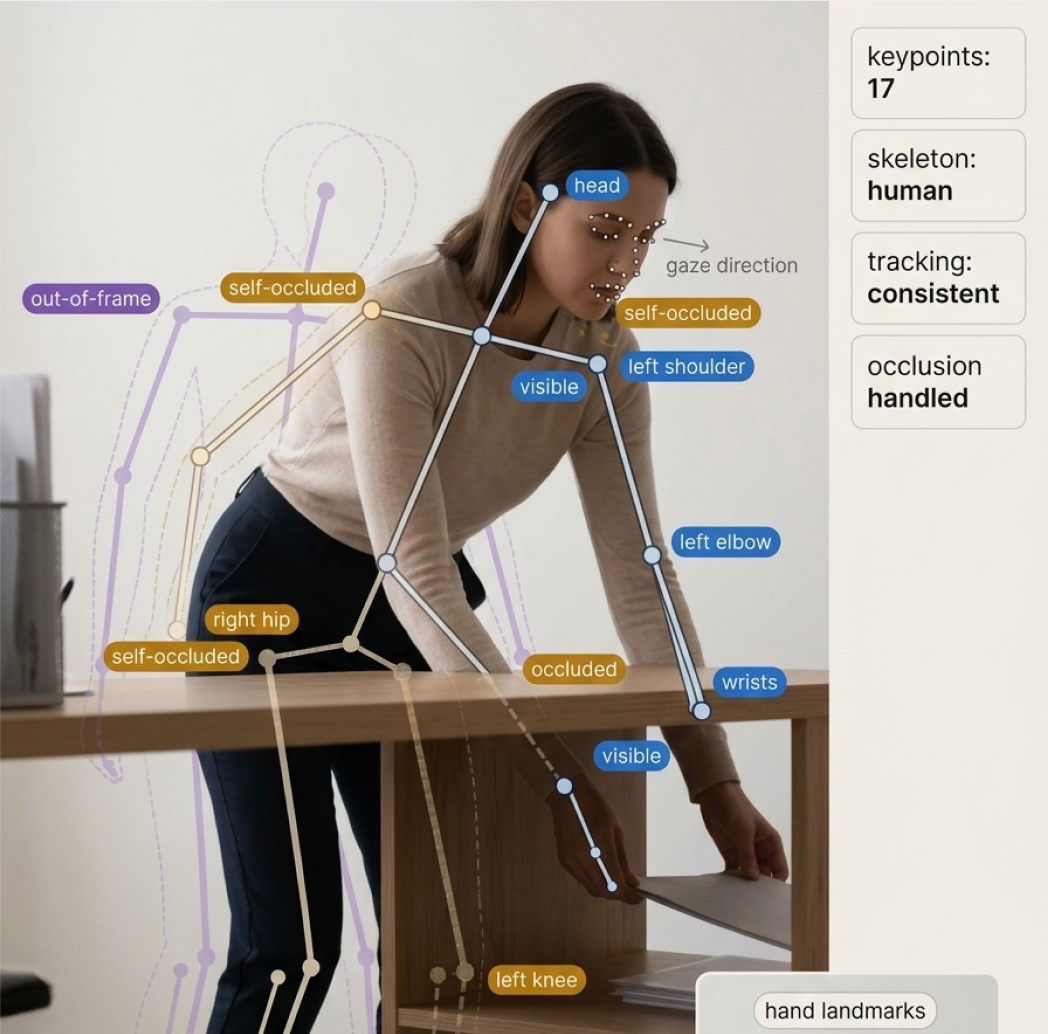
The “Skeletal Tracking during Motion” Problem:

A person bends behind a table, and half the skeleton keypoints are occluded. The automated pose estimator hallucinates joint positions, and the model trains on phantom anatomy or incomplete sequences.

Our Solution:

  • 14–17+ keypoints annotated per subject, each flagged per frame as visible, self-occluded, externally-occluded, or out-of-frame
  • Skeleton schemas configured to your model: human anatomy, animal morphology, robotic joints, or custom articulation structures
  • Specialists infer occluded joint positions from surrounding visible keypoints and temporal context instead of random guessing
  • Landmark annotation for expression recognition, gaze tracking, and sign-language dataset creation
Keypoint and Pose Estimation Annotation

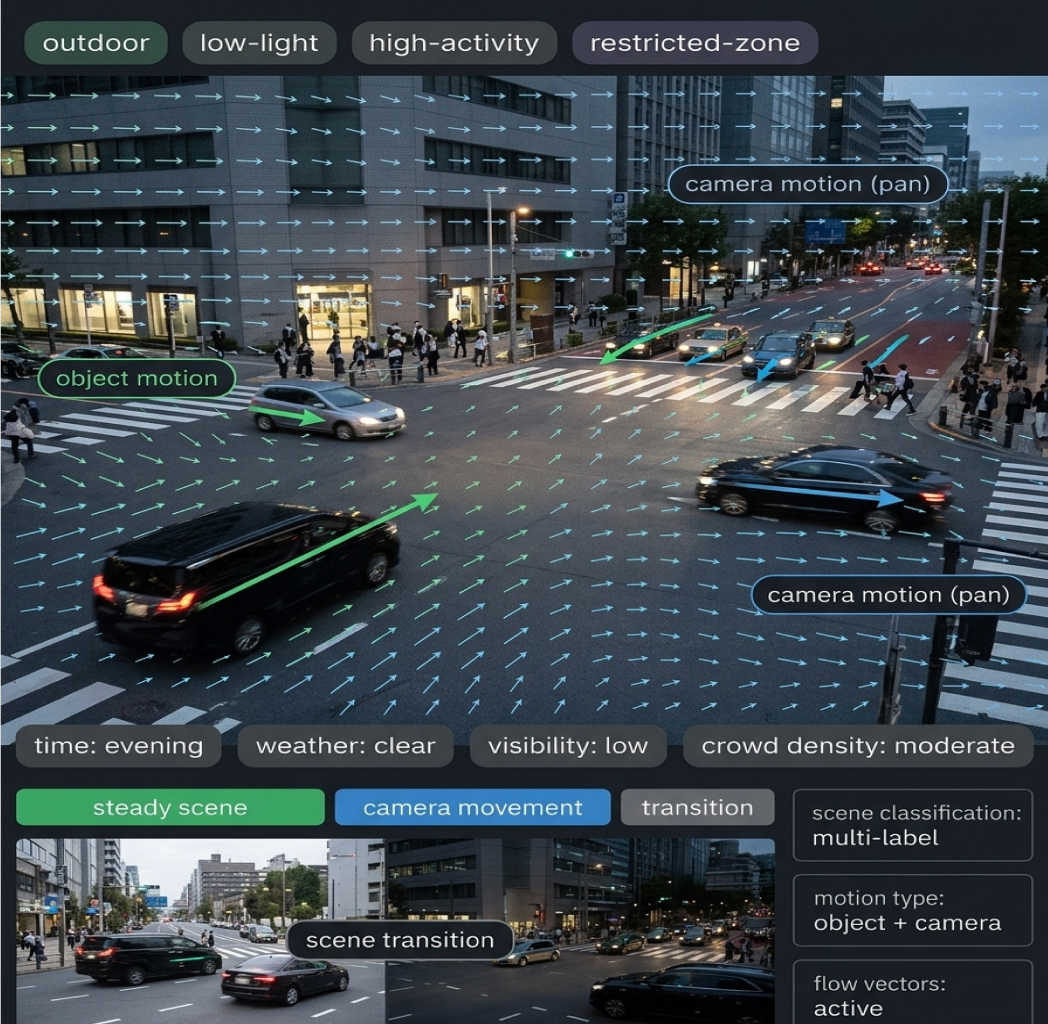
The “Scene Understanding” Problem:

Object detection annotation without understanding environmental context leads to models that react to items in isolation.

Our Solution:

  • Multi-label scene classification to annotate overlapping attributes (indoor, low-light, high-activity, restricted-zone) concurrently
  • Optical flow annotation for motion vectors between consecutive frames — what is moving, how fast, in which direction
  • Camera ego-motion annotations separating real object movement from apparent movement caused by shake, pan, tilt, or zoom
  • Environmental context labeling for weather, time of day, terrain, visibility, crowd density, etc.
  • Labeling scene transitions (camera cuts, environment shifts, state changes) so models can segment continuous video into distinct events
Scene Classification and Optical Flow Annotation

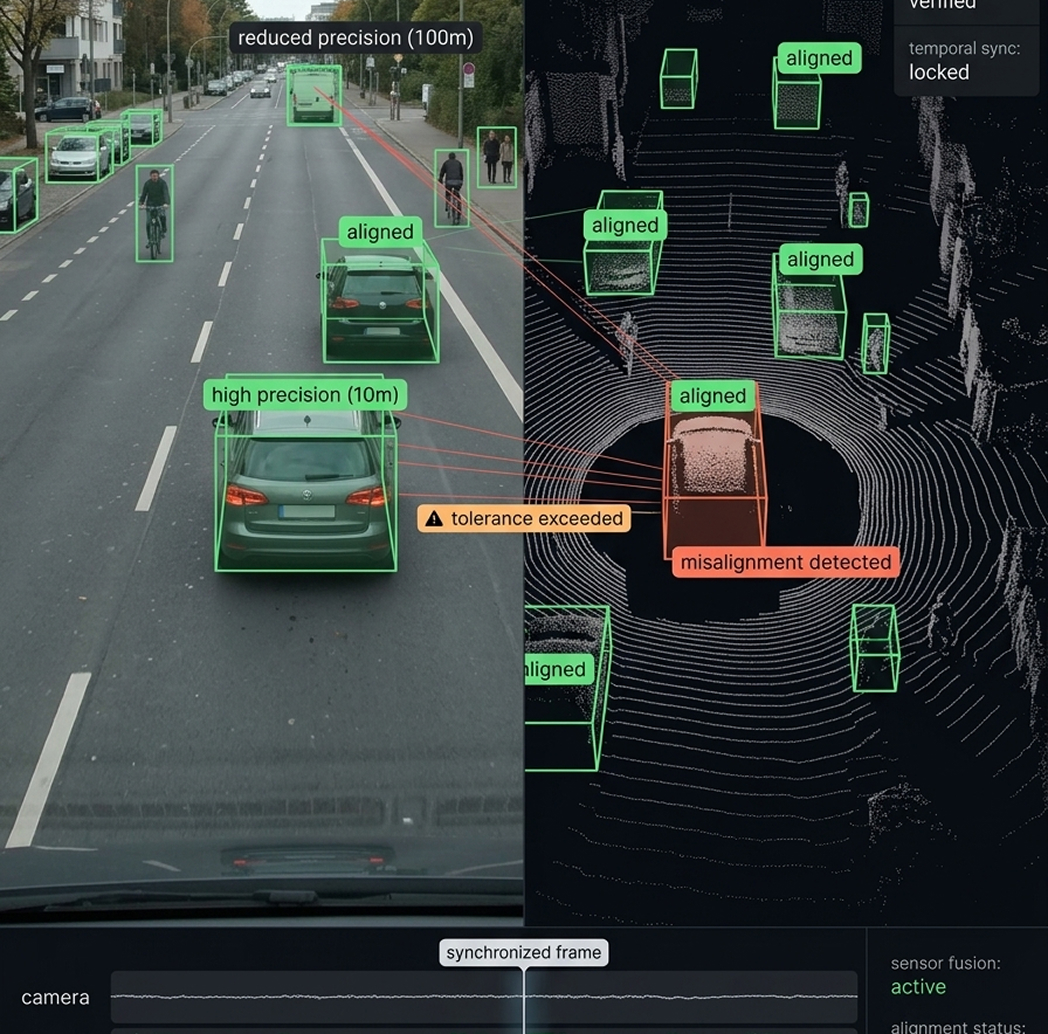
The “Sensor Alignment” Problem:

A 3D cuboid that is spatially correct in the point cloud but misaligned when projected onto the camera frame leads to inconsistent object detection.

Our Solution:

  • 3D cuboid annotation on video frames synchronized with LiDAR point cloud data, with cross-modal projection verification at each annotated frame
  • Camera-LiDAR alignment validation, with discrepancies above configurable tolerance thresholds flagged and corrected
  • Temporal synchronization across multi-sensor inputs (camera, LiDAR, radar, IMU) to ensure labels represent the same physical moment across all modalities
  • Distance-dependent annotation granularity: objects at 100m receive different labeling precision than objects at 10m, matching sensor resolution limits rather than applying uniform standards
3D Video Annotation and Sensor Fusion

PROCESS

A Systematic Annotation Pipeline for High-Fidelity Video Training Data

Offering Full Visibility into How Your Dataset Moves from Raw Footage to Model-Ready Training Data

Video annotation at scale requires two things that are in tension: speed (because you may have hundreds of thousands of frames) and precision (because a single identity switch or temporal gap can degrade an entire training batch). Our video annotation company resolves this tension by assigning automation and human expertise to the specific stages where each delivers the most value.

01

Our domain specialists collaborate with your team to define video-specific annotation guidelines that account for temporal dependencies, occlusion handling rules, and inter-annotator agreement thresholds. We define class taxonomies, attribute hierarchies, and edge-case escalation protocols before video labeling can commence.

02

Using the annotation tool best suited to your data type and project complexity (CVAT, V7, Labelbox, Supervisely, or your proprietary platform), we generate initial annotations and object tracks across your video dataset — dramatically accelerating throughput on routine patterns and reducing manual annotation effort.

03

Every AI-generated label is reviewed by a domain specialist. Trained professionals with subject-matter expertise relevant to your vertical handle context-dependent judgments, correct tracking drift and identity switches, and resolve edge cases that automated tools miss.

04

We implement inter-annotator agreement metrics, consensus adjudication for disputed labels, and frame-sampling QA checks across the full video sequence. Production-ready annotations are delivered in your preferred format (COCO, YOLO, Pascal VOC, nuScenes, or custom) via S3, GCS, Azure Blob, or direct platform export.

CLIENT SUCCESS STORIES

It's all about results.

The Proof is in the Pipeline

Discover how we’ve helped businesses across 50+ nations bridge the gap between "lab-ready" and "market-ready" AI/ML applications by solving their most complex training data challenges.

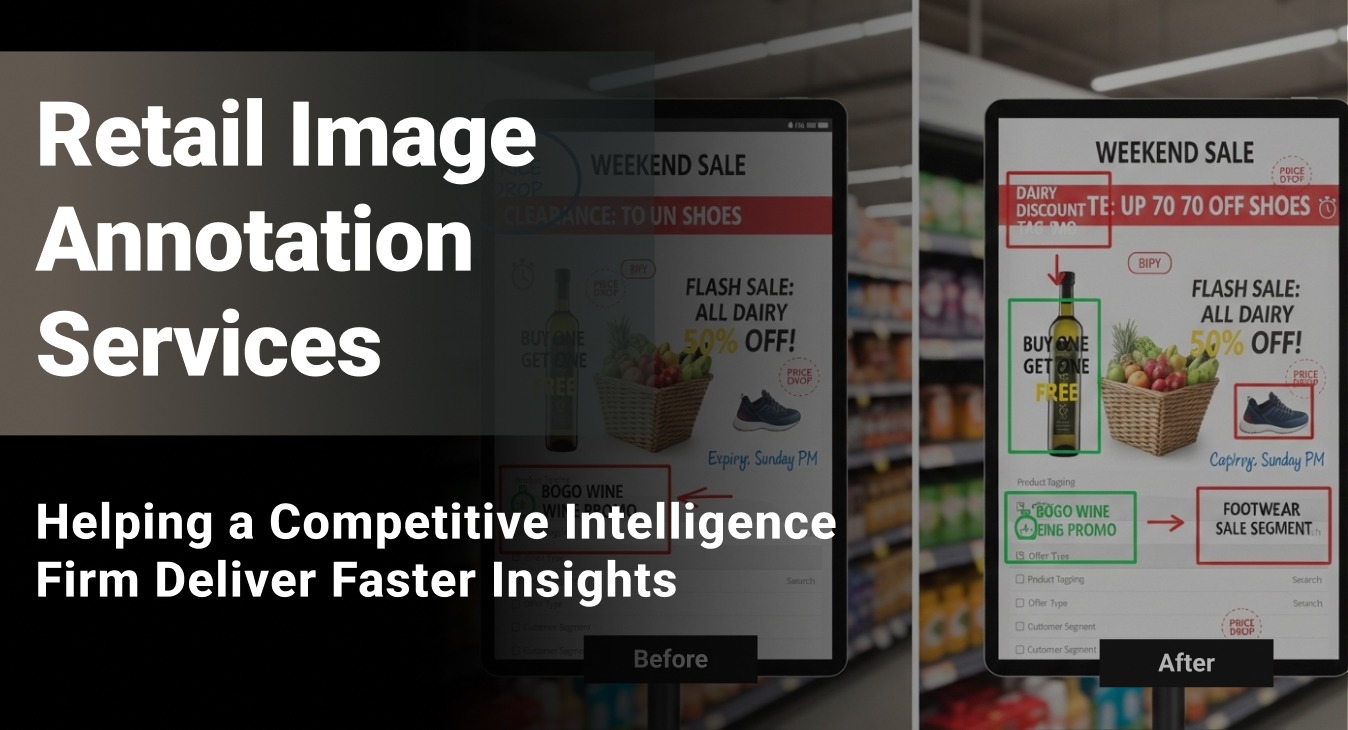
Retail Image Annotation

Bounding box annotation and metadata tagging across retail promotional images, powering competitive intelligence solutions for a US-based company.
250K+

Annotations Delivered Monthly

98.5%

Annotation Accuracy
Bounding Box Annotation Services

Precise bounding box annotation for high-resolution aerial river images to train an AI-powered river flow obstruction detection system using the client’s proprietary data annotation tool.

1,500 to 2,000

Images Labeled per Week

98%

Labeling Accuracy Rate Maintained

<1%

Revision/Rework Rate
  • Service Image Annotation
  • Platform Client’s Proprietary Annotation Platform
  • Industry Environmental Monitoring / Forestry
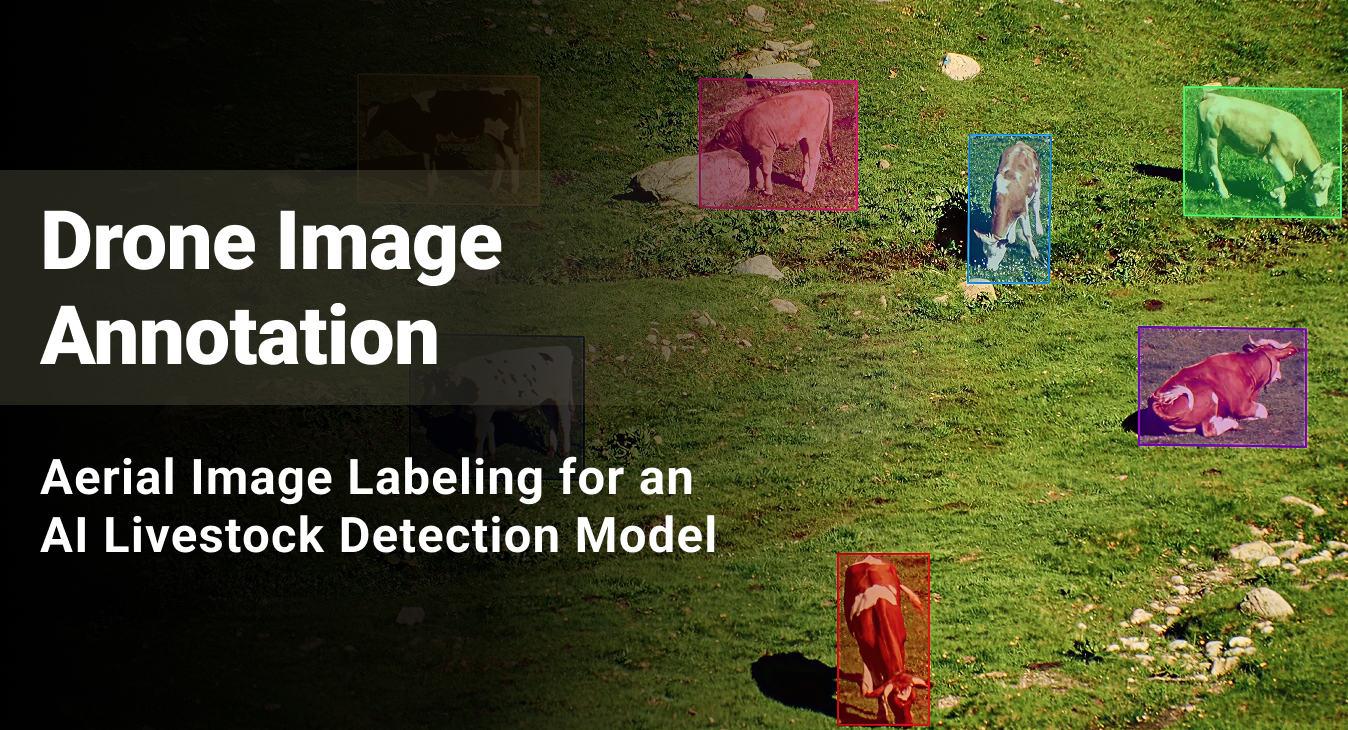
Drone Image Annotation

Labeled and validated over 10,000 high-resolution drone images monthly using QuPath to train an AI-powered livestock detection model, delivering 95%+ annotation accuracy.

10K+

Images Annotated Monthly

95%+

Labeling Accuracy
Data Labeling for a Predictive Content Intelligence Platform

Labeled over 2500 entertainment content (Movies, TV Series, Trailers) monthly to enable the accurate prediction of the target audience engagement rates and response.

65%

Improved AI Model Accuracy

60%

Less Content Categorization Errors

4-Month

Faster Model Development

View All

TECH STACK

Video Annotation Expertise across Industry-Leading Tools & Platforms

Ensuring Consistent and Temporally Accurate Video Data Labeling at Any Frame Volume

We work within your existing video labeling tool ecosystem or recommend the right platform for your project's requirements — so you never have to rebuild workflows to accommodate your data annotation vendor. When needed, we quickly implement advanced automation and custom scripting to maximize throughput while avoiding unnecessary complexity or infrastructure changes, whether you require high-speed object tracking or intricate pixel-level segmentation.

Labelbox
SuperAnnotate AI
CVAT
Dataloop
Scale AI
V7
Keylabs
Label Studio
labelImg
Segments.ai
CloudCompare
Supervisely

HUMAN-IN-THE-LOOP VIDEO ANNOTATION OUTSOURCING

AI Video Annotation Services: Faster Labels, Higher Accuracy

The Data Annotation Infrastructure behind High-Performance Vision Models

SunTec India has combined industry-leading video labeling tools (CVAT, V7, Labelbox) with a specialized in-house annotation workforce trained by vertical domain to create a seamless, high-performance solution. While our human-in-the-loop (HITL) delivery model uses AI to make human annotation faster and more consistent, every AI-generated pre-label is reviewed, corrected, and validated by a qualified annotator before it becomes part of your training dataset. Here's how our video annotation company implements this HITL model across your annotation pipeline:

AI-Assisted Pre-Labeling

Machine learning models generate initial annotations for each frame that our annotators review, correct, and refine. For segmentation-heavy projects, we incorporate foundation model outputs — including SAM 2-generated masks — for pre-labeling. This reduces per-frame annotation time considerably without compromising label accuracy.

Frame Interpolation

For object tracking tasks, AI automatically propagates bounding box positions or keypoint locations between manually labeled keyframes, based on detected motion vectors. Our annotators validate and adjust interpolated positions, dramatically reducing the manual effort required for long tracking sequences.

Active Learning Integration

For clients using active learning pipelines, our annotation workflow can integrate with your model's confidence scores to prioritize annotating frames where your model is least confident — ensuring that human annotation effort is directed toward ambiguous examples the model finds confusing, where labeling can improve performance the most.

Inter-Annotator Agreement (IAA) Scoring

Automated tracking of labeling consistency in real time, so QA leads can intervene before errors multiply. QA leads are alerted when IAA scores drop below the threshold, allowing intervention before inconsistency propagates through the batch.

Automated Edge Case Flagging

Frames containing occlusion, motion blur, unusual lighting conditions, object overlap, or low image quality are automatically flagged for specialist annotator review. This prevents the most common source of ground truth errors — the difficult frames that catch generic annotators off guard.

Continuous Feedback Loop

As your model trains and performance data become available, we use model error analysis to refine annotation guidelines, update edge-case handling instructions, and reprioritize annotation effort — ensuring your dataset quality evolves alongside your model's development.

Security and Compliance

Your data security is our priority

ISO
Certified

HIPAA
compliance

GDPR

GDPR
adherence

Regular
security audits

Encrypted data
transmission

Secure
cloud storage

WHO WE SERVE

Video Labeling Services, Engineered for the Computer Vision Problems You Are Solving

From Autonomous Navigation and Surveillance Analytics to Action Recognition and Spatial Perception

Outsource video annotation services to SunTec India to ensure your computer vision models capture the temporal dynamics, motion patterns, and scene-level context your industry demands. For every niche AI/ML use case, our team builds custom annotation architectures and labeling rules tailored to your specific technical terminology and unique edge cases. We also configure the annotation workflow to match your video data type and operational needs.

  • Temporal tracking of crop growth stages across aerial and satellite video feeds
  • Drone video annotation for object detection in livestock monitoring models
  • Pest and disease movement tracking through time-series video labeling
  • Semantic segmentation of field boundaries, irrigation channels, and terrain features across video sequences
  • Multi-spectral video annotation for soil health and vegetation index analysis

Autonomous Vehicles

  • Persistent object tracking with ID maintenance for vehicles, pedestrians, cyclists, and road infrastructure across thousands of frames
  • 3D cuboid annotation synchronized with LiDAR point cloud data for depth-aware perception models
  • Lane-marking and polyline annotation for HD map creation from dashcam video
  • Keypoint annotation for pedestrian intent prediction and vulnerable road user detection
  • Video annotation solutions for UI/UX testing — labeling user interaction sequences, click paths, and navigation patterns
  • Screen recording annotation for software QA automation training data
  • Gesture and expression annotation for video conferencing AI features
  • Activity recognition labeling for workplace safety and compliance monitoring
  • Multi-modal video-text alignment for AI assistant training and demonstration datasets

Robotics

  • 3D spatial annotation for robotic arm movement tracking and collision avoidance training
  • Human-robot interaction video labeling: gesture recognition, proximity detection, handover sequences
  • Warehouse navigation video labeling for autonomous mobile robot (AMR) training
  • Pose estimation and skeletal annotation for humanoid robot locomotion models

Retail

  • In-store CCTV annotation for shopper movement tracking and heatmap generation
  • Shelf monitoring video labeling for out-of-stock detection
  • Delivery route video annotation for field service management
  • Customer-staff interaction labeling for service quality analysis
  • Security camera video annotation for intrusion detection and incident response training
  • Product interaction video labeling for visual search and virtual try-on model training
  • Warehouse video annotation: pick-pack-ship activity recognition and error detection
  • Customer unboxing and review video annotation for sentiment and product quality analysis
  • Conveyor belt video labeling for automated quality inspection and defect detection

Aviation

  • Video annotation of CCTV and tarmac footage for ground operations safety monitoring
  • Runway condition assessment via temporal segmentation of inspection video
  • Object tracking for drone detection and airspace intrusion monitoring
  • Cockpit video annotation for pilot behavior and fatigue detection models

Energy, Oil & Gas Companies

  • Pipeline inspection video annotation for corrosion detection and anomaly flagging
  • Drone surveillance video labeling for facility perimeter monitoring and leak detection
  • Thermal and infrared video annotation for equipment overheating and failure prediction
  • Offshore platform video labeling for safety compliance monitoring (PPE detection, restricted zone violation)
  • Bridge and road inspection video annotation for structural deformation tracking
  • Drone video labeling for power line, wind turbine, and solar panel inspection
  • Construction site video annotation for safety violation detection, equipment tracking
  • Railway track inspection video labeling for defect detection and predictive maintenance

Finance

  • KYC video verification annotation for face matching and document authentication labeling
  • Surveillance video annotation for suspicious transactions and fraud behavior detection
  • Branch security video labeling for threat detection and incident analysis
  • Remote identity verification video labeling for insurance claims and loan processing
  • Video annotation of call transcripts for sentiment analysis and agent performance scoring
  • Screen-share session labeling for technical support workflow optimization
  • Sign language video annotation for accessible customer service AI models
  • Facial expression and tone labeling for empathy detection in customer interactions

Geospatial

  • Satellite video annotation for land-use change detection and urban expansion monitoring
  • Drone video labeling for environmental impact assessment and deforestation tracking
  • Temporal segmentation of geospatial video for disaster response and damage assessment
  • Object tracking in aerial video for maritime surveillance, port monitoring, and vessel identification
  • Video content classification and scene-level labeling for recommendation engine training
  • Metadata tagging for movies, trailers, and series — genre, mood, theme, and audience labeling
  • RLHF video annotation for generative AI output evaluation and preference ranking
  • Ad and branded content video labeling for brand safety, compliance, and sentiment analysis
  • Deepfake detection annotation — frame-level labeling of synthetic vs. authentic video content

RELATED SERVICES

Beyond Video Annotation Services: Consistent Labels across Every Data Modality

Eliminate Cross-Vendor Schema Drift with Unified Multi-Modal Data Annotation Services

CONTACT US

Scale Your Video Annotation Pipeline without the Overhead

Stop Letting Video Annotation Backlogs Delay Model Training

Our video annotation company targets annotation effort at failure-prone frames, reducing that risk at the data layer, before it reaches your model. Validate label accuracy on your own dataset — request a free sample or get a quote customized to your requirements by reaching out to the SunTec India team.

FAQ - Frequently Asked Questions

Video Annotation Services

Our video labeling company ingests your video datasets in any format (MP4, AVI, MOV, MKV, raw sensor feeds). We configure frame-extraction parameters (FPS, resolution, keyframe selection) based on your model’s input requirements and the annotation complexity. The annotated video datasets are delivered in your preferred format, including COCO, YOLO, Pascal VOC, nuScenes, KITTI, Argoverse, or custom schemas. Delivery can be arranged via S3, GCS, Azure Blob Storage, or direct platform export, and it includes the annotated dataset, annotation guidelines, a QA report with IAA scores, and schema documentation.

We prevent tracking drift and identity switching in video data labeling by running automated pre-labeling for initial trajectories, then assigning specialists to verify ID persistence at occlusion boundaries, re-entry points, and scene transitions. Specialists review the specific frames where switches occur. IAA checks are applied to tracking-critical sequences, and any ID discontinuity is resolved before delivery.

Yes. Our video labeling workflow can integrate with client-managed instances of CVAT, V7, Labelbox, Supervisely, or a proprietary tool. We preserve your schema, class taxonomy, attribute definitions, and QA workflows. If you do not have a platform preference, we select the platform that best matches your data type and annotation requirements.

We integrate rigorous checks at every stage of the pipeline to ensure temporal consistency across long sequences:

  • Automated pre-labeling that utilizes tracking algorithms and frame interpolation to maintain label continuity between keyframes
  • Specialized reviewers who validate class labels, object IDs, and attribute states at every transition boundary
  • QA team that performs sequence-level validation across the entire video duration to guarantee long-term stability
  • Annotation quality measurement using industry-standard metrics, including IAA (Cohen’s Kappa), IoU thresholds for segmentation, MOTA/MOTP for tracking

Our video annotation company defines turnaround expectations based on dataset volume, annotation complexity (e.g., bounding boxes are faster than pixel-level segmentation), the number of label categories, and your QA requirements. We share a detailed project plan with milestone-level delivery dates before work begins, so you know exactly what to expect and when. We can also handle expedited timelines by structuring the team and workflow accordingly.

Our team flags ambiguous instances rather than guessing the label. All such highlighted cases are escalated to the QA lead, who either resolves them using the existing video labeling guidelines or routes them to your team for a ruling. Your decision and logic are documented, added to the annotation guidelines as a reference example, and communicated to the full team for future cases.

It happens often. Our video annotation services for machine learning projects can be recalibrated without restarting: we update the guidelines, retrain affected annotators, run a fresh calibration exercise, and audit prior labels to determine whether re-annotation or schema remapping is needed. The goal is to achieve zero inconsistency in training data labeling regardless of the changing guidelines.

SunTec India is an ISO 27001:2022-certified, HIPAA-compliant, and GDPR-compliant video labeling company. All annotators operate under NDAs within access-controlled environments. All data is protected via encrypted transmission and secure cloud storage, with role-based access controls. Client data is never retained or repurposed.

The cost of video annotation outsourcing is project-specific and depends on the annotation type, dataset volume, label complexity, QA requirements, and domain-specific expertise. Contact us at info@suntecindia.com for a quote tailored to your needs.

Yes. You can request a free sample for quality assessment on a small batch or a paid pilot to validate the full workflow — tool compatibility, delivery format, turnaround, and accuracy at your actual scale. Write to info@suntecindia.com with your requirements for a free sample of our video labeling services.

Yes. Specialized AI applications rarely have linear training data requirements. So, when you need additional capacity, we onboard and calibrate new annotators within one to two weeks — including project-specific training, guideline review, sample annotation exercises, and accuracy benchmarking against your existing ground truth datasets. This means new annotators enter production at the same quality standard as your current team.

All annotated datasets, raw data, and project-specific annotation guidelines developed during the engagement are the client’s intellectual property upon project completion. We do not retain copies, reuse client data to serve other clients, or repurpose your annotation guidelines for other projects.

Yes. We identify these frames and route them to specialist annotators who apply techniques such as temporal interpolation, multi-frame referencing, and brightness-contrast enhancement to label these videos.

Yes. For enterprise ML teams that iterate on training data across multiple annotation cycles, we maintain versioned label histories so your engineering team can trace exactly what changed between dataset versions — which labels were added, corrected, or reclassified, by whom, and against which version of the annotation guidelines.