Developing an App like Uber-Features, Models, and Cost Insights

Table of Contents
- What You Need to Learn from Uber Before Attempting a Rideshare App Development
- 6 Important Factors that Influence the Creation of an App like Uber
- Let’s Talk About The Top Features of Uber Like App Development
- How Much Does It Cost to Develop A Taxi Booking App Like Uber?
- DIY Ridesharing App Development Vs. Outsourcing: Which One Should You Choose?
Get your hands on all there is to know about the nitty-gritty of a taxi mobile app, features of Uber like app development, and critical insights into the cost structure for creating an app like Uber.
US$61 Billion- that is the total worth of the global ridesharing industry.
Ridesharing is a popular practice that nearly 25% of the US population uses once a month, at the very least. It is a welcome luxury, credits to its affordability and convenience. Plus, if projections are to be believed, the market value of ride-sharing apps could very well cross USD 185.1 billion by 2026.
Unsurprisingly, every business wants a share of that pie. And, what better way to do so than by learning from the best?
Explore this tried and tested strategy to build an app like Uber. Come along with our mobile app development service provider and uncover key insights that explain how Uber operates and what you need for a similar ridesharing app development.
Here’s How We Shall Proceed:
- How Does Uber Work?
- Factors that Influence the Creation of an App like Uber
- Features of Uber like App
- Cost Structure For Creating An App Like Uber
- DIY Ridesharing App Development Vs. Outsourcing
What You Need to Learn from Uber Before Attempting a Rideshare App Development
Tip numero uno- Stop asking, ‘How do I make an Uber clone?’
Your core intent shouldn’t be to build an app that could pass for Uber’s twin. So do not obsess over cloning an app like Uber. Instead, aim to create an app that allows you to reach Uber’s target audience and generate revenue.
To do so, you need to pay closer attention to how Uber operates.
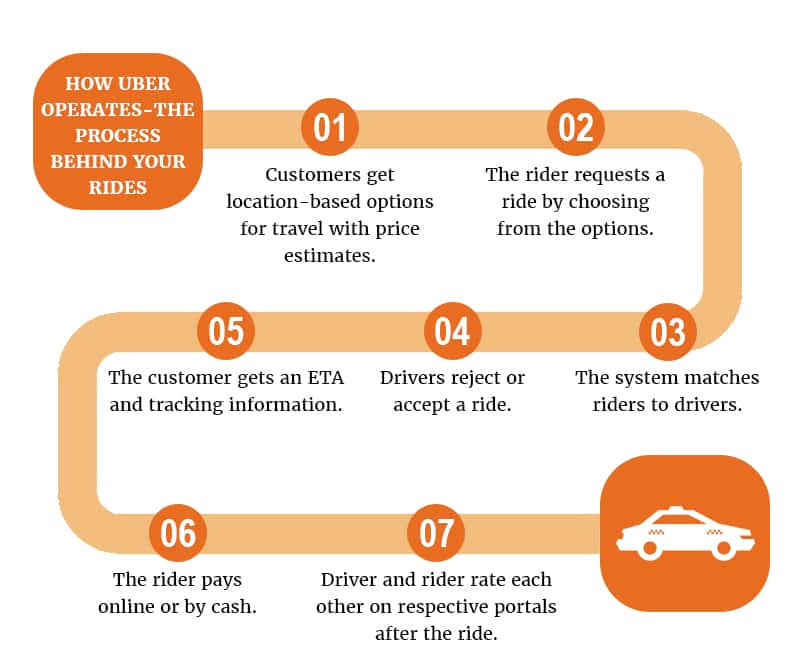
Simple?
Not really!
While the algorithm presents a straightforward workflow, making it work would require a complete understanding of the process behind the scenes.
For example, take the first point. To achieve that simple output, i.e., a list of vehicles available nearby a location with price estimates, you need integrated geolocation. To implement tracking, you need routing and in-app calling features. You need push notifications, payment portals, route optimization, profile editing, etc. In there somewhere, you will also find the use for two-sided authentication, ride-sharing modules, etc.
So, when working on creating an app like Uber, here’s what you need to keep in mind.
- The app should work on the principle that Uber uses.
- The app should be good enough to facilitate customer satisfaction.
- The app should generate ROI.
6 Important Factors that Influence the Creation of an App like Uber
Here is a top tip from a veteran mobile app development company with several iOS and Android app development services– never start a project blindly.
It is one thing to know what a project needs to attain functional success. It is, however, a completely different thing to conceptualize what you need from that project. When matched on the scale of practical and acceptable outcomes, your expectations lead to defining factors that influence the creation of an app like Uber.
Here are a few to start you off.
1. Deliverables
This part deals with the number of the final developed products.
In any ridesharing app template, you will find several portals. For example, Uber has an app for drivers and one for riders. It has an app on the Google Play Store and one on the Apple store as well. In addition, you can have an admin dashboard or a dispatch panel.
Each of these counts as a deliverable entity. Before you set out to create an app like Uber, determine how many of these you need at the end of the development phase.
2. Physical Reach
Which regions do you plan to target?
Geographical regions will impact your ride-sharing app’s UI, language, and outlook. Depending on the areas your Uber-like app will target, you will need local map settings. Plus, it will also affect your final revenue.
So, determine what regions you want to target with your Uber-like taxi applications and plan the development phase accordingly.
3. Complexity
Complexity is directly related to the features of Uber-like app development. But, at the same time, it also directly impacts the cost structure for creating an app like Uber, the total time taken, and the resources you will need.
So, determine in advance:
- The total number of screens
- Ridesharing app UI requirements
- Total number of features
- Basic or high-end design quality
Remember, it is not possible to create something like the Uber you use at present.
The first version of Uber- then called UberCab -had a basic interface where users would enter their card information and request a cab. There were no ride options, cashless or cardless payments, or advanced features like mid-ride destination change and multiple-stoppage journeys.
So, do not stress about only launching when your app is perfect. Instead, determine the complexity for your first version release and pick it up from there.
4. Features
You must start with a definite idea of what your taxi app can and can not do. This information will help you effectively manage the project budget, steer the development phases, and maintain a strict time-effective schedule.
In the next section, we will talk about all the features you can have in your ridesharing and taxi booking app.
5. Resources
Consider everything your app should be. Then, determine what resources you will need to develop the app within your budget and time constraints.
Considering the resources at hand is essential because not every business has a team of developers available at hand. Some might need to hire dedicated software developers or outsource this project to a mobile app development company. Of course, you can also try to do it yourself, although getting the training and setting up an in-house team is a project in itself.
Whichever path you choose, knowing beforehand will help you better plan the budget.
6. Per Hour Development Cost
This tactic applies to in-house as well outsourced app development.
Whether you hire an employee or outsource Android & iOS app development services for an Uber-like app to a third-party vendor, there will be a per-hour development cost. Before the project commences, your job is to compare the cost against the requirements, outcomes, and expected ROIs.
Let’s Talk About The Top Features of Uber Like App Development
Uber operations involve the driver, rider, and admin. A similar taxi booking app will also depend on how these three entities interact in the ecosystem you have created.
Now, keep in mind, here we are discussing probabilities around the features of Uber-like app development. You do not have to use all of these, at least not in the first version release. However, this is an exhaustive list that you can use to grow your application in complexity and functionality over time.
1. Uber for Riders
Here is a list of the core features that a rider expects in a taxi booking application.
- Account registration (via email, phone number, or social media)
- Geolocation (automatic location recognition)
- Fare calculator
- Taxi booking
- Ride tracking
- Payment choices (Cards, cash, cashless and cardless online payments, in-app payments)
- Calling or messaging the driver
- Push notifications
- Driver and ride review
- SOS + ride detail sharing options
- Ridesharing choices/types of rides
- Customer support
Now, once you have this basic setup ready to go, you can think about simplifying the rider’s journey and amplifying their convenience through certain advanced features. These include:
The choice to manually change the pick-up location
- Book rides for third-party
- Cancel rides
- In-app voice commands for ride booking
- Device-based voice control for ride booking
- Discount, offers, coupon codes
- Ride history
- Driver blacklisting
2. Uber for Drivers
Uber for drivers looks a lot like Uber for riders. Adopt that policy in your taxi booking app as well because it advocates simplicity in development while keeping the app convenient to use.
These include:
- Account registration (via email, phone number, or social media)
- Geolocation (automatic location recognition)
- Calling or messaging the rider
- Push notifications
- Rider review
- Ride detail sharing options
- Driver support
Additionally, you can use the following features to enhance the driver’s experience.
- Incoming trip alert
- Driver and vehicle status (license, vehicle insurance, pollution certificate, etc.)
- Optimized route finder
- Navigation (voice-enabled or manual)
- Rider destination alert
- Earnings and trip reports
- Waiting & cancellation charge report
- Heat maps (to better manage consecutive rides during peak season)
3. The Uber Admin Panel
You need to balance the driver’s performance and the rider’s experience. An admin or dispatch panel/app is the best way to do that.
Here are the features you can consider in an admin app for Uber like app development.
- Manual driver dispatch
- Driver’s trip, revenue, commission, and deduction details
- Area and time-based fare management
- Complete trip status for all vehicles
- Admin reports for all the trip statistics
- Communications and notifications
- System content management
- Discount and coupon system control
- Google analytics integration
- Vehicle details and reports
How Much Does It Cost to Develop A Taxi Booking App Like Uber?
The cost structure for creating an app like Uber depends on a few things:
- The Chosen Features & Complexity
- Your Revenue Model
- The App Development Platform & Technology Stack
- The Time Equation
The Chosen Features & Complexity
Every feature has a cost associated with it. For example, simple email registration is quick and easy to implement, be it iOS or Android app development. But, when you add layers to this function, the complexity increases. If you want your user to log in via a social platform like Facebook or directly via any email provider platform, that adds to the cost of development.
This is a very fundamental example. Others may include:
- Multiple screens to book a cab
- An interactive dashboard (as opposed to a basic one)
- Multiple profile screens
And so on!
Your Revenue Model
In this article, we have focused on creating an on-demand taxi booking app like Uber. However, your business model may not necessarily be similar to the one Uber follows.
Therefore, create your revenue model before calculating the cost structure for creating an app like Uber. Look at how Uber makes profits. There is a fixed per-kilometer charge levied on every ride, plus a charge for reservation, cancellation, waiting, and peak time surges. It also has a per-minute charge. And there is a module to tip the drivers, up to the rider’s discretion. Its dynamic revenue charging model uses all these criteria to create the most fitting charge.
It is advisable not to copy this model and instead conduct an analysis to understand which revenue model will serve your customers the best.
The App Development Platform & Technology Stack
Google the cost of Android app development services and iOS app development services, and you will notice the differences. The platform you choose will affect the type of technologies that your project will use. In return, it will impact the kind of resources you need. And, it may also affect the number of hours you expect to allot to each development phase.
Therefore, choose how many app platforms you want to develop on. Then, go through their technology stacks and pick out a preferable combination. Finally, calculate the total cost.
The Time Equation
You can figure this out by analyzing the time it takes to develop the features you have chosen for the final version of your Uber like taxi booking app.
You can find a detailed list of features and their time expense in one of our other articles. For now, we suggest you vet the list of features by their time expenditure and calculate the cost accordingly.
Build A Taxi Booking App, Just Like Uber, In No Time
DIY Ridesharing App Development Vs. Outsourcing: Which One Should You Choose?
Easy!
Answer:
- Do you have an in-house team of iOS and Android developers?
- Are your in-house resources updated on all the technologies needed to create an app like Uber?
- How much would it cost to train your team/create a team for such a project?
- Does the cost of building an in-house team for this job pass the cost feasibility test?
- Do you have the time and resources to manage said team, its operations, and the project flow?
- Would this endeavor distract your employees from other core activities?
Five ‘Yes’ and one ‘No’? You are good to go with a DIY approach.
Otherwise, it is highly likely that you will benefit more if you hire dedicated mobile application developers. So, go for that approach. If you need any help there, to develop an uber like app, get in touch with our team at info@suntecindia.com.

The SunTec India Blog
Brought to you by the Marketing & Communications Team at SunTec India. We love sharing interesting stories and informed opinions about data, eCommerce, digital marketing and analytics, app development and other technological advancements.