Master LinkedIn Lead Generation: 8 B2B Strategies for 2026
Table of Contents
- Why LinkedIn Outperforms Other Channels for B2B Lead Generation
- LinkedIn Company Page Optimization for Lead Generation
- 8 Proven Strategies for High-Quality B2B Lead Generation on LinkedIn in 2026
- What the 2026 LinkedIn Algorithm Actually Rewards
- How AI Is Enhancing LinkedIn Lead Generation—And Where It Breaks
- Your 30-Day B2B LinkedIn Lead Generation Roadmap
- Conclusion
LinkedIn has become indispensable for B2B lead generation. The platform now has 1.2 billion members globally, marking four consecutive years of double-digit growth. For B2B companies, this represents an unmatched concentration of decision-maker-level prospect data accessible through a single platform. Yet many businesses approach lead generation on LinkedIn casually—posting sporadically, sending generic connection requests, and wondering why results remain elusive. This guide changes that.
Let’s walk you through the LinkedIn lead generation strategies that consistently deliver high-quality B2B leads.
Whether you are building your first LinkedIn marketing program or refining an existing approach, the insights ahead will help you turn this platform into a predictable source of qualified sales opportunities.
Why LinkedIn Outperforms Other Channels for B2B Lead Generation
Here is why B2B lead generation on LinkedIn consistently outperforms alternatives.
Unmatched Access to Decision-Makers
LinkedIn is where business decisions happen. Its unique advantage is its user base, which includes over 63 million decision-makers, with over 10 million C-level executives [Source: LinkedIn]. On top of that, this Microsoft-owned platform is very different from others like Facebook and X. The primary intent of users on LinkedIn is to network, learn, and find solutions, making them receptive to B2B messaging, unlike other platforms where B2B outreach might feel out of place. Currently, there is no other platform that concentrates this level of buying authority in one place.
Higher Conversion Quality
The platform’s professional nature creates a natural filtering effect. Users who engage with B2B content on LinkedIn are typically doing so because it’s relevant to their work responsibilities. When someone downloads a whitepaper or fills out a form on LinkedIn, they’re often in an active research phase for business solutions—a fundamentally different scenario than impulse clicks on entertainment-focused platforms.
The Trust Advantage
B2B purchases involve significant risk. Buyers research extensively before committing. LinkedIn has cultivated a reputation as a trusted space for professional knowledge-sharing and business relationships. Content shared on the platform carries implicit credibility that’s absent from platforms associated with viral content or clickbait. This trust transfer benefits B2B marketers by helping establish credibility from the first interaction, shortening the trust-building cycle that delays deals elsewhere.
LinkedIn Company Page Optimization for Lead Generation
Your company page is your always-on sales representative, and hence, the foundation of your LinkedIn lead generation efforts, working 24/7 to convert curious browsers into qualified leads. Yet most B2B companies treat it like a static brochure rather than a conversion engine, when you should continuously optimize it so visitors who arrive curious should leave compelled to engage.
Here is how to make that happen.
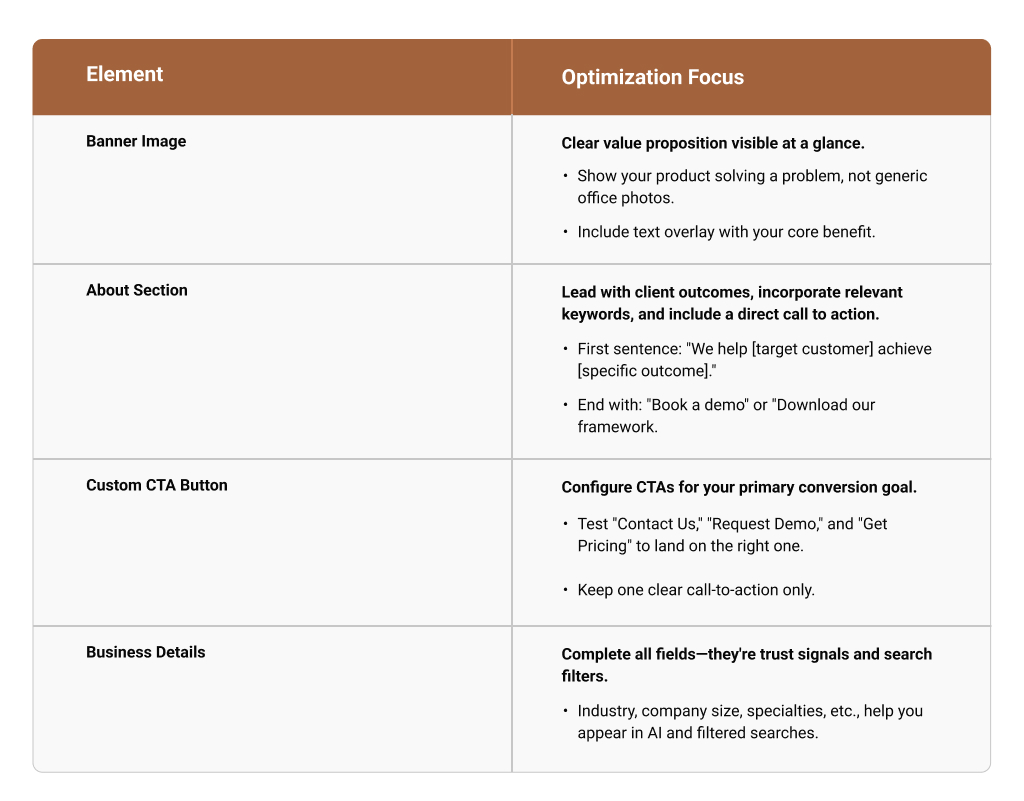
1. The Anatomy of a High-Converting Company Page
Treat your company page as a landing page for B2B lead generation on LinkedIn, not a brochure. Every element should move visitors toward action:
2. The Posting Frequency Formula
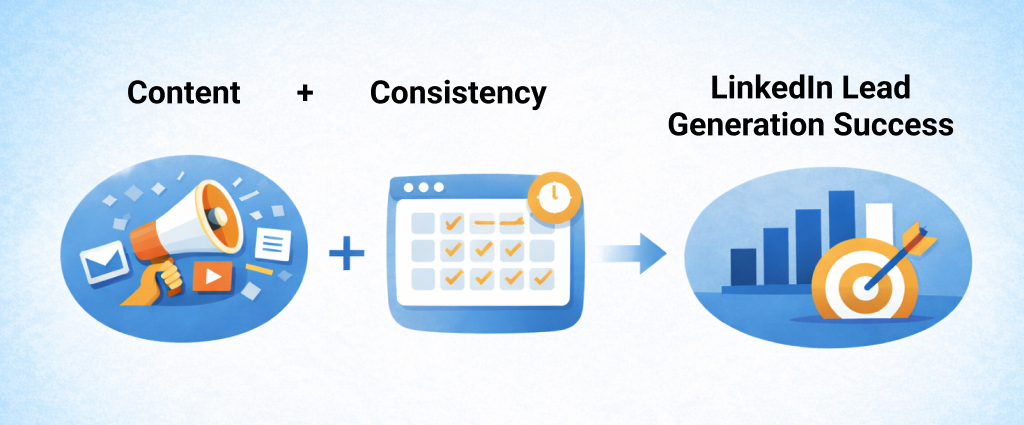
Consistency determines visibility. Pages that post weekly have 5.6x more followers than those that post monthly; their following also grows 7x faster. More importantly, regular posting keeps you algorithmically relevant: LinkedIn’s feed prioritizes active pages, meaning your content reaches more decision-makers during their research phase. So, aim for three to five posts weekly (make a content calendar) to maintain momentum without exhausting your content pipeline.
3. Activating Your Employee Network
Employee engagement is essential for two reasons. First, LinkedIn’s algorithm heavily weights early engagement. Employees can engage immediately after you post, which signals to LinkedIn that your content is valuable and relevant. Second, your employees’ combined networks are much larger than your company’s follower base; in fact, an earlier LinkedIn report suggests they may be up to 10x larger. This means that when employees engage with the company page’s content, they help extend your reach well beyond your company’s direct followers, putting your posts in front of potential customers, partners, and influencers. So, you must ensure every team member links their profile to your company page. This simple alignment amplifies reach organically.
4. Optimizing for LinkedIn’s AI Search Discovery
LinkedIn launched AI-powered conversational search in November 2025, fundamentally changing how prospects discover companies and people on the platform. Instead of rigid keyword searches, users can now type natural-language queries like “B2B SaaS companies helping healthcare providers with patient scheduling” or “cybersecurity vendors with SOC 2 compliance experience” and get a list of providers, rather than a list of possibly matching results.
Since AI interprets intent rather than exact matches, your optimization strategy needs to evolve when posting on LinkedIn for lead generation purposes:
- Your About section should describe what problems you solve and who you help in conversational language—the way your customers actually talk about their challenges, not in marketing jargon.
- LinkedIn’s AI uses structured data (job titles, skills, certifications, company details) combined with natural language understanding to surface relevant results. So you must complete your specialties section thoroughly.
- Instead of keyword stuffing, naturally incorporate variations of how customers describe their problems. If you solve “customer churn,” also mention “retention challenges,” “reducing cancellations,” and “improving renewal rates.”
- The AI is trained on LinkedIn’s 900+ million professional profiles, but it prioritizes prominent, complete profile data. So, keep critical information above the fold. Your value proposition should be immediately visible without having to click “see more.”
8 Proven Strategies for High-Quality B2B Lead Generation on LinkedIn in 2026
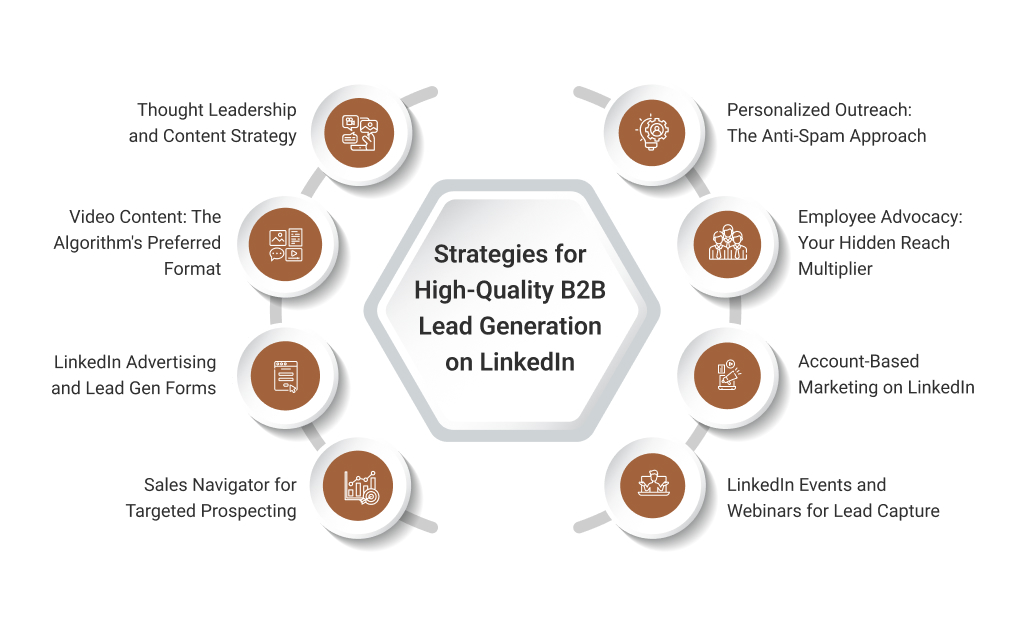
Optimizing your company page establishes the foundation for B2B lead generation on LinkedIn. Now we move to the strategies that actively generate leads. These tactics separate companies that generate LinkedIn leads accidentally from those who do it systematically.
1. Thought Leadership and Content Strategy
Decision-makers do not respond to generic pitches; they react to expertise. The 2025 Edelman-LinkedIn B2B Thought Leadership Impact Report confirms this: 95% of hidden decision-makers (people with buying influence in an organization but little or no interaction with sales teams) say strong thought leadership makes them more receptive to sales and marketing outreach. Also, thought leadership creates what paid advertising cannot buy: permission to continue the conversation. When prospects recognize names from valuable content, connection requests get accepted, emails get opened, and discovery calls start from a position of credibility rather than skepticism.
The ROI of thought leadership is compounding. A single high-value post can generate inbound leads for months when prospects reference it in connection requests, cite it in discovery calls, and share it internally to justify vendor selection.
Building Your Thought Leadership Framework:
Start by identifying three to five content pillars—topics where your organization possesses genuine expertise. Then commit to a consistent publishing rhythm that demonstrates depth rather than breadth.
What resonates with today’s B2B buyers:
- Fresh perspectives that challenge assumptions, like contrarian takes on industry norms (86% of decision-makers actively seek such content)
- Original insights drawn from your direct experience, where you share what failed, not just what worked
- Practical frameworks readers can apply immediately
- Human, accessible language: 65% of buyers prefer more human, less formal content over academic or intellectual content.
- Predictions with accountability: “Here’s what I predicted 6 months ago and what actually happened”.
The goal is not virality. It is building the kind of authority that makes prospects seek you out rather than you reaching out to them.
2. Video Content: The Algorithm’s Preferred Format
If your content strategy relies solely on text and static images, you are leaving reach on the table.
LinkedIn has clearly signaled its priorities—video views on the platform increased 36% year-over-year, and as of July 2025, video uploads rose by over 20%. The algorithm favors video because it keeps users engaged longer, translating directly into distribution advantages for those who embrace the format.
Video Best Practices for B2B Lead Generation on LinkedIn:
| Element | Recommendation |
|---|---|
| Length | Under 90 seconds for feed videos; longer for Live sessions. |
| Format | Native upload only (external links reduce reach) |
| Captions | Always include |
| Content Focus | Quick insights, behind-the-scenes glimpses, customer stories, live Q&As |
3. LinkedIn Advertising and Lead Gen Forms
[Source: Dreamdata | 2025 LinkedIn Ads Benchmarks Report]
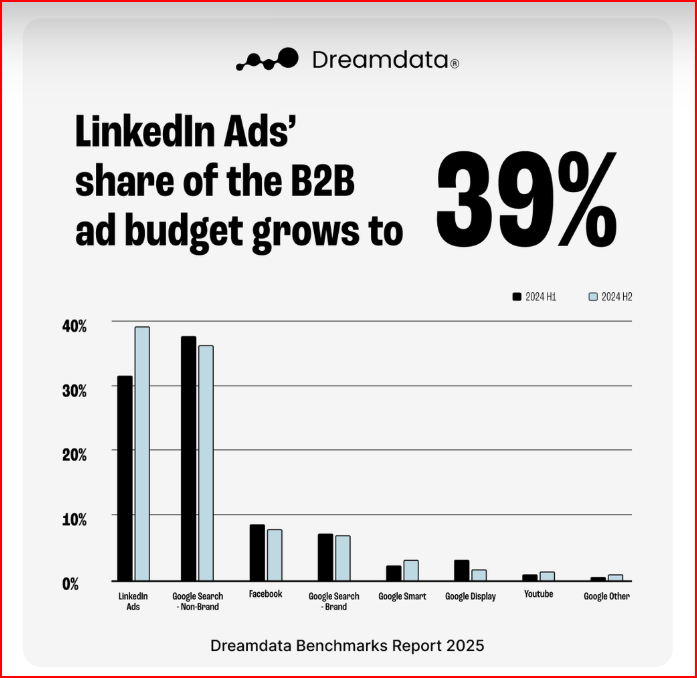
Organic reach builds long-term authority, but paid campaigns accelerate the pipeline when you need results in a short window or are working on ABM at scale. LinkedIn Ads have matured into a full-funnel growth engine for B2B marketers.
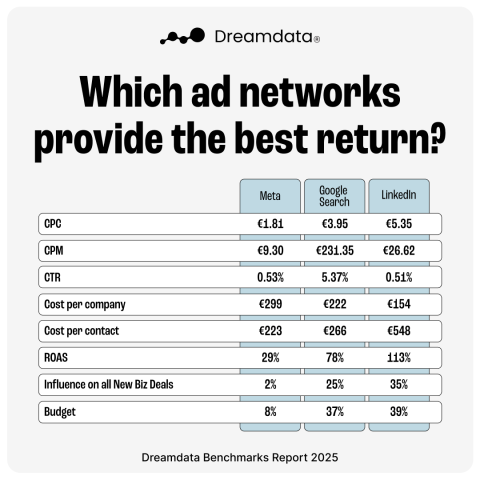
Earlier LinkedIn studies have shown Lead Gen Forms achieving a 13% conversion rate, when the average landing page conversion rate across industries was around 6.6%. The 2025 LinkedIn Ads Benchmarks Report from Dreamdata notes that while LinkedIn Ads have a higher cost per individual click and per impression than platforms like Google Search Ads and Meta (formerly Facebook), the overall cost to target a company is lowest on LinkedIn.
The difference comes from reduced friction in form-filling. When someone clicks a Lead Gen Form, they’re likely already logged into LinkedIn. Lead Gen forms pre-populate with user profile data, eliminating the typing that causes abandonment. Contrast this with landing pages, where prospects must context-switch from LinkedIn to your website, wait for the page to load, manually fill out fields, and often second-guess whether to use their work email. Each of these micro-decisions creates dropout points that Lead Gen Forms eliminates.
Ad Formats That Deliver:
| Format | Strategic Use |
|---|---|
| Lead Gen Forms | Primary choice for direct lead capture |
| Thought Leader Ads | According to a LinkedIn report, Thought Leader Ads have a higher click-through rate (1.7x) and higher engagement rate (1.6x) compared to other single-image ad campaigns. |
| Sponsored Content | Build awareness before conversion campaigns |
| Conversation Ads | Personalized, interactive engagement for high-value targets |
B2B advertisers report 113% average return on ad spend on LinkedIn, which showcases the efficiency the platform brings and the opportunity for businesses to drive leads at a reasonable cost. The key to success is precise targeting: layer job titles, company size, industry, and seniority to reach exactly the buyers you want.
[Source: Dreamdata | 2025 LinkedIn Ads Benchmarks Report]
4. Sales Navigator for Targeted Prospecting
[Source: LinkedIn | Sell]
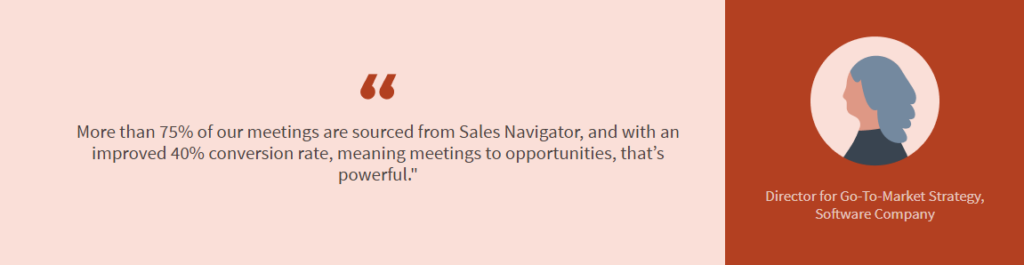
For organizations serious about LinkedIn lead generation, investing in Sales Navigator pays for itself quickly. Forrester’s Total Economic Impact Study found 312% ROI over three years, with the investment recovered in less than six months.
Maximizing Sales Navigator for B2B Lead Generation on LinkedIn:
- Advanced Search Filters – Use 50+ filters to build precise prospect lists matching your ideal customer profile
- Buyer Intent Signals – Track when target accounts engage with your company or relevant content
- TeamLink – Surface warm introduction paths through colleagues’ connections
- Account IQ and Lead IQ – Generate instant prospect summaries to personalize outreach at scale
- Account Hub and Alerts – Sales Navigator users can use these features to identify and reach out to qualified prospects more quickly.
5. Personalized Outreach: The Anti-Spam Approach
Generic connection requests and templated pitches fail. The data proves it: personalized connection requests achieve approximately 45% acceptance rates, compared with 15% for generic messages.
The difference between effective outreach and spam comes down to relevance and timing.
The Anti-Spam Framework:
Warm Up before Reaching Out
- Engage with their content first (thoughtful comments, not just likes)
- Let them see your name before receiving your request
Personalize Every Touch
- Reference specific content they published
- Mention mutual connections or shared experiences
- Acknowledge recent company news or role changes
Keep Connection Notes Concise
- Under 300 characters
- Lead with relevance, not your pitch
- Example: “Hi [Name], your post on [topic] resonated—particularly [specific point]. Would love to connect.”
Follow Up Thoughtfully
- Plan four to five touches over 10-14 days
- Space messages two to five business days apart
- Each touch should add value, not just remind them you exist
What Destroys Response Rates:
- Generic “I’d like to add you to my network” messages
- Immediate sales pitch after connection acceptance
- Automated sequences without personalization
- Exceeding 100 connection requests weekly (triggers platform restrictions)
6. Employee Advocacy: Your Hidden Reach Multiplier
Your company page has limitations that your employees do not. Content shared by employees generates 561% greater reach and 8x more engagement than the same content posted through brand channels.
Employee advocacy leverages human connections to extend your brand’s reach exponentially. The reason is straightforward: people trust people more than they trust logos. By involving your team in sharing authentic content, you tap into networks that trust their voices more than any corporate messaging.
Building an Effective Employee Advocacy Program for LinkedIn Lead Generation:
| Component | Implementation |
|---|---|
| Make Participation Easy | Provide pre-approved content that employees can share with minimal effort |
| Start With Leadership | Executive participation signals importance and sets expectations |
| Focus on Authenticity | Encourage employees to add personal commentary rather than sharing without context |
| Track Results | Measure reach, engagement, and leads attributed to employee shares |
7. Account-Based Marketing on LinkedIn
Traditional lead generation campaigns cast a wide net. Account-based marketing flips the model—you identify high-value accounts first, then pursue them with precision. This is the reason why 79% of marketers report ABM delivers higher ROI than other marketing strategies.
LinkedIn makes ABM execution practical by solving the most challenging part: identifying and reaching the people who actually influence purchase decisions.
Why ABM Requires a Multi-Stakeholder Approach:
The average buying committee includes six to ten stakeholders. Reaching only one or two decision-makers leaves your deal vulnerable—more than 40% of B2B deals stall due to internal misalignment among buying committee members.
LinkedIn changes this equation. With ABM, you can identify every stakeholder and engage each with content tailored to their specific concerns—building consensus before your competitor even reaches the full committee.
ABM Execution Framework for Effective B2B Lead Generation on LinkedIn:
- Define Your Target Account List: Use firmographic data, intent signals, and ideal customer profile criteria to identify high-value targets
- Map the Buying Committee: Average B2B purchases involve six to ten stakeholders. More than 40% of deals stall due to internal misalignment—your content must address multiple personas within each account
- Orchestrate Multi-Touch Sequences: Combine LinkedIn advertising, personalized outreach, and content engagement across seven to fourteen touchpoints before expecting conversion
- Personalize by Account: Develop account-specific messaging, case studies featuring similar companies, and landing pages tailored to each target’s industry challenges
ABM requires more coordination than broad-based campaigns, but rewards that investment with larger deals and faster sales cycles.
8. LinkedIn Events and Webinars for Lead Capture
The strategies covered so far for B2B lead generation on LinkedIn—content, outreach, advertising, and advocacy—all drive engagement. LinkedIn Events converts that engagement into registered leads with declared intent.
When someone registers for your event, they signal active interest in your expertise. Unlike passive content consumption, registration represents commitment—a prospect willing to invest time in exchange for the value you promised to deliver.
Why LinkedIn Events Work for B2B Lead Generation:
Events attract prospects earlier in their buying journey. Someone registering for a webinar titled “How CFOs Are Reducing SaaS Spend in 2026” has revealed a priority you can address—before they ever fill out a contact form or speak with sales.
Event Strategy that Generates Qualified Leads:
| Element | Approach |
|---|---|
| Topic Selection | Address specific challenges your buyers face—not product features |
| Format | Webinars, live Q&As, panel discussions, or virtual workshops |
| Promotion | Combine organic posts, employee shares, and targeted ads to reach your ideal audience |
| Registration | Keep forms short; LinkedIn can pre-fill professional details |
Post-Event: Where LinkedIn Lead Generation Actually Happens
The event itself is the beginning, not the end. Export your attendee list, segment by engagement level, and follow up with personalized outreach. Share the recording with registrants who missed the live session. Repurpose key insights into posts, carousels, or short video clips that extend your reach and reinforce your expertise.
A single well-executed event can fuel weeks of content and conversations—turning one hour of delivery into dozens of qualified touchpoints.
What the 2026 LinkedIn Algorithm Actually Rewards
Understanding how LinkedIn distributes content is the difference between shouting into the void and appearing in the feeds of decision-makers actively researching solutions. The algorithm underwent significant changes throughout 2024-2025, shifting from optimizing for raw engagement (likes, shares) to optimizing for meaningful engagement—comments, dwell time, and repeat interactions.
What this means for B2B lead generation: Your posts can reach qualified prospects even with modest follower counts, if you align with the signals LinkedIn’s algorithm prioritizes.
The Shift toward Expertise Over Virality
In 2024, LinkedIn’s engineering team published updates confirming a deliberate pivot: the algorithm now weighs who engages and how they engage more heavily than simple engagement volume. For instance, a post with 50 comments from senior decision-makers outperforms a post with 500 likes from random users.
For B2B marketers, this means LinkedIn no longer rewards engagement bait or content designed purely to go viral. The algorithm now prioritizes expertise, relevance, and meaningful interaction.
| Signal | Why It Matters |
|---|---|
| Topic Authority | Consistent posting on specific subjects builds credibility; the algorithm distributes your content to relevant audiences who engage with those topics |
| Comments | Comments carry much more algorithmic weight vs. likes |
| Dwell Time | How long users spend reading your post significantly influences distribution |
| First-Hour Engagement | Strong initial interaction signals quality and triggers broader distribution |
| Native Content | Posts without external links perform substantially better |
What the Algorithm Can Penalize
Avoid these patterns that can suppress distribution:
- External links in the post body (redirects users off-platform)
- Engagement bait (“Comment YES if you agree!”)
- Excessive hashtags (Using 6+ hashtags can flag a post as low-quality or spam, which the algorithm then suppresses)
- Rapid posting (multiple posts within 24 hours can cannibalize each other’s reach)
- Generic AI-generated content (lacking a personal voice or specific examples)
The algorithm rewards content that keeps users engaged on the platform. So, create posts worth reading, spark conversations worth having, and the distribution follows.
How AI Is Enhancing LinkedIn Lead Generation—And Where It Breaks
Artificial intelligence has reshaped how B2B teams approach LinkedIn lead generation. With 88% of organizations now using AI in at least one business function, the question is no longer whether to adopt these tools—it is how to deploy them effectively without sacrificing the human connection that drives conversions.
We continue to bring AI to every part of the LinkedIn experience, introducing agents across hiring as well as sales.
— Satya Nadella, CEO Microsoft – Q4 FY25 Earnings Call, July 2025
Where AI Delivers Genuine Value
AI accelerates the repetitive work that consumes sales and marketing teams’ time. Used strategically, it creates capacity for higher-value activities. Here are a few activities that AI can perform effortlessly:
- Prospect Research
- Initial Message Drafting
- Lead Scoring
- Content Ideation
- Follow-Up Automation
Where AI Breaks Down
AI falters where B2B relationships matter most: nuance, context, and authentic connection.
Human-written follow-ups consistently outperform AI versions—humans recognize when to adjust tone or acknowledge timing sensitivities. LinkedIn’s algorithm penalizes generic AI content, and prospects instinctively delete messages that feel automated.
Over-automation also triggers platform restrictions. Aggressive patterns lead to connection limits or account suspension—short-term efficiency gains vanish when your prospecting channel becomes inaccessible.
Remember: AI cannot read the room; Humans can.
The Human-in-the-Loop Solution
The organizations winning on LinkedIn in 2026 reject the false choice between AI efficiency and human effectiveness. They embrace both through deliberate integration.
Delegate to AI:
- First-draft message creation
- Research compilation and summarization
- Scheduling and sequencing logistics
- Data enrichment and lead scoring
- Performance pattern analysis
Reserve for Humans:
- Follow-up conversations with engaged prospects
- High-priority account outreach
- Relationship-building moments that require empathy
- Content that shares genuine experience and perspective
- Final review of any AI-generated output before sending
Your 30-Day B2B LinkedIn Lead Generation Roadmap
Strategy without execution produces nothing. This roadmap translates the approaches above into a structured action plan you can begin implementing today.
Conclusion
LinkedIn has earned its position as the leading B2B lead generation platform. The statistics confirm what businesses experience daily: no other channel offers comparable access to decision-makers, cost efficiency, and conversion quality.
But the platform rewards strategy, not activity. If you have grasped everything discussed so far, the path forward should be clear.
- Build your foundation with an optimized company presence
- Choose strategies that match your resources
- Execute consistently with personalization
- Leverage AI thoughtfully as an accelerator
The businesses winning in B2B lead generation on LinkedIn in 2026 are not those with the largest budgets or the most sophisticated tools. They are the ones showing up authentically, providing genuine value, and building relationships at scale—one meaningful connection at a time.


Rohit Bhateja, Director - Digital Engineering Services & Head of Marketing
Rohit Bhateja, Director of Digital Engineering Services and Head of Marketing at SunTec India, is an award-winning leader in digital transformation and marketing innovation. With over a decade of experience, he is a prominent voice in the digital domain, driving conversation around the convergence of technology, strategy, customer experience, and human-in-the-loop AI integration.