Transforming Workflows: Process Automation as a Key to Higher Productivity

Table of Contents
- Table of Contents
- The Current State of Process Automation
- The Case for Higher Productivity with Business Process Automation
- How does Business Process Automation Work?
- Which Business Processes Should you Automate?
- Steps to Implement Business Process Automation
- Critical Considerations for Successful Process Automation
- The Way Forward
In recent years, advanced technologies such as AI and ML have driven a significant shift towards process automation, enabling businesses to future-proof their operations. The main impact stems from the increasing productivity that comes with automated workflows, saving significant time and resources spent on repetitive tasks. Underscoring this impact, according to MarketsandMarkets, the global business process automation market is set to nearly double by 2026!
Let’s explore this arena in detail.
Table of Contents
- The Current State of Process Automation
- The Case for Higher Productivity with Business Process Automation
- How does Business Process Automation Work?
- Which Business Processes Should you Automate?
- Steps to Implement Business Process Automation
- Critical Considerations for Successful Process Automation
- The Way Forward
The Current State of Process Automation
According to MarketsandMarkets, the global business process automation market is expected to reach USD 19.6 billion by 2026, up from USD 9.8 billion in 2020, growing at a CAGR of 12.2%.
Such extensive growth stems from the widespread adoption of automated workflows (especially after the COVID-19 pandemic) for improved efficiency, reduced operational costs over the long run, and enhanced customer satisfaction.
The Case for Higher Productivity with Business Process Automation
As per a McKinsey podcast that discusses a recent report on global productivity with senior partners Chris Bradley and Olivia White, the median productivity (globally) is now six times more than it was 25 years ago!
A significant reason behind it is the investments made in automation and digital transformation.
While this can be a success story for many (in simple framing), it’s also accompanied by a stalling rate of productivity growth. The report mentioned above discusses increasing investment in automation and digital transformation vis-a-vis the impact of gen AI on employee productivity, highlighting the following critical questions:
- Are companies deploying automation in the right place, enabling individuals to be more productive in their work?
- Are their employees qualified and prepared to work with systems integrated with AI and generative AI?
- For people whose jobs may become less relevant as AI rolls out, are these workers being retrained?
The answer is pretty intuitive. To drive growth with business process automation in the AI era, companies must strategically deploy automation and prepare employees for AI-integrated workflows. With AI poised to transform entry-level white-collar jobs, it’s also important to retrain employees for roles that leverage human capabilities.
Let’s dig deeper to understand how its strategic implementation improves overall efficiency and productivity.
How does Business Process Automation Work?
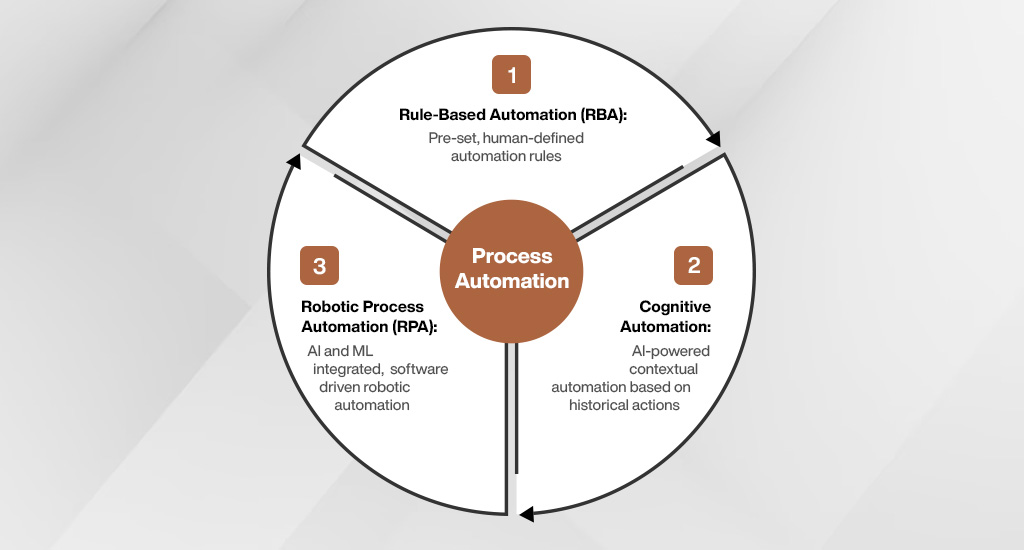
There are three primary categories of process automation solutions:
Rule-Based Automation (RBA)
This is the simplest form of business process automation that uses pre-set, human-defined rules to manage data storage and manipulation. It’s ideal for high-volume, straightforward tasks such as copying and pasting information or transferring data from invoices.
Cognitive Automation
Cognition-based process automation solutions leverage advanced AI to operate like humans by understanding context and continuously learning from historical actions. They are more suitable for complex decision-making processes and tasks like logistics management and employee onboarding.
Robotic Process Automation (RPA)
This category of process automation solutions is more advanced and utilizes software-driven robots to mimic human actions. RPA solutions are often integrated with AI and ML algorithms, allowing them to learn and adapt to various tasks without extensive pre-programming. It is generally used in managing customer service inquiries, performing data analysis, and processing transactions.
Which Business Processes Should you Automate?
As per Gartner, business process automation should cater to “complex processes and functions beyond conventional data manipulation and record-keeping.” Keeping this in mind, here are some key areas for you to consider process automation:
- Customer Service: Automated responses to consumer inquiries, streamlining ticket management, and automated email replies.
- Finance and Accounting: Automated invoice processing, expense management, and financial reporting.
- Supply Chain Management: Automated inventory management, order processing, shipment tracking, etc.
- Marketing: Automated email campaigns, social media postings, and customer segmentation for more targeted marketing efforts.
- Human Resources: Automated employee onboarding, payroll processing, employee data management, etc.
Steps to Implement Business Process Automation
Shifting from manual workflows to automated ones can be challenging, even if you start with just one process. Here are some steps to ensure a smooth transition:
Identify the Business Processes you Want to Automate
Start by identifying repetitive and time-consuming tasks. Think about the maximum benefits of automating such tasks. Most often, these include point-of-sale data management, payroll, fraud detection, quality control, and supply chain management.
Outline your Business Goals
Before implementing any process automation solution, define specific goals you aim to achieve with automation, such as reducing operational costs or enhancing productivity.
Select the Right Tool/BPA Service Provider
Once you have a clear idea, look for a reliable and affordable automation tool, platform, or service provider based on the complexity and requirements of the tasks. This could be anything, ranging from a basic virtual assistant or rule-based BPA system to advanced AI-driven cognitive automation solutions.

Implement and Integrate the Solutions
After selecting an ideal automation tool, platform, and service provider, work with them to create a detailed map of the current processes and design the workflow for automation to develop your solution. Once done, integrate the finalized BPA solution into your existing system. This includes setting up the automation rules, configuring the software, and ensuring that all components work together smoothly.
Ensure a Smooth Transition with Communication and Retraining
To ensure successful adoption and efficiency, keep your employees informed and updated throughout the transition. From planning to final execution, communicate the benefits of business process automation and provide comprehensive training on the new systems. This approach will maximize the ROI of your investment and ease the transition.
Optimize and Scale
After implementing the process automation solution, conduct thorough testing to ensure that your processes work just as expected. Monitor performance and keep track of relevant metrics such as error rates, processing time, uptime, cost savings, etc. This will help you optimize automation implementation, enabling you to scale accordingly.
Critical Considerations for Successful Process Automation
Shifting to automated business processes, even with all this clarity and planning, can pose certain challenges.
- Initial Cost Considerations
Business process automation solutions can be expensive to set up, requiring a significant investment in advanced technologies, infrastructure, employee training, and ongoing maintenance. Hence, decide on a budget before implementing any solution.
- Integration with Legacy Application and Systems
One of the most prominent automation challenges is integrating new systems with existing systems and applications, requiring several customizations and workarounds. You need proper integration planning and rigorous testing to ensure compatibility and optimal performance. In some cases, you may even have to modernize legacy systems by rearchitecting them or migrating to the cloud.
- Employee Resistance
Introducing business process automation can cause significant resistance among employees. Many fear job losses as machines take over many of the tasks they traditionally perform, leading to anxiety and reduced morale. Additionally, employees may worry about the increased complexity of their workflows, feeling overwhelmed by the need to learn new systems and adapt to changes in their routine tasks.
- Security Concerns
Process automation can introduce several security vulnerabilities (malware, viruses, unidentified access points, bugs) in your systems, which is a major concern for all businesses. Consequently, sensitive data may be at risk if robust security measures are not in place.
- Ongoing Maintenance Updates
Business process automation is not a one-time solution; it requires regular maintenance and updates to stay up and running. This includes planning and provisioning for continuous performance monitoring, regular software updates, and security patches to address potential issues promptly.
The Way Forward
As AI and automation are here to stay, and they will take over a portion of what we used to do, the future outlook with automated business processes depends on how you train your employees to work in synergy with these systems. To fully benefit from automated business processes, companies must strategically invest in and deploy these solutions, enabling their workforce to lead the change with more productivity and efficiency. The key is to leverage process automation alongside human intelligence.

The SunTec India Blog
Brought to you by the Marketing & Communications Team at SunTec India. We love sharing interesting stories and informed opinions about data, eCommerce, digital marketing and analytics, app development and other technological advancements.