Building Smart Wearable Solutions: The Role of Mobile Developers in Healthcare Innovation
Table of Contents
- All you Need to Know about Healthcare Wearables
- Innovations in Mobile Healthcare App Development
- The Benefits of Wearable and Healthcare Apps
- Overwhelmed by the Complexity of Wearable App Development?
- Future of Wearable Tech in Healthcare: A Human-Centric Evolution
- Steps to Build a Healthcare Wearable App
- Case Study: HealthCore – Revolutionizing Patient Care Through Digital Transformation
- Conclusion
During and post Covid, healthcare has witnessed a remarkable transformation driven by technology. From digitizing medical records to introducing AI-powered diagnostics, tech integration into healthcare has opened doors to innovative and efficient solutions. Among these advancements, wearable solutions and mobile apps have emerged as major winners. They are redefining patient care, enabling preventive health measures, and making healthcare more accessible.
Why Wearable and Mobile Apps Matter Today
The global focus on wellness, coupled with rapid advancements in technology, has made healthcare app development services an important part of modern healthcare. Wearable devices such as fitness trackers, smartwatches, and implantable sensors are no longer just consumer gadgets. They play an integral role in monitoring health in real-time, providing remote patient management, and even predicting medical conditions. Complementing these devices, mobile apps ensure seamless data integration, analysis, and interaction between patients and healthcare providers.
Consider this: the wearable healthcare market is projected to grow from $16.2 billion in 2021 to an astonishing $30.1 billion by 2026. Similarly, mobile healthcare apps are experiencing unprecedented demand, with over 350,000 health apps available globally. This surge reflects a growing consumer preference for convenient, tech-driven solutions.
In this blog, we will explore:
- The latest trends in healthcare app development services and wearable technologies.
- Real-world benefits for patients and providers.
- Challenges developers face in creating wearable healthcare applications, along with solutions.
- Insights into the future of wearable solutions in healthcare.
This is more than just a tech-driven evolution—it’s a step toward a healthier, more connected world. Whether you’re a healthcare professional or planning to hire mobile app developers, the insights here will help you navigate this dynamic field.
All you Need to Know about Healthcare Wearables
The healthcare industry has been incredibly fast at embracing innovation, and wearable devices in healthcare are leading this charge. From smartwatches that track heart rates to implantable sensors that monitor glucose levels, these devices are transforming the way we approach health and wellness.
What Are Healthcare Wearables?
Wearable technology refers to electronic devices designed to be worn on the body, often seamlessly integrating with mobile applications or other connected platforms. These devices are equipped with sensors that collect real-time data about various aspects of a person’s health and activity. Examples include:
- Smartwatches: Devices like the Apple Watch or Samsung Galaxy Watch, which monitor heart rate, oxygen levels, and even perform ECG readings.
- Fitness Bands: Affordable and lightweight options like Fitbit or Xiaomi Mi Band, focused on tracking steps, calories, and sleep patterns.
- Implantable Devices: Advanced innovations such as continuous glucose monitors (CGMs) for diabetes management, pacemakers, and neural implants that offer deeper health insights.
- Wearable Health Monitoring Devices: Specialized gadgets like wearable ECG monitors, posture correctors, and even smart clothing embedded with sensors for tracking vitals.
These wearables work in tandem with health and fitness monitoring apps, empowering individuals to take control of their health while providing actionable insights to healthcare providers.
Market Trends in Wearable Devices for Healthcare
The global market for wearable devices in healthcare has been growing exponentially. As stated above, the wearable tech market was valued at approximately $16 billion in 2021 and is projected to reach over $30 billion by 2026.
A few factors contributing to this growth include:
- Post-Pandemic Adoption: The COVID-19 pandemic accelerated the adoption of remote healthcare solutions, making wearables a key player in telemedicine and virtual care.
- Consumer Demand for Preventative Care: As more individuals prioritize wellness, the need for health-tracking devices and apps has surged.
- Technological Advancements: Improvements in IoT, AI, and data analytics have made devices smarter, more accurate, and easier to use.
Moreover, businesses in this space are flourishing. For instance, a healthcare software development company specializing in wearable integration can offer tailored solutions, enabling hospitals and fitness companies to leverage this technology effectively.
Key Drivers Behind the Popularity of Wearables in Healthcare
The rise of wearable health monitoring devices isn’t just a coincidence—it’s driven by several powerful trends reshaping the healthcare landscape:
- Increased Health Awareness
Today’s consumers are more informed about the importance of tracking their health metrics. Wearables provide convenient, real-time feedback on vital statistics, encouraging healthier lifestyles and fostering early detection of health issues. - Integration with IoT
The Internet of Things (IoT) has revolutionized connectivity, allowing wearable devices to seamlessly transmit data to smartphones, fitness apps, or even directly to healthcare providers. This interconnected ecosystem enhances both accuracy and accessibility. - Remote Monitoring Needs
Remote patient monitoring has become essential, particularly for managing chronic conditions like hypertension, diabetes, or cardiac issues. Wearables empower doctors to monitor patients’ health continuously, reducing the need for frequent in-person visits.

Innovations in Mobile Healthcare App Development
From health and fitness monitoring in IoT to advanced wearable medical devices, these innovations are reshaping how healthcare services are delivered. Here’s a closer look at the emerging technologies and the features that define successful healthcare apps:
A. Emerging Technologies in Healthcare App Development
1. AI-Powered Chatbots & Diagnostics
AI is transforming diagnostics by enabling health monitoring wearable devices to provide real-time insights. Apps like K Health use machine learning to analyze patient symptoms and recommend care pathways. Similarly, Sensely employs an AI-powered virtual nurse to assist with symptom triage, delivering personalized care while reducing the burden on healthcare professionals.
These chatbots not only address routine inquiries but also integrate with wearable medical devices, allowing healthcare providers to monitor patient conditions remotely and act proactively.
2. Cloud Computing Solutions
The integration of cloud computing into healthcare smart watches development and other wearable technologies has redefined data storage and security. By leveraging HIPAA-compliant cloud platforms, healthcare apps ensure secure access to patient data, enabling seamless collaboration between doctors and patients.
Cloud solutions also allow health monitoring wearable devices to transmit data in real-time, enhancing the speed and precision of diagnostics while reducing infrastructure costs for healthcare organizations.
3. Big Data Analytics
Big data has emerged as a cornerstone of predictive healthcare. By collecting and analyzing vast amounts of data from wearable devices, healthcare providers can identify trends, predict potential health risks, and tailor interventions for patients.
For example, health and fitness monitoring in IoT-powered devices enables the continuous tracking of vital parameters like heart rate, blood pressure, and sleep patterns. These insights empower both patients and providers to make informed decisions that promote well-being.
4. Internet of Medical Things (IoMT)
The IoMT ecosystem connects devices such as wearable medical devices, smart insulin pens, and ECG monitors to create a network of real-time health insights. These devices, integrated with mobile apps, provide patients with a comprehensive view of their health.
For instance, healthcare smart watches development has led to wearables that monitor cardiac health, detect arrhythmias, and even alert users to potential emergencies. By combining IoT with mobile technology, these solutions bring healthcare directly into the hands of users.
5. AR/VR in Healthcare
Augmented Reality (AR) and Virtual Reality (VR) technologies are redefining patient care and medical training. AR-powered apps assist surgeons in planning and visualizing complex procedures, while VR applications offer immersive therapy for conditions like PTSD and chronic pain.
Moreover, AR/VR integrated into health monitoring wearable devices enhances rehabilitation and physical therapy by creating engaging, patient-specific programs that improve recovery outcomes.
B. Features of Successful Healthcare Apps
1. Data Encryption and Privacy
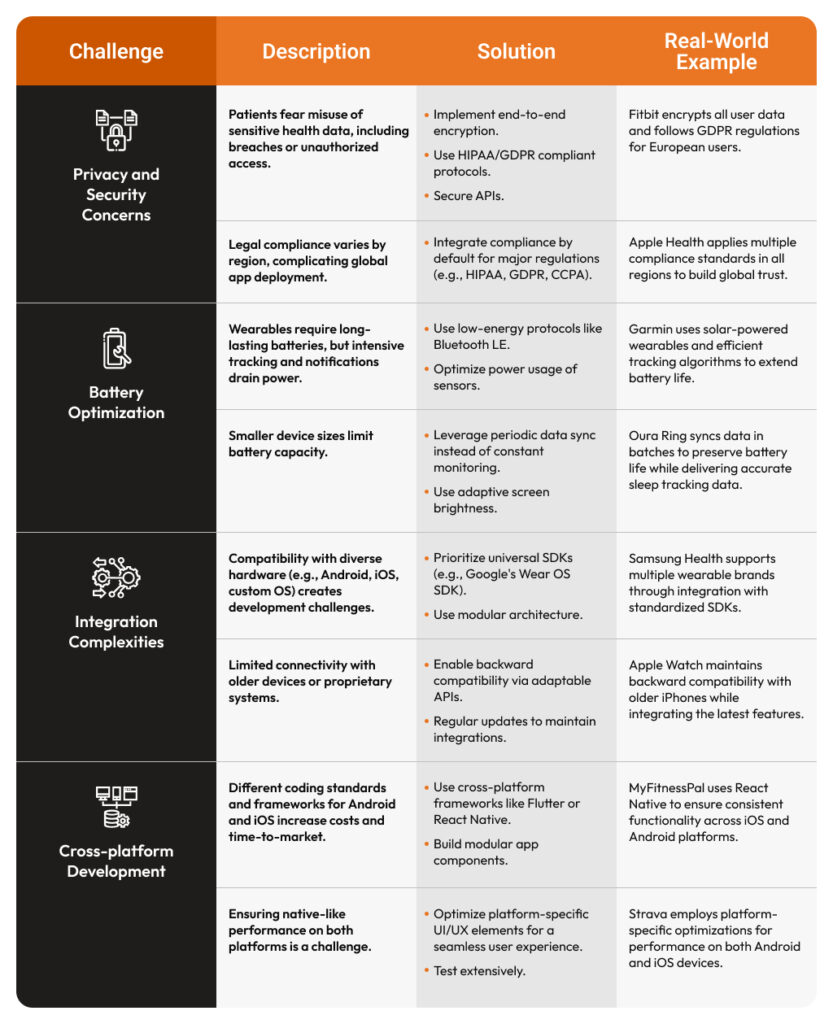
Healthcare apps must prioritize security, especially when handling sensitive data from wearable medical devices. End-to-end encryption, multi-factor authentication, and HIPAA-compliant protocols ensure user data remains confidential.
2. Seamless UI/UX for Smaller Screens
Wearable devices often have limited screen sizes, making intuitive design essential. Successful apps leverage minimalistic, gesture-based interfaces to deliver essential information without overwhelming the user.
For example, healthcare smart watches development focuses on displaying actionable insights through simple visuals, making data easily interpretable at a glance.
3. Compatibility Across Multiple Platforms
A crucial feature of any app is its ability to work seamlessly across platforms. Whether it’s integrating health and fitness monitoring in IoT systems or syncing with various wearable medical devices, cross-platform functionality ensures a cohesive user experience.
By using frameworks like React Native, developers can create apps that function across iOS, Android, and even custom device ecosystems, enhancing accessibility for diverse user groups.
Real-World Impact
The integration of these technologies and features has already begun transforming lives. From real-time health insights delivered by smartwatches to predictive analytics preventing chronic illnesses, health monitoring wearable devices are driving a shift from reactive to proactive healthcare.
As the demand for personalized and accessible care grows, the role of healthcare smart watches development and IoT-powered devices will only expand. By addressing security, usability, and integration challenges, mobile healthcare apps can bridge the gap between technology and human well-being, making healthcare smarter and more inclusive.
The Benefits of Wearable and Healthcare Apps
Healthcare apps and wearables are much more than tech trends—they are essential tools reshaping the healthcare vertical. Let’s explore how they benefit both patients and providers.
For Patients
- Early Diagnosis and Preventive Care: Wearable devices equipped with sensors for vital signs monitoring enable early detection of health issues. For example, smartwatches can detect irregular heart rhythms or track sleep patterns, helping patients address potential problems before they escalate. Mobile apps complement these devices by offering personalized insights and reminders for preventive care.
- Real-Time Health Tracking: Modern wearables can monitor metrics like blood pressure, heart rate, glucose levels, and even oxygen saturation. These insights are fed into healthcare apps that visualize trends, empowering users to make informed lifestyle choices. For those managing chronic conditions, such as diabetes, these tools are life-changing, ensuring adherence to treatment plans.
- Remote Monitoring and Telemedicine: Telemedicine apps have become essential, particularly in rural or underserved areas. Patients can share real-time data from their wearables with healthcare professionals, allowing for virtual consultations and timely interventions. This is especially useful for elderlies or those with mobility challenges.
Healthcare Providers
- Reduced Administrative Tasks: Wearables and apps help streamline administrative workflows by automating routine tasks. For example, patient data collected by wearables is directly integrated into healthcare software systems, reducing paperwork and enabling healthcare professionals to focus on patient care.
- Enhanced Data Analytics for Decision-Making: Wearables generate vast amounts of health data that apps analyze using AI and machine learning. These analytics can provide actionable insights, from identifying patterns in patient health to predicting disease progression. For providers, this means faster, more accurate decision-making and personalized care strategies.
- Improved Patient Outcomes: The combined use of wearable technology and healthcare apps fosters better communication between patients and providers. Regular monitoring, coupled with proactive care interventions, ensures improved health outcomes and patient satisfaction. Providers employing healthcare software development services can customize solutions tailored to their patient base.
Overwhelmed by the Complexity of Wearable App Development?
Experience the expertise of our mobile developers in building apps for smart wearable solutions.
Future of Wearable Tech in Healthcare: A Human-Centric Evolution
As wearable technology continues to evolve, its potential to reshape healthcare delivery becomes even more apparent. From enhancing accessibility to driving personalized care, wearables are not just gadgets—they are becoming essential tools for healthier lives. Let’s explore the trends, collaborative opportunities, and future developments that will define this sector.
Trends to Watch
1. Integration with latest Networks
Faster data transfer speeds, lower latency, and improved connectivity will enable wearables to function seamlessly in real-time.
- What This Means: Wearables will communicate more effectively with healthcare providers, allowing instantaneous updates for remote monitoring of patients with chronic conditions like diabetes or hypertension.
- Real-World Example: Imagine a smartwatch detecting arrhythmias in real-time and instantly notifying both the wearer and their cardiologist, who can intervene proactively.
2. Advances in AI for Deeper Insights
Artificial intelligence is already proving transformative in healthcare, and its integration with wearables will take things to the next level. AI algorithms can analyze data collected by wearables to detect patterns and predict potential health issues before they manifest.
- What This Means: Beyond counting steps or monitoring heart rates, AI-powered wearables could provide actionable insights, such as identifying early signs of depression through behavioral patterns or predicting migraines through subtle physiological changes.
- Real-World Example: Companies like Fitbit are experimenting with stress management features powered by AI that analyze heart rate variability and suggest mindfulness exercises.
The Potential for Smart Wearable Communities
Collaboration Between Tech Providers and Healthcare Systems
The future of wearables lies in collective intelligence, where individual devices work in concert with larger healthcare ecosystems. This requires close collaboration between technology providers, healthcare organizations, and regulators.
- What This Means: Shared data platforms will allow healthcare providers to analyze population-level trends while still maintaining individual patient confidentiality. Wearables could also form the foundation for smart health communities, where data from different users is aggregated to predict local health crises like flu outbreaks.
- Real-World Example: A rural health clinic partnered with a tech company to monitor patients remotely during a pandemic, using wearables to measure oxygen levels and alert clinicians about deteriorating conditions.
Predicted Developments
1. Miniaturization of Wearables
Wearables are set to become smaller, less obtrusive, and more integrated into everyday life. Advances in nanotechnology and flexible electronics will enable devices to be embedded in clothing, skin patches, or even within the body.
- What This Means: Patients will no longer need to carry multiple devices; instead, wearable tech will seamlessly blend into their lives. For instance, adhesive biosensors could replace bulky heart monitors, offering the same precision with added convenience.
- Real-World Example: Companies are already piloting electronic tattoos that can measure vital signs and transmit data wirelessly to healthcare providers.
2. Expansion into Rural and Underserved Regions
Wearables have the potential to bridge the healthcare gap in rural and underserved areas where access to medical facilities is limited. By providing real-time health monitoring and diagnostics, these devices can act as a lifeline for patients who cannot regularly visit doctors.
- What This Means: Governments and NGOs could distribute affordable wearables to monitor chronic conditions in remote areas, supported by telemedicine platforms. This democratization of healthcare could save countless lives by detecting and treating illnesses early.
- Real-World Example: Wearables have been deployed to track maternal health in remote areas, alerting community health workers to potential complications during pregnancy.
Steps to Build a Healthcare Wearable App
- Market Research and Gap Identification
- Analyze user needs in the healthcare domain (e.g., fitness, chronic illness monitoring).
- Identify gaps in existing wearable apps to target niche opportunities.
- Collaborate with healthcare professionals for practical insights.
- Platform Selection (iOS, Android, or Both)
- Evaluate the target audience’s device preferences and market share.
- Leverage WatchKit for iOS and Wear OS for Android to build platform-specific features.
- Consider cross-platform frameworks like React Native for broader reach and cost efficiency.
- Backend Integration for Analytics
- Develop a solid backend for real-time data collection, processing, and visualization.
- Use HIPAA-compliant servers to store and share sensitive health data securely.
- Include APIs for integration with existing healthcare systems (e.g., EHRs).
- Iterative Testing and Compliance Adherence
- Perform rigorous testing across devices to ensure smooth user experience and performance.
- Validate the app against compliance standards like HIPAA, GDPR, or FDA guidelines.
- Conduct usability testing with both patients and healthcare providers for feedback.
- Continuous Updates Post-Launch
- Roll out regular updates to fix bugs, enhance security, and introduce new features.
- Use user analytics and feedback to refine functionality and improve satisfaction.
- Stay updated with wearable technology advancements to remain competitive.
Case Study: HealthCore – Revolutionizing Patient Care Through Digital Transformation
Overview:
HealthCore, a prominent hospital network, sought to enhance its operations and patient care experience through digital transformation. By partnering with SunTec India, the organization embraced smart solutions in telemedicine and data management.
Key Achievements:
- Improved Efficiency: Custom-built digital solutions streamlined workflows, saving time and resources.
- Seamless Telemedicine: Integrated telemedicine services expanded patient accessibility and care reach.
- Enhanced Data Management: AI-powered systems facilitated secure and efficient patient data handling.
- Better Patient Outcomes: The transformation resulted in improved diagnostics and personalized treatment plans.
Testimonial:
“Partnering with SunTec was critical for our hospital network. Their expertise in AI and healthcare digitization truly set them apart. We now provide telemedicine and manage patient data seamlessly, improving outcomes and our bottom line.”
– John Doe, Chief Information Officer, HealthCore
Conclusion
Wearable technology and mobile app development are transforming the healthcare landscape, bringing an unprecedented level of accessibility, personalization, and efficiency to patient care. By seamlessly integrating smart devices with advanced applications, healthcare providers are now better equipped to monitor patient health in real time, predict potential issues before they arise, and deliver more accurate, data-driven care.
From tracking vital signs to enabling remote consultations, wearables have shifted the focus from reactive treatment to proactive, preventative care. This not only improves patient outcomes but also alleviates the burden on overstretched healthcare systems. Features like AI-powered diagnostics, big data analytics, and IoMT connectivity empower medical professionals with actionable insights, ensuring faster and more precise decision-making.
For healthcare organizations, the opportunity to scale services while reducing costs is monumental. With the help of an experienced healthcare software development company, they can overcome integration and compliance challenges to deliver apps that enhance patient engagement and trust.
Whether you’re a startup aiming to disrupt the market or an established provider looking to modernize, it’s crucial to partner with the right team. When you hire mobile app developers who specialize in healthcare technologies, you gain access to expertise that ensures robust, secure, and innovative solutions tailored to your needs.
As the demand for wearable and mobile healthcare solutions grows, now is the time to act. By investing in the right technology and team, you can not only stay ahead of the curve but also make a meaningful difference in patients’ lives while optimizing your operational efficiency.

The SunTec India Blog
Brought to you by the Marketing & Communications Team at SunTec India. We love sharing interesting stories and informed opinions about data, eCommerce, digital marketing and analytics, app development and other technological advancements.