AI search engines and the future of information ownership
Table of Contents
- SEO/Content heists are not new- AI is just making it simpler
- There can be no uproar, because the ball has always been in Google’s court
- Be upset about lost traffic all you want, but AI was inevitable and it is here to stay
- More importantly, the public sentiment towards AI search is turning positive
- Now, the battle is to be a Brand
- But, content is not yet dead
- The future will be shaped by the battle for AI's attention
As businesses that rely on Google for traffic and leads, what is our future?
Right after artificial intelligence became mainstream (thanks to ChatGPT), OpenAI and Microsoft began facing lawsuits. Google was next as it decided to openly build SGE (search generative experience)- an AI search engine.
These lawsuits may be multiple, but they all highlight a single problem- How is it fair for big players to use information that does not belong to them to train their respective AI systems? Why is it okay for them to present information taken from a third party as responses when their AI tool/search engine is queried?
The thing is, information was always supposed to be free, never to be hoarded. AI is only exercising that idea and building its reality- and our future -upon it.
SEO/Content heists are not new- AI is just making it simpler
Writers have been borrowing content from the web for years, paraphrasing it in one way or another to create a more comprehensive version. Businesses have been hiring such writers (at as low as point twelve cents per word) and not subject matter experts, for content creation. The same goes for the field of SEO. It is a well-established system of “if someone’s doing something and it seems to be working, cut, copy, and paste it into your strategy”.
The burglary of digital content and strategies is not at all a new concept but has been expedited by AI. It is easier to execute now. We have seen this happening.
- An SEO finds a decent website and copies its sitemap.
- The SEO uses an AI content generation tool to create content for all the pages in the sitemap.
- The site goes live and gets millions of visitors.
But, now, there is a new twist in this tale.
- Google catches on (somehow) and the site goes from an average organic traffic of 600K to zero within two months.
With Google penalizing such a website, that entire established system of borrowing, copying, and carrying on happily comes crashing down. This is a huge statement. Google knows you are using AI, and it knows you are populating the web with spam content, and it is getting ready to unleash a check on AI-generated spammy content at a scale potentially similar to Panda or Penguin.
Ironically, at the same time, Google plans to launch a search engine that steals content from multiple web pages, paraphrases it into a response that seems fitting to the user query, and does so without crediting the sources.
There can be no uproar, because the ball has always been in Google’s court
The web made information accessible. And at some point, Google and other search engines decided to reward websites for sharing this information with others in the form of traffic. It suited their intent and thus became their business model.
Now that the entire information-access landscape is changing, Google’s business model is bound to follow suit.
AI makes accessing information easier than manual search does. A user does not need to read an entire article to get to the answer they seek, they just need a rightly worded question. Given that context, it does not make sense for Google to tolerate poor content (that it is littered with). It is now able to present users with concise information that sounds more logical than those existing web pages (at least in appearance).
“Google has always had the power to remove almost any player from the web,
but now it has the means to replace them. With AI.“
And, no one can pressure Google to credit anyone, owing primarily to the fact that it holds 90% of the search engine market.
Be upset about lost traffic all you want, but AI was inevitable and it is here to stay
After a certain point, information needs to be cataloged into a system where it can be retrieved through a query or command. Human brains are not designed to handle much information at once. That is why books were written. That is why databases were built. That is why search engines came into existence.
That is why we have AI tools like ChatGPT, Bard, and Claude now.
But, before this, content used to be “King”. Search engine rankings and visibility depended on what content was being published. With AI search engines assuming the role of a search guide with such finesse that a user does not even need to browse the organic results, content no longer matters.
Content is no longer a differentiating factor in online visibility.
More importantly, the public sentiment towards AI search is turning positive
[Source- Statista]
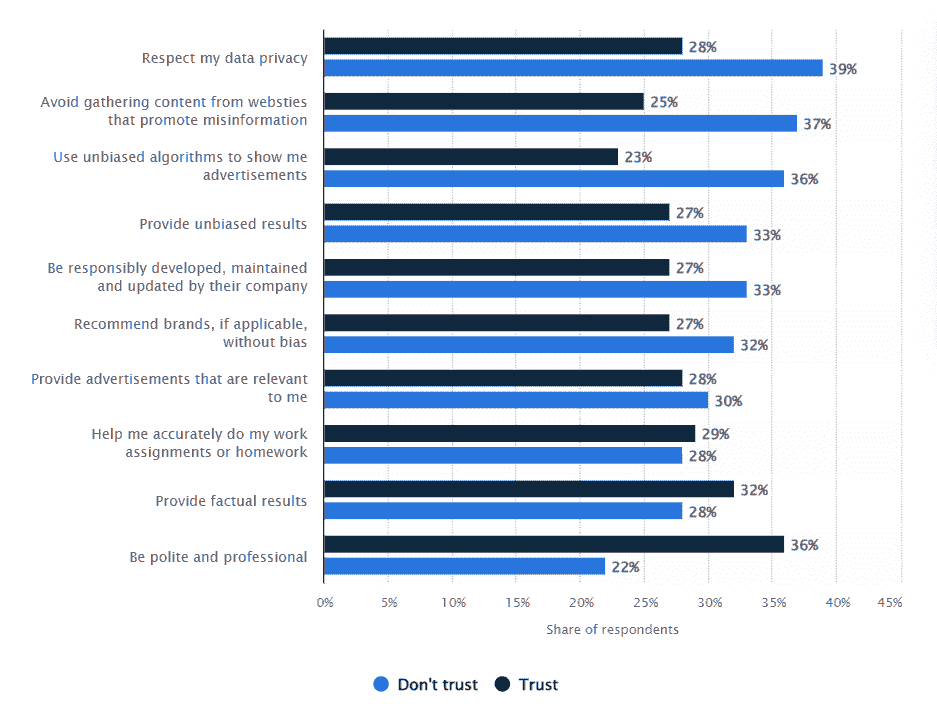
A 2023 survey puts AI-powered search among the most preferred AI products for users (49%). More than a quarter of users were reported to trust AI-powered search results, ads, and brand recommendations. 28% believe that AI search engines respect their data privacy. 23% believe that AI uses unbiased algorithms to show advertisements. And, 32% users trust AI search engines to show factual results.
“The user does not know what goes into a search engine algorithm, nor do they care.”
The non-digital marketers and end-users are not aware of the issues with search results. They have always believed that the first page of a Google search result has the most relevant responses to their query. The same idea, when translated into AI search, makes them trust it.
Also, AI search is simpler to use and reduces search and decision fatigue. It allows the users to act on their idea within minutes, without the need to burden themselves with more information.
Now, the battle is to be a Brand
As businesses slowly lose their primary source of traffic, the new race is to be
- that source which AI search references (and hopefully credits) when responding to user queries
- a brand that users can recognize and trust
For the former, there is no discernible formula yet. There are no indicators as to what Google factors in when choosing information to display in its AI search snippet.
For the latter, brand mentions and publicity are the only tools a digital marketer and business owner has.
Brand marketing is the only way to tell an AI search engine or an LLM (large language model) that you exist and are trusted for any particular product/service. More importantly, relying solely on the SERP to drive traffic to your website will soon be an obsolete strategy.
“AI will conquer all search engines. The only thing to do is to be a brand people recognize.”
But, content is not yet dead
A unique copy that manages to gain user attention will still go viral. New content that gets read and shared will always be needed. What changes here is how SEO uses content.
AI search will still fail if it lacks the context to answer a question. If its training dataset does not have the information required to respond, it will not be able to generate the desired output. So, even as AI search engines advance, finding out what is missing on the web and supplying that information will remain a valid way to get noticed online.
The future will be shaped by the battle for AI’s attention
Search engines will increasingly rely on AI to generate results, and the websites and brands that are able to capture AI’s attention will be the ones that succeed.
- This means that content marketing will need to shift its focus from creating large amounts of content to creating content that is innovative, engaging, and truly valuable.
- Brands will also need to focus on building their reputation and authority, as this will be a key factor in determining whether AI includes them in its search results.
This transition may be painful for some businesses. But adapting now is better than being left behind.


Rohit Bhateja, Director - Digital Engineering Services & Head of Marketing
Rohit Bhateja, Director of Digital Engineering Services and Head of Marketing at SunTec India, is an award-winning leader in digital transformation and marketing innovation. With over a decade of experience, he is a prominent voice in the digital domain, driving conversation around the convergence of technology, strategy, customer experience, and human-in-the-loop AI integration.