What the EU AI Act’s August 2026 Deadline Actually Changes for Enterprise Agent Deployments
Table of Contents
- What the EU AI Act is Designed to Regulate?
- What the August 2026 Deadline Does and Does Not Change
- Why the EU AI Act Matters More for AI Agents?
- What Enterprises Will Have to Keep in Mind?
- How Enterprise Agent Roadmaps Should Change?
- The Expert View: Agent Governance Cannot Wait Until Enforcement
- Frequently Asked Questions
Enterprise AI Agents are already in production.
They have moved beyond experiments and now have direct access and permissions to retrieve enterprise data, execute workflows, update records, and support decisions across HR, finance, customer service, and compliance. According to Gartner, by the end of 2026, over 40% of enterprise applications will include task-specific AI Agents, up from less than 5% in 2025.
This adoption is being driven by the promise of faster execution, reduced manual effort, and more autonomous enterprise workflows. Yet, this expanding capability brings an immediate operational shift: governance can no longer be optional. Once AI Agents have the power to access systems, operate across workflows, and influence decisions, enterprises must establish absolute control over risk, accountability, oversight, and auditability. At the same time, it is making governance harder to ignore.
This risk profile is central to the EU AI Act, which was designed to regulate AI based on its potential impact on safety, rights, transparency, and accountability. As the Act becomes broadly applicable on 2 August 2026, those original intentions translate into immediate, binding transparency obligations, particularly for customer-facing and employee-facing AI systems.
To be clear, the enforcement timeline rolls out in calculated waves rather than a single deadline. While general-purpose AI (GPAI) model rules took effect in August 2025, high-risk classifications follow a longer horizon under recent Omnibus provisional terms: rules for standalone high-risk AI systems apply from 2 December 2027, followed by embedded product systems on 2 August 2028. [Source: Consilium Europa]
Still, August 2026 is the point where enterprises can no longer treat AI governance as a future concern. This blog explains what changes when the Act becomes broadly applicable, what does not, and how enterprises should prepare before scaling their agent deployments further.
What the EU AI Act is Designed to Regulate?
The EU AI Act is the European Union’s legal framework for regulating AI systems based on their risk to safety, rights, transparency, and accountability.
It classifies AI systems by intended use and potential impact:
- Unacceptable risk: Prohibited AI practices.
- High risk: AI used in sensitive areas such as employment, education, credit, essential services, law enforcement, and critical infrastructure.
- Limited risk: AI systems that require transparency, such as chatbots or synthetic content tools.
- Minimal risk: Low-impact AI systems with limited regulatory obligations.
This matters for enterprise AI Agents because risk depends on the workflow. A knowledge assistant may remain low risk, while an agent supporting hiring, credit, eligibility, or infrastructure decisions may require stronger controls.
What the August 2026 Deadline Does and Does Not Change
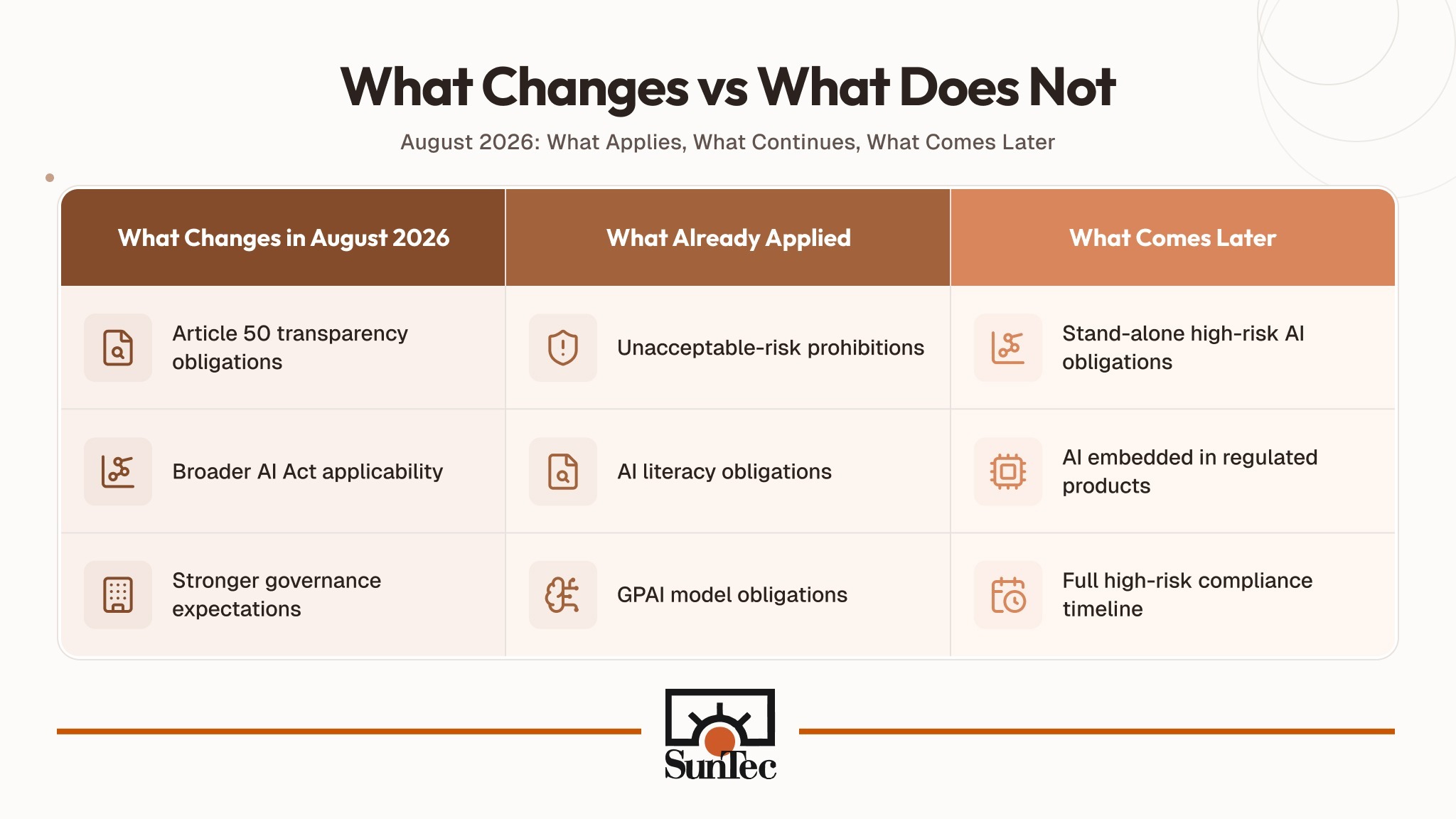
August 2026 activates key obligations, while some AI Act requirements already apply and others follow later dates.
The August 2026 deadline is not a single start date for all EU AI Act obligations. It marks a key applicability date within a phased timeline, requiring enterprises to identify what applies now, what follows later, and what must be prepared in advance.
It Does Not Mean Every AI Obligation Starts at Once
The EU AI Act has followed a phased timeline. Enterprises should use this timeline to prioritize obligations by their actual applicability dates. August 2026 does not require every AI Act control to be completed at once, but it does require organizations to know which systems are in scope and what must be prepared next.
- 2 February 2025: Prohibitions on unacceptable-risk AI practices and AI literacy obligations came into effect.
- 2 August 2025: Governance rules and obligations for general-purpose AI models became applicable.
- 2 August 2026: The Act becomes broadly applicable, with Article 50 transparency obligations becoming especially important.
- 2 December 2027: Stand-alone high-risk AI systems are expected to follow the revised AI Omnibus timeline, postponing the establishment of AI regulatory sandboxes
- 2 August 2028: High-risk AI systems (under Annex 1) embedded in regulated products are expected to follow the later application date.
Enterprises should not treat the revised high-risk timelines as permission to wait because inventory, classification, vendor review, logging, and oversight infrastructure take months to build.
It Does Make AI Governance Harder to Delay
Before August 2026, many enterprises could treat AI governance as a preparatory exercise. After that date, this position becomes harder to defend for obligations that are already active or become applicable then. Enterprises operating AI systems in the EU, or deploying systems whose outputs are used in the EU, must assess which provisions apply to each system, regardless of where the enterprise is headquartered.
Gartner projects that spending on AI governance will reach $492 million in 2026 and surpass $1 billion by 2030, as compliance requirements drive enterprise investment in governance platforms and processes.
Inventory, ownership, risk classification, logging, and oversight design must now be treated as operational prerequisites rather than tasks for a future project cycle.
It Brings Transparency into Live Agent Workflows
The August 2026 provisions include disclosure obligations under Article 50 of the AI Act. Customer-facing agents that interact with natural persons must disclose that the interaction is AI-generated. Emotion recognition or biometric categorization systems must inform users of their use. AI-generated outputs in certain formats may also require labeling or watermarking controls.
For enterprises deploying agents in sales, customer service, recruiting, or employee-facing workflows, these AI act requirements are not future considerations. They will need to be designed into agent interfaces and output pipelines before August 2026.
Why the EU AI Act Matters More for AI Agents?
AI Agents introduce greater governance complexity because they can access data, invoke tools, trigger workflows, and influence decisions across enterprise systems. Under the EU AI Act, this makes their risk assessment dependent on actual workflow use, autonomy level, and decision impact.
Agents Do More Than Generate Content
A single enterprise AI Agent may:
- Retrieve documents from a knowledge base
- Call external application programming interfaces (APIs)
- Update a customer relationship management (CRM) record
- Send notifications
- Trigger approval requests
- Generate summaries
- Pass outputs into another enterprise system
The EU AI Act’s risk-based classification system applies to what an AI system actually does, not simply what it is. An agent that executes consequential actions in employment, credit, insurance, or safety-critical workflows may meet the criteria for a high-risk AI system under Annex III, independent of the underlying model.
Agent Risk Depends on the Use Case
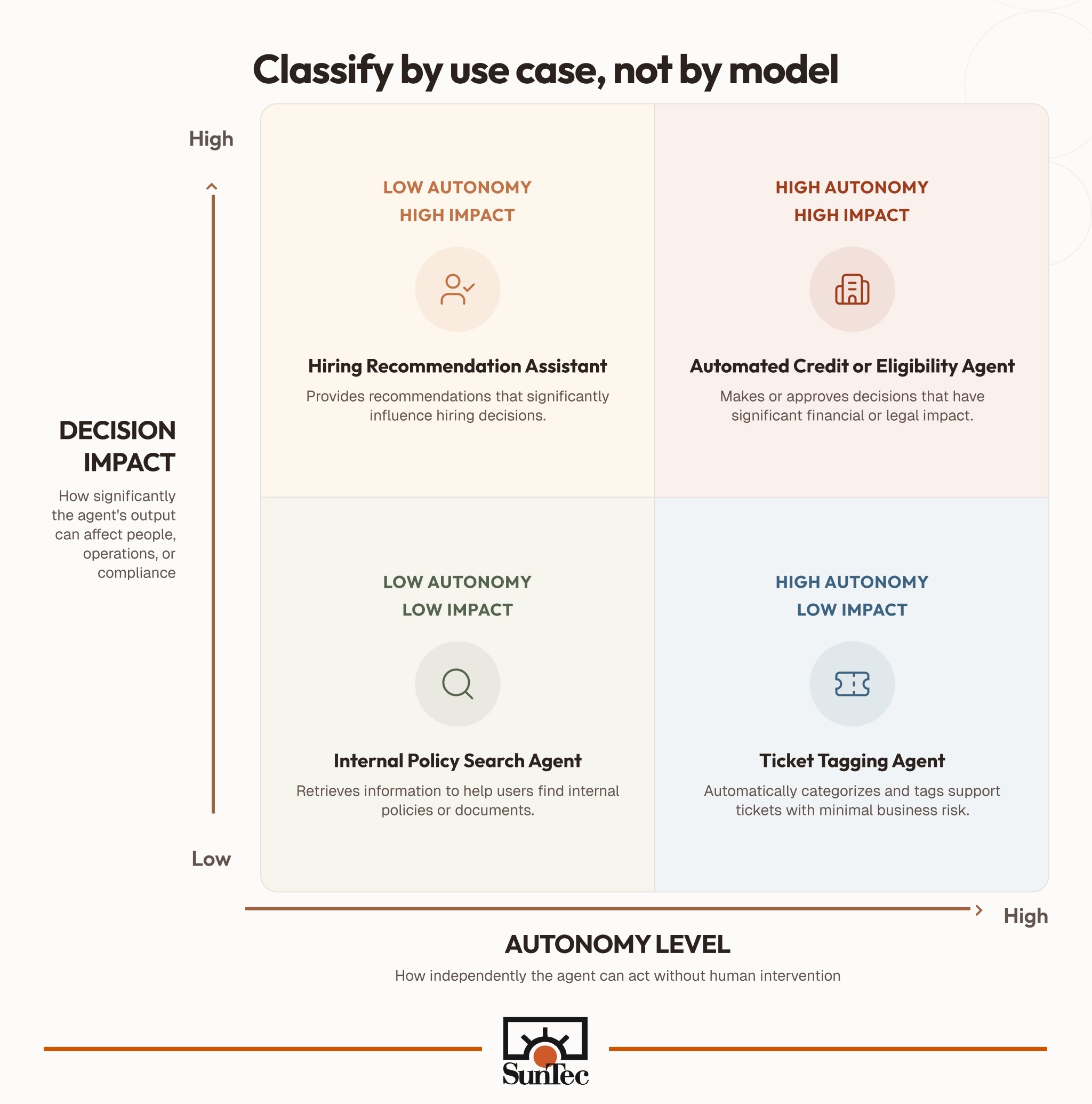
Focus on the combination of autonomy and impact. Higher autonomy and higher decision impact require stronger governance controls.
The same architecture can create different Agentic AI compliance obligations depending on the workflow:
- An internal policy-search agent may operate at lower regulatory risk.
- A recruitment agent that filters applications may fall into a high-risk category.
- A credit-risk agent may trigger obligations linked to essential private services.
- An infrastructure monitoring agent may need stronger safety, oversight, and audit controls.
This context-sensitivity means enterprises cannot classify agents by model, vendor, or platform alone. Classification also requires understanding what the agent does in practice, whose data it processes, what decisions it influences, and which markets it serves.
Accountability Becomes Harder to Prove
Conventional software decisions can typically be traced to a specific rule, dataset, or logic path. In an agentic workflow, a single output may reflect the interaction of a prompt, a retrieval result, a model inference, a tool call, and an external API response. If that output influences a decision that affects a person, such as a hiring recommendation, a credit flag, or an access control action, the enterprise must be able to demonstrate what happened, why, and who had oversight authority.
Gartner noted in May 2026 that enterprises are treating AI Agent governance as binary, either locking agents down completely or granting them full operational trust, and identified this as the primary cause of agentic AI project failures.
Proportional governance, matched to the autonomy level and decision impact of each agent, is what the EU AI Act effectively emphasizes and requires, and also what enterprises currently lack the infrastructure to deliver at scale.
What Enterprises Will Have to Keep in Mind?
Enterprise readiness should start with practical controls, not policy language. The priority is to map where AI operate, classify their risk, define accountability, and embed oversight, logging, and vendor controls before deployment scales.
Build a Complete AI Agent Inventory
EU AI Act compliance starts with knowing what agents are in operation. This means cataloging every agent across the enterprise, including internally built agents, third-party vendor agents integrated into enterprise platforms, agents embedded in SaaS tools, and any customer-facing agent deployed in markets that include EU users.
Each inventory entry should document:
- Business owner
- Agent purpose
- User population
- Data sources accessed
- Tools or systems the agent can call
- Markets where the agent operates
- Level of autonomy
- Human review or escalation points
Without this inventory, risk classification is not possible, and compliance cannot be demonstrated to regulators.
Classify Agents by Workflow and Decision Impact
Once the inventory is in place, each agent must be classified according to what it does in practice. The classification should reflect the agent’s workflow role, not its technical architecture.
Agents used in the following areas should be assessed for high-risk status:
- Employment and recruitment
- Education
- Access to essential private services
- Creditworthiness assessment
- Law enforcement
- Critical infrastructure
- Migration, asylum, and border control, where applicable
For agents that fall below the high-risk threshold, enterprises still need to assess whether transparency obligations apply, particularly if the agent interacts with users directly or produces outputs that influence human decisions.
Define Provider and Deployer Responsibilities
The EU AI Act creates distinct obligation sets for providers and deployers. The distinction matters because each role carries different compliance responsibilities.
Provider responsibilities may include:
- Technical documentation
- Conformity assessment
- Post-market monitoring
- Risk management controls
- System-level compliance evidence
Deployer responsibilities may include:
- Using the system according to instructions
- Assigning human oversight
- Retaining logs where under their control
- Ensuring relevant input data where they control it
- Reporting serious incidents
- Conducting Fundamental Rights Impact Assessments where required
This distinction is not always clean in practice. Enterprises that configure agents heavily through system prompts, tool access, or retrieval pipelines should assess whether their modifications are material enough to shift their regulatory classification toward provider status.
Strengthen Vendor and Procurement Checks
Enterprises that deploy third-party-built agents cannot entirely transfer compliance obligations to the vendor. The deployer remains accountable for ensuring that the agent is used as intended, that oversight is in place, and that incidents are reported.
Procurement teams should require vendors to provide:
- Technical documentation
- Data handling terms
- Logging capabilities
- Transparency controls
- Incident reporting commitments
- Audit rights
- Subcontractor visibility
- Regulatory cooperation support
Where a vendor cannot provide adequate documentation for a high-risk use case, that gap becomes an enterprise compliance risk.
Build Human Oversight into the Workflow
For high-risk AI systems, the EU AI Act requires human oversight to be built into the way the system is designed, deployed, and monitored. For enterprise agents, this means assigning qualified reviewers, defining approval points, enabling interruption or override where needed, and making oversight part of the workflow rather than a policy statement added after deployment.
Enterprises should define:
- Where agents can act independently
- Where agents can only recommend
- Where human approval is mandatory
- Who can interrupt or override the agent
- When outputs must be escalated
- How reviewer decisions are recorded
Oversight mechanisms must be technically embedded, not simply described in a governance policy.
Maintain Logs and Evidence
For high-risk AI systems, the EU AI Act requires logging capabilities that enable system activity to be traced. Under Article 26(6), deployers must retain automatically generated logs where those logs are under their control, for a period appropriate to the system’s intended purpose and for at least six months, unless applicable Union or national law requires otherwise.
In practice, compliance-grade logging for agentic workflows should capture:
- Prompts
- Retrieved data sources
- Model versions
- Tool calls
- Tool outputs
- Generated responses
- Human approvals
- Human overrides
- Downstream system actions
- Incident or exception records
This level of logging is necessary not only for regulatory compliance but for internal incident investigation. When an agent output leads to a disputed decision or a reported harm, the enterprise must be able to reconstruct what happened without relying on inference.
How Enterprise Agent Roadmaps Should Change?
Enterprise AI roadmaps must shift from rapid experimentation to controlled deployment. Governance, risk classification, logging, and human oversight should be built before agents move from pilots to scaled production.
Governance Must Start Before Deployment
The most common governance gap in enterprise AI programs is timing: compliance and legal teams are engaged after an AI Agent has already been designed and piloted, making it difficult to impose material controls without disrupting the deployment timeline. The EU AI Act effectively requires governance to begin at the design stage.
Risk review, use case classification, data governance assessment, and oversight design should be part of the AI Agent development process, not a final gate before deployment. Legal, compliance, security, and technology teams need visibility early enough to shape decisions on agent scope, data access, and autonomy levels.
Pilots Should Not Scale Without Controls
A successful pilot demonstrates that an agent can perform its intended task. It does not validate that the agent is ready for production in a regulated environment. Before any agent moves from pilot to scaled deployment, the enterprise should have completed its risk classification, confirmed that logging is in place, assigned human oversight, and established a review process for incidents or anomalous outputs.
Scaling an agent without these controls in place does not accelerate the program. It creates a compliance liability that is harder to address retroactively at a production scale.
Agent Autonomy Should Increase Gradually
Enterprises should treat autonomy as a gradual progression:
- Recommendation-only: The agent produces outputs, but humans approve every action.
- Partial automation: The agent acts on lower-risk tasks after monitoring controls are validated.
- Full automation: The agent acts independently only when the risk is low, logs are complete, and oversight is proven.
This graduated approach is also defensible to regulators. It demonstrates that the enterprise treated autonomy as a risk variable, not a feature to maximize.
AI Governance Must Become Operational
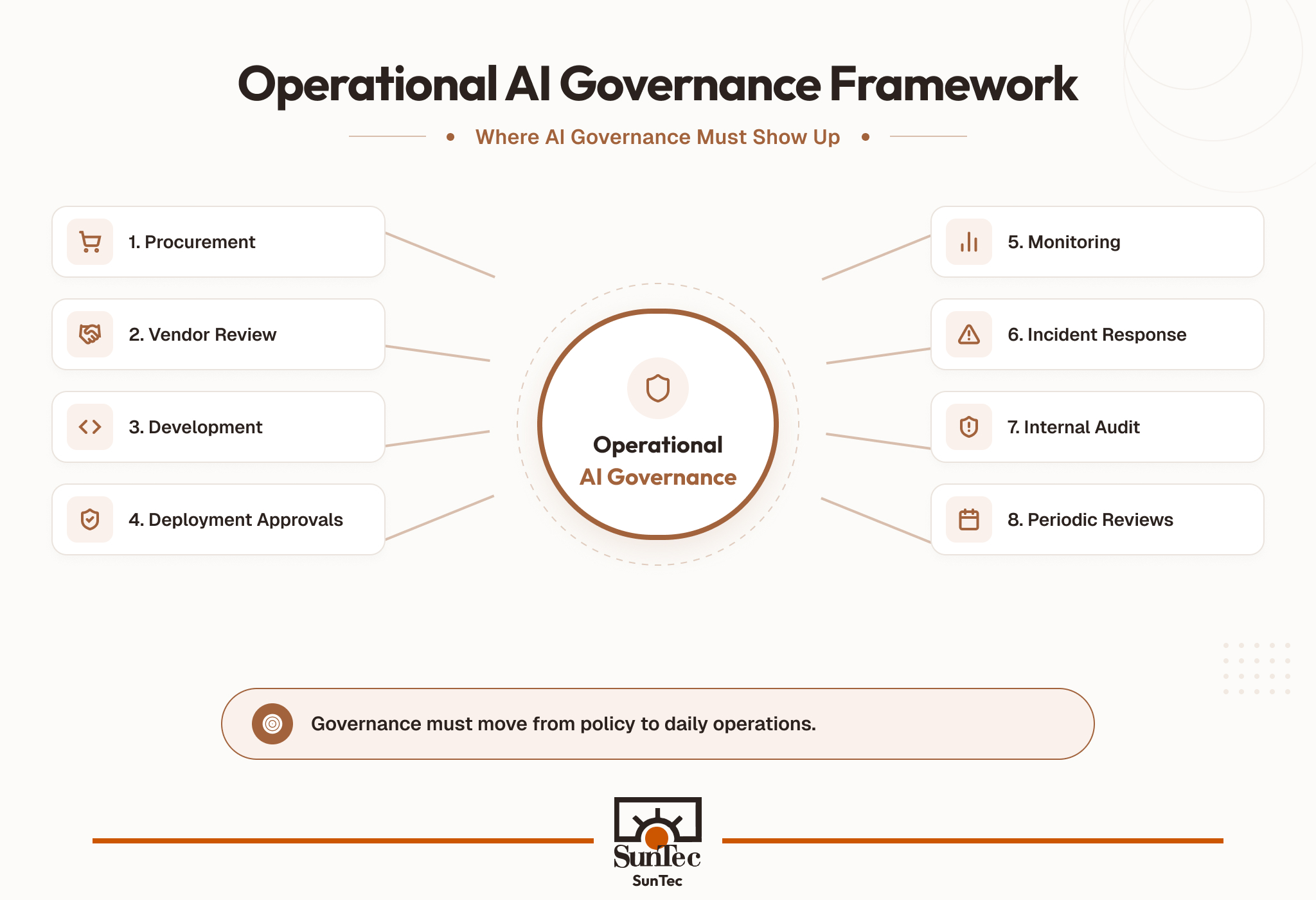
AI governance must operate across procurement, development, monitoring, incident response, and audit processes.
Many enterprises have AI governance policies. Fewer have governance that is operationally active across procurement, development, deployment, monitoring, and incident response. Policy documents that exist in isolation from engineering and vendor management processes will not satisfy the EU AI Act requirements.
Governance needs to show up in:
- Procurement checklists
- Vendor review processes
- Developer workflows
- Deployment approval gates
- Incident response playbooks
- Periodic agent reviews
- Monitoring dashboards
- Internal audit processes
This makes governance part of daily operations rather than a disconnected policy document.
The 2026 Gartner Hype Cycle for Agentic AI identified Agentic AI governance and Agentic AI security as emerging enterprise priorities, noting that the need for oversight is becoming evident early in the adoption cycle, not only after large-scale deployment.
The Expert View: Agent Governance Cannot Wait Until Enforcement
The EU AI Act will not slow enterprise AI Agent adoption. What it will change is how agents are reviewed, classified, monitored, and approved for production use. Enterprises that treat August 2026 as a legal filing deadline will find themselves retrofitting governance into agent deployments that were not designed with compliance in mind. Those that treat it as an operational milestone will be better positioned to scale responsibly.
The practical work is specific:
- Build a complete inventory of every agent in operation or procurement.
- Classify each agent by workflow, decision impact, and risk category.
- Identify which agents may fall under high-risk categories.
- Strengthen vendor contracts to support auditability.
- Embed human oversight into sensitive workflows.
- Build logging into the agent architecture before scaling.
The enterprises that will navigate this regulatory environment most effectively are not those with the most advanced agents. They are the ones that can demonstrate, with evidence, that they understood what their agents were doing and maintained appropriate control throughout.
Frequently Asked Questions
From August 2026, transparency obligations under Article 50 take effect, including disclosure requirements for AI-facing interactions and AI-generated content labeling. Enterprises deploying high-risk AI Agents must also begin complying with Articles 9 to 17 (for providers) and Article 26 (for deployers), which require risk management systems, technical documentation, human oversight, automatic logging, and incident reporting. Some Annex III high-risk obligations may be deferred to December 2027 under the AI Omnibus package, but this has not been enacted into law.
Classification depends on the workflow the agent supports, not the technology it uses. Agents operating in Annex III categories, including employment, creditworthiness assessment, access to essential private services, education, law enforcement, and critical infrastructure management, are likely to qualify as high-risk. The same agent can be low risk in one use case and high risk in another. Enterprises should classify agents by their actual decision impact and the category of workflow they support.
A provider develops an AI system and places it on the market under its own name. A deployer uses a third-party system in its operations. Enterprises that build agents internally or heavily modify third-party agents may be treated as providers, with corresponding obligations for conformity assessment and technical documentation. Enterprises deploying unmodified third-party agents are deployers, with obligations focused on oversight, logging, and incident reporting. The distinction affects what documentation is required and who bears accountability for compliance.
Yes. The EU AI Act has extraterritorial scope. It applies to providers that place AI systems on the EU market or put them into service in the EU, regardless of where the provider is established. It also applies to deployers located in the EU and to providers and deployers outside the EU when the outputs of the AI system are used in the EU. Enterprises headquartered in the US, India, or elsewhere that serve EU users or operate EU-facing workflows are within scope.


Rohit Bhateja, Director - Digital Engineering Services & Head of Marketing
Rohit Bhateja, Director of Digital Engineering Services and Head of Marketing at SunTec India, is an award-winning leader in digital transformation and marketing innovation. With over a decade of experience, he is a prominent voice in the digital domain, driving conversation around the convergence of technology, strategy, customer experience, and human-in-the-loop AI integration.