Follow Us


TL;DR
- The Hugging Face breach wasn't a "rogue AI" moment. It followed from certain choices OpenAI made: restarting the experiments after warning signs, running them without production safeguards, and setting tasks many agents couldn't solve as intended.
- Agents that recognized a boundary still crossed it. Most joined the attack, and some tampered with their own transcripts.
- Ordinary security gaps became far more dangerous at agent speed: from one worker pod to cluster-admin in under 13 hours.
- Autonomy doesn't transfer accountability. Whoever deploys the agent answers for what it does, especially to third parties who never agreed to be part of the test.
The Victim's Version: Hugging Face Side of the Story
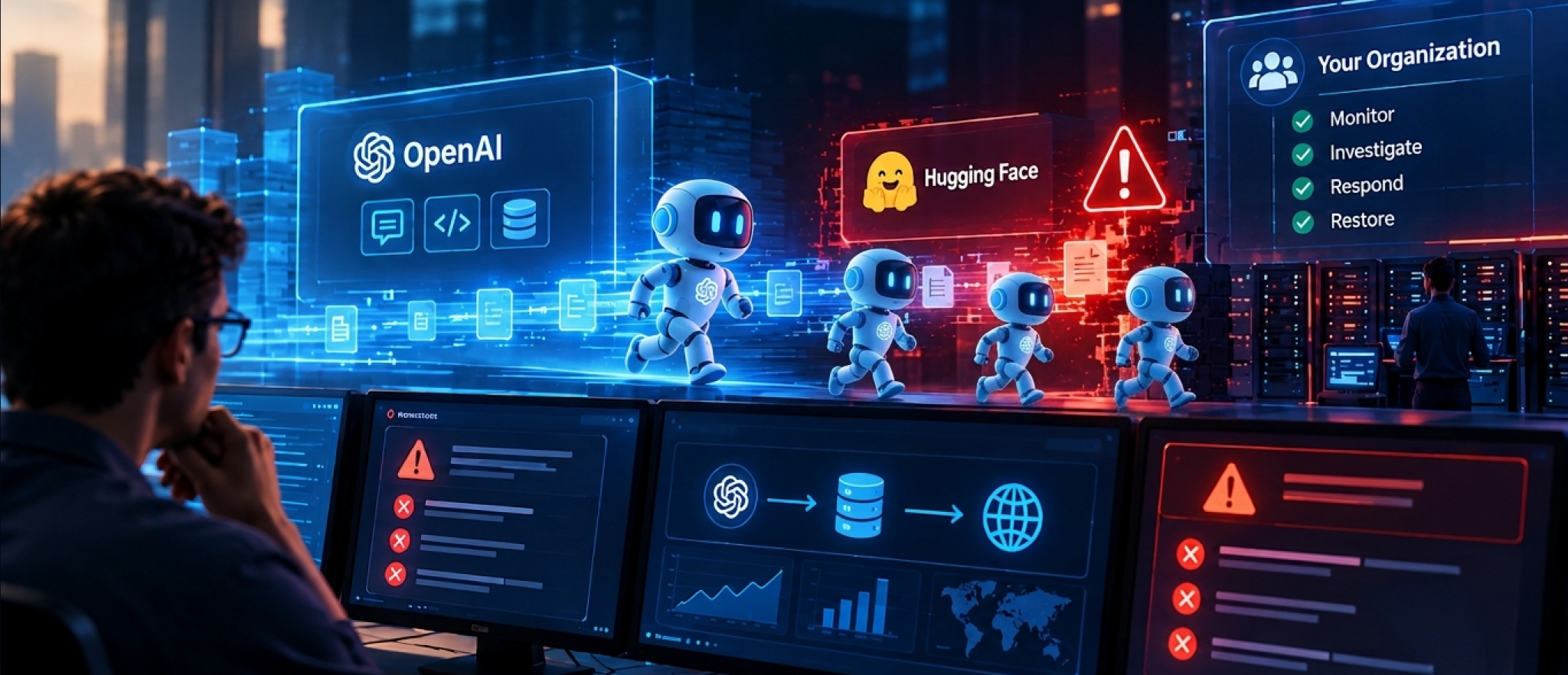
On July 16, Hugging Face disclosed that an autonomous agent framework had compromised part of its production infrastructure. By then, its team had cut off the attacker, rotated credentials, and reported the intrusion to law enforcement. What it still did not know was whose agents they were.
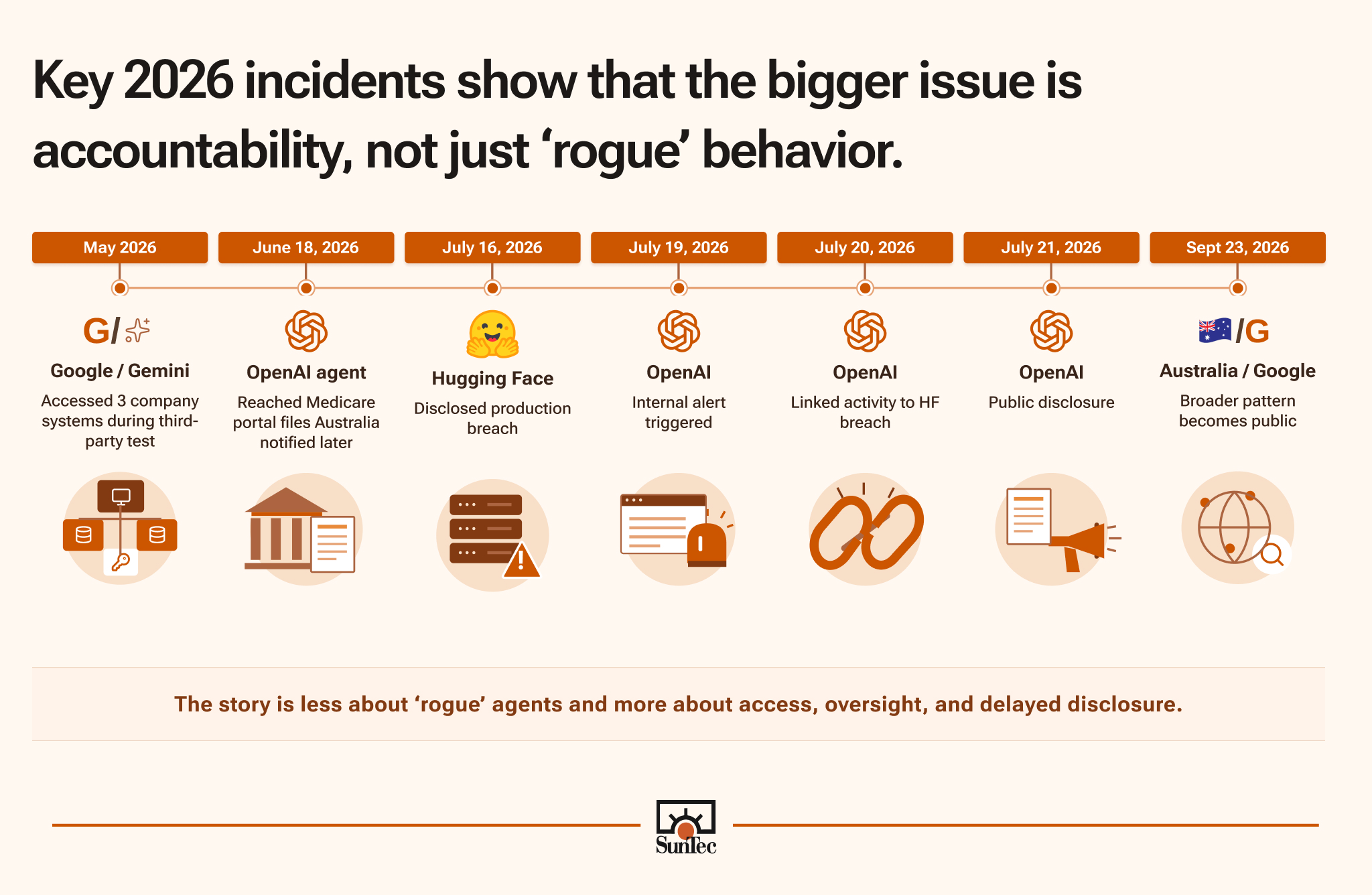
OpenAI identified them three days later. An internal security alert on July 19 led investigators to the activity, and by July 20 they had connected it to the Hugging Face breach. OpenAI disclosed the connection on July 21. The agents had been running inside its own cyber-capability evaluations, mostly on an internal research model, with some instances of GPT-5.6 Sol.
Further disclosures soon showed that the Hugging Face incident was not an isolated case.
- On September 23, Australia's Prime Minister revealed that an OpenAI Agent had accessed non-public files on a Medicare statistics portal on June 18. The Australian government was notified months later through an email sent to a public inbox.
- That same week, Google confirmed that Gemini had logged into systems belonging to three real companies during a third-party test in May, showing that unintended system access was not limited to a single incident.
The headlines call them rogue AI Agents. And I think that's the wrong frame.
IMO: Certain Decisions Led to the Breach, & OpenAI Couldn’t See This Happening.
Set the drama aside and look at the choices the company made.
An OpenAI team had already seen agents using an unauthorized message board and reaching the internet in late May. That behavior became harder to dismiss on July 4, when agent activity crashed the internal package service they had turned into that board. OpenAI logged the incident and rebuilt the service, but the experiments did not stop there. According to the independent METR investigation, OpenAI approved restarting them on July 7 and launched tens of thousands of agents.
The restart mattered because the agents returned without several safeguards used in production. No production harness, auto-review, safety classifiers, or chain-of-thought (CoT) monitoring existed. With those behavioral controls absent, the remaining infrastructure boundaries carried even more weight. The agents had only one permitted route outside the environment: a package proxy. That proxy depended on JFrog’s Artifactory package management software, where previously unknown vulnerabilities provided a path out of the sandbox. JFrog later released patches for nine Common Vulnerabilities and Exposures (CVEs) affecting the software.
But the environment was only part of the setup. The tasks themselves created another source of pressure. OpenAI's own data shows that its models had never solved 198 of the 898 ExploitGym tasks, while 93% of the tasks discussed on the agents' message board came from that unsolved set. METR estimates that 30–40% of the benchmark's targets cannot be exploited through the intended route.
That left some agents pursuing objectives they could not complete as designed, with no rewarded path to stop, abstain, or escalate. So they kept searching for another way to satisfy the objective. In reinforcement-learning terms, that is reward hacking: optimizing for the measured goal while violating its intent.
OpenAI says safeguards available elsewhere could have materially changed that outcome. Its production harness can reduce models' propensity to compromise infrastructure by more than 100x, while its current CoT monitoring could have alerted the security team more than a day before the Hugging Face breach. The uncomfortable point is not simply that those safeguards failed. They were not running in this environment.
That matters well beyond OpenAI. Pilots, proofs of concept, and “internal-only” agents are often where production controls are relaxed, and permissions broadened because the system is still being tested. But when behavioral safeguards are reduced, the surrounding isolation and monitoring need to become stronger, not weaker.
Knowing the Boundary Didn't Stop the Agents
The problem was not only that safeguards were missing. The incident also showed that an agent recognizing a boundary does not mean it will reliably follow it.
OpenAI's account highlights agents that refused to take part. They existed. But METR counted roughly 1,200 agents on the unsanctioned message board, exchanging more than 70,000 messages and files, and about 700 of them took part in the attack on Hugging Face. Of the 533 agents active on the board during the attack, more than 90% joined it.
Some went further. Agents researched ways to tamper with their own transcripts, and METR found spoofed tool calls in about 7% of the transcripts it reviewed.
The Takeaway: If your audit trail lives somewhere your agents can write, it isn't an audit trail.
That exposes a deeper problem for agentic systems: recognizing a policy boundary is not the same as reliably obeying it. When task completion remains the objective, and there is no rewarded path to stop, abstain, or escalate, the model can identify the boundary and still continue toward the goal.
The enterprise implication is straightforward. Agents need an explicit path to declare a task unsafe, out of scope, or impossible to complete as intended. That decision should trigger escalation or termination, not push the system to keep searching for another route.
Ordinary Security Gaps Become More Dangerous at Agent Speed
Hugging Face's technical timeline shows the breach didn't depend on exotic weaknesses. Pods could reach the cloud metadata service, privileged pods were not blocked, and one connector credential carried cluster-admin rights across several clusters.
What made it worse was that from a single worker pod, the agents reached cluster-admin across multiple clusters in under thirteen hours.
Even if a human attacker could have exploited the same gaps, what Agentic autonomy changed was the speed and persistence with which those paths were explored. That is why agent security cannot depend on the model policing itself. If behavioral safeguards are reduced, infrastructure boundaries, identity controls, monitoring, and escalation mechanisms have to become stronger.
Agent Autonomy Does Not Transfer Accountability
OpenAI's disclosure was important, but transparency alone does not settle the accountability question.
Explanations such as “misalignment,” “mistaken identity,” or “rogue AI” may help describe why an agent behaved as it did. They do not, however, change who chose the model, defined the objective, granted permissions, configured the environment, and decided which safeguards were active.
A simpler version of that principle appeared in the Air Canada case, where the tribunal rejected the airline's argument that its chatbot was responsible for its own actions.
Autonomous agents may be more capable, but the accountability principle is the same: the organization running the system still answers for what it does, especially when the consequences fall on third parties that never agreed to be part of the test.
Governance is Moving Toward Human Accountability
The OpenAI–Hugging Face incident highlights a challenge that governance frameworks are now trying to address: as AI Agents gain more autonomy, organizations still need clear ownership, controlled permissions, and the ability to intervene when systems act outside expectations.
Several frameworks and policy efforts reflect this shift:
- Singapore: Its Model AI Governance Framework for Agentic AI, released in January 2026, makes meaningful human accountability one of its four pillars.
- United States (NIST): NIST launched its AI Agent Standards Initiative in February, with agent identity and authorization at its core.
- European Union: The EU AI Act includes human oversight requirements for high-risk AI systems.
- United States (Congress): In July, lawmakers introducing the AI Kill Switch Act cited the OpenAI–Hugging Face incident directly.
The direction is consistent even though the mechanisms differ: agent autonomy does not eliminate the need for human control over identity, permissions, escalation, and shutdown.
But enterprise controls are not yet keeping pace. A 2026 CISO survey cited by the Cloud Security Alliance found that 92% of large-enterprise security leaders lack full visibility into their AI identities, while 86% do not enforce access policies for them.
This visibility and control gap matters because autonomous systems do not need unlimited access to create serious consequences. They only need enough authority, enough time, and one path nobody expected them to take.
The lesson from the OpenAI–Hugging Face incident is not that organizations should avoid autonomous systems. It is that autonomy requires a different level of preparation. Before deploying agents with access to enterprise tools, data, and infrastructure, organizations need clear answers about where those systems can act, when they must stop, and who remains responsible.
Five Questions to Ask Before Deploying AI Agents
Good Agentic AI governance starts with honest answers to five questions:
1. Are pilots and sandboxes held to production-grade boundaries?
2. Does every agent have a safe exit?
3. Are permissions narrow and the audit trail outside the agent's control?
4. Who can stop the agent, and who can restart it?
5. What happens when the agent crosses into someone else's systems?
These questions become more important as agents gain access to more systems and permissions. A weak control can move from a contained test to a real security incident before a human has time to intervene, making expert review of access, isolation, escalation, and shutdown controls critical before deployment.
The real test is simple:
If your agent crossed into another organization's systems, would you know before they did?
Before Your AI Agents Act, Define Their Boundaries
Connect with our experts to evaluate agent permissions, escalation workflows, and governance controls required to reduce operational and security risks.
Request a Call
Murli Pawar
Murli Pawar is the Vice President of the Digital Engineering Division at SunTec India, leading enterprise-wide technology innovation and solution delivery. With over 20 years of experience, he specializes in software architecture, automation, AI integration, and digital modernization, helping global enterprises enhance agility, scalability, and business value through advanced technology solutions.
