

Bringing a new product to market is a high-stakes endeavor: time is limited, competition is fierce, and resources are finite. Minimum Viable Products (MVPs) provide a proven solution, enabling companies to validate ideas with real users and minimize risk before undertaking full-scale development.
However, the journey from MVP to market-ready product reveals a critical divide. While some MVPs evolve seamlessly into thriving platforms, others become expensive technical debt requiring complete rebuilds that burn through budgets and market timing.
The difference? Modular MVP architectures. Traditional monolithic MVPs hit scaling walls, but modular MVPs are built as interconnected, independent components from day one. This enables parallel development, component-level pivoting, and targeted scaling based on real user demand. Most importantly, modular architecture transforms MVPs from disposable prototypes into enterprise-grade foundations, eliminating costly rebuilds that can kill momentum.
This blog will explore how modular MVP architectures can accelerate market entry without hitting any scaling walls.
Table of Contents
Why MVPs are Critical for Rapid Product Launches?
Before diving into modular MVPs, let’s quickly see what an MVP is capable of doing for your product. Whether you’re a startup or an established business, MVPs can provide a streamlined path to market. They focus on the essentials, allowing your teams to:
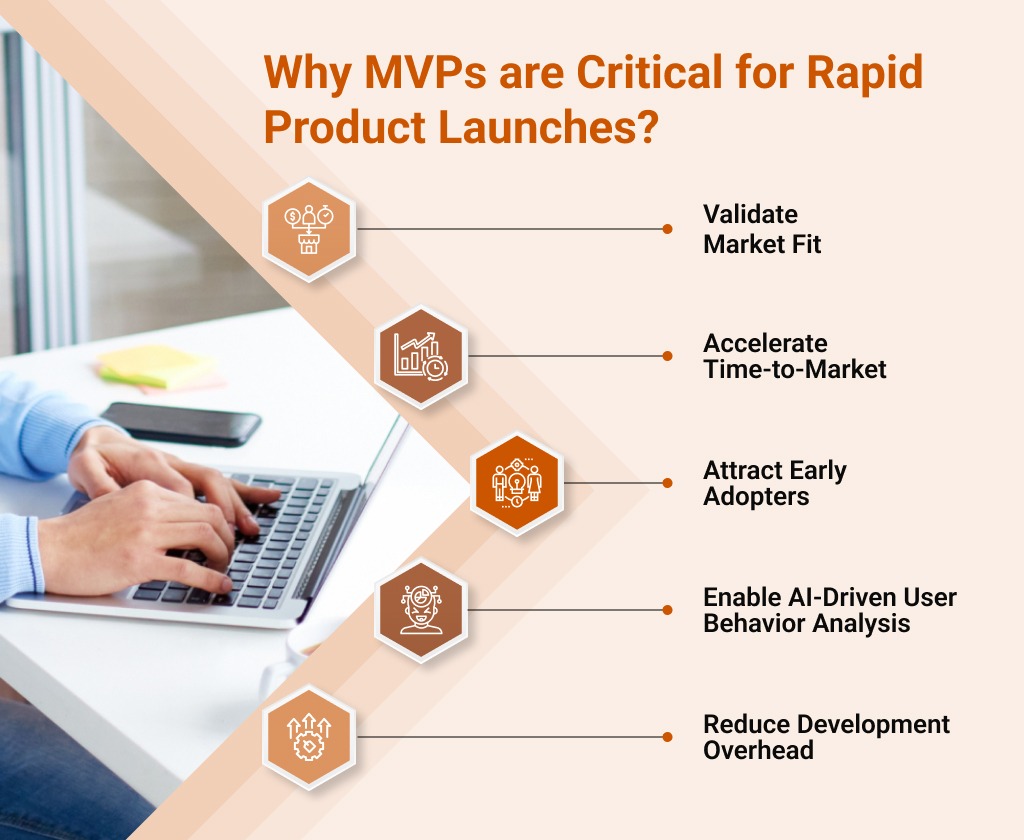
MVPs are not just a stepping stone; they are the foundation for scalable products.

Why Modular MVPs Outperform Monolithic Alternatives?
With modular MVP architectures, businesses can ensure their MVP isn’t just a short-term strategy, but a highly scalable starting point for long-term success.
1. Scalable Software
Monolithic MVPs require system-wide rebuilds to add new features or pivot based on user feedback, often taking weeks and risking the loss of existing functionality. With modular architecture, you can swap out your recommendation engine, upgrade your payment processor, or add AI features by simply replacing or adding individual modules without touching your core system.
2. Faster Development
Monolithic MVPs create development bottlenecks where teams wait for each other to finish before proceeding, turning simple feature additions into months-long dependencies. Modular MVP architectures eliminate these bottlenecks by allowing your front-end, back-end, and integration teams to work simultaneously on different modules, reducing time-to-market by 40-60%.
3. Minimized Risks
In monolithic systems, a single bug in your notification feature can crash your entire application, taking down payments, user accounts, and core functionality simultaneously. Modular MVP architectures contain failures within individual modules (or containers), ensuring that a messaging system outage doesn’t prevent users from completing other actions, such as making purchases.
4. Future-Proofing
Monolithic MVPs quickly accumulate technical debt as they grow, eventually requiring expensive complete rewrites that can cost three to five times the original development budget. Modular architectures evolve incrementally; you can migrate individual modules to new technologies, update specific components for compliance, or integrate with new platforms without needing to rebuild your entire product.
5. Better Resource Allocation
Monolithic systems waste computing resources by allocating the same power to rarely-used admin features as high-traffic user interfaces. Conversely, modular architectures optimize resources per component. In other words, your AI recommendation engine utilizes high-performance computing, while your static content modules run on cost-effective servers, resulting in a 30-50% reduction in total infrastructure costs.
Until now, we’ve discussed how modularity enhances traditional benefits of developing MVPs. But how is it actually implemented?
Understanding Modular Architecture Through Expert Eyes

Full-stack developers view modular architectures as the foundation for scalable, modern MVP development. By isolating features into self-contained modules, teams can work in parallel, reduce dependencies, and enable seamless iteration.
For example, a user authentication module can be built, tested, and deployed independently of other components, accelerating development timelines.
Building Modular MVPs: Tech Stack Recommendations from Full-Stack Experts
Selecting the right tech stack is critical for delivering scalable and efficient MVPs. MVP development specialists emphasize the use of technologies that align with modularity principles, enabling fast development, smooth integration, and future scalability. Here’s a breakdown of the most recommended tools and frameworks for MVP success.
Back-End Technologies
The back-end is the backbone of any MVP, handling data, business logic, and server operations. Full-stack developers recommend:
- Django (Python, Flask, FastAPI): Offers rapid development and built-in features, such as authentication and admin panels, making it ideal for fast MVP iterations.
- Node.js (JavaScript/TypeScript): Lightweight and scalable, perfect for handling real-time applications like chats or collaborative tools.
- C# (.NET): Enterprise-grade reliability with strong typing and excellent microservices tooling, ideal for MVPs that need to scale into robust business applications.
- PHP (Laravel or Symfony): Cost-effective rapid development with extensive package ecosystems and built-in features, perfect for web-based MVPs with tight budgets and timelines.
Front-End Technologies
The front-end defines user experience and directly impacts engagement. Experts suggest:
- React.js: Component-based and highly reusable, ideal for modular architectures and scalable UI designs.
- Angular: Great for building dynamic, feature-rich applications with strong two-way data binding.
- Vue.js: Lightweight and beginner-friendly, excellent for smaller MVPs with rapid iterations.
Database Technologies
Efficient data handling is key to MVP scalability. Recommended databases include:
- MongoDB: NoSQL database for flexible schemas, well-suited for dynamic MVPs requiring rapid changes.
- PostgreSQL: A robust relational database with advanced querying capabilities for data-intensive applications.
- Amazon DynamoDB: Serverless NoSQL database with automatic scaling, perfect for MVPs with unpredictable traffic patterns.
- Google Cloud Firestore: Real-time NoSQL database with offline support, ideal for mobile and web MVPs requiring instant data synchronization.
- Azure Cosmos DB: Multi-model database with global distribution, excellent for MVPs targeting international markets from day one.
Tooling and DevOps
Modular MVPs thrive with the right DevOps practices and tooling. Full-stack experts recommend implementing:
- Version Control: Use Git and platforms like GitHub or GitLab for seamless collaboration and code management.
- CI/CD Pipelines: Tools like Jenkins, GitHub Actions, or CircleCI ensure faster deployments and quality assurance.
- Containerization: Docker enables consistent environments across development and production.
- Infrastructure Management: Use Kubernetes or Terraform for scalable and efficient resource allocation.

Best Practices for Modular MVP Development
When it comes to building robust and scalable MVPs, adhering to best practices is critical. Full-stack experts in MVP development recommend the following to lay a solid foundation for MVP growth.
For Structuring Modules
- Define Core Features First: Identify essential functionalities and isolate them into distinct, self-contained modules.
- Set Modular Hierarchy: Design a clear dependency hierarchy to avoid tightly coupled components.
- Utilize APIs as the Glue: Use APIs to connect modules, ensuring seamless communication while maintaining module independence.
For Ensuring Code Independence and Reusability
- Decouple Logic: Ensure each module handles a single responsibility, reducing interdependence.
- Utilize Reusable Components: Develop modules that can be applied to future projects, like authentication or payment systems.
- Implement Testing in Isolation: Test modules independently to guarantee they function correctly before integration.
For Maintaining Documentation for Long-Term Success
- Maintain Modular Blueprints: Document the purpose, inputs, and outputs of each module.
- Standardize Practices: Adopt coding standards across teams for consistency and clarity.
- Emphasize Future-Friendliness: Keep documentation up to date with every iteration to facilitate onboarding and scaling.
For Scaling MVPs Without Compromising Performance
- Start Small: Focus on optimizing core modules before scaling others.
- Monitor and Adjust: Utilize tools like New Relic or Datadog to track performance and identify bottlenecks.
- Scale Incrementally: Scale modules individually based on demand to preserve system stability.
The Future of Modular MVPs

As businesses increasingly prioritize scalability and speed-to-market, modular architectures are poised to dominate MVP development, transforming from niche practice to industry standard. This shift will be accelerated by the mainstream adoption of automation tools that make testing and deployment of modular systems accessible to teams regardless of technical expertise.
Simultaneously, AI-driven optimization will further this evolution, enabling intelligent systems to automatically identify performance gaps and recommend architectural improvements in real-time. Together, these advancements will establish modular-first approaches as the definitive path for successful MVP development.
What This Means for Businesses: Faster time-to-market, reduced development costs, and lower technical debt will become standard expectations. Companies will gain competitive advantages through rapid iteration and seamless scaling capabilities.
What This Means for MVP Developers: Development workflows will become more streamlined with AI-assisted decisions and automated testing. Developers must focus more on innovation & QA; less on core development & maintenance overhead.
Ending Note
The advantages of modular MVP architectures are undeniable, especially for startups and businesses eager to lead in today’s market. They are the ultimate blend of scalability, cost-efficiency, and flexibility. With modular MVPs, adding new features, integrating with third-party tools, or pivoting based on user feedback becomes seamless and straightforward.
They enable you to design products that hit the market faster, adapt effortlessly, and evolve in tandem with your business, keeping you ahead of competitors. As the demand for modular, scalable software grows, businesses that act now will be able to catch pace with the future and create a product that’s not only ready for success today but also in the future.
If you’re ready to build modular, future-proof MVPs, we can help. Our MVP development services can help you with end-to-end MVP support, from selecting modular architectures to optimizing core features for end-user testing and validation. Start today to make the most out of this competitive window because while your competitors are still planning monolithic MVPs, you’ll already be scaling toward market leadership.