“Generative AI is shifting from coding assistants to enterprise transformation, enabling organizations to analyze and modernize complex legacy systems.” — Gartner, Generative AI for Enterprise Transformation, 2024.
Generative AI (Gen AI) is often framed as a tool for accelerating developer productivity, with most discussions centering on code generation. Although that narrative captures attention, it fails to address a deeper, high-value opportunity: transforming and modernizing legacy systems. Enterprises grappling with decades-old applications can leverage Gen AI not just to write code faster, but to analyze, refactor, and modernize legacy applications intelligently.
From understanding legacy architectures to uncovering hidden dependencies, Gen AI offers a pathway to AI-driven legacy transformation that reduces costs and accelerates modernization timelines. In this blog, we will explore how Gen AI accelerates legacy modernization, the benefits it brings beyond code generation, and how organizations can leverage it to drive impactful transformation across their legacy systems.
How Gen AI is Currently Used in SDLCs?
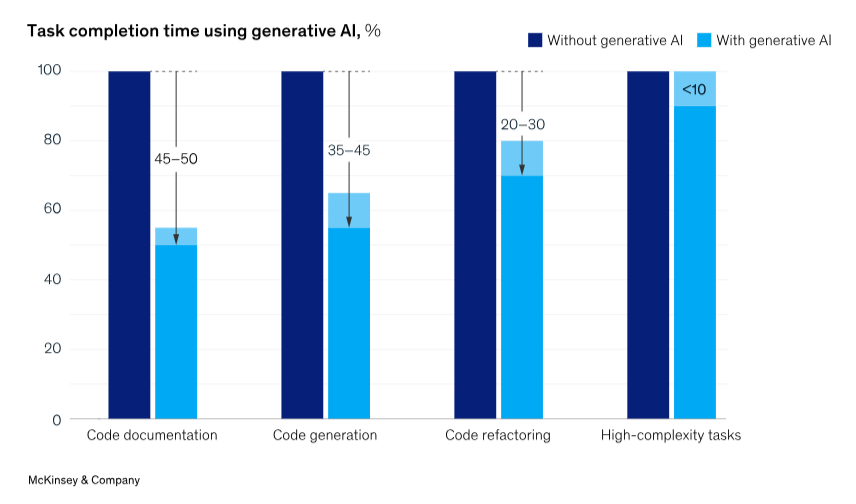
Gen AI is increasingly integrated across several stages of the software development life cycle (SDLC), enhancing efficiency and quality. These include code documentation, generation, refactoring, and some high-complexity tasks.
Moreover, according to McKinsey & Co., developers utilizing Gen AI tools can complete coding tasks up to twice as fast, across all major use cases. Particularly in generating and documenting boilerplate code, Gen AI has outpaced developer productivity and efficiency, while higher-value tasks such as refactoring remain to be mastered.
Gen AI also stood out in building new features or applications, generating test cases, and automating deployments.
While Gen AI’s use has yielded results in forward engineering, organizations still struggle to justify its utility for addressing complex, outdated systems. Given the fact that developers spend significantly longer times reading/analyzing code than actually writing it, the untapped potential (of using Gen AI to refactor enterprise legacy code) contributes to the above challenge.
Why Modernization Stalls (Even with AI Coding Tools)
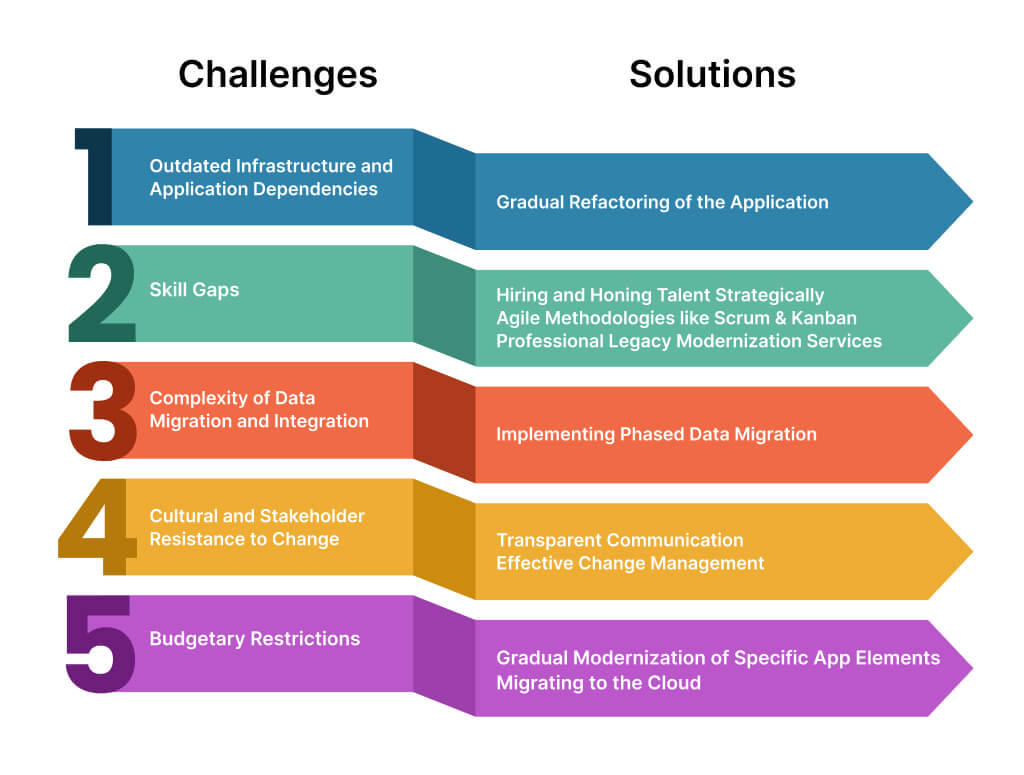
Traditionally, legacy modernization processes have faced several challenges, such as skills gaps, outdated tech stacks, and stakeholder resistance. However, a proper strategy and effective change management practices were able to solve a significant portion.
Here is a deep dive into how organizations worked through traditional legacy modernization challenges:
But today, with AI in the loop, even the above solutions need to be rethought.
There are two main reasons why organizations still struggle when automating legacy IT modernization despite having access to AI tools:
1. Backlog is Architectural, Operational, and Data-Centric (Not Only Code)
While AI coding tools accelerate development, legacy modernization involves more than just refactoring code. The backlog often includes massive overhauls: architectural redesigns, operational changes, and, critically, data modernization.
So, even if an organization streamlines its coding tasks, it doesn’t automatically resolve challenges related to data integration, business logic extraction, or system compatibility.
2. Heavy Reliance on COBOL (Common Business-Oriented Language)
COBOL remains one of the most widely used programming languages for legacy enterprise systems, particularly in industries such as finance and government. Due to this reliance, legacy modernization challenges extend beyond mere automated code refactoring; they require mapping out complex data flows, understanding legacy connections, and ensuring business continuity in a language that everyone understands.
Sizing the Legacy Challenge
The reliance on legacy systems (particularly those built on COBOL) remains a monumental challenge. Estimates suggest that billions of lines of COBOL code still exist, with many systems running outdated, complex logic that’s hard to decipher or update. This complicates risk management and ROI modeling, as businesses struggle to quantify the cost of maintaining, updating, or migrating legacy infrastructure.
To navigate this challenge, many organizations are turning to Gen AI for mainframe modernization (improving interface, performance, affordability, and maintainability). Over 80% of respondents in a Kyndryl 2024 State of Modernization survey expressed interest in deploying Gen AI in their mainframe environments. This growing adoption shows that Gen AI streamlines legacy modernization efforts.
How Gen AI Can Fill This Gap/ Where Gen AI Accelerates Modernization (Beyond Coding)
1. Knowledge Extraction
Gen AI can automatically extract business rules, logic, and system behavior from legacy code. It can create clear documentation and living records for future updates, eliminating the need for manual reverse engineering and accelerating the transition to modern architectures.
2. Inventory & Dependency Mapping
With Gen AI legacy modernization tools, inventory and dependency mapping become faster and more accurate. These tools identify and map hidden dependencies, and help visualize how legacy components interact with each other and with other systems. This ensures no critical systems are overlooked.
3. Test & Harness Generation
Gen AI-powered refactoring for legacy systems extends to test and harness generation. Automating the creation of unit tests and test harnesses ensures that modernized legacy systems maintain functionality, reducing the risk of disruptions and enabling more efficient legacy modernization.
4. Translation & Refactoring at Scale
Gen AI also helps with scaling code translation and refactoring from outdated COBOL or PL/I to modern languages like Java, C++, or Python. By repurposing features and generating code equivalents, companies can accelerate their modernization process, even at scale.
5. Cutover Validation
Gen AI supports cutover validation through dual-run or shadow-traffic methods, allowing organizations to verify that their modernized systems perform as expected. This process minimizes risk and ensures a seamless transition.
You can read more on: The Role of Generative AI in Legacy Modernization
Step-Guide: Utilizing Gen AI for Modernization
Step 1: Value map
Identify key legacy systems that offer the highest business value for modernization. Prioritize areas where Gen AI can deliver the most ROI, such as high-cost or frequently updated systems. Choose Gen AI legacy modernization tools that align with business goals and have proven success.
Step 2: Controls & guardrails
Set up data security, model validation, and compliance controls. Before you begin modernizing legacy apps, ensure the Gen AI tool offers built-in governance and audit capabilities. This ensures safe deployment and minimizes risks, such as hallucinations or inaccurate outputs.
Step 3: Discovery sprint
Run a discovery sprint to map out the legacy system’s dependencies and business logic. Leverage Gen AI legacy modernization tools that specialize in code analysis and dependency mapping to identify modernization opportunities quickly.
Step 4: Implement Phased Modernization Attempts
Choose a small, manageable segment of the system to modernize first. Use the selected Gen AI tool to refactor this slice, ensuring it functions correctly before scaling. This ensures business continuity and minimizes the risk of system failure.
Pro tip: If this months-long (sometimes, even years) phased migration/modernization process overwhelms your product teams, you can consider seeking professional support. Opt for legacy modernization services and partner with a service provider who can take over phased modernization while your teams focus on innovation and expansion.
Step 5: Scale with an Assembly Line
Automate repetitive tasks with the chosen Gen AI tool. Use CI/CD pipelines to streamline the process, ensuring continuous integration and deployment across larger sections of the legacy system.
Step 6: Finalize & Realize Value
Once modernization is complete, begin decommissioning legacy systems. Track the ROI from your Gen AI-driven legacy modernization to ensure the project delivers measurable business value.
What C-Suite Executives Should Consider?
Legacy modernization isn’t just an IT concern; it has significant financial and operational implications for the business. C-suite executives should seriously consider Gen AI for legacy modernization, as it speeds up and improves the process. In some cases, it can even help organizations reduce modernization timelines from years to months.
Gen AI refactors code and migrates legacy systems, but true transformation requires more than just technology. It requires a comprehensive catalog of existing processes and the people who manage them. Human judgment is critical here. While Gen AI can analyze code and generate modern equivalents, it can’t ensure that the team managing the legacy system can handle the new infrastructure.
You will need a comprehensive retraining, recruiting, and knowledge-transfer strategy, in addition to a Gen AI-driven legacy modernization roadmap. Hence, it is often advisable to collaborate with a reliable service provider to maximize modernization ROI.
At SunTec India, we offer strategic consulting and AI development services to guide you through the entire modernization process. Whether it is basic rehosting or a complete AI-driven infrastructure rehaul, we have the expertise to make it happen for you. Get in touch with our experts at info@suntecindia.com.
The potential of Gen AI in legacy modernization is immense. However, without aligning technology with strategic planning and talent management, the transformation process may not yield lasting success.