

Imagine running a massive business like Capital One, where even a brief downtime can result in significant disruptions for millions of customers. Before moving to the cloud, Capital One faced exactly this challenge with its on-premises data centers, which were prone to outages that impacted services and frustrated customers. In 2016, the company took a bold step and decided it was time to leave the instability of its on-prem infrastructure behind. The move to AWS wasn’t just about upgrading technology; it was about ensuring higher availability, security, and a future where downtime would no longer be a constant concern.
But it’s not just Capital One that realized the importance of a more reliable solution. In 2018, T-Mobile experienced a massive server outage that left millions of users in the dark, highlighting how on-premises infrastructure failures can create chaos and damage a brand’s reputation.
These examples underscore why an increasing number of CIOs have turned to the cloud. However, almost all of them face the big question: How do we manage cloud migration costs without exceeding our budget?
This is because cloud adoption is not just a technical change, but an organizational and infrastructural one. For the majority of organizations, this is a substantial investment, with average cloud migration costs ranging from $30,000 to several million dollars for larger enterprises.
In this blog, we will delve deeper into the intricacies of cloud migration costs that you need to consider, as well as how to ensure a smooth, cost-effective, and future-proof transition to the cloud.
Table of Contents
- Why Should You Migrate to The Cloud?
- The 7R Framework for Migrating to The Cloud
- Rehosting (Lift-and-Shift) – The Classic, Quick Move
- Replatforming (Lift, Tinker, and Shift) – Slight Modifications
- Repurchasing (Switch to SaaS) – Drop and Shop
- Refactoring (Re-Architecting) – The Remodel
- Retiring – Kill Outdated Apps
- Retaining – Stay On-prem
- Revisiting – Assess Your Cloud Migration Strategy Again
- Key Factors That Influence Cloud Migration Costs
- Size and Complexity of IT Infrastructure
- Scope of Cloud Migration: Full vs. Partial
- Migration Approach
- Type of Cloud Deployment
- Data Volume and Transfer Costs
- Choice of Cloud Service Provider
- Application Dependencies and Integrations
- Compliance and Security Requirements
- Skills and Expertise Required
- Downtime and Productivity Impact
- Breaking Down Cloud Migration Costs: Key Constituents
- Cloud Migration Costs by Nature: One-Time vs. Recurring
- Cloud Migration Costs by Location
- Cloud Migration Costs by Business Size
- Cloud Migration Costs by Different Cloud Service Providers
- Cloud Migration Costs by Industry
- How to Estimate Cloud Migration Costs Accurately?
- How to Optimize Cloud Migration Costs?
- How SunTec India Can Help with Cloud Migration?
Why Should You Migrate to The Cloud?
Cloud migration is a direct result of increasing demand for more agile workflows and reduced IT overheads.
Here is why several organizations migrate to the cloud:
- Ease of Scalability and Flexibility: Instantly scale resources up or down without heavy upfront investment.
- Improved Cost-Efficiency: Reduced capital expenditure (CAPEX) on servers and hardware; more predictable cloud migration pricing.
- Enhanced Collaboration: Cloud-hosted applications improve accessibility and productivity across distributed teams.
- Security and Compliance: Leading providers (AWS, Azure, Google Cloud) invest billions annually in security, offering built-in compliance frameworks.
- Innovation Enablement: Access to artificial intelligence (AI), machine learning (ML), and analytical tools, helping businesses automate and gain deeper insights.
Considering them as primary driving factors, Gartner predicted that 85% of enterprises will adopt a cloud-first strategy by the end of 2025. IDC research further estimates that organizations see an average cost savings of 20–30% after moving workloads to the cloud.
While the benefits are distinct, the average cost of cloud migration is significant. Although it is often outweighed by long-term cost savings and operational improvements, your cloud migration strategy must accurately factor in the associated costs.
The 7R Framework for Migrating to The Cloud
There is no single, foolproof way of moving your workloads to the cloud. Something that works for a startup may not work for an established enterprise with 10x more servers, workload, and storage requirements. This is where the “7 R’s of Cloud Migration” comes into play – a widely adopted framework that provides a structured approach to assessing and planning a cloud migration strategy tailored to your specific requirements.
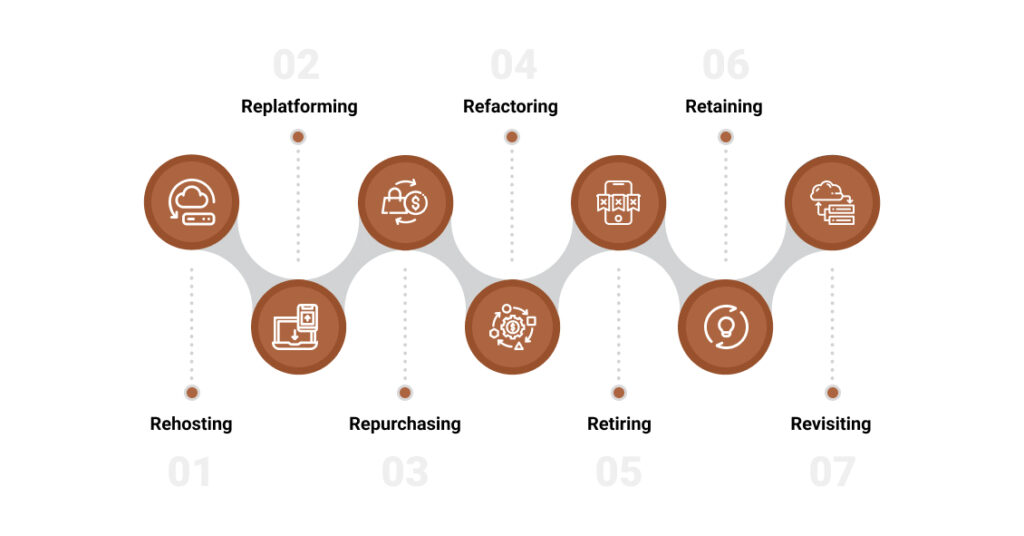
1. Rehosting (Lift-and-Shift) – The Classic, Quick Move
This cloud migration approach moves applications to the cloud with minimal modification. No significant code changes. Simply moves your virtual machines (VMs) to the cloud.
Cloud Migration Cost Impact: Lowest upfront cost, but may lead to higher operational costs in the cloud if resources are not optimized.
2. Replatforming (Lift, Tinker, and Shift) – Slight Modifications
In this cloud migration strategy, you modify applications to better fit the cloud without changing their core architecture. Just enough changes are introduced to leverage cloud efficiencies.
Cloud Migration Cost Impact: Moderate cost; requires some investment in replatforming, but can optimize long-term cloud performance.
3. Repurchasing (Switch to SaaS) – Drop and Shop
In certain scenarios, replacing your software is more feasible than moving it. This cloud migration approach replaces existing applications with cloud-based Software-as-a-Service (SaaS) solutions, particularly when aiming to transition from a legacy system.
Cloud Migration Cost Impact: Significant cost savings in infrastructure and maintenance but may involve licensing costs for the new SaaS product.
4. Refactoring (Re-Architecting) – The Remodel
This cloud migration strategy rebuilds applications from the ground up to fully leverage cloud-native features, including elasticity, scalability, and microservices.
Cloud Migration Cost Impact: High initial cost, but the most cost-effective in the long run for scalability and performance optimization.
5. Retiring – Kill Outdated Apps
With this cloud migration strategy, you decommission outdated applications that are no longer needed or that do not provide value to the business.
Cloud Migration Cost Impact: Direct cost savings by eliminating unnecessary infrastructure and services.
6. Retaining – Stay On-prem
Many workloads are designed to be on-premises. Forcefully migrating them to the cloud will only hamper existing performance and gains. Hence, it is better to keep them on-premises due to regulatory, security, or performance requirements.
Cloud Migration Cost Impact: Low cost if kept minimal, but adds complexity to hybrid environments.
7. Revisiting – Assess Your Cloud Migration Strategy Again
A reassessment of the cloud strategy after the initial migration to see if it really was worth the effort (and expense). This may even include rethinking the cloud migration approach or adjusting strategies based on post-migration feedback.
Cloud Migration Cost Impact: Variable; typically involves additional costs for analysis, but can identify areas for optimization and savings.

Key Factors That Influence Cloud Migration Costs
The average cost of cloud migration can range from a few thousand dollars for small businesses to several million dollars for enterprises. Let’s look at some aspects that influence cloud migration costs:
1. Size and Complexity of IT Infrastructure
Larger infrastructures with multiple applications, databases, and interdependencies require more extensive cloud migration planning and strategy to ensure optimal performance.
Legacy systems often require re-architecting, which increases cloud migration expenses.
2. Scope of Cloud Migration: Full vs. Partial
Are you moving everything altogether? Or just a few IT ops?
Naturally, cloud migration cost estimation for a complete migration is significantly more than that of a partial one. Complete migration requires you to eliminate your data centers and migrate all apps.
3. Migration Approach
Lift-and-shift: Quick but less optimized; lower upfront cloud migration costs but higher long-term expenses.
Re-Platforming or Re-Architecting: Higher initial investment, but greater cloud migration cost savings through efficiency and scalability.
4. Type of Cloud Deployment
Public Cloud Migration Cost: Cost-effective for most workloads with pay-as-you-go models.
Private Cloud Migration Cost: More secure, but significantly higher cloud migration services cost.
Hybrid or Multi-Cloud Migration Cost: Flexibility, but additional integration costs.
5. Data Volume and Transfer Costs
Large-scale data transfers, especially those across regions, can significantly increase cloud migration pricing.
Compliance-heavy industries, such as healthcare and finance, often require additional encryption and monitoring tools, which can lead to increased cloud migration costs.
6. Choice of Cloud Service Provider
The cloud platform you migrate to also influences the total cost of cloud migration.
- AWS’s cloud migration pricing models are often availed by enterprises, considering the expanse of their offerings.
- Azure cloud migration costs can be easily minimized if your organization is already invested in Microsoft’s other systems and apps.
- GCP’s cloud migration costs can be optimized for AI/ML-powered, data-heavy systems.
7. Application Dependencies and Integrations
Applications that rely on custom APIs or third-party systems often require reconfiguration or redevelopment to ensure seamless integration.
This contributes to both migration timelines and cloud migration costs.
8. Compliance and Security Requirements
Regulatory requirements such as HIPAA, GDPR, or PCI DSS may necessitate advanced security controls.
These can impact the cloud migration cost breakdown by introducing licensing or consulting expenses.
9. Skills and Expertise Required
In-house IT teams may lack specialized cloud expertise.
Outsourcing cloud migration services to managed providers or consultants can raise the cost of cloud migration, but it often ensures a smoother transition.
10. Downtime and Productivity Impact
Any migration-related downtime can translate to lost revenue and reduced productivity.
Gartner estimated that the average cost of IT downtime is $5,600 per minute (over $300K per hour) for large enterprises. Even smaller businesses can face thousands of dollars in losses during outages.
For instance, a 12-hour-long Apple store outage resulted in the company losing over $25 million.
Breaking Down Cloud Migration Costs: Key Constituents
When estimating the total cost of cloud migration, it’s crucial to consider the following major cost components. Each area plays a significant role in shaping the overall migration budget.
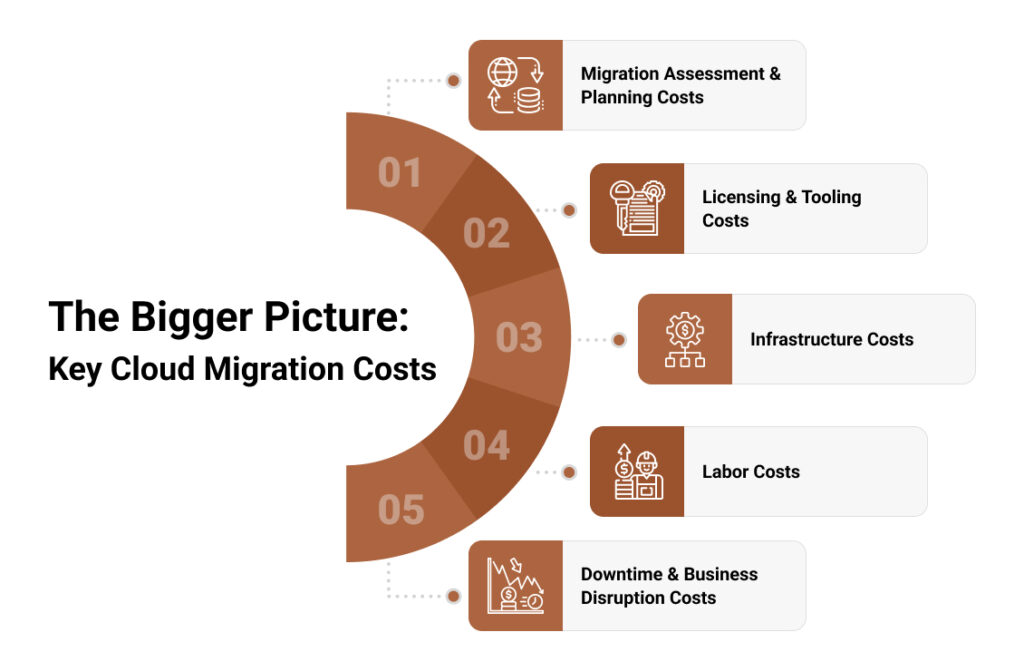
1. Migration Assessment & Planning Costs
You can consider this as laying the foundation for cloud migration. This includes evaluating the current IT infrastructure, conducting a workload inventory, mapping dependencies, and developing a migration strategy.
Cloud migration cost estimation for this phase: $5,000 – $50,000, depending on the complexity and scale of the migration.
2. Licensing & Tooling Costs
Migrating to the cloud often requires you to rethink your software and tooling strategy. You will have to factor in additional costs related to cloud-native tools and third-party software necessary for migration. This includes backup solutions, data transfer services, and migration management platforms.
Cloud migration cost estimation for this: $10,000 – $60,000
3. Cloud Migration Infrastructure Costs
As soon as your workloads migrate to the cloud, infrastructure and hosting costs begin to accumulate. This can involve compute instances, storage, and networking components, all of which vary depending on the scale and complexity of the migration.
Cloud migration cost estimation for infrastructural changes: $20,000 – $1M+
4. Labor Costs
Your workloads won’t migrate themselves. You will either need to allocate or hire internal resources to carry out the cloud migration process, or you will have to outsource cloud migration services to external providers. Either way, you will incur labor costs that cover the personnel involved in the migration process.
Cloud migration cost estimation for this: $15,000 – $200,000
5. Downtime & Business Disruption Costs
While downtime does not directly reflect in your explicit cloud migration costs, it surely affects your profit and loss (P&L) statements. It can cause disruptions to business operations, affecting productivity and the overall customer experience.
Cloud migration cost estimation for this: A few thousand dollars, depending on your tolerance and the nature of your industry.
Cloud Migration Costs by Nature: One-Time vs. Recurring
To accurately estimate cloud migration costs, consider the broader perspective. Consider what needs to be paid before migrating, and then consider the costs incurred after cloud migration.
Pre-Migration (One-Time) Expenses
These are one-off, upfront investments made before migrating to the cloud. You can also consider them as “set-up” charges when categorizing your cloud migration cost breakdown.
- Assessment & Planning: $10,000 – $50,000 for workload discovery, dependency mapping, and TCO analysis.
- Data Transfer: $100 – $500 per TB when moving data into the cloud; higher if using accelerated services like AWS Snowball or Azure Data Box.
- Migration Execution: $50,000 – $200,000, depending on the number of workloads, re-platforming requirements, and tools used.
- Training & Consulting: Typically, 10–20% of the overall cloud migration services cost when third-party experts are involved.
Average upfront spend: $60,000 – $250,000
Ongoing Cloud Migration Costs (Post-Migration)
This category encompasses cloud migration pricing that continues after the migration.
- Compute & Storage Usage: $5,000 – $50,000/month depending on workloads and usage models.
- Cloud Governance & Monitoring Tools: $1,000 – $5,000/month for cost tracking, performance monitoring, and compliance enforcement.
- Licensing & SaaS Subscriptions: $5,000 – $20,000 annually for third-party integrations and cloud-native services.
- Optimization & FinOps: Continuous right-sizing and reserved instance strategies, usually 5–10% of monthly spend.
- Security & Compliance: $10,000+ annually for advanced monitoring, encryption, and audit support in regulated industries.
Average ongoing spend: $10,000 – $60,000/month
Cloud Migration Costs by Location
Cloud migration costs may also vary because of your location. Factors such as local labor rates, data sovereignty regulations, network infrastructure, and provider pricing models all contribute to regional variations in cloud migration costs.
Let us explore the differences across key regions, including the USA, the UK, Europe, and Southeast Asia.
Cloud Migration Costs in the USA
Estimates:
- Upfront Migration Costs: $50,000 – $300,000+
- Ongoing Costs: $10,000 – $100,000+/month
Drivers:
Labor costs: High-skilled labor costs are a major contributor to cloud migration services cost. Cloud architects and consultants in the USA typically charge premium rates.
Data transfer and storage: The USA also tends to offer competitive pricing from all major cloud providers, but costs can vary depending on the specific region and data center used.
Regulations and compliance: While the USA has fewer data sovereignty regulations compared to Europe, data security requirements (like HIPAA) can increase costs, especially in healthcare and financial sectors.
Cloud Migration Costs in the UK
Estimates:
- Upfront migration costs: $70,000 – $250,000
- Ongoing costs: $15,000 – $70,000+/month
Drivers:
- Labor rates: Higher costs compared to other regions due to a strong demand for cloud experts, especially in tech hubs like London.
- Compliance: The GDPR and other data protection laws require businesses to implement stricter controls, which can add to the cost of migration and ongoing operations.
- Local infrastructure costs: While cloud managed service providers have a strong presence in the UK, infrastructure and network connectivity costs can still be significant due to geographic factors.
Cloud Migration Costs in Europe
Estimates:
- Upfront migration costs: $60,000 – $350,000
- Ongoing costs: $12,000 – $90,000+/month
Drivers:
- Data sovereignty: Countries within Europe have varying levels of data protection regulations, particularly in Germany and France. Businesses must comply with GDPR, which may require specialized security and data management tools, adding to cloud migration pricing.
- Energy costs: Some European countries have high energy costs, which can increase the overall cost of running cloud infrastructure, especially for compute-heavy workloads.
- Labor and expertise: Countries like the Netherlands and Germany offer competitive cloud talent, but rates are generally higher than those in South-East Asia or parts of Eastern Europe.
Cloud Migration Costs in Southeast Asia
Estimates:
- Upfront migration costs: $20,000 – $150,000
- Ongoing costs: $5,000 – $30,000+/month
Drivers:
- Labor rates: Labor costs are significantly lower in Southeast Asia, making it an attractive destination for outsourcing cloud migration services. Countries such as India, Singapore, and Malaysia are known to offer competitive pricing for both cloud migration assessments and post-migration optimization support.
- Regulatory landscape: While cloud adoption is growing, data protection laws are evolving, and compliance costs may increase in countries such as Singapore and Thailand.
- Infrastructure costs: Providers have been expanding their data centers in key Southeast Asian hubs, reducing latency and improving service availability, which has helped optimize cloud migration costs for businesses in the region.
| Region | Upfront Cloud Migration Cost | Ongoing Monthly Cost | Key Cost Drivers | |
|---|---|---|---|---|
| USA |  |
$50,000 – $300,000+ | $10,000 – $100,000+ | Labor, compliance, provider pricing |
| UK |  |
$70,000 – $250,000 | $15,000 – $70,000+ | Labor, GDPR compliance, infrastructure |
| Europe |  |
$60,000 – $350,000 | $12,000 – $90,000+ | GDPR, data sovereignty, labor costs |
| South-East Asia |  |
$20,000 – $150,000 | $5,000 – $30,000+ | Labor, evolving regulations, and infrastructure |
Cloud Migration Costs by Business Size
Generally, smaller companies incur modest one-time cloud migration costs and manageable monthly spend. Conversely, larger enterprises incur millions of dollars annually due to hybrid environments, compliance requirements, and the need to modernize legacy systems.
Cloud Migration Costs for Small Businesses
Typical Costs: $25,000 – $100,000 upfront; $2,000 – $10,000/month ongoing.
With fewer workflows and reliance on SaaS-based models, startups/small businesses focus on cloud migration cost savings over advanced architecture. Consequently, they often opt for lift-and-shift migrations to minimize upfront spend, using pay-as-you-go pricing for flexibility.
Cloud Migration Costs for Mid-Sized Organizations
Typical Costs: $100,000 – $500,000 upfront; $20,000 – $60,000/month ongoing.
Multiple applications and a mix of SaaS and custom workloads make partial hybrid cloud adoption the ideal approach for mid-sized organizations to migrate to. This is why they are more likely to invest in re-platforming for performance gains and cloud migration cost savings.
Cloud Migration Costs for Enterprises
Typical Costs: $500,000 – $1.5M+ upfront; $100,000 – $300,000+/month ongoing.
The presence of complex infrastructures, legacy mainframe applications, and strict compliance mandates (such as HIPAA, PCI DSS, and GDPR) leads enterprises to adopt phased cloud migration strategies. They invest heavily in re-architecting their ecosystems, aiming for long-term cloud migration cost savings.
| Business Size | Upfront Cloud Migration Cost | Ongoing Monthly Cost |
|---|---|---|
| Small Business | $25,000 – $100,000 | $2,000 – $10,000 |
| Mid-Size Enterprise | $100,000 – $500,000 | $20,000 – $60,000 |
| Large Enterprise | $500,000 – $1.5M+ | $100,000 – $300,000+ |
Cloud Migration Costs by Different Cloud Service Providers
Cloud migration costs also depend heavily on the chosen provider. While AWS, Microsoft Azure, and Google Cloud offer similar pricing models (pay-as-you-go, reserved instances, and enterprise agreements), their cloud migration cost breakdowns still differ.
Amazon Web Services (AWS)
- Cloud Migration Tools: AWS Migration Hub, Database Migration Service (DMS), AWS Snowball for bulk data transfer.
- Data Transfer Costs: First 1 GB/month is free; thereafter, outbound data starts at around $0.09/GB. Bulk transfers with Snowball cost roughly $200–$300 per device plus $0.03/GB.
- Compute & Storage: EC2 on-demand instances average $70–$200/month per instance, while S3 storage costs $0.023/GB/month for standard storage.
Average Cloud Migration Cost Range: $70,000 – $250,000 upfront, depending on workloads; ongoing costs vary widely but typically fall between $10,000 – $100,000/month for mid to large deployments.
Microsoft Azure
- Cloud Migration Tools: Azure Migrate, Database Migration Service, Azure Site Recovery.
- Data Transfer Costs: Inbound data is free; outbound data starts at $0.087/GB. Azure ExpressRoute (dedicated connection) is priced higher but reduces latency.
- Compute & Storage: Virtual machines average $60–$180/month per instance; Azure Blob Storage costs $0.0184/GB/month for the hot tier.
- Licensing Advantage: Businesses already using Microsoft products benefit from Hybrid Use Rights, reducing cloud migration services cost by up to 40%.
Average Cloud Migration Cost Range: $60,000 – $220,000 upfront; ongoing cloud bills often land in the $8,000 – $90,000/month range.
Google Cloud Platform (GCP)
- Cloud Migration Tools: Migrate for Compute Engine, BigQuery Data Transfer Service, Transfer Appliance for large datasets.
- Data Transfer Costs: First 1 GB is free; outbound traffic begins at $0.12/GB, but sustained-use discounts can lower effective rates.
- Compute & Storage: Compute Engine VMs average $50–$150/month per instance; Google Cloud Storage standard tier costs $0.020/GB/month.
- Discount Programs: Sustained-use discounts and committed-use contracts can yield 20–30% cloud migration cost savings.
Average Cloud Migration Cost Range: $50,000 – $200,000 upfront; ongoing spend often ranges between $7,000 – $80,000/month depending on workload scale.
| Provider | Upfront Migration Cost | Ongoing Monthly Cost |
|---|---|---|
| AWS | $70,000 – $250,000 | $10,000 – $100,000 |
| Azure | $60,000 – $220,000 | $8,000 – $90,000 |
| GCP | $50,000 – $200,000 | $7,000 – $80,000 |
Cloud Migration Costs by Industry
While cloud migration pricing models are broadly similar across providers, the average cost of cloud migration varies significantly by industry. Compliance requirements, workload complexity, and reliance on legacy systems all influence both upfront and ongoing expenses.
1. Cloud Migration Costs in the Healthcare Industry
Nature: Strict compliance with HIPAA, advanced encryption, and audit-ready logging.
- Impact on Cost: Security and compliance features can add 15–25% to the overall cloud migration services cost.
- Typical Range: $80,000 – $300,000 upfront; $15,000 – $70,000/month ongoing.
2. Cloud Migration Costs in the Financial Services Industry
Nature: PCI DSS, GDPR, and SOX compliance; high-availability and zero-downtime requirements.
- Impact on Cost: Real-time replication, disaster recovery, and governance tools increase cloud migration cost factors.
- Typical Range: $100,000 – $400,000 upfront; $30,000 – $120,000/month ongoing.
3. Cloud Migration Costs in the Retail & eCommerce Industry
Nature: Seasonal demand spikes, omnichannel integrations, and customer experience personalization.
- Impact on Cost: Need for scalability and analytics drives investment in re-platforming.
- Typical Range: $50,000 – $200,000 upfront; $10,000 – $80,000/month ongoing.
4. Cloud Migration Costs in the Manufacturing & Logistics Industry
Nature: IoT/edge computing, ERP modernization, and integration with legacy production systems.
- Impact on Cost: Industrial workloads often require hybrid cloud models, which adds to cloud migration cost estimation.
- Typical Range: $70,000 – $250,000 upfront; $20,000 – $90,000/month ongoing.
5. Cloud Migration Costs in the Media & Entertainment Industry
Nature: Large-scale data transfer, content storage, and high-performance computing for rendering and streaming.
- Impact on Cost: Data egress charges and storage optimization play a significant role in cloud cost optimization.
- Typical Range: $100,000 – $500,000 upfront; $25,000 – $150,000/month ongoing.
| Industry | Upfront Migration Cost | Ongoing Monthly Cost | Cost Drivers |
|---|---|---|---|
| Healthcare | $80,000 – $300,000 | $15,000 – $70,000 | Compliance & data security |
| Financial Services | $100,000 – $400,000 | $30,000 – $120,000 | Zero-downtime, governance |
| Retail & eCommerce | $50,000 – $200,000 | $10,000 – $80,000 | Scalability & peak loads |
| Manufacturing | $70,000 – $250,000 | $20,000 – $90,000 | IoT & hybrid models |
| Media & Entertainment | $100,000 – $500,000 | $25,000 – $150,000 | Data-heavy workloads |
How to Estimate Cloud Migration Costs Accurately?
One of the most common challenges businesses face is underestimating the actual cost of cloud migration. To avoid surprises, organizations need a structured approach to cloud migration cost estimation.
- Conduct a comprehensive cloud migration assessment — list applications, databases, and storage requirements.
- Breakdown cloud migration costs in different categories: upfront, ongoing, etc.
- Use cloud migration cost calculators:
- AWS Pricing Calculator – models EC2, S3, RDS, and migration services.
- Azure Pricing Calculator – includes VM costs, storage tiers, and hybrid licensing benefits.
- Google Cloud Pricing Calculator – estimates VM, storage, and data analytics workloads.
- Factor in hidden and overlooked cloud migration costs.
- Build scenarios and create best-case, expected, and worst-case cloud migration cost models.
How to Optimize Cloud Migration Costs?
There are several ways to keep your cloud migration costs under check.
Right-size Before As Well As After You Migrate
Start by acknowledging that not every workflow or process can be “lifted and shifted” as is. For example, if you have a large on-premises server, directly migrating to the cloud would result in wasted spend. To match the exact compute demand, right-size resources by analyzing your workloads. In later stages, when the cloud migration cost stabilizes, you can switch to an auto-scaling cost model.
Migrate Incrementally, Not at Once
Rushing everything to the cloud may have a counter-effect, and this approach often backfires. Start with migrating low-risk, low-volume workloads to the cloud. This way, the overall cloud migration cost is spread across the entire timeline.
Rely on Managed Services
To minimize cloud migration burden on your internal teams, lean on cloud managed services to simplify the process and maximize migration ROI. While this approach comes with an upfront service/subscription fee, it often helps organizations save on downtime and resources.
Choose a Trusted Cloud Migration Service Provider
Work closely with the right cloud migration service provider. Today, there are multiple service providers in the market, making it challenging for you to select an ideal one. However, look for professionals who are not only skilled in technical heavy lifting, but also understand how each organization has unique workflow and hosting requirements in the cloud.
They can help you avoid typical cloud migration mistakes, such as over- or under-provisioning resources, neglecting data egress costs, and more.
How SunTec India Can Help with Cloud Migration?
Migrating to the cloud is more than simply moving your workloads. It is about ensuring that this move generates value, enhances business agility, and brings long-term cloud migration cost savings.
However, a significant part of it depends on your chosen cloud migration strategy. By evaluating each step—assessment, licensing, infrastructure, labor, and downtime—you can avoid unexpected cloud migration costs and ensure a smooth transition.
At SunTec India, we acknowledge how each workflow and organizational requirement is unique. Which is why our cloud managed services are designed to offer tailored migration assistance, optimizing overall cloud migration costs to fit within your budget.
Check out some of our cloud-based projects:
- Digitally Transforming Healthcare Ops: Our experts built a digital transformation solution, hosted on the AWS cloud, to automate and streamline healthcare operations, from telemedicine to billing and record management.
- Modernizing an Analytical Platform: We reduced the physical footprint for an analytics service provider by migrating their workloads to the cloud (AWS).
- Streamlining Food Delivery Ops: Our experts built a custom data visualization and dashboard solution, hosted on AWS, to provide deeper insights into delivery operations.
Ready to move your workloads and operations to the cloud? Let us help you take the complexity out of cloud migration, so you can focus on what matters—growing your business.
Frequently Asked Questions
1. What is the average cloud migration cost for enterprises?
The average cloud migration cost for enterprises can range from $500,000 to $1.5 million+, depending on the complexity, infrastructure, and compliance requirements of the business. Ongoing costs typically range from $100,000 to $300,000 per month.
2. How much does it cost to migrate to the cloud for small businesses?
For small businesses, cloud migration costs generally range from $25,000 to $100,000 upfront, with ongoing monthly costs of $2,000 to $10,000, depending on the size of the workloads and chosen cloud provider.
3. How to estimate cloud migration costs accurately?
Accurate cloud migration cost estimation involves evaluating workload dependencies, assessing the current infrastructure, and utilizing cloud migration cost calculators provided by providers such as AWS, Azure, and Google Cloud. It’s essential to factor in upfront and ongoing costs, including data transfer, licensing, and labor.
4. What are the typical steps involved in migrating to the cloud?
Typical cloud migration steps include:
- Assessment & Planning – Analyze current infrastructure and select cloud strategy.
- Data Transfer & Infrastructure Setup – Move data and set up cloud resources.
- Testing & Optimization – Ensure smooth performance and optimize resources.
- Post-Migration Monitoring – Continuously monitor and optimize the cloud environment.
5. Is it worth paying for cloud migration services?
Yes, paying for professional cloud migration services can save time, reduce risks, and ensure a smooth transition. Experts help minimize downtime, optimize resources, and avoid common migration pitfalls, ultimately leading to a more cost-effective and efficient cloud environment.