
Marketing in 2025 isn’t a linear funnel—it’s a dynamic, intricate omnichannel journey, where every touchpoint matters. Traditional attribution models—focused on last-click, first-click, and linear frameworks were built for a simpler era, where customer journeys were straightforward, cookies tracked everything, and a purchase happened within days of that first ad impression.
That era is now over.
Today’s purchase path looks nothing like the linear funnel we once knew. Consumers interact with brands across an average of 8 touchpoints before converting, spanning social media, connected TV, podcasts, retail media networks, search engines, email, and traditional digital channels—often across 3-4 different devices. A customer might see a streaming TV ad, search for a product on their phone, abandon a cart on their tablet, and finally convert via a Sponsored Products ad days later. Giving 100% credit to that final click means you are consistently defunding the critical upper-funnel efforts that initiated the sale. This is where Amazon Marketing Cloud comes into play. Designed for more effective audience targeting and better return on ad spend, AMC offers a multi-touch attribution model that accounts for the entire customer journey.
Let’s explore how multi-attribution modeling-based AMC is quickly surpassing traditional attribution models and shaping the future of advertising.
Table of Contents
- TL;DR: Traditional Attribution Model vs Amazon Marketing Cloud
- Traditional Marketing Attribution Challenges—And How AMC Overcomes Them for More Targeted Advertising
- Key Features of Amazon Marketing Cloud That Make it a Go-To Option for Targeted Advertising in 2025
- Eligibility Requirements: Who Qualifies for Amazon Marketing Cloud (AMC) Access
- Amazon Marketing Cloud Prerequisites: What You Need Before AMC Implementation
- Implementation Process: How to Set Up Amazon Marketing Cloud Solutions
- DIY Approach or Amazon Marketing Cloud Managed Services – How to Make the Right Choice?
- Amazon Marketing Cloud Is Defining the Future of Marketing. Are You Ready?
TL;DR: Traditional Attribution Model vs Amazon Marketing Cloud
| Aspect | Traditional Attribution Models | Amazon Marketing Cloud (AMC) |
|---|---|---|
| Primary Focus | Last-touch or first-touch attribution | Multi-touch attribution spanning the entire customer journey ( including upper and lower funnel activities) |
| Timeframe/Lookback Windows | Fixed, often short (7-28 days), with last-touch prioritization | Extensible up to 5+ years, allowing deeper analysis of long purchase cycles |
| Data Privacy | Cookie-dependent, increasingly restricted by privacy laws | Privacy-safe clean room with pseudonymized, aggregated data |
| Platform Coverage | Single platform (e.g., Google, Facebook, Amazon) | Cross-channel: Amazon ad types + external sources (CRM, social) |
| Optimization & Decision-Making | Based on limited, often skewed insights | Data-driven, customizable models reflecting actual buyer behavior |
| Insight Timeliness | Often delayed, tedious manual analysis | Near real-time with automated audience building and activation |
| Flexibility & Customization | Rigid, pre-set models (last, linear, time-decay) | Flexible, with custom weighting and advanced analysis (AI, SQL) |
| Audience Segmentation depth | Broad audience segmentation relying on basic demographic and interaction data | Granular audience segmentation powered by thousands of behavioral, transactional, and contextual signals—enabling precise targeting and high-value audience modeling |
Traditional Marketing Attribution Challenges—And How AMC Overcomes Them for More Targeted Advertising
As marketing transitions into a privacy-first, cross-channel ecosystem, traditional attribution models have reached their limits. Amazon Marketing Cloud (AMC) is changing the paradigm with a clean-room, multi-touch framework that captures the entire customer journey without compromising privacy. Here’s how AMC addresses the critical limitations of traditional attribution models holding marketers back:
Challenge 1: Strict Privacy Regulations and Cookies Deprecation
Traditional Attribution Models’ Limitation: Over the past few years, stricter privacy laws (GDPR, CCPA) and the decline of third-party cookies (with Chrome, Safari, Firefox blocking them) have drastically limited tracking capabilities. With cross-site tracking disabled, traditional attribution models lose their ability to connect various touchpoints that lead to a conversion. This leaves marketers with a fragmented view of the customer journey.
AMC Advantage: The Amazon Marketing Cloud solution is built on a privacy-safe, clean-room model. All personal data is pseudonymized or aggregated (never shared at the user level). Additionally, the data from different sources is matched using protected identifiers, allowing detailed analysis without exposing any raw, personally identifiable information (PII) to either Amazon or the advertiser.
Challenge 2: Platform Silos Create Fragmented Views
Traditional Attribution Models’ Limitation: Insights are confined to a single platform, failing to track cross-channel interactions and conversions. Facebook, Google, and Amazon each report conversions separately—leading to duplicate or inflated numbers.
AMC Advantage: Amazon Marketing Cloud solution unifies data from various Amazon advertising campaigns (Sponsored Products, Sponsored Brands, Sponsored Display, Amazon DSP) and even first-party sources (CRM, websites, social media platforms, etc.). By unifying cross-channel data, AMC provides a 360-degree customer view, helping brands understand what’s working for them.
Challenge 3: Upper-Funnel Efforts Remain Invisible
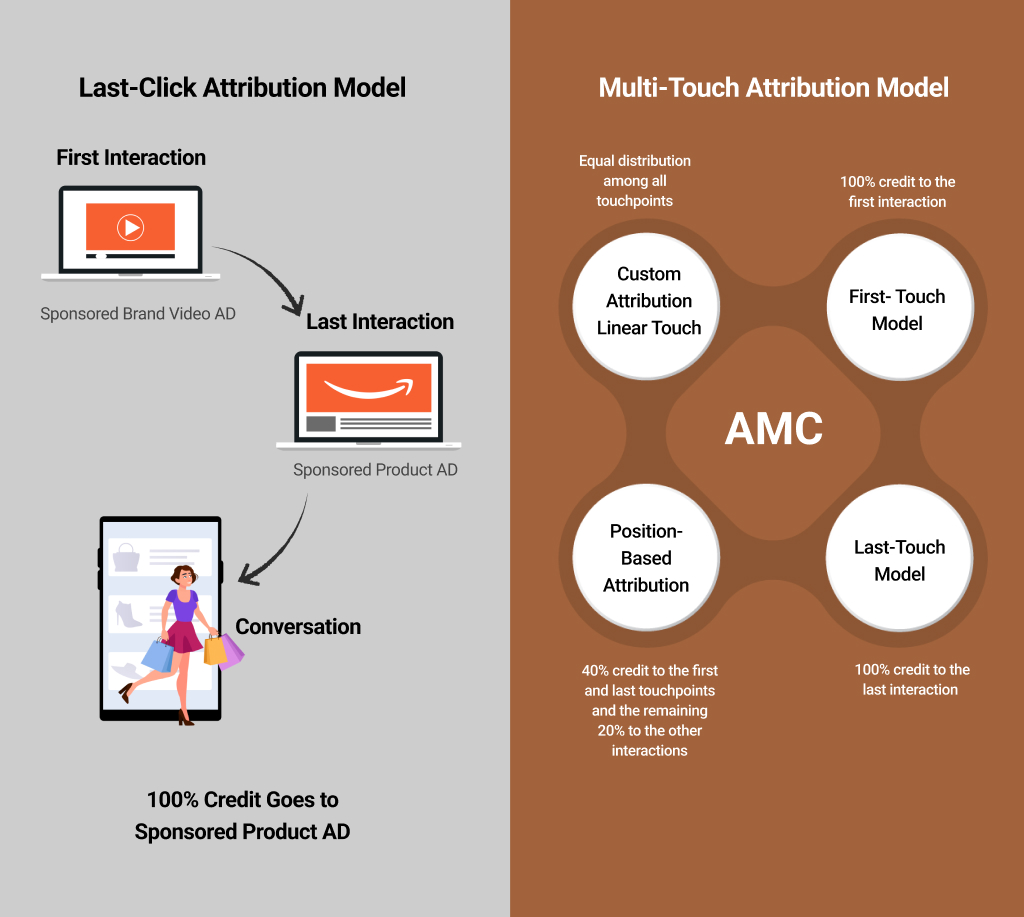
Traditional Attribution Models’ Limitation: Either the first-click or the last-click is prioritized in the traditional attribution models, neglecting all the other touchpoints or efforts that might have contributed to that final conversion. This causes brands to reduce spend in channels that actually drive future conversions, limiting their growth opportunities.
AMC Advantage: Multi-Touch Attribution (MTA) model within Amazon Marketing Cloud (AMC) uses advanced machine learning and randomized control trials to fairly assign conversion credit across all relevant ad interactions, rather than just the last click. This approach provides a much more precise and complete understanding of the customer journey by revealing how each touchpoint—whether a Sponsored Products click, a Sponsored Brands engagement, or a DSP ad view—contributes to the final sale.
Apart from the custom model, AMC also supports standard options, including last-touch, first-touch, and position-based, and allows marketers to customize how credit is allocated based on their unique business goals.
Challenge 4: Limited Lookback Windows
Traditional Attribution Models’ Limitation: Traditional attribution models usually operate within fixed, often short, lookback windows—commonly 7 to 28 days—which limit how far back they analyze past ad interactions. Moreover, last-click models prioritize recent interactions, potentially overlooking important earlier touchpoints that contributed to the conversion. This results in undervaluing ads that influenced longer decision-making journeys.
AMC Advantage: Amazon Marketing Cloud advertising solution offers custom, extended lookback windows (up to 5 years) to better analyze customer journey metrics, such as customer lifetime value (CLV) and percentage of new-to-brand (NTB) customers. For products with longer purchase cycles, such as laptops, which are typically bought every 3 to 5 years, this extended purchase history window enables brands to optimize their marketing strategies.
Key Features of Amazon Marketing Cloud That Make it a Go-To Option for Targeted Advertising in 2025
The strategic value of AMC extends far beyond attribution. Its advanced feature set addresses the operational and analytical bottlenecks that have plagued digital advertisers for years, delivering capabilities that fundamentally change how brands approach audience targeting and campaign optimization.
1. AI-Powered SQL Generator
Launched in early 2025, the AI-powered SQL generator provides a natural language interface that enables advertisers to generate SQL queries for their desired audience use case. Leveraging advanced AI capabilities, the AMC SQL generator eliminates the need to write code manually and reduces query development time from hours to minutes.
Simply describe the audience you want in plain English: “Show me customers who watched my video ads three times, added products to cart, but didn’t purchase within 14 days.” The AI instantly translates this into executable SQL code, complete with the logic steps it used.
This capability of Amazon Marketing Cloud doesn’t just reduce query development time from hours to minutes; it fundamentally changes how marketing teams interact with data. It allows non-technical strategists to test hypotheses, build lookalike audiences, and uncover behavioral trends once hidden behind code barriers. Now, advertisers can ask more relevant questions about their target audience, explore novel use cases, and get detailed guidance.
For example, an advertiser can use a prompt like “how to create a custom audience targeting people who interacted with our audio Ads but haven’t made any purchase,” and the AI-powered SQL generator will generate code in seconds to build this custom audience, with step-by-step instructions.
Real-World Impact:
During beta testing of AMC’s AI-powered SQL generator, L’Oréal US reported significant efficiency gains. According to Brendan Frawley, VP at L’Oréal, “This new Amazon Marketing Cloud capability will democratize advertisers’ ability to leverage advanced audiences with fewer technical requirements.” The feature enabled their team to experiment with new audience combinations in real time, dramatically accelerating campaign iteration cycles.
2. Optimal Frequency Analysis
Frequency optimization has long been advertising’s resource allocation problem—too few impressions waste potential conversions, too many trigger diminishing returns or active ad fatigue. Amazon Marketing Cloud’s “Optimal Frequency Analysis” feature has been launched to solve this problem. It analyzes conversion rates for different audience segments by impression frequency (1x, 3x, 5x, 10x, 20x views) to identify:
- Optimal frequency: The optimal range where conversion peaks
- Diminishing returns threshold: When more impressions stop helping
- Ad fatigue point: When over-exposure actively hurts conversions.
By determining how many times a customer should see an ad before conversion likelihood diminishes, AMC enables brands to efficiently allocate budget, avoid ad fatigue, and maximize engagement.
Real-World Impact:
A CPG brand named Honest Kitchen leveraged the Optimal Frequency Analysis feature to improve Amazon DSP campaign performance. After analyzing their cross-channel ad frequency, they maintained their daily ad frequency caps within the optimal range and witnessed a 23% increase in average impressions alongside a 44% lift in product detail page views—without budget expansion.
3. High-Value Audience Analysis
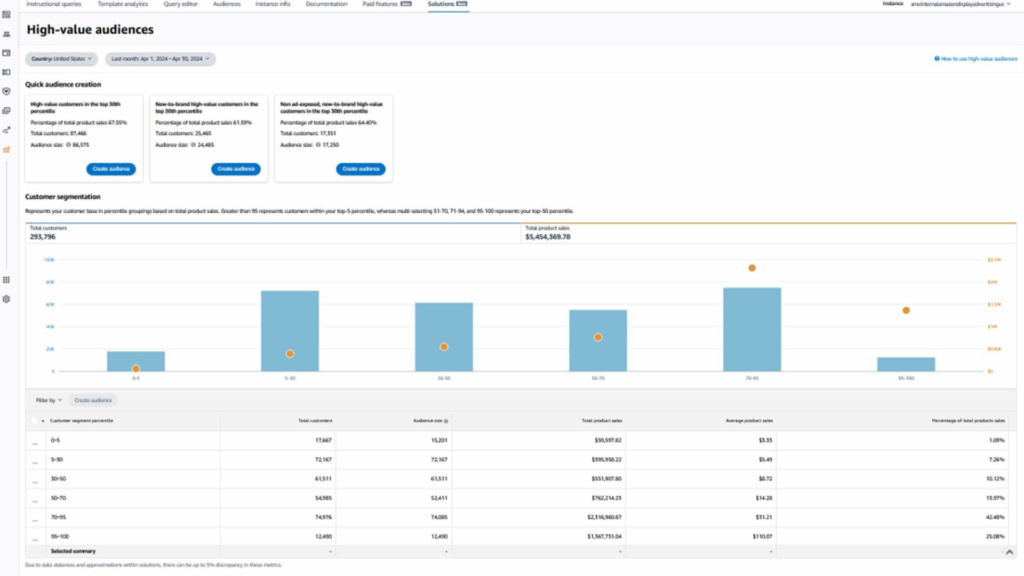
Amazon Marketing Cloud’s high-value audiences solution (beta) enables brands to evaluate the value of their customer groups based on historical spend data. Brands can specify parameters such as time frame, ASINs, and new-to-brand status to identify and filter for a “high-value” audience, and then create a lookalike or rule-based audience within the same interface. The best thing about Amazon Marketing Cloud is that the audience created in this solution will be automatically integrated with your Amazon DSP accounts, so you can easily use them for your future campaigns.
Real-World Impact:
An advanced home security brand, SimpliSafe, leveraged AMC audiences to refine its retargeting strategy, focusing on customers who had previously engaged with the brand but had neither viewed recent ads nor completed a purchase. By targeting this new audience in its marketing campaigns, SimpliSafe increased its RoAS by 109%. Additionally, their new-to-brand purchases accounted for 29% of total purchases.
4. Flexible Shopping Insights
The path from product discovery to purchase is rarely linear—and Flexible Shopping Insights gives marketers visibility into those overlooked stages. This feature helps brands expand their targeting capabilities by providing additional data around “organic” purchasers. With AMC Flexible Shopping Insights, advertisers can target customers who have organically visited your product page and added an item to the cart but have not made a purchase.
Along with organic cart abandonment retargeting, the feature also enhances “view remarketing” capabilities. Under view re-marketing, advertisers can target customers who have viewed a product multiple times but have not made a purchase. Through this granular targeting, AMC Flexible Shopping Insights fundamentally changes how brands approach lower-funnel optimization, shifting from reactive conversion tactics to proactive engagement with demonstrated intent.
Real-World Impact:
Consumer goods brand The Honest Company leveraged Flexible Shopping Insights to target organic visitors with strong purchase intent who had not yet transacted. By activating audiences identified through Flexible Shopping Insights, the brand achieved a 20% increase in new-to-brand purchase rates.
5. New-to-Brand (NTB) Measurement Across All Ad Formats
Customer acquisition costs are 5-7x higher than retention costs. Brands need to differentiate:
- Acquisition campaigns (bringing in first-time buyers)
- Retention campaigns (serving existing customers)
Traditional reporting conflates these, making high-NTB campaigns appear “expensive” when they’re actually efficiently building a customer base. AMC enables comprehensive new-to-brand customer tracking across Sponsored Products, Sponsored Brands, Sponsored Display, and Amazon DSP—revealing which campaigns actually acquire new customers rather than serve existing ones. Advertisers can track up to 12 months of sales and conversion data using the NTB metric to identify untapped market segments and product opportunities based on new customer behavior, enabling informed decision-making.
Real-World Impact:
Lavazza, a premium Italian coffee brand, improved its conversion rate by 14% and new-to-brand customer acquisition by 6% by leveraging Amazon Marketing Cloud’s NTB feature. This feature helped the brand discover that their Amazon DSP campaigns are influencing many customers to buy the products, but it is the Amazon Sponsored Products campaign that is converting. Utilizing this insight, the company created specialized remarketing audiences to bring consumers back into their purchase funnel. By integrating AMC audiences into their Search Campaigns, the company maintained visibility among high-intent customers, driving higher conversion rates.

Eligibility Requirements: Who Qualifies for Amazon Marketing Cloud (AMC) Access
Access to Amazon Marketing Cloud Services is not open to everyone. AMC is reserved for advertisers meeting specific criteria that ensure they can fully leverage its analytical depth.
Advertisers who are using any of these are eligible for AMC access:
| Amazon DSP + Sponsored Ads | Only Amazon DSP Ads | Only Amazon Sponsored Ads |
|---|
Advertisers who don’t have their Amazon Ads account can partner with a service provider/company registered on the Amazon Ads Partner network to access AMC.
Other eligibility requirements for Amazon Marketing Cloud Solutions include:
- An active Amazon DSP account with campaigns running or planned within the past 28 days.
- An executed DSP Master Service Agreement (MSA) with Amazon Ads.
- AMC operates across 17 global markets, including the U.S., UK, India, Germany, Japan, and Australia. Your business must be located in any of these markets to gain access to a dedicated clean room—a secure data space for in-depth campaign intelligence and audience analytics.
- Significant monthly ad spend recommended.
Additionally, you need an Amazon AWS account to use AMC APIs for programmatic management and data integrations (such as storing query results in an S3 bucket).
Amazon Marketing Cloud Prerequisites: What You Need Before AMC Implementation
To unlock AMC’s data potential, advertisers need both infrastructure and expertise. While Amazon Marketing Cloud Solutions provides the technical framework, effective implementation depends on readiness in three key areas:
1. Data Preparedness
- Your first-party data (customer records, CRM data, historical ad interactions) must be cleaned, properly structured, and pseudonymized before uploading to Amazon Marketing Cloud Solution. Your data must conform to AMC’s required schema structure (column headers like hashed_email, event_time, event_type).
- AMC strictly enforces data privacy policies, meaning no raw customer identifiers are processed. Hence, all data must be anonymized before upload, with no personally identifiable information available.

2. Technical Setup
- SQL knowledge: AMC doesn’t provide pre-built dashboards—someone on your team needs SQL expertise to build custom queries and extract insights (though 2025’s AI SQL generator reduces this barrier).
- AWS Account (Optional): Required only for API access, programmatic management, and advanced integrations.
- Integration tools: AMC connects through APIs, AWS S3 buckets, or DSP accounts to import event-level ad data.
3. Strategic Planning
Define what you want AMC to solve: full-funnel attribution, high-value audience activation, media overlap analysis, or cross-channel ROAS measurement. This aligns your datasets and analysis workflows with real business goals.
Checking Eligibility for Amazon Marketing Cloud Solutions:
To check your eligibility for AMC, log into your Amazon Advertising account, navigate to the “ Measurement & Reporting dashboard”, and look for the “Amazon Marketing Cloud” under available tools.
- If visible: You have access! Start exploring no-code templates immediately.
- If not visible: Contact your Amazon Ads account executive or reach out through the AMC application page to verify eligibility and request access.
Implementation Process: How to Set Up Amazon Marketing Cloud Solutions
Implementing AMC follows a well-defined structure:
- Access Request: Apply via Amazon Ads Managed Services—advertisers can’t self-create an AMC instance. Amazon’s team verifies eligibility and provisions access after review (usually takes around 3-5 days for approval).
- Instance Setup: Once approved, Amazon builds your private AMC instance, preloaded with the past 28 days of DSP data and automatically capturing campaign signals moving forward (up to 12.5 months of historical data retention).
- Data Uploading/Integration: Using Amazon Marketing Cloud APIs or the Event Manager, advertisers upload their first-party data—ensuring hashing (SHA-256 encryption) for privacy compliance. Amazon’s AMC environment matches advertiser data with ad signals securely and anonymously.
- Testing and Querying: Within AMC’s sandbox environment, advertisers run test queries, simulate campaign scenarios, and experiment with data aggregation. Predefined workflows help ensure that privacy thresholds (a minimum of 100 unique users per query) remain intact.
- Workflow Automation: Through AMC’s Schedule and Workflow APIs, brands automate key analytical tasks—such as campaign overlap reports, path-to-conversion studies, or frequency analyses—removing manual effort from recurring data pulls.
- Insight Activation: Insights from AMC are connected directly into Amazon DSP or Sponsored Ads, enabling real-time audience activation and campaign optimization.
In theory, AMC implementation seems like a straightforward technical setup. However, in practice, most advertisers encounter bottlenecks around:
- Data architecture planning: Determining which first-party data sources to integrate and how to structure pseudonymized inputs for maximum analytical flexibility
- Query development: Building a library of business-relevant queries that align with strategic KPIs rather than generic exploration
- Cross-functional coordination: Ensuring marketing, analytics, and technical teams have an aligned understanding of AMC capabilities and reporting cadences
- Privacy compliance validation: Confirming all uploaded data meets pseudonymization standards and adheres to regional privacy regulations
These operational complexities explain why brands frequently partner with Amazon Marketing Cloud consulting service providers for streamlined implementation and management. An experienced Amazon Marketing Cloud agency typically reduces AMC deployment time from months to weeks by leveraging established query frameworks, pre-built data schemas, and defined data integration workflows.
DIY Approach or Amazon Marketing Cloud Managed Services – How to Make the Right Choice?
This question surfaces in every AMC evaluation conversation, often after advertisers have reviewed eligibility requirements and confronted the technical realities of SQL-based analytics. The choice between building internal capabilities versus partnering with Amazon Marketing Cloud experts isn’t purely financial—it’s a strategic calculation about time-to-market, resource allocation, and competitive positioning. Here’s how to evaluate which path aligns with your operational maturity and growth objectives.
- In-house implementation makes sense for advertisers with dedicated analytics teams, large Amazon PPC budgets, and the capacity to manage ongoing audience and performance insights independently.
- For everyone else—which represents the majority of the advertiser ecosystem—Amazon Marketing Cloud managed services are the ideal option. Rather than spending 6-12 months recruiting SQL analysts, establishing governance protocols, and building query libraries through trial-and-error, advertisers can choose a reliable Amazon Cloud Marketing consulting partner like SunTec India to access experienced resources at 60% lower in-house implementation cost and achieve faster time-to-market.
Amazon Marketing Cloud Is Defining the Future of Marketing. Are You Ready?
Amazon Marketing Cloud (AMC) is not merely a more advanced attribution tool—it’s a new intelligence layer for modern advertising. It closes the gap between insight and action, between data and decision-making. While traditional models define what happened, AMC explains why it happened—and what to do next. The sooner marketers adopt Amazon Marketing Cloud solutions, the sooner they’ll shift from reactive measurement to proactive strategy.