Process Automation in SMEs: How Small Businesses Can Compete with Larger Enterprises?

Table of Contents
- Key Factors Driving MSMEs Toward Process Automation & Digital Transformations
- Why MSME Digital Transformations Require a Distinct Approach?
- What Processes Should MSMEs Automate?
- How Automation Drives Competitiveness for SMEs?
- How Much Does Process Automation Cost for Small Businesses?
- How MSMEs Can Automate Business Processes?
- The Future of Workflow Automation for Small Businesses: Agent-Driven Automation
- How SunTec India Can Help?
- Frequently Asked Questions
MSMEs (Micro, Small, & Medium Enterprises) are the backbone of any modern economy. In fact, they are known to account for over 2/3rds of employment in growing economies. However, they continue to struggle with business productivity due to manual processes, siloed data, fragmented systems, and resource constraints.[1]
As observed over the last few years, MSMEs that have embraced digital transformations through strategic process automation have been able to change that equation. By streamlining repetitive workflows, digitizing all data, and enabling more intelligent decision-making, automation has helped MSMEs operate with the speed and efficiency of larger competitors.
In essence, workflow automation for small businesses isn’t just a tech upgrade but a practical path to continuous growth and sustainable competitiveness. This blog will explore how process automation helps MSMEs achieve productivity benchmarks, reduce costs, and scale efficiently. You’ll also learn ways to implement process automation in MSMEs, discover how it enhances decision-making, and see real-world examples of successful automation in small businesses—along with practical tips to overcome common challenges.
Key Factors Driving MSMEs Toward Process Automation & Digital Transformations
Several driving factors push for MSME digital transformations:
- Evolving Customer Expectations: Today’s buyers expect seamless, personalized experiences. 84% say the experience a company provides is as necessary as its products. The other 72% expect businesses to understand their needs beforehand, none of which would be possible if the workforce is stuck in manual loops.[2]
- Increasing Global Competition: With 35% of MSMEs targeting Europe, followed by Asia and Latin America, global competition is no longer limited to big enterprises. Implementing process automation for small businesses presents opportunities to scale operations, manage cross-border workflows, and maintain consistency across markets.[3]
- Remote and Hybrid Work Models: Nearly 1 in every 5 people works entirely from home in the US alone—taking that to a global scale only increases the number of people working remotely. Cloud-based workflow automation for small businesses can help employees stay productive through remote collaboration, automated reporting, and mobile access.
- Operational Inefficiencies and Cost Pressures: Rising operating costs continue to pose a challenge for more than half of MSMEs. Workflow automation can reduce these costs through process standardization, reduced manual errors, and faster cycle times.
Why MSME Digital Transformations Require a Distinct Approach?
MSMEs face particular challenges that determine how small businesses can compete with large enterprises using automation.
Limited Budgets and Resources
Unlike large enterprises, MSMEs operate with constrained budgets and smaller teams. Their investments are often limited to cost-effective automation solutions, which deliver a quick (if temporary) ROI rather than significant, multi-year transformations that yield lasting results.
Skill Gaps and Change Management
MSME digital transformations must address employee upskilling. This is because process automation succeeds only when supported by digital literacy and clear process ownership across all people involved.
Large Scale AI Technology Adoption
Most MSMEs cannot afford operational disruptions that come with large-scale process automation. Consequently, implementing workflow automation for small businesses requires a phased, low-risk approach—starting with automating core, repetitive tasks before scaling to advanced integrations.
Reliance on Legacy Applications/Systems
Many small businesses rely on a mix of legacy systems and manual processes. Successful approaches to implement process automation in MSMEs, therefore, depend on adaptable, modular tools. These tools must have backward compatibility to fit the existing stack.
Otherwise, MSMEs must start with basic digitization or legacy modernization before implementing process automation.
Lack of Agile Decision-making
Unlike larger corporations, MSMEs can pivot more quickly, as they have limited resources at their disposal. They need a well-planned, validated process automation strategy tailored for small businesses, allowing them to rapidly test, iterate, and benefit from agility.
What Processes Should MSMEs Automate?
According to McKinsey Research, of over 60% jobs known in the US, more than 30% can be automated. That points to hundreds of processes and workflows (many of which are common in MSMEs) that can benefit from small business automation tools.[1]
However, given the challenges MSMEs face, automation shouldn’t start with core operations—it should start with small-scale initiatives. The best approach is to begin with non-critical, repetitive tasks to test feasibility, measure ROI, and build internal confidence before scaling to high-impact areas.
Below is a list of key processes where the impact of automation on SME productivity and efficiency can be realized.
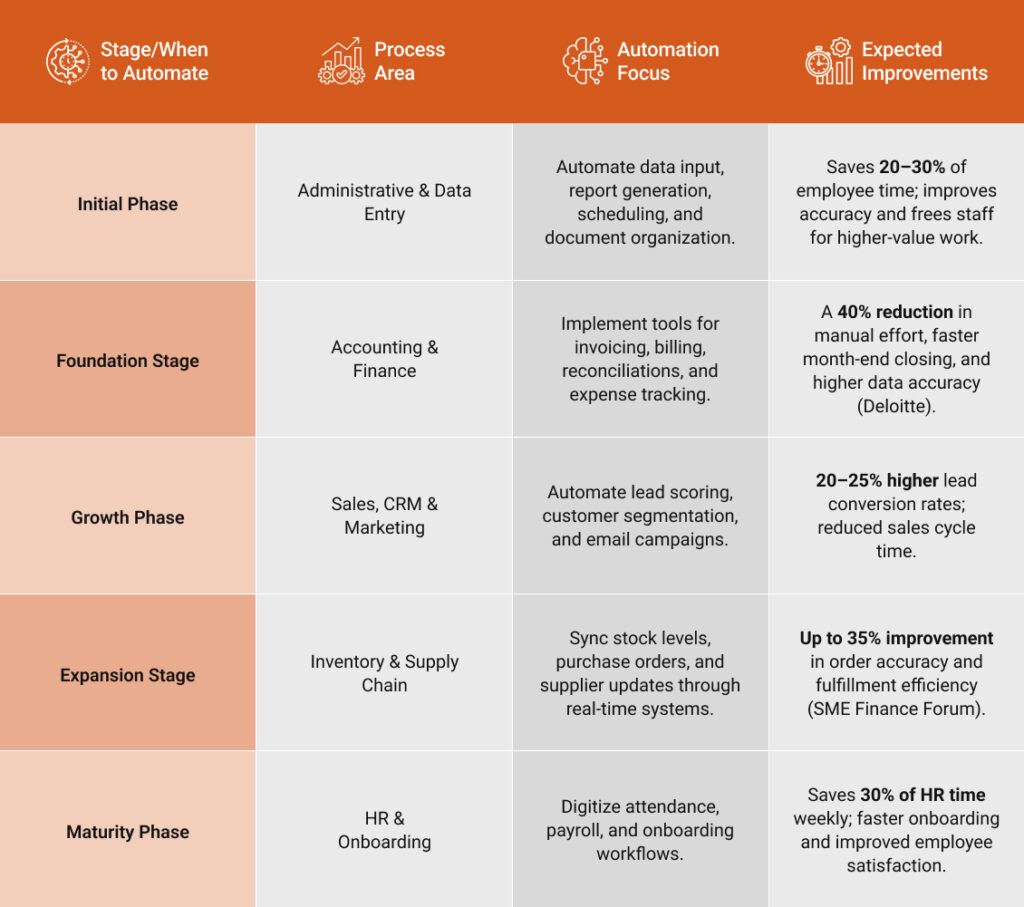
With this approach to implementing process automation for small businesses, you can achieve measurable, rapid wins and scale to mission-critical operations with confidence.

How Automation Drives Competitiveness for SMEs?
When small businesses automate processes, they compete not by scale, but by efficiency. It allows their teams to match the speed, precision, and responsiveness of large enterprises—without proportional increases in cost or headcount.
1. Operational Efficiency and Speed
According to a survey, 63% of small businesses that adopt automation report higher productivity. By reducing manual tasks and process bottlenecks, workflow automation for small businesses shortens delivery cycles, enabling faster responses and fulfillment.
2. Cost and Resource Optimization
Process automation for small businesses minimizes human error, eliminates redundant processes, and reallocates staff to higher-value activities. Studies have found that MSMEs implementing business process automation can reduce operating costs by up to 25–40%.
3. Real-Time Insights and Agility
Automating data collection and reporting gives MSMEs instant visibility into performance metrics. This agility allows quicker pivots in pricing, inventory, or marketing—something they often struggle to match.
4. Improved Customer Experience
Automating CRM data processing and analysis, as well as customer-facing processes and support systems, can help MSMEs deliver consistent, personalized service. In the long run, this workflow automation leads to better retention and stronger brand trust.
5. Scalable, Consistent Growth
Once established, process automation can scale seamlessly even for small businesses. As demand grows, a solid baseline enables them to expand capacity by integrating a few other cost-effective automation solutions without incurring proportional operational overhead.
How Much Does Process Automation Cost for Small Businesses?
The cost of implementing process automation for small businesses primarily depends on three key factors: the scope of automation, the tools and technologies used, and the complexity of the processes.
Below is a realistic cost breakdown based on industry benchmarks and typical MSME implementations of automated workflows.
| Workflow Automation Level | Example Use Cases | Extent of Automation | Estimated Monthly Cost (USD) | Expected ROI Period |
|---|---|---|---|---|
| Basic Task Automation | Data entry, invoice forwarding, email responses, and appointment scheduling | 1–2 low-risk workflows via no-code, small business automation tools (Zapier, Make, Power Automate) | $50–$400/month | 1–3 months |
| Functional Workflow Automatio | Accounting, CRM sync, customer follow-ups, order notifications | 3–5 business workflows automated using SaaS or built-in APIs | $200–$600/month | 3–6 months |
| Departmental Workflow Automation | Inventory sync, HR onboarding, sales reporting, payroll, etc. | Multi-step workflows integrated across 2–3 systems (CRMs, TMS, ERPs, etc.) | $600–$1,500/month | 6–9 months |
| Robotic Process Automation (RPA) | Repetitive data validation, reconciliations, and document handling | Custom-built RPA bots via UiPath, Automation Anywhere, or Robocorp | $1,500–$4,000/month (includes setup + license) | 9–12 months |
| AI Agent-Powered or Cognitive Automation | AI Agents, GPT-based assistants, sentiment analysis, and predictive analytics | Contextual or decision-based automation with agentic (autonomous decision-making) capabilities | $4,000–$10,000+ (project-based) | 12-15+ months |
Key Insights:
- Entry-level business process automation for small businesses can start at under $400/month, often replacing manual administrative work.
- As MSMEs progress to cross-department workflow automation, investments between $600–$2000/month can yield strong time and productivity gains.
- High-value use cases, such as GPT integrations or predictive analytics, require upfront investment but unlock long-term scalability and data-driven decision-making.
How MSMEs Can Automate Business Processes?
There are two primary ways to implement process automation in SMEs: building a custom automation solution or using off-the-shelf tools and platforms.
Building a Custom Process Automation Solution
A custom-built process automation solution is designed specifically for a business’s unique workflows and data systems. It often involves using APIs or tailored scripts to connect tools, automate data exchange, and create proprietary workflows.
This approach works best for MSMEs with specialized processes, strict compliance requirements, or complex integrations that generic tools can’t manage.
While the upfront investment, typically ranging from $10,000 to $40,000, is higher, it offers greater ease of scalability and long-term control over the solution.
Using Off-the-Shelf Tools and Platforms
Many organizations start their SME digital transformation journey by using off-the-shelf small business automation tools, such as Zapier, Make, Power Automate, or HubSpot. These platforms are designed for quick, no-code deployment and can automate standard processes such as invoice forwarding, CRM updates, and customer follow-ups with simple, robotic automation scripts.
At a cost of $200 to $700 per month, these tools are cost-effective, easy to implement, and require little to no technical expertise. They’re ideal for businesses that want to start small, validate ROI, and scale automation gradually.
The trade-off, however, is limited customization and integration constraints when processes become more complex.
The Future of Workflow Automation for Small Businesses: Agent-Driven Automation
Until now, workflow automation for small businesses has delivered clear benefits: boosting employee productivity, improving accuracy, and streamlining repetitive tasks. But it falls short when it comes to making decisions or handling exceptions.
This is where Agentic AI (a system of AI Agents) marks the next frontier. Unlike rule-based process automation, AI Agents can think, plan, and adapt. They understand context, evaluate options, and perform multi-step actions autonomously, bridging the gap between execution and intelligence.
The shift opens a new phase of business process automation for small businesses, where systems don’t just follow commands but change the course of action based on real-time data. As a result, MSMEs can move from process efficiency to strategic autonomy.

How SunTec India Can Help?
Process automation is evolving from simple rule-based task handling to intelligent decision-making. For MSMEs, this shift means faster operations, reduced costs, and a level playing field with larger competitors. Starting small, by automating repetitive workflows, and gradually expanding into advanced, AI Agent-integrated systems can help small businesses grow efficiently and sustainably.
At SunTec India, we help MSMEs at every stage of this journey. Our team builds custom automation solutions tailored to your business, from basic rule-based robotic process automation (RPA) to comprehensive business process automation (BPA) systems and advanced agent-driven automation. Whether you’re looking to streamline data workflows, reduce manual errors, or leverage GPT-integrated AI Agents for intelligent decision-making, we can design automation solutions that fit your goals, ecosystem, and budget.
Contact our AI consultants at info@suntecindia.com to schedule a complimentary consultation.
Frequently Asked Questions
How small businesses can compete with large enterprises using automation?
Automation enables small businesses to operate with the efficiency and precision of large enterprises, without requiring massive teams or infrastructure. Whether it is automating responses to customer queries or enhancing operational efficiency, workflow automation for small businesses can eliminate manual errors, reduce overhead costs, and expedite the entire service/product delivery cycle. This speed and proactivity can give them an edge to compete against established enterprises.
How to choose the right automation tools for SMEs?
Choosing the right small business automation tools depends on your goals, budget, and required technical capacity. Begin by mapping repetitive workflows that consume time but add little strategic value, such as invoicing, order tracking, or customer communication. Then, evaluate process automation tools that:
- Integrate easily with your existing systems (e.g., CRM, accounting software, ERP).
- Offer scalability and customization options as your operations expand.
- Provide no-code or low-code functionality for easier adoption.
- Ensure data security and compliance.
Platforms like Zapier, Make, Power Automate, and Zoho Flow are ideal starting points for MSMEs seeking cost-effective automation solutions for small businesses. You can gradually move on to building autonomous, AI Agent-integrated process automation solutions for growing workflows.
What is the best automation software for small and medium businesses?
There’s no one-size-fits-all solution. The best automation software depends on your process maturity and automation goals.
- For basic task automation: Tools like Zapier, Make, or IFTTT are affordable and easy to set up.
- For business operations: Platforms such as HubSpot Operations Hub, Zoho Creator, and Airtable Automations offer prebuilt workflows for CRM, marketing, and project management.
- For advanced process automation: Consider UiPath, Automation Anywhere, or Blue Prism for scalable BPA solutions that can automate data-heavy or back-office processes. You can also opt for BPA consulting and development services to build a tailored solution.
- For AI Agent-driven automation: Solutions integrating GPT models or AI Agents can enable intelligent workflows, helping small businesses predict trends, analyze data, and make autonomous decisions.
References:
1. McKinsey & Co.
2. Salesforce – State of the Connected Customer Report 2025
3. DHL – U.S. MSMEs in 2025 Survey


Murli Pawar, VP - Technology
Murli Pawar is the Vice President of TechnoScore (the dedicated Digital Engineering Division of SunTec India), leading enterprise-wide technology innovation and solution delivery. With over 20 years of experience, he specializes in software architecture, automation, AI integration, and digital modernization, helping global enterprises enhance agility, scalability, and business value through advanced technology solutions.