


Sustainability Research Services for ESG Rating Agencies

ESG Data Research Services for Regulatory Framework Analysis and ESG Risk & Opportunity Assessment

  • Coverage Across 100+ Metrics, All Major Frameworks
  • 100% Source-Documented, Audit-Ready Datasets
  • Trained ESG Research Analysts Embedded in Your Workflow
Get Your Sustainability Research Proposal

Success Stories

...it's all about results

ESG Research Services

Environmental, social, and governance data research and collection with ESG framework mapping.

Read More
Environmental Research Data Collection

Environmental Research Services

Delivering audit-ready, source-document datasets for a climate risk platform.

Read More

SUSTAINABILITY RESEARCH SERVICES

ESG Rating Agencies are Entering a New Era of Accountability

Is Your Research Infrastructure Prepared?

New regulations and codes of conduct have emerged across several jurisdictions worldwide, raising expectations for transparency and oversight from ESG rating agencies and sustainability consulting firms. The outlook is clear: disclose your methodologies, demonstrate data traceability, manage conflicts of interest, and ensure your scores are reliable, comparable, and defensible under scrutiny. The implication is straightforward: the research behind your ratings needs to be as rigorous and auditable as the ratings themselves.

SunTec India provides sustainability research services to help ESG rating agencies and scoring firms meet these transparency standards.

We collect, verify, and structure sustainability data on companies, with a specific focus on regulatory framework analysis and risk and opportunity assessment, at any scale you require. Our team reads the disclosures, extracts the required data, cross-checks it against multiple authoritative sources, calculates the derived metrics where direct reporting is missing, and delivers structured, audit-ready datasets, complete with page-level citations, confidence tiering, and clearly flagged regulatory status, risks, and opportunities.

No Black Box Research Methodology

If a regulator asks how you reached an ESG score, your team has a clear, documented answer. Every regulatory, risk, and opportunity assessment we produce is grounded in recognized, externally verifiable frameworks, such as IPCC scenarios for climate risk or established regulatory taxonomies for compliance classification.

Data You Can Trace Back to the Source

Every data point we deliver, from a regulatory breach to a supply chain incident, is traceable to its origin document. Your due diligence team can follow any data point back to the source of data collection (such as government filings, primary news sources, local regulatory records, etc.)  without hitting a dead end.

AI-Assisted &
Human-Verified

We prevent any reputational and regulatory exposure due to unverified data by using AI for large-scale data extraction and employing domain specialists to verify the overall outcomes. Every material risk discovered by our systems goes through a structured human review before it reaches your database.

OUR SUSTAINABILITY DATA RESEARCH SERVICES

The Research Foundation behind Reliable Sustainability Scoring

A defensible ESG score is built on two distinct data axes: ensuring a company meets its legal disclosure requirements and quantifying its actual exposure to environmental and social shifts. And as your coverage universe grows — more suppliers, more industries, more jurisdictions, more regulations like driving demand — the analytical workload grows proportionally. Our sustainability market research​ service provides the research infrastructure to absorb that load without any dent in data integrity.

Regulatory Framework Analysis

Our sustainability regulation and policy analysis services assess companies against the specific regulatory standards and voluntary frameworks your methodology requires. Every data point is source-documented with page-level citations. When sources conflict, we flag the discrepancy and document the resolution. Estimated or derived values are clearly tagged with confidence tiers so your scoring models can weight data reliability accordingly.

  • EU Taxonomy Alignment: Activity-level eligibility and alignment assessment, including technical screening criteria, DNSH checks, and revenue/CapEx/OpEx quantification.
  • SDG Mapping: Company and bond-level mapping of products, services, and use of proceeds to the 17 SDGs and 169 underlying targets.
  • Multi-Framework Coverage: CSRD / ESRS, ISSB / IFRS S1 & S2, GRI, BRSR, SASB, PRI — scoped to your specific requirements.

Risk & Opportunity Assessment

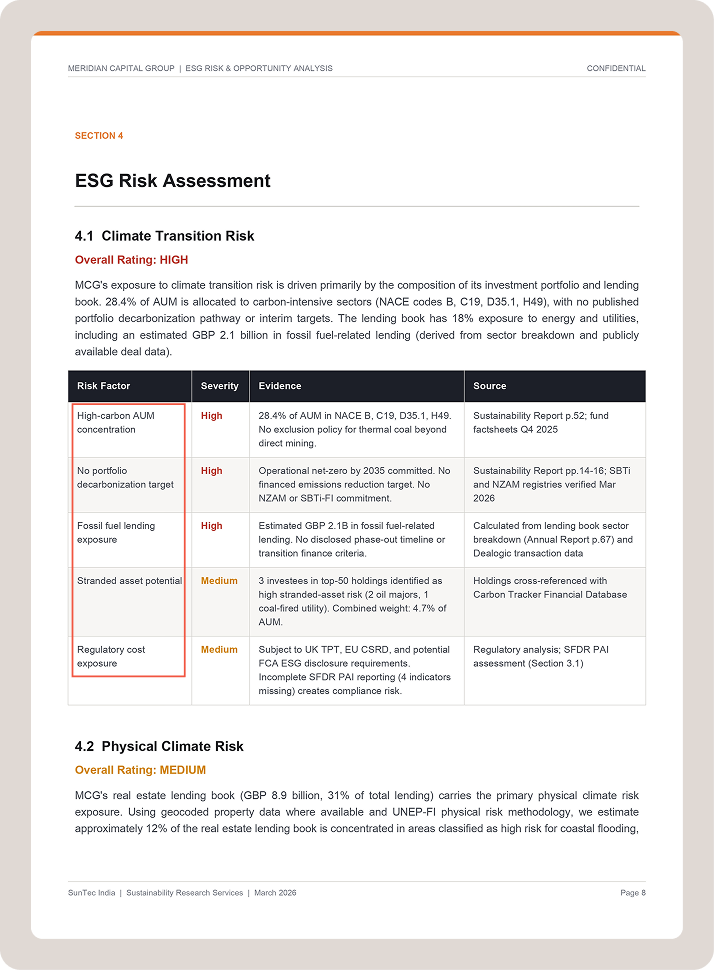
We identify and assess ESG-related risks and opportunities at the company level, delivering datasets that become a direct input for your proprietary scoring models and rating methodologies, ensuring reliable final scores. Our sustainability risk assessment services include both quantitative inputs (emissions trajectories, energy transition readiness, physical risk exposure data) and qualitative assessments (policy strength, target credibility, governance quality).

  • Climate Risk Assessment: Identifying and categorizing company-level physical, transition, and liability risks, including exposure to extreme weather, sea-level rise, policy shifts, stranded assets, and technology disruption.
  • Supply Chain Risk Profiling: Entity identification, location-based risk mapping, and industry risk categorization at the supplier level.
  • Controversy Screening: Screening and classifying company-level ESG controversies across environmental incidents, labor and human rights issues, governance failures, regulatory actions, litigation, and adverse media, with severity and recency clearly documented.
  • Exposure Metric Research: Measuring company exposure to material ESG risk factors through structured indicators such as carbon intensity, physical climate exposure, water stress, biodiversity sensitivity, and other sector-specific risk metrics.
  • ESG Due Diligence Data Support: Collecting and structuring the ESG performance data, regulatory exposure analysis, and gap identification that your team or client needs to conduct their due diligence.
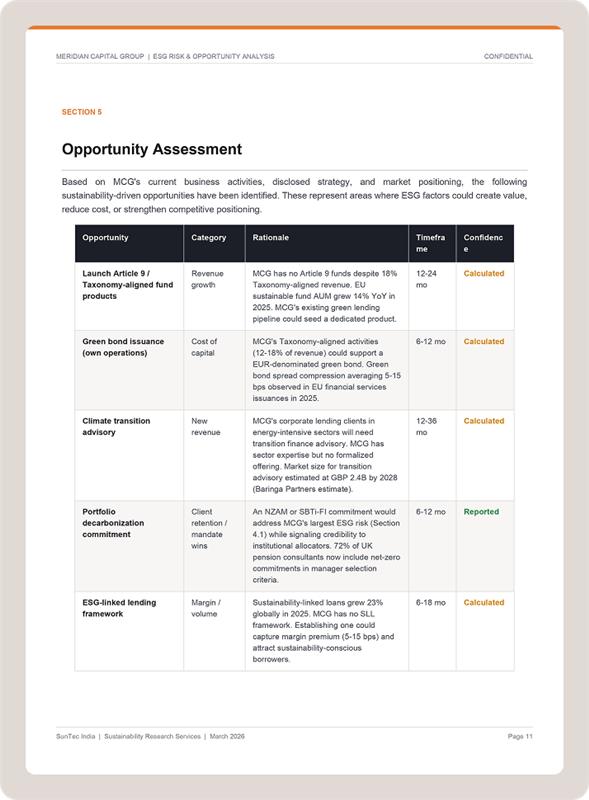
  • Opportunity Identification: Identifying where a company could benefit from sustainability-related market and regulatory shifts, including revenue from eligible green activities, clean energy transition potential, and access to new incentives.
INSIDE THE DELIVERABLE

Explore the Sample Sustainability Report

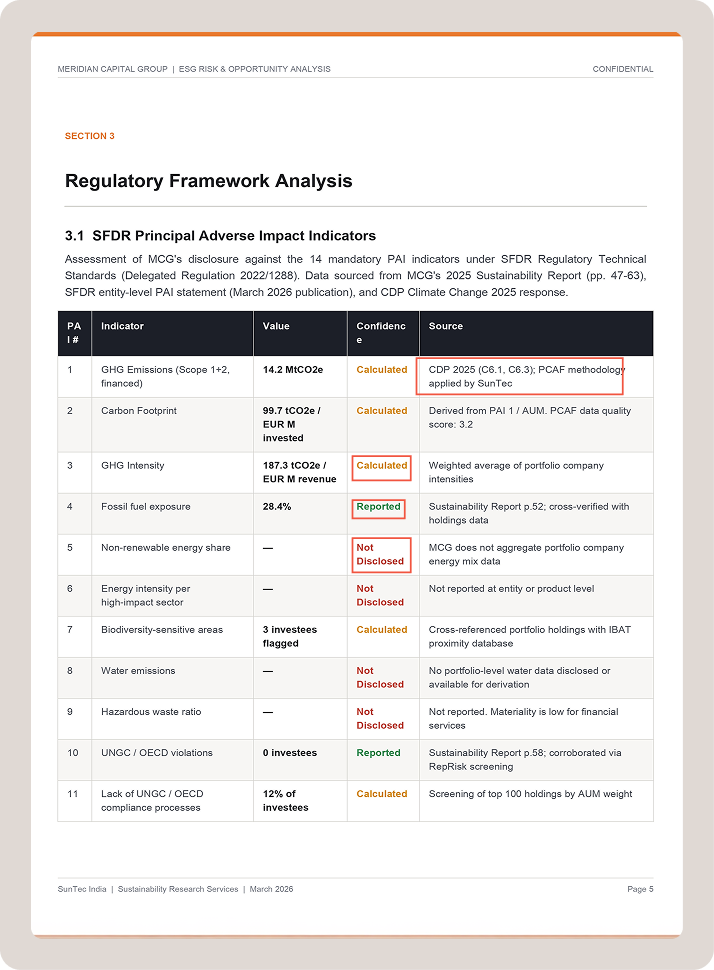
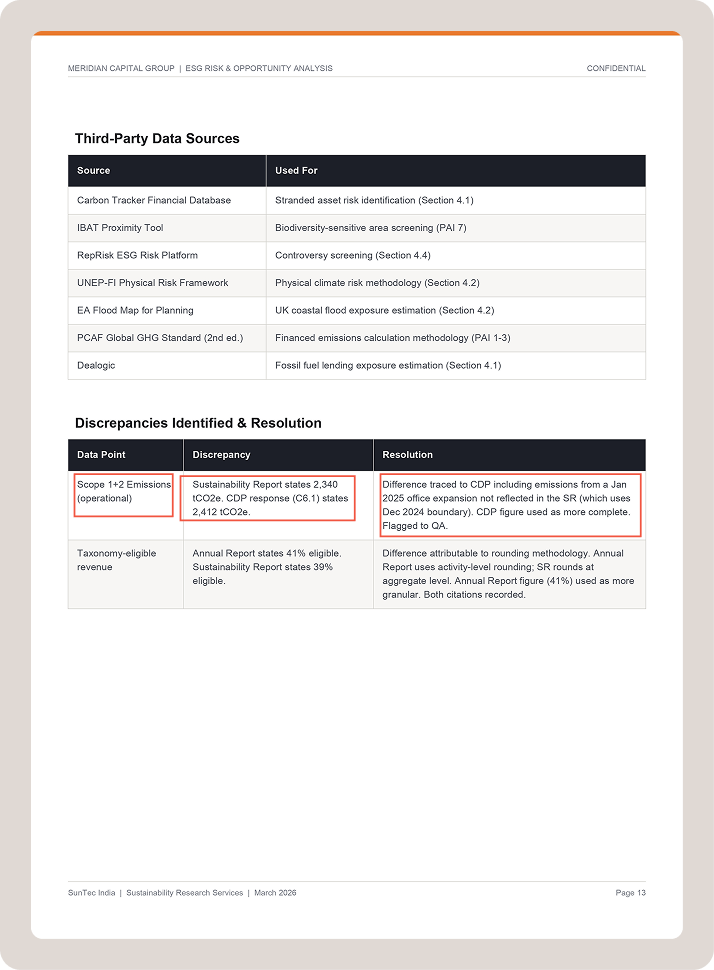
Each regulatory review, risk assessment, and opportunity analysis we deliver follows a consistent methodology: structured data, verifiable sources, and transparent, documented judgment. This sample report shows how our sustainability research services support ESG rating agencies in practice.

View the Sample Report

Framework Indicators with
Source-Level Traceability

When Sources Contradict,
We Document the Resolution

Risk Signals Structured
for Your Scoring Model

Opportunities Identified
with Evidence

SUSTAINABILITY RESEARCH SERVICES: PROCESS

How We Build Reliable, Audit-Ready Sustainability Datasets for ESG Rating Firms

Our process is built to produce decision-grade data at scale by combining AI-assisted data extraction, methodology-based calculation, and multi-step validation to produce structured company data with high traceability.

01

We study your proprietary indicators, scoring logic, data taxonomy, and quality standards to build an internal style guide. We also collect the frameworks, metrics, and companies you need covered.

02

For each company, we identify the primary sources relevant to your scope, such as regulatory filings, company disclosures, government databases, and credible local news sources where required.

03

The required data points are scraped directly from source documents, with manual data extraction where needed. When direct reporting is absent, we calculate derived metrics using recognized methodologies and flag them accordingly.

04

Every extracted data point is checked against available, authoritative sources. Where sources conflict, the discrepancy is documented for further analysis.

05

Domain specialists review the derived calculations and low-confidence data points and perform judgment-intensive tasks like sustainability risk analysis and framework alignment checks.

06

You receive a clean, audit-ready dataset in your preferred format, with page-level citations, confidence tiers, regulatory status, and risk and opportunity estimates clearly documented against each data point.

FRAMEWORK COVERAGE

Sustainability Regulation and Policy Analysis Services across the Frameworks that Matter to Your Methodology

Our analysts are trained on the technical requirements of each framework — the specific indicator definitions, calculation methodologies, and disclosure standards — required to judge how a company fares against the ESG regulations and mandates specific to its industry.

Security and Compliance

Your data security is our priority

ISO
Certified

HIPAA
compliance

GDPR

GDPR
adherence

Regular
security audits

Encrypted data
transmission

Secure
cloud storage

METRICS COVERAGE

Scalable Coverage across the ESG Metrics that Matter

Our sustainability research services enable you to track thousands of companies across over a hundred ESG metrics without having to scale your internal ESG data research team in parallel. Whether the metric requires extracting a reported disclosure, verifying it against a framework's technical definition, or calculating a derived risk score where reporting is absent, the research methodology stays consistent across your full coverage universe.

What You Get: Environmental data research and sustainability data collection of required metrics from reputed sources, normalized, framework-mapped (CSRD/ESRS, GRI, SASB), quality-checked by SMEs, and delivered audit-ready with traceability and metadata.

Metrics Covered Data Captured
Energy consumption & efficiency Total, direct, indirect, and renewable energy use, energy efficiency policies, and targets.
Carbon footprint & GHG emissions Scope 1, 2, 3 GHG emissions, reduction targets, and net-zero policies.
Waste management Hazardous and non-hazardous waste, recycling, radioactive waste, and reduction initiatives.
Air & water pollution Air pollutant emissions (NOx, SOx, VOCs, PM), and water discharge contaminants.
Water withdrawal & consumption Water withdrawal, consumption, discharge, recycling volumes, and efficiency policies.
Environmental policies Commitments to net zero, biodiversity, GHG reduction, waste, and supply chain sustainability.
Production & sales (cement, steel, clinker) Cement, clinker, steel, and cementitious production volumes, intensity ratios, and efficiency.
Assets under management (AUM) Financial institutions’ total AUM, fund categories, and ESG integration disclosures.
Monetary losses from natural catastrophes Financial losses and insurance payouts from climate and natural catastrophe events.

What You Get: Social data research, collection across the value chain, gathered from industry-standard, approved sources (discovered via thorough web research), standardized, deduplicated, and delivered with an auditable lineage.

Metrics Covered Data Captured
Employee diversity Gender representation, women in management, workforce diversity ratios, and DEI initiatives.
Working conditions & satisfaction Employee turnover, lost working days, workplace satisfaction levels, and labor practice disclosures.
Health & safety for employees Injury rates, fatalities, safety incidents, and occupational health & safety policies.
CSR data collection Corporate philanthropy, community engagement, employee volunteering, and broader social impact initiatives.
Social policies Policies on child labor, forced labor, whistleblower protection, and grievance redressal.
Society & human rights Union representation, human rights due diligence, and community impact initiatives.
Human rights & supplier ethics Supplier codes, ethical sourcing, contractors, and supply chain working conditions.
Diversity & inclusion Gender pay gap data, equal opportunity disclosures, diversity targets.
Product responsibility Product quality management systems, safety standards, and responsible lifecycle policies.
Customer experience Customer data privacy policies, consumer rights, and service quality commitments.

What You Get: Evidence-backed CSR data collection and ESG data management services from charters, policies, filings, attestations, and such sources, with reconciled contradictions, compliant with applicable ESG frameworks, and delivered with linked citations.

Metrics Covered Data Captured
Corporate information Company details, shareholder rights, voting mechanisms, and secretary roles.
CEO compensation ratio CEO pay vs. employee wages and performance-based compensation data.
Board structure & diversity Board composition, gender diversity, mix of skills, and leadership roles.
Board independence & executives Ratio of independent directors, separation of powers, executive vs. non-executive roles.
Board leadership profiles Director profiles, qualifications, compensation, and governance responsibilities.
Board committees Committee structures, meeting attendance, and oversight responsibilities.
Internal control systems Risk management frameworks, audit processes, and compliance systems.
Business ethics & code of conduct Anti-bribery, anti-corruption, political donations, and business ethics policies.
Financial Transparency & Reporting Passenger revenue details, operating profit margin, net premiums written, and capital expenditure disclosures.

CROSS-INDUSTRY DATA SUPPORT

Sustainability Research Services across Every Major Sector

The regulatory frameworks a company must comply with and the ESG risks it faces are both sector-dependent. For instance, an energy company's research profile is dominated by emissions reporting mandates, physical climate exposure, and stranded asset risk, while a consumer goods company may have minimal direct regulatory burden but carry significant supply chain and controversy risk that requires deeper sourcing. We scope both the regulatory framework analysis and the risk and opportunity assessment to the materiality profile of each sector — adjusting the sources we prioritize, the metrics we extract, and the risk factors we flag — while maintaining a single quality standard across every dataset.

  • Energy & Utilities
  • Oil & Gas
  • Chemicals
  • Finance & Banking
  • Real Estate
  • Mining & Metals
  • Manufacturing
  • Transportation & Logistics
  • Insurance
  • Technology
  • Telecommunications
  • Healthcare & Pharma
  • Retail & Consumer Goods
  • Food & Agriculture
  • Tourism & Hospitality

CLIENT SUCCESS STORIES

It's all about results.

Supporting the Market’s Leading ESG Rating Agencies with Reliable Data

Here’s how our research methodology performs under real-world conditions, timelines, and scale requirements.

ESG data research and management services

Environmental, social, and governance data collection, with cross-pillar verification, metric calculation, and multi-framework mapping.
8000+

Companies Covered

800,000+

Data Points Processed

100%

Source-Documented Data
Environmental Research Data Collection

Delivering audit-ready, source-documented datasets for a North American investment consulting firm's proprietary climate risk platform.

6000+

Companies
Covered

250k+

Environmental Data Points Processed

100%

Source-Documented
Data
  • Service Environmental Research Services ESG Research Services
  • Platform Client's Proprietary Climate Risk Assessment Platform
  • Industry Investment & Financial Consulting

View All

WHAT SETS US APART

ESG Sustainability Research Services Built on Two Decades of Data Expertise

We’ve spent 25+ years building the data infrastructure, quality systems, and delivery methodology that make this work possible at scale. Multilingual research teams, dedicated delivery units across time zones, and a quality framework refined across thousands of engagements — all of it is why our ESG data research services operate at the accuracy, speed, and coverage levels they do.

Gartner Logo

Featured by Gartner among Top Global Data Validation and Enrichment Vendors

Clutch Global Logo

Among the Top 10% Service Providers on Clutch

OA500 2025

Among the Top 500 Global Outsourcing Providers

Clutch Logo

Recognized as the Global Leader for Data Services

CONTACT US

Build ESG Ratings on a Defensible Data Foundation

Whether you need regulatory framework analysis, ESG risk assessment, or large-scale metric coverage, we deliver source-documented sustainability research that helps your team scale without compromising traceability, consistency, or audit readiness.

FAQ - Frequently Asked Questions

Sustainability Research Services

When a company falls under multiple jurisdictions — for example, a US-headquartered manufacturer with EU revenues — we use a ‘Double-Materiality Mapping’ approach. Our analysts identify the company’s "Home" jurisdiction requirements (e.g., CSRD in the EU) while simultaneously screening for local mandates in secondary operating regions (e.g., SEC requirements in the US). Where frameworks overlap or conflict on a specific metric (such as differing emissions boundary definitions), we document both positions, note the discrepancy, and flag which standard was applied for your scoring model. This way, your team has the data needed to decide how to reconcile jurisdictional differences.

When a company's disclosure addresses a requirement but falls short of full compliance — for instance, reporting Scope 1 and 2 emissions but omitting material Scope 3 categories required under ISSB S2 — our analysts document exactly what was disclosed, identify the specific gaps against the framework's technical criteria, and note whether the gap is a reporting omission or a substantive non-compliance. Each assessment is accompanied by the relevant excerpt and page-level citation so your team can review the judgment independently without re-reading the source filing.

When direct disclosures are absent, we pivot to ‘Sector-Based Proxy Modeling’ and ‘Asset-Level Analysis’. We identify the company’s physical locations and industry classification to estimate exposure using external datasets (e.g., IPCC climate scenarios or water stress maps). We then assess "Transition Readiness" by analyzing secondary indicators like R&D pivot towards green tech or CapEx trends. All such assessments are clearly tagged as "Modeled/Proxy Data" to maintain your audit trail.

We provide continuous event monitoring. By tracking intra-year disclosures—such as Form 8-K filings, RNS announcements, and regulatory enforcement databases—we ensure your ratings reflect real-time executive turnover, board reshuffles, and governance controversies as they happen, rather than waiting for the next annual cycle.

To maintain audit-readiness, we never blend reported data with estimates. Every data point is tagged with a reliability marker:

  • Tier 1: Direct disclosure from primary audited reports.
  • Tier 2: Derived data (calculated using reported underlying metrics).
  • Tier 3: Proxy/Modeled data (used when no disclosure exists).

This allows your rating engine to assign different weights based on the data's level of concreteness.

We assess materiality by looking at more than the event itself. Our review considers severity, recurrence, regulatory or legal involvement, operational or financial impact, relevance to the company’s sector and business model, and whether the issue points to a broader governance or risk-management weakness. Every classification is documented with the supporting evidence and the reasoning behind the severity rating, so your analysts can audit or override the judgment where needed.

We use AI tools selectively for tasks where they add real speed and consistency, such as parsing large PDF sustainability reports to locate specific disclosures or extracting structured data from tables in annual filings. We involve subject matter experts to interpret whether a company's climate target is credible, judge whether a disclosure meets a specific framework's requirements, or resolve contradictions between sources.

Whatever your platform or workflow requires — Excel, CSV, JSON, or direct API feed. Each delivery includes the structured data, source documentation with page-level citations, confidence tier tags, and an audit trail documenting any discrepancies and their resolutions. If you have a specific data schema or template, we map our output to it during onboarding.

The timeline for a pilot depends on factors such as the number of companies, the complexity of the metrics, and the quality of disclosures. You can get a more informed estimate of the timeline if you share your requirements with us at info@suntecindia.com.

Yes. Our teams can process non-English disclosures. We are also transparent about the added complexity of translation, and flag any potential interpretation risks in our analyst notes for further verification.

We offer flexible engagement models — one-time research projects, ongoing project-based engagements, or a dedicated research team embedded in your workflow — tailored to your coverage scope, metric requirements, and delivery timelines.

We move beyond simple "Yes/No" binary checks. Our analysts perform qualitative content analysis—evaluating the depth and binding nature of a policy (e.g., distinguishing between a vague commitment to human rights and a robust, board-oversight-backed policy). Every qualitative judgment is backed by a quoted excerpt and a page-level citation for your final review.

Our process is designed to adapt as standards change. We update framework scope during onboarding, revise internal research rules when disclosure requirements or taxonomies change, and train analysts on the technical definitions, calculation logic, and evidence thresholds relevant to each framework. Because our outputs are source-documented and methodology-aligned, your coverage can be refreshed without losing traceability or consistency as regulations evolve.