ESG Exposure Research Services
For Data Providers, Rating Agencies & Index Constructors
Get Your ESG Exposure Research ProposalFor Data Providers, Rating Agencies & Index Constructors
Get Your ESG Exposure Research ProposalWHO WE SERVE
We work with organisations across the ESG data value chain, from ESG data providers and risk rating agencies to ESG index constructors, providing reliable data on the exposure metrics their methodologies depend on.
Your platform's value to subscribers scales with coverage. But expanding coverage in-house means hiring and training analysts (a 6–12-month cycle per hire), while the backlog grows faster than your team can handle.
We run the research layer underneath your product:
Exposure data is a material input to your risk models, but it's where most rating processes face a bottleneck — particularly for mid-caps and emerging-market issuers whose disclosures are fragmented across languages, regulatory regimes, and reporting standards.
Our output is designed for your rating workflow:
An exclusion-based index is only as defensible as the exposure thresholds behind it. A 5% revenue exposure rule means nothing if a constituent company — or a regulator — can challenge how "revenue" was attributed.
Our data is built for that scrutiny.
The problem with licensing a pre-built ESG rating is that you inherit someone else's methodology, weightings, and black box. Building in-house solves that, but you still need reliable exposure data to feed the model.
We supply the input through comprehensive ESG exposure data research services:
Our exposure assessment process combines systematic web research, AI-assisted analysis, data scraping, and rigorous verification by subject-matter experts to deliver accurate, audit-defensible exposure metrics. A typical proof-of-concept involves business involvement screening for 50–100 companies across 3–5 exposure metrics, delivered in 2–3 weeks with a full audit trail. Additionally, our controversial activity exposure research methodology can scale from 500 to 50,000+ companies, and data delivery can be calibrated to your preferences (for one-time or recurring schedules).
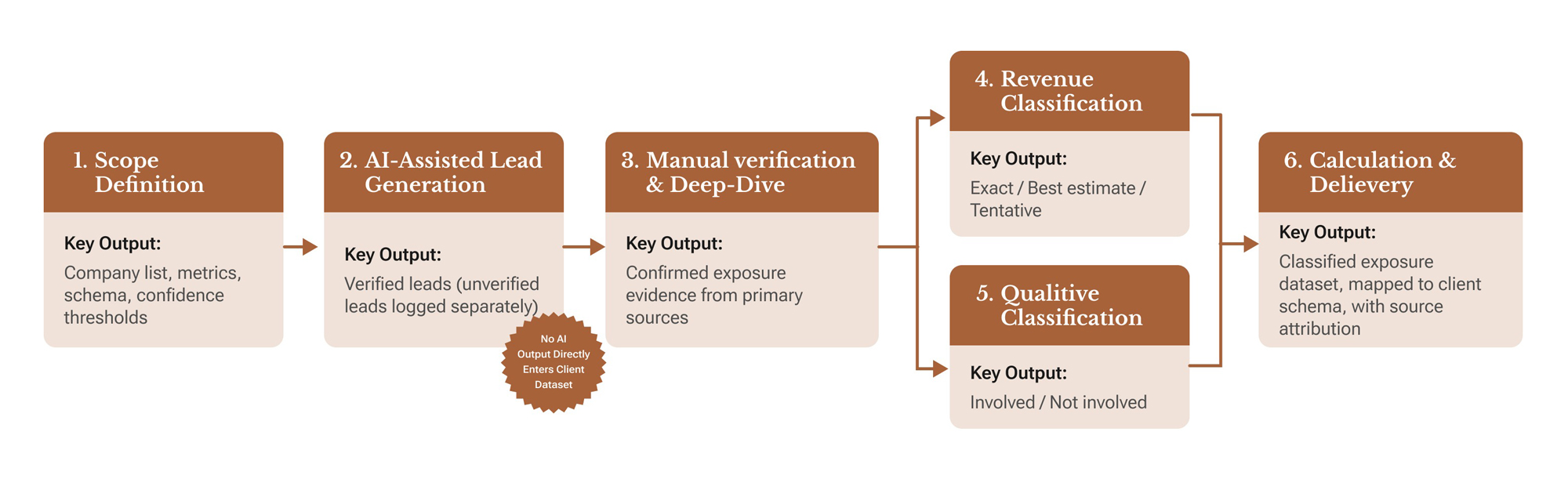
Provide the company names, industry classifications, and the specific exposure metric(s) you need assessed. We also require details on schema requirements, delivery format, confidence thresholds, and any methodology-specific parameters before research begins.
We systematically review company websites, annual reports, and sustainability disclosures. AI research platforms (ChatGPT, Perplexity, Claude, Gemini) are used to identify potential risk indicators and directional leads. Every AI lead passes a mandatory verification check before entering your dataset. Unverified leads are discarded and retained in the audit trail.
AI-flagged indicators are verified by an analyst against data sources such as regulatory filings, governance disclosures, investor presentations, and press releases. For complex corporate structures, we trace exposure through subsidiaries, joint ventures, and equity stakes.
Confirmed exposure is classified into four tiers: Exact Revenue (the company explicitly reports revenue figure), Best Estimate (exposure is derived from segment or product-level revenue proportions), Tentative Estimate (involvement is confirmed but revenue detail is insufficient; a conservative default is applied), and Qualitative Flag (applied to metrics not requiring revenue quantification, such as animal testing or GMO research, recorded as Involved or Not Involved).
For metrics that do not require revenue quantification — such as animal testing, stem cell research, or GMO involvement — exposure is determined based on whether the company's disclosures, filings, or operational evidence confirm involvement in the activity. Classification is recorded as a binary flag: Involved or Not Involved.
The final exposure percentage is calculated, and the dataset is delivered with full source attribution, confidence tier, direct/indirect involvement, and analyst notes. Data is delivered in your preferred format, mapped to your schema.
Not all exposure data carries the same precision. SunTec’s Four-Tier Exposure Confidence Framework is applied at the data-point level, so every figure in a company's dataset carries a clear signal of how much weight it can bear. This enables client teams to decide which data points to apply directly, which to flag for review, and which to treat as directional.
| Classification | Confidence | When Is It Applied | |
|---|---|---|---|
Exact Revenue |
Highest |
|
|
Best Estimate |
Moderate |
|
|
Tentative Estimate |
Indicative |
|
|
Qualitative Flag |
Disclosure-Based |
|
|
We research company involvement across the full range of ESG-sensitive activities. Each category is assessed for both direct (Production) and indirect (Participation) exposure and involvement.
01
02
03
04
05
SunTec India's exposure datasets serve as research inputs for the ratings your team creates under SFDR, EU Taxonomy, ISSB, CSRD, and other norms-based screening frameworks. We structure every dataset so the fields we deliver map directly to the indicators those frameworks require — without your team having to reinterpret or reformat the data before it can be used.
Principal Adverse Impact (PAI) indicators, including exposure to fossil fuels, controversial weapons, and activities in violation of UN Global Compact principles.
Revenue share from taxonomy-eligible and taxonomy-aligned economic activities, plus exposure to activities incompatible with a sustainable economy (e.g., fossil fuel expansion).
Entity-specific information about material sustainability-related risks and opportunities, including exposure to climate-related activities and transition risks.
Identification of companies involved in activities that violate UN Global Compact principles, OECD Guidelines, or ILO conventions.
Due diligence screening against OECD Guidelines covering supply chain exposure, controversial activity involvement, and operations in high-risk sectors or geographies.
Company involvement in sensitive activities across the environmental and social topic areas covered under ESRS E and ESRS S standards.
What Sets us Apart
With a specialized ESG exposure research service team, SunTec India acts as an extension of your operations. We've built our process around the failure points that most commonly compromise data quality: incomplete disclosures, opaque corporate structures, inconsistent revenue reporting, and the over-reliance on automated outputs without human verification.
Moreover, we understand that knowing that a data point exists is only part of the problem — your team also needs to know how much to trust it, whether the exposure is direct or indirect, and whether the dataset is structured to your methodology or someone else's. That is why we deliver exposure data that your team doesn't have to second-guess, re-verify, or explain away when a client asks how the number was derived.
Four-Tier Exposure Confidence Framework
So your team knows which data points to trust at 100% and which to flag for review
Production vs. Participation Distinction
For direct and indirect controversial activity exposure, customized to your exclusion methodology
Verified AI-Assisted Research
Every AI-generated lead is verified by an expert and used/discarded, with a complete audit trail

ISO
Certified
HIPAA
compliance

SOC 2
Certified

GDPR
adherence
Regular
security audits
Encrypted data
transmission
Secure
cloud storage
CONTACT US
Get the granular, analyst-verified data your risk models and indices demand. If you have a specific schema or a complex exclusion logic, our experienced analysts can also build a custom workflow for your team.
Start with a proof-of-concept. Send us a company list and key exposure metrics. We’ll deliver a complimentary sample dataset so you can evaluate our capability before committing.
FAQ - Frequently Asked Questions
ESG exposure research services identify and quantify a company’s financial involvement in specific activities, sectors, or assets that may be environmentally harmful, ethically sensitive, or misaligned with sustainability goals. They provide investors with a clear, revenue-based or qualitative measure of how deeply a company is embedded in sectors such as fossil fuels, weapons, tobacco, gambling, alcohol, adult entertainment, and other areas through controversial activity screening and ESG risk exposure data collection.
Exposure data is a foundational input across the ESG data value chain. Data providers need it to power their screening platforms. Risk rating agencies use it as a material input to scoring models. Index constructors rely on it to set defensible exclusion thresholds. In each case, the quality of the upstream research directly affects the credibility of the downstream product. On the other hand, inaccurate or incomplete exposure data creates rebalancing risk, client disputes, and regulatory scrutiny.
We are not a competitor to those vendors — we're a research layer that often feeds into them. MSCI, Sustainalytics, Bloomberg, S&P Global, and LSEG sell licensed access to pre-built ESG databases. Their product is a database with their proprietary methodology, coverage universe, and refresh schedule. That's the right fit for asset managers who want ESG data as a feed, not a research operation. SunTec India operates differently. We're a custom research layer for controversial activity exposure screening. You bring the company list, the metric definitions, and the schema. We research and classify the exposure data fresh, to your specification, delivered only to you. Our clients include ESG data providers, rating platforms, and index constructors who use our output to expand their own coverage — which is why we describe ourselves as a back-office research layer, not a data product.
Three reasons, in order of how often they come up in our engagements.
Against all three, the case for outsourcing ESG exposure data research services is simple: domain knowledge, quality control, and data exclusivity. With SunTec India, that benefit is compounded with our Proprietary Four-Tier Exposure Confidence Framework and full source attribution.
Not in the regular sense. Exposure metrics data vendors sell access to a pre-existing database. Our model is different—we conduct bespoke research tailored to your company list, metric definitions, and delivery specifications. Unlike regular ESG exposure data providers, data is collected fresh for each engagement at SunTec India, structured to your schema, and delivered exclusively to your team.
Our core focus is revenue-based exposure data — quantifying what percentage of a company's total revenue is derived from sensitive or controversial activities — and qualitative exposure data — recording involvement in sensitive domains like animal testing, based on company disclosures. This falls under the broader category of activity-based ESG data, where the goal is to identify and measure controversial product involvement at the company level. In addition to company-level data collection, we also cover ESG disclosure data, sector exposure data, geographic exposure data, and environmental, social, and governance data, collected as needed.
Specifically, our ESG research services support:
No. Our ESG exposure data collection service is focused on identifying exposure and measuring the percentage of a company’s total revenue derived from specific activities. However, we do not assess management quality, operational efficiency, or ESG practices within those sectors. For example, a coal mining company earning 70% of its revenue from coal is flagged with 70% exposure, regardless of whether it is the best-managed or poorest-managed operator in its industry. Similarly, a company is flagged for animal testing because it performs the activity, not based on its testing standards.