
For CTOs, VPs, directors, CEOs, and other tech leaders, choosing a web development approach is ultimately a trade-off between speed in the short term and capital efficiency in the long run. Website builders and low-code/no-code (LC/NC) platforms now account for roughly 75% of new website deployments among small businesses, largely because they minimize upfront cost and reduce time to launch.
However, its adoption, particularly where scalability matters, tells a different story. As websites become more tightly coupled with core business operations, enterprises and tech-driven startups are prioritizing more architectural control, performance tuning, and AI-readiness capabilities that LC/NC tools were not designed to optimize. This demand is driving rapid growth in the custom web development market, which is projected to reach $87.75 billion by 2026, growing at a CAGR of 8.87%.
This divergence sets the stage for a critical decision: should you rely on a website builder optimized for convenience, or invest in a custom-built web solution engineered for scalability and performance? While website builders lower the barrier to entry, they often struggle to meet the sub-3-second latency benchmark that modern B2B users expect. Custom development, by contrast, can deliver those performance gains but introduces new considerations around where to find the best website developers.
In the sections ahead, we will break down the pros and cons of website builders vs. hiring web developers for custom solutions across performance, scalability, security, and user experience. For stakeholders responsible for digital infrastructure decisions, this comparison will clarify which approach aligns best with your organization’s needs.
Table of Contents
- Website Builder vs. Web Developer
- Understanding Website Builders in Detail
- Understanding the Role of Web Developers in Building Scalable Solutions
- How to Choose between a Website Builder and Hiring Web Developers?
- What is Hybrid Web Development and Why Tech Leaders Should Consider this?
- Closing Thoughts
- Frequently Asked Questions (FAQs)
- Which option is more cost-effective for a small business, a website builder or hiring web developers?
- How long does it take to launch a website using a website builder vs web developer?
- When should I consider hiring web developers instead of using a website builder?
- Can I switch from a website builder to a custom-built site later on?
- What are the potential risks of relying on a website builder for my business website?
- What are the best places to hire web developers?
- What are some of the best website builders available?
- What is a website builder vs. WordPress?
A Quick Rundown: Website Builder vs. Web Developer
Before diving into the details, here is a quick breakdown of using a website builder and hiring professional developers, which will help you weigh the pros and cons of each.
| Factors | Website Builders | Hiring Web Developers |
|---|---|---|
| Time-to-Market | Quick deployment within hours or days | Duration depends on project complexity |
| Customization | Limited customization | Fully customizable |
| Scalability | It can become cumbersome with growth | Highly scalable |
| Performance | Slow due to heavy templates and unoptimized code | Optimized for performance and meeting latency benchmarks |
| SEO and Visibility | Basic SEO capabilities | SEO best practices integrated under your guidance |
| Security | It relies on the platform’s security measures | Custom security tailored to specific needs |
| Third-Party Integration | Basic integrations | Seamless integration with enterprise systems |
Understanding Website Builders in Detail
You must have heard the names of Wix, Squarespace, and Shopify website builder that help non-technical users create websites easily with minimal coding knowledge. These tools provide pre-designed templates and drag-and-drop functionality to launch professional-looking websites without a development team.
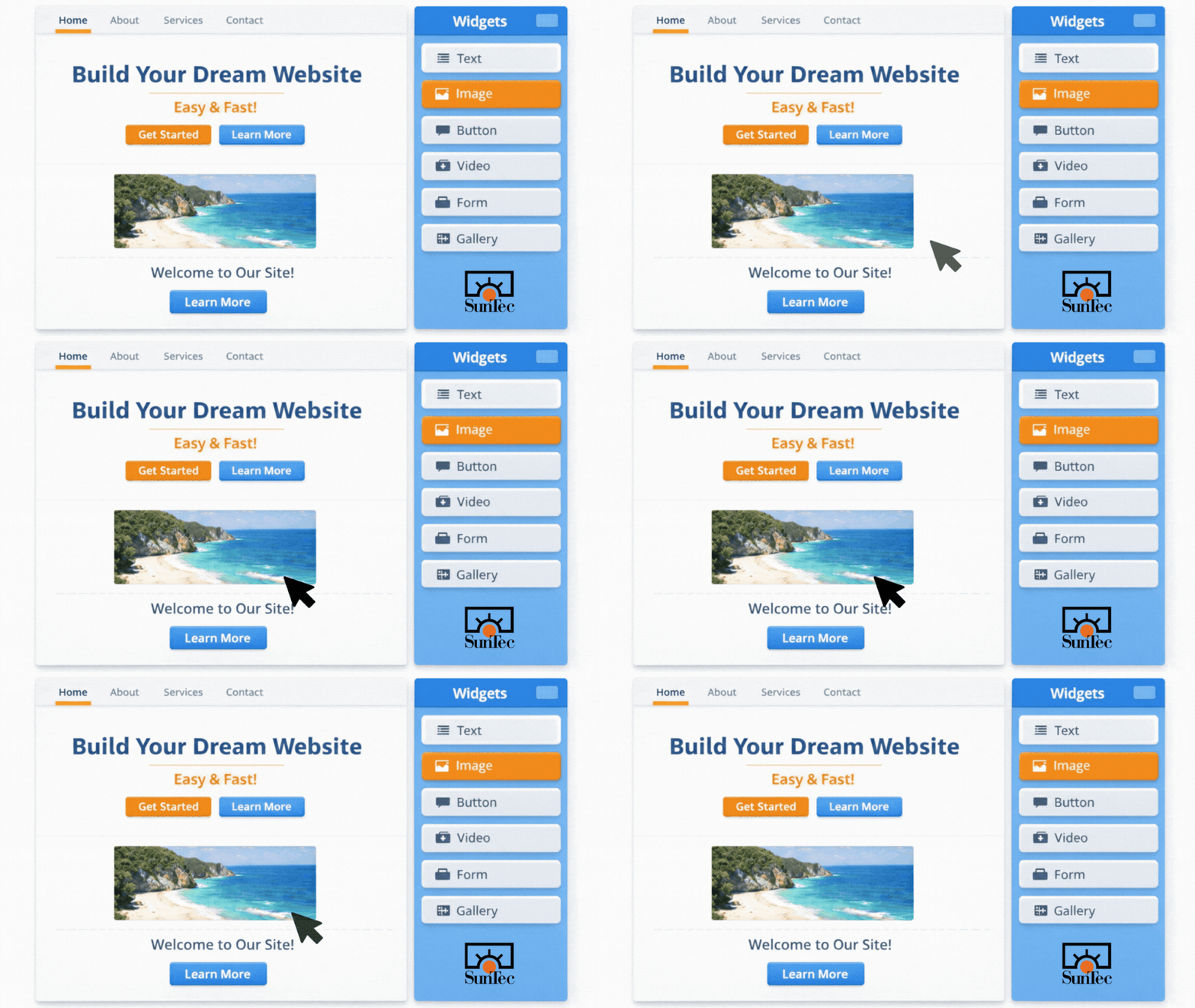
Ideal use cases for website builders include personal blogs, small businesses, and low-budget projects. However, as businesses grow, the limitations of these platforms can become more apparent.
When to Use Website Builders?
When speed-to-market is your primary KPI, certain scenarios demand a more agile approach. See the scenarios where leveraging a website builder is the right choice.
1. Quick Deployment
For time-sensitive campaigns or product promotions, a website builder is the ideal choice for deploying assets like landing pages or event sites. This approach provides speed-to-market within a very short window.
2. Low-Cost Solutions
For startups or small businesses with limited budgets, website builders offer a cost-effective way to establish an online presence.
3. Non-Technical Teams
If your team lacks the technical skill set for web development, these platforms allow the marketing team (or other teams with limited tech knowledge) to maintain and update the site. For example, using Squarespace to update blog content or Shopify for product listings without needing developer assistance.
4. Basic Websites
This is perfect for businesses that need a simple website with minimal animation and customization, or for personal projects such as portfolios or blogs.
5. Short-Term Projects
If your goal is to launch a temporary site for a campaign or event, website builders offer quick solutions. For instance, a CTO managing a marketing initiative might use an eCommerce website builder to create a temporary eCommerce store or a microsite with minimal resources.
Key Considerations for Tech Leaders When Choosing Website Builders
Consider the following factors to evaluate the trade-offs between speed and long-term maintainability.
1. Architectural Differentiation
Relying on ubiquitous templates creates a “sea of sameness,” forcing your brand into rigid structures and overused UI components shared by millions. This lack of architectural uniqueness caps your UX innovation and stifles brand differentiation.
2. Technical Debt
Website builders introduce technical debt through Bloated Codebases, generating high volumes of redundant boilerplate and “hidden” background scripts that degrade Core Web Vitals. These constraints often lead to legacy modernization initiatives or migration to more robust frameworks such as Next.js, Node.js, Laravel, or Django.
3. Security and Compliance
For enterprises handling sensitive data or requiring strict regulatory compliance, such as GDPR, CCPA, SOC 2, or industry-specific regulations like HIPAA, CMS, or PCI-DSS, these website-building platforms fall short. They provide basic security but lack the capability to implement advanced measures like custom SSL or encryption.
4. Limited Support and Vendor Lock-In
These platforms often provide limited options for urgent issues. Additionally, the risk of vendor lock-in grows as your reliance on these platforms increases. For instance, when Google shut down its own low-code platform, “App Maker,” in 2019, many companies that had built custom internal tools on it were forced to scramble and migrate their applications to new platforms, causing major disruptions.
5. Future Integrations
As your business needs become more complex, website builders often lack the ability to integrate with CRM, ERP, and other enterprise systems. This limitation may prompt businesses to reassess their infrastructure.
6. Limited Customization
Website building platforms are restrictive in terms of back-end control. They limit the ability to integrate third-party APIs, custom authentication systems, caching, query management, security, and compliance configurations. All of these add up and make them less suitable for businesses with unique needs or complex functionalities.
7. SEO and Control Over Code
Closed ecosystems often restrict your ability to implement advanced technical SEO, such as complex schema markup and server-level performance optimizations. By imposing rigid URL structures and limiting deep HTML accessibility, these platforms often prevent your site from achieving its full organic visibility.

Understanding the Role of Web Developers in Building Scalable Solutions
The decision of hiring a web developer for most of the tech leaders is driven by the ability to scale without hitting the “template ceiling”. As enterprise needs become more complex, it becomes nearly impossible to rely on a templatized website. Hence, a shift toward augmented web development professionals is observed.
The market for IT staff augmentation services is growing at a 13.2% CAGR and is expected to reach USD 857 billion by 2032. It clearly indicates that organizations are increasingly relying on external technical partners to bridge the skill gap.
Ideal Scenarios when Hiring Web Developers Make Sense

1. Custom Features and Functionality
If you need advanced features and functionality, such as Custom Post Types (CPTs), dynamic content, 24/7 AI-powered chatbots, interactive animations, and a Headless CMS, etc., hiring web developers is essential. Beyond basic CRUD operations, they implement WebXR frameworks for AR/VR-powered micro-interactions and integrate Vector Databases to power RAG-based AI Agents.
2. AI-Enabled Websites
AI is impacting every industry, even web development. By leveraging AI, you can develop and integrate features like personalized recommendations, semantic search, multilingual support, AI-powered chatbots, and dynamic pricing (for an eCommerce store) that website builders are not designed to offer.
3. Scalability
Hard-coded, templatized websites offer limited architectural sovereignty, often accumulating technical debt and introducing scalability issues in the future. But web developers can help you design your scalable website architecture to address key infrastructure challenges such as database congestion, server resource exhaustion, caching, system downtime, complex transactions, and increasing data volumes. They also leverage cloud-native platforms such as AWS, Google Cloud, or Azure to build architectures that can auto-scale based on load.
4. Third-Party Integrations
As your business grows, third-party and API integration becomes essential for establishing a connected ecosystem. Custom web development allows you to move beyond surface-level plugins, establishing deep integrations with business systems, proprietary AI models, and cloud services to enhance functionality and streamline operations without requiring a rebuild.
5. Security and Regulatory Compliance
While LCNC platforms provide black-box security, custom website engineering positions you for a Hardened Security Posture. By hiring web developers, you can implement strict, proprietary AES-256 encryption layers, granular OAuth 2.0 scopes, and complex RBAC or ABAC hierarchies.
6. Performance Optimization
Website builders can help you launch quickly, but they can also become a liability when you start scaling or enhancing features. The generic ‘one-size-fits-all’ scripts used by these platforms often result in ‘Plugin Soup.’
Contrarily, hiring web developers for Day 2 operations to help you optimize performance beyond the launch. They can strip away this unnecessary bloat, prioritizing exactly what a customer needs to see first and ensuring the site feels instantaneous. Over the long term, they can also eliminate technical debt by ensuring your code remains clean and adaptable, even as new features are included—something that website builders cannot support you with.

Pros and Cons of Hiring Web Developers [An Honest Take]
| Pros of Hiring Web Developers | Cons of Hiring Web Developers |
|---|---|
| Full control over design and functionality | Higher upfront costs |
| You get scalable websites | Longer time-to-market |
| Ability to implement complex features | Dependency on developers |
| Tailored security protocols and compliance with industry-specific regulations | Project management overhead |
| Sustainable option for long-term success. | Risk of delays due to unforeseen technical challenges or scope changes |
How to Choose between a Website Builder and Hiring Web Developers?
1. Understand the Purpose of Website
- If your project is a landing page or a small business website that doesn’t require much customization, a website builder is often the best solution.
- For projects like custom e-commerce websites, enterprise portals, or platforms that require advanced functionalities, it’s better to hire a web developer.
2. Consider your Budget
- If your business has a limited budget and the website doesn’t require significant customization, a website builder offers an affordable way to create a functional site.
- While the upfront costs of hiring web developers are high, the solution is scalable and offers greater control in the long term.
3. Evaluate the Timeline
- If faster time-to-market is your priority, build your website with one of the best website builders and launch in hours or days.
- If you have the time to invest in a custom solution, web developers will take longer but provide a far more flexible and future-proof website.
4. Understand your Growth Plans
- Building basic websites with a website building platform for short-term projects is a practical option.
- If you are focused on long-term growth, scalability, or need complex integrations, hiring web developers is a better option.
What is Hybrid Web Development and Why Tech Leaders Should Consider this?
Hybrid web development enables businesses to leverage LC/NC platforms for rapid launches, while also setting the stage for seamless scalability and custom feature development by hiring seasoned web developers. It is the optimal solution for organizations that need to balance speed-to-market with the demand for ongoing customization.
When to Use Hybrid Approach to Web Development?
This approach is particularly effective for organizations deploying phased web development strategies. Initially, a website builder is used to build a basic site or an MVP (Minimum Viable Product).
Once a business moves beyond idea validation and enters an MVP scaling phase, the product must evolve to support growth without friction. At this point, web developers can transform the platform from a static template into a modular ecosystem that readily integrates advanced technologies. They can rapidly build and test sophisticated new tools, such as voice-activated shopping or AI-driven inventory forecasting, without disrupting the existing function.
To handle increasing traffic and complexity, they can also implement event-driven microservices. This deeper level of control extends to the infrastructure itself, where database sharding, API orchestration, and Infrastructure as Code (IaC) enable seamless horizontal, predictable scaling.
Benefits of Choosing Hybrid Web Development
1. Speed and Agility
You can rapidly deploy basic websites or MVPs with website builders. As your platform matures, developers help you evolve seamlessly as your business needs grow.
2. Scalability
When there is a need to scale, you can leverage the expertise of a web developer to scale dynamically with cloud-native platforms like AWS, Google Cloud, and Azure.
3. Cost-Efficiency
By starting with a basic website, you can minimize initial costs and when needed, leverage custom solutions to enhance functionality by mitigating the recurring costs and limitations of website builders.
Closing Thoughts
The trade-off between low-code/no-code (LCNC) platforms and a custom-engineered web solution is a critical decision for any CTO. While site builders offer a rapid Time-to-Market (TTM), they often introduce significant vendor lock-in and lack the extensibility required for enterprise-grade performance.
To ensure a future-proof infrastructure that supports deep third-party integrations and high concurrency, investing in skilled web developers is vital. This approach minimizes technical debt and provides the 100% control over your source code.
For leaders, the decision depends on both saving time and the thoughtful use of the budget provided. If you are ready to create a future-proof web platform that can grow with your business, hire a team of dedicated web development professionals to take your digital infrastructure to the next level.
Frequently Asked Questions (FAQs)
If you want a low-cost, low-complexity solution, a website builder is an affordable choice.
A website builder allows for a rapid launch in a few days. On the other hand, hiring web developers takes longer due to the recruitment duration and custom development process. The total development time of a custom website, however, depends on its complexity.
If your website requires complex integrations, advanced custom features, or scalability that templatized websites cannot offer, you should hire web developers. Website builders are suitable for basic websites such as portfolios, landing pages, and single-page websites for any time-sensitive project, with minimal customization.
Yes, it is possible. However, migrating from a website builder to a custom solution can be challenging and costly. Web developers can build your website with future-proof architecture from the beginning, ensuring that you avoid the need for costly migrations and complex overhauls down the road.
While website-building platforms offer quick deployment and low costs, they also carry risks such as limited customization, scalability issues, and vendor lock-in. As your business grows, these platforms can accumulate technical debt, requiring costly migrations or workarounds.
Top sources for hiring skilled web development professionals include specialized web development companies like SunTec India and TechnoScore. You also have the option to hire from freelance marketplaces like Toptal and Upwork. Many businesses also explore developer-centric communities such as GitHub or Stack Overflow to find specialized technical talent.
Here are some of the best website builders for different needs:
- Wix is ideal for customizable websites with drag-and-drop features.
- Squarespace is best for visually appealing designs.
- Shopify is perfect for e-commerce businesses.
- WordPress is a great option for content-heavy sites.
- Weebly is for user-friendly and budget-friendly websites.
A website builder is a platform with visual design tools and pre‑built templates, for example, Wix and Squarespace. WordPress is a content management system (CMS) that can be used as a simple builder with themes/plugins or extended into a fully custom platform with developer support.