The prototyping landscape has undergone a fundamental transformation.
While traditional prototyping methods and conservative design thinking have served organizations well for decades, they have begun to consume significant resources and development time. On average, a conventional design process consumes 8-20 weeks (and more if the use case is complex), resulting in a painfully slow process.
Then came AI-powered prototyping (artificial intelligence), the technology that delivers 70% faster design cycles at a fraction of the cost. This development paved the way for several debates and boardroom discussions around traditional vs. AI-powered prototyping.
Although AI accelerated the process, design experts were still required to validate the AI-generated prototypes, making sure they aligned with user expectations, business objectives, and the design vision.
The real question became: How to bridge this gap in legacy design thinking and modern AI-powered prototyping?
This isn’t simply a choice between old and new methodologies, but one that structurally reshapes how organizations approach design thinking, iteration cycles, and stakeholder validation. Through this blog, we will examine when traditional methods remain superior, where AI-powered prototyping approaches excel, and, critically, when dedicated prototyping experts become essential for achieving a competitive advantage.
Table of Contents
- Understanding Traditional Prototyping & Design Thinking
- How Has Traditional Prototyping & Design Thinking Evolved?
- The Impact of AI on Prototype Development & Overall Design Thinking
- What Does an AI Prototyping Process Look Like?
- A Side-by-Side Comparison of Traditional vs. AI-Powered Prototyping
- Integrating AI in Prototyping: Key Challenges and Considerations
- Need Help Fixing your Training Data?
- Future Outlook: The Evolution of Prototyping with AI
Understanding Traditional Prototyping & Design Thinking
Traditional prototyping followed the established design thinking methodology:
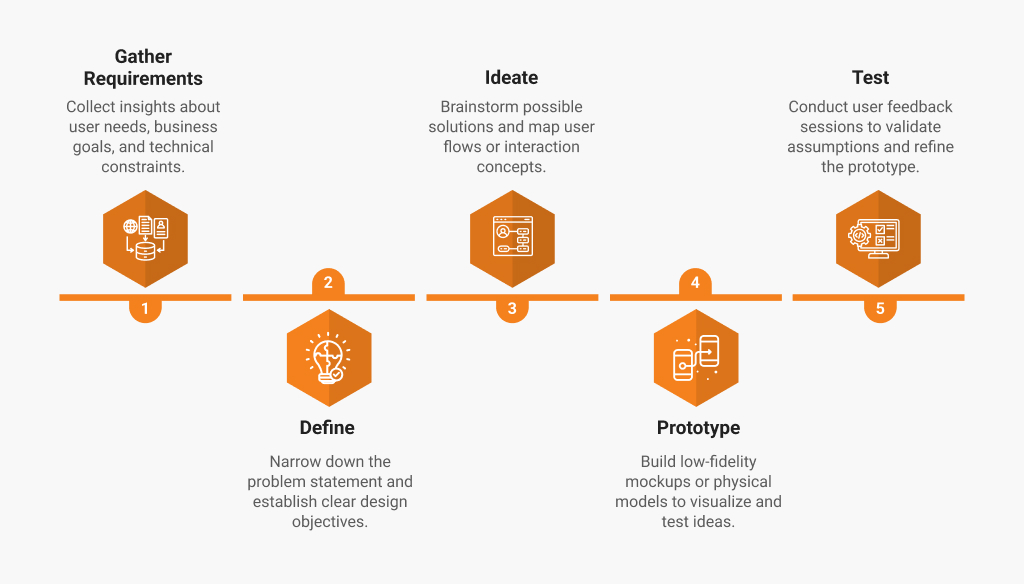
Evidently, traditional prototyping was characterized by:
- Manual Effort: Relied on UI/UX designers and dedicated prototyping experts for hire.
- Linear Design Process: Each stage was followed sequentially, making it harder to pivot quickly.
- Time-Intensive: Iterations required lengthy feedback loops and repeated manual updates.
- Resource Heavy: Dependent on cross-functional collaboration, with limited automation.
- Limited Scalability: Testing multiple variations was costly and slowed down innovation.
How Has Traditional Prototyping & Design Thinking Evolved?
Over the past decade, prototyping and design thinking methodologies have undergone a significant shift.
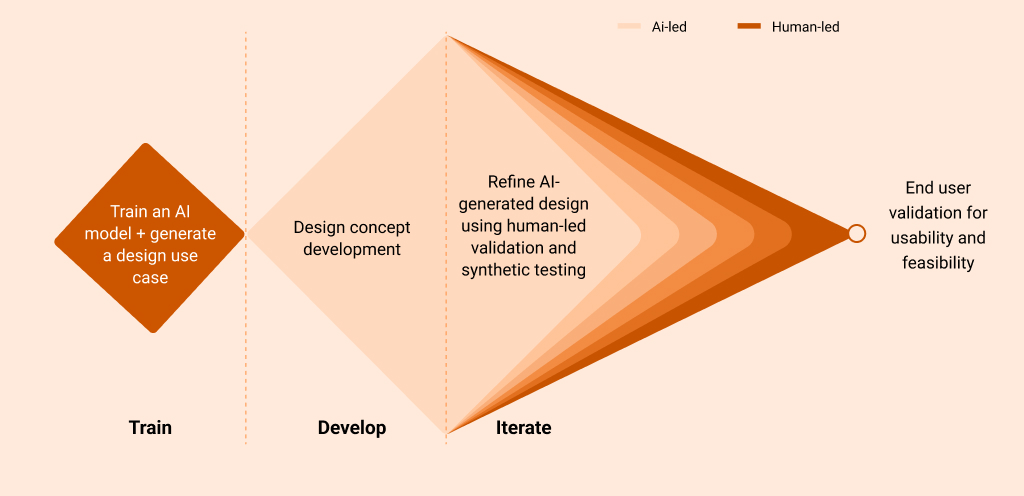
The above traditional vs. AI-powered prototyping shift is achieved through:
- A Shift from Linear to Iterative Prototyping Processes: Traditional prototypes followed a step-by-step path. Modern prototyping encourages shorter cycles with early integration of feedback.
- Transition from Paper to Digital Prototyping Tools: Where manual prototyping relied on sketches and static wireframes, today’s teams leverage digital prototyping platforms like Figma, Balsamiq, InVision, and Sketch for faster, interactive models.
- Taking User-Centered Testing as Core: Usability testing has moved from a late-stage activity to a continuous process.
- Integrating with Agile & Lean: Modern prototyping aligns with agile and lean principles, favoring incremental validation and faster experimentation.
In short, while traditional prototyping set the foundation, today’s design thinking methods are faster, iterative, and more user-centric.
However, with AI integration, even these changes are drastically altered.
The Impact of AI on Prototype Development & Overall Design Thinking
The emergence of AI in the prototyping process has introduced a major shift in how teams design, test, and validate products.
How AI is Changing Prototype Development?
AI-powered prototyping tools have brought the following changes to a conventional design process:
- AI prototyping tools can generate prototype drafts, transform 2D sketches into 3D clickable interfaces, or auto-complete design components, drastically reducing time to first usable prototype.
- AI-powered prototyping tools can handle repetitive tasks, such as reviewing style consistency, generating variant designs, and filling in grids. This frees up designers to focus more on high-level UX.
- AI in prototyping also helps with analytical insights. The tools gather and analyze usage data, user flows, usability metrics, heatmaps, etc., generating insights in real-time. AI prototyping tools can also surface patterns that designers may overlook.
- AI-powered prototyping enables predictive modeling, where the tool can suggest which design elements are likely to succeed.
- AI in the prototyping process lets you spin up multiple prototypes tailored to different user personas, A/B test variations, and generate personalized UIs.
- More advanced AI-powered prototyping tools can create realistic simulations and virtual walkthroughs, even generating likely edge cases.
What Does an AI Prototyping Process Look Like?
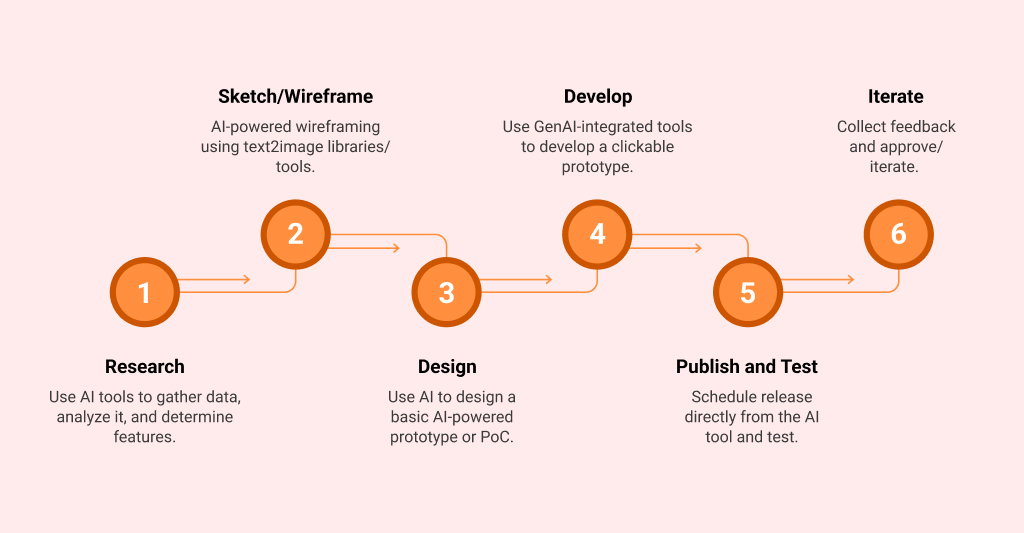
A Side-by-Side Comparison of Traditional vs. AI-Powered Prototyping
| Aspect | Traditional Prototyping (Manual) | AI-Powered Prototyping |
|---|---|---|
| Process Flow | Sequential: gather → define → ideate → prototype → test. Iterations are often delayed by manual revisions. | Non-linear: AI accelerates ideation, wireframing, and testing simultaneously, enabling continuous iteration. |
| Speed & Efficiency | Typically 2–4 weeks from sketches to high-fidelity prototypes (Cieden, 2025). Manual updates extend timelines. | AI-powered prototyping tools can reduce this to hours or days, cutting design time in the early stages by up to 70-80%. |
| Tools & Methods | Paper sketches, static wireframes, Adobe XD, Sketch. Limited automation. | AI prototyping tools like Uizard, Balsamiq, and Galileo AI can turn hand-drawn sketches into interactive screens in under 10 minutes. |
| Iteration Cycles | Lengthy feedback loops; only a few variations tested due to cost and time constraints. | Perplexity AI reported reducing iteration cycles from 3–4 days to ~1 hour by utilizing AI tools for interface changes. |
| User Testing | In-person sessions with limited participants are costly and time-consuming, as scenario testing is a labor-intensive process. | AI in prototyping simulates diverse user flows, predicts adoption risks, and runs stress tests at scale. |
| Personalization | Hard & time-consuming to prototype for multiple personas; most teams test “average” use cases. | AI in prototyping generates hyper-personalized prototypes tailored to personas, boosting relevance and engagement. |
| Resource Dependency | Requires heavy involvement of designers/developers at each step; bottlenecks are common. | Automates repetitive work (layout, alignment, styling). Designers spend more time on strategic creativity. |
| Scalability | Cost and time grow exponentially when testing multiple variations. | AI-powered prototyping scales effortlessly, spinning up dozens of design variations without proportional effort. |
| Data Utilization | Relies on qualitative feedback and intuition; insights are limited. | Data-driven: AI integrates behavioral data, heatmaps, and predictive analytics into design refinements. |
| Overall Outcome | Reliable but time-intensive and rigid. Slows experimentation. | Faster, adaptive, and predictive. Encourages experimentation, reduces risks, and accelerates the go-live process. |
Integrating AI in Prototyping: Key Challenges and Considerations
While the benefits of AI in prototyping are clear: speed, scalability, and data-backed insights, there are some challenges and considerations to factor in.
Securing Stakeholder Buy-In
Gaining leadership trust and securing their buy-in is one of the most prominent challenges of AI in prototyping. Despite the promised efficiency gains, many leaders remain skeptical about the quality and accuracy of AI-generated outputs. In fact, a report by the Business Application Research Center (BARC) reveals that over 42% of organizations do not trust their AI/ML models to generate reliable outcomes.
Eliminating bias
Even the most advanced AI prototyping tools are only as good as the data they’re trained on. If training datasets contain cultural, gender, or accessibility biases, those biases may be reflected in the prototypes that AI generates. For instance, if the training dataset is heavy on creating UIs with right-to-left text flows, it may unintentionally overlook the challenges faced by other users and undermine usability.

Ethical considerations
The rise of AI-powered prototyping raises critical ethical questions, as in every traditional vs. AI prototyping debate, accountability is blurred. If AI is generating most of the prototypes, where does human creativity fit in? More importantly, who is accountable if an AI-generated prototype excludes certain user groups or fails accessibility standards?
Job implications
The integration of AI in the prototyping process is also reshaping the role of creative designers. Instead of spending hours on manual iterations, designers now act more as strategists, curators, and reviewers of AI-generated outputs. While this elevates their role, it also fuels anxiety about job security. Will AI replace human designers?
Future Outlook: The Evolution of Prototyping with AI
While concerns around stakeholder buy-in, bias, ethics, and job implications are understandable, they don’t outweigh the transformative potential of AI in the prototyping process.
- Stakeholder confidence can be built by clearly defining where AI fits in the prototyping process and validating its outputs with human reviews.
- AI bias can be mitigated by diversifying the training dataset and regularly auditing the AI prototyping tool’s performance.
- Lastly, positioning AI prototyping tools as assistants while leaving the creative ownership of vision, empathy, and accountability on human designers will also help organizations address job-related concerns.
At SunTec, we recognize that the world is rapidly shifting toward AI-powered workflows, and prototyping is no exception. Businesses are under pressure to move faster, test more, and deliver user-centered experiences at scale. However, we also understand that tools alone don’t deliver meaningful outcomes. That’s why our prototyping services the efficiency of AI-powered prototyping tools with the creative vision and business context expertise of our UI/UX design experts.
Our experts utilize AI to accelerate initial wireframing, automate routine iterations, and explore variations, but the final prototypes are always guided by human insight, empathy, and a deep understanding of each client’s unique business use case. Contact us at info@suntecindia.com to collaborate with our prototype development company.