Customized CVAT and Built a Semi-Automated Video Annotation Solution
The goal was not just to label data, but to create a repeatable, auditable process that could deliver precise annotations at scale — without compromising on the client’s strict research standards. So, we customized our video annotation services to meet the client’s needs. Our approach combined structured human judgment with intelligent automation, ensuring every annotated frame contributed meaningful information to the AI model. Here’s how we engineered this end-to-end system.
Establishing a Shared Visual Baseline
Before automation could be effective, our annotation team needed a shared understanding of how each waste category appeared in real-world CCTV footage. We created a visual reference guide for all 16 waste types using actual client images — showing variations such as torn paper, reflective foil, wet cardboard, or crushed bottles.
This reference set guided our annotation decisions, ensuring that all annotators labeled objects consistently. It was also embedded into the automated video annotation workflows we built.
Automated Frame Preprocessing to Eliminate Redundancy
To prevent the team from wasting time on labeling images that were almost identical, we asked annotators to compare each frame with its immediately previous one. If nothing changed, they could skip labeling the frame. If something changed (such as an item shifting, unfolding, separating, or becoming clearer), they could annotate the image.
However, at this scale, manually screening frames was very inefficient. Unfortunately, CVAT does not have a built-in feature that can automatically detect and skip "near duplicate" video frames during annotation.
To address this, we developed a custom preprocessing pipeline that ran outside CVAT, but was integrated with its upload workflow. This Python-based system, powered by OpenCV and scikit-image, automatically analyzed video sequences before they entered the annotation stage. It compared consecutive frames for visual similarity and motion to filter out near-duplicate frames. Only the most informative frames — those showing new object angles or improved clarity — were passed for video labeling.
Customized Annotation Interface for Judgment Consistency
There was no way in CVAT to natively enforce the client’s detailed “skip” conditions or record why a frame was skipped. So, we customized the interface to enable annotators to follow the rules more consistently.
We added a “Skip Reason” dropdown that required annotators to select why a frame or object was not labeled (for example, less than half visible, too blurry, or unclear category). We also included small on-screen tips reminding them of key video labeling rules. Each skip reason and annotator ID was automatically recorded in the task data, making every decision traceable.
With these modifications, we transformed CVAT from a generic data labeling tool into a domain-specific annotation control environment aligned precisely with our client’s research needs.
Dual-Layer Review for Edge-Case Validation
To ensure uniform interpretation of skip conditions and prevent human bias, we established a two-tier validation process. It helped ambiguous cases where annotators were at risk of making subjective (and hence, inconsistent) decisions based on their perception:
- Annotators flagged uncertain frames instead of labeling them.
- These flagged frames were then automatically sent to a senior reviewer.
- The reviewer made the final decision based on the client’s guidelines.
- Their notes and decisions were logged in CVAT for full transparency.
Structured QA Transparency and Feedback Loop
Every annotation event — including skips, flags, and corrections — was automatically logged within CVAT’s metadata. We extended this logging into a QA documentation report that summarized:
- Frame acceptance/rejection ratios,
- Common skip reasons, and
- Category-level label confidence.
Weekly reports were reviewed jointly with the client’s research team. This collaborative audit process enabled them to refine category definitions, analyze which item types were most frequently skipped, and supply additional footage featuring those items, ensuring the model had more relevant examples to learn from.
Custom Data Export Pipeline for Model Readiness
Although CVAT provides standard COCO export options, the client’s AI training workflow required additional metadata and a unified dataset structure that the default format couldn’t support. We developed a custom export converter that merged multiple CVAT task outputs, appended client-specific fields (annotator ID, skip reason, timestamp, and frame sequence), and validated schema consistency prior to integration.
This ensured full traceability and a ready-to-train dataset that aligned precisely with the client’s TensorFlow pipeline.
Hybrid AI Assistance for Faster Bounding Box Creation
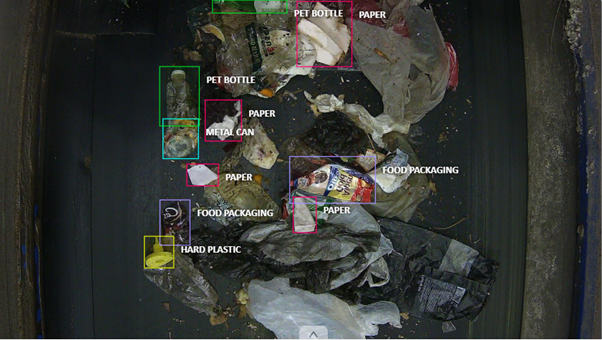
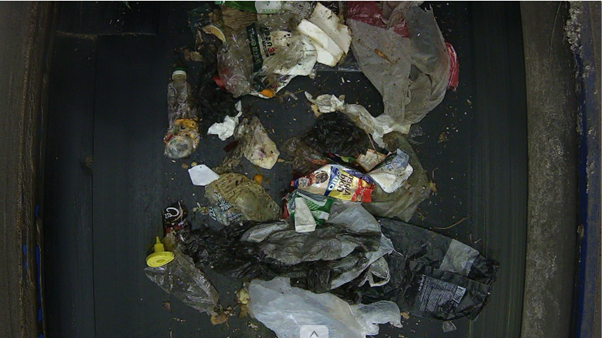
Where feasible, we leveraged CVAT’s AI-assisted pre-annotation feature. Early batches of annotated data were used to train a lightweight object detector, which then auto-generated preliminary bounding boxes for new frames. This automated pre-annotation approach handled most object detection tasks, while human annotators performed targeted verification and corrections as needed, achieving high accuracy with considerably less manual work.
Raw image
Annotated image