Follow Us





For years, the digital funnel was relatively easy to observe. A consumer searched, clicked a result, visited a website, compared products or services, returned through another channel, and eventually converted. Most of those interactions generated measurable website sessions.
AI search changes that visibility.
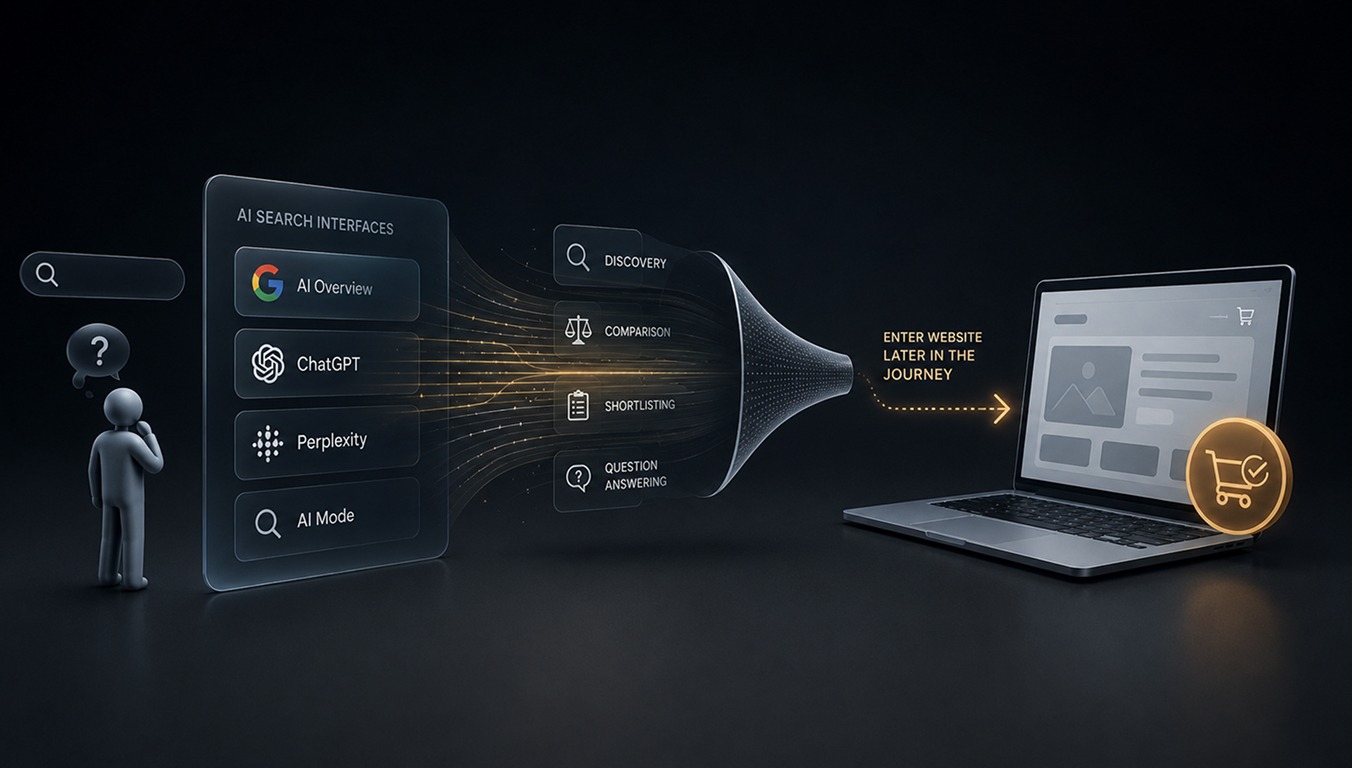
A growing portion of discovery, comparison, question answering, and shortlist creation can now happen inside Google AI Overviews, AI Mode, ChatGPT, Perplexity, Claude, and other AI-assisted interfaces before a buyer reaches the brand's website.
Fewer website visits do not necessarily indicate lower brand influence, purchase intent, revenue potential, or category demand. They may indicate that the website is entered later in the customer journey.
The brands losing traffic and the brands losing demand look identical in analytics. They are not the same problem.
The data increasingly supports that distinction. Pew Research Center found that users encountering a Google AI summary clicked a traditional search result in only 8% of visits, compared with 15% when no AI summary appeared. Only 1% clicked a link directly within the AI summary. At the same time, Google said total organic click volume from Search has remained relatively stable year over year, and that click quality has increased.
Those findings may appear contradictory, but they point to a more useful conclusion: search traffic is not disappearing uniformly. It is being redistributed according to query intent, answer format, search experience, and whether the user still needs a website to complete the next step.
Traffic Is Becoming an Incomplete Measure of Search Influence
For marketing leaders, companies, and businesses, this means the traditional relationship between rankings, traffic, and commercial influence is becoming less linear.
Consider a consumer researching a laptop. Previously, that buyer might have opened several articles, retailer pages, comparison sites, and product pages to answer questions about processors, battery life, price, specifications, and competing models. Today, an AI assistant can synthesize much of that information before the consumer visits a retailer.
By the time that person clicks through, several stages of consideration may already have happened.
That helps explain why some AI-referred traffic is showing unusually strong commercial intent. Shopify's Q1 2026 commerce data found that AI-referred sessions converted at nearly 50% higher rates than organic search, while AI-referred orders carried a 14% higher average order value. More than half of AI-referred sessions also began directly on product pages, compared with 20% of organic-search sessions.
Adobe's data showed a similar progression. In March 2026, AI-referred traffic to U.S. retail websites converted 42% better than non-AI traffic. Those shoppers spent 48% longer on-site and viewed 13% more pages per visit.
This changes how brands should interpret declining traffic.
A visit that once marked the start of product discovery may now mark the end of research and the start of purchase consideration. Traffic volume therefore needs to be evaluated alongside traffic intent, conversion quality, AI visibility, and recommendation presence.
The executive question is no longer only, “How many people reached our website from search?”
It is also, “Was our brand present while AI systems were helping the customer decide what to consider?”
AI Visibility Is Also an Off-Site Reputation Problem
That second question has major implications for SEO strategy.
Brands have historically concentrated search optimization heavily on assets they own: product pages, category pages, service pages, blogs, landing pages, technical SEO, and backlinks pointing toward those assets.
Owned content remains essential. But AI-generated recommendations introduce another layer: what credible sources across the wider web say about the brand.
Brands spent a considerable amount of time optimizing the assets they control. AI answers are assembled mostly from sources they do not.
AirOps analyzed 21,311 brand mentions across ChatGPT, Claude, and Perplexity for commercial discovery queries. It found that 85% of brand mentions came from third-party domains, while only 13.2% came directly from brand-owned domains. Brands were 6.5 times more likely to appear through third-party content.
The study focused specifically on top-of-funnel commercial discovery, so the percentage should not be treated as a universal rule for every AI query. But the strategic implication is significant.
AI Presence Does Not Automatically Mean Recommendation
Reviews, editorial coverage, specialist publications, comparison content, marketplace listings, retail partners, community discussions, industry directories, and independent product validation can all contribute to the information environment from which AI systems build answers and recommendations.
AI visibility, however, is not binary. A brand can be retrieved as a relevant source or mentioned in an answer without being accurately represented, validated, shortlisted, or ultimately recommended. The commercial value of visibility increases as the brand progresses through these stages.
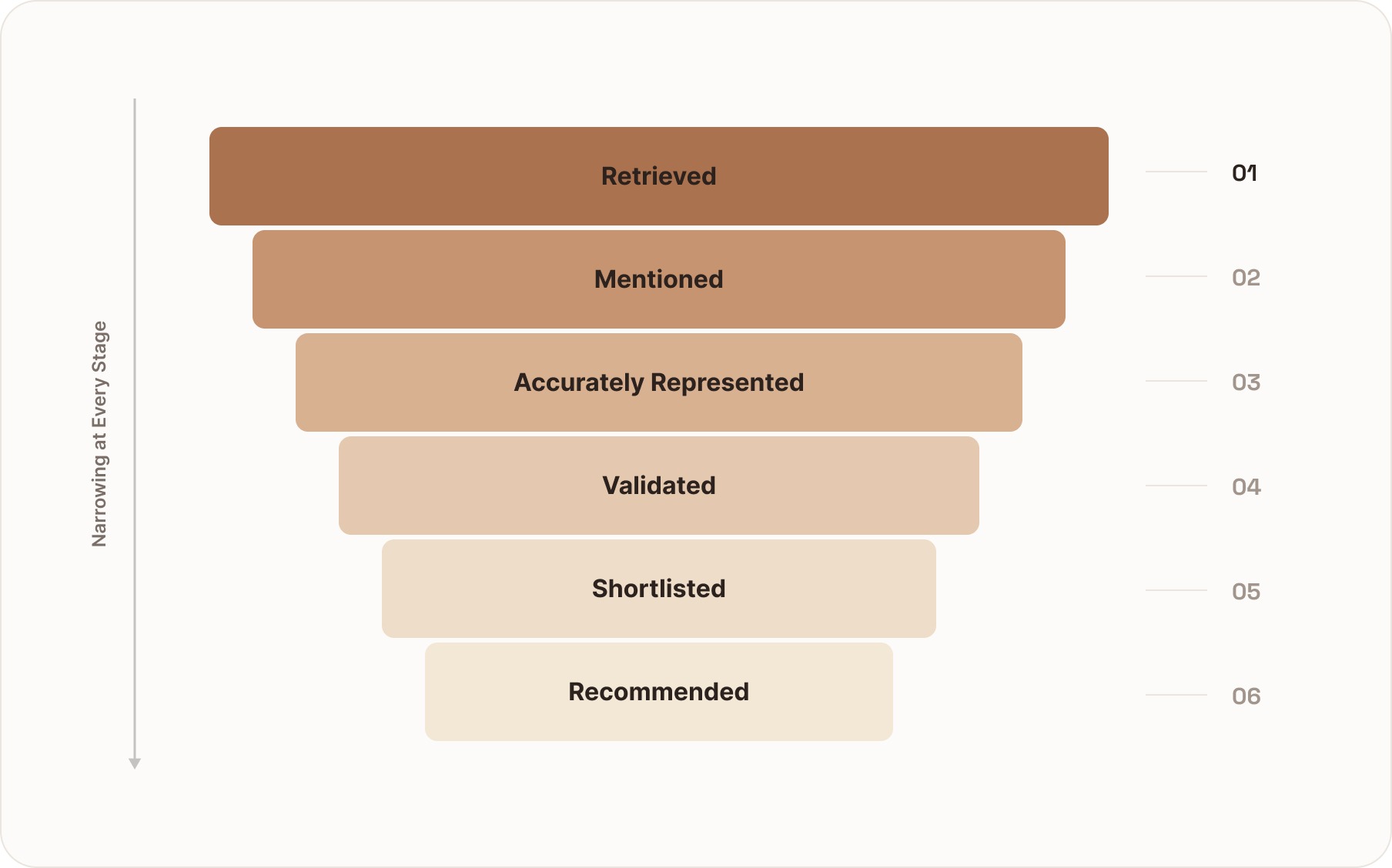
A practical way to assess that progression is across four levels:
- Presence: Does the brand appear?
- Representation: Is the brand described accurately?
- Consideration: Is it included among viable options?
- Preference: Is it recommended relative to competitors?
These stages are commercially different. A brand that merely appears in an AI response does not automatically mean it has entered the buyer’s consideration set, while a brand that is consistently recommended against relevant competitors occupies a much stronger position.
This means product content, structured product data, SEO, digital PR, marketplace presence, and reputation signals can no longer be managed as disconnected disciplines.
This changes who owns search visibility. SEO teams cannot be solely responsible for AI visibility if the signals influencing that visibility sit across product information management, content operations, marketplace management, PR, customer reviews, brand reputation, and digital commerce.
Product Data Is Becoming Part of Search Visibility Infrastructure
For eCommerce businesses, this shift goes deeper than content marketing.
An AI system cannot reliably recommend, compare, or describe products if the underlying information is incomplete, inconsistent, ambiguous, or inaccessible.
Adobe's 2026 analysis found that the average U.S. retail product page received a machine-readability score of only 66%, meaning a substantial portion of product-page content in its benchmark was not readable by AI systems. Homepages scored 75% and category pages 74%.
That makes product information architecture a search consideration.
Attributes such as dimensions, compatibility, materials, variants, specifications, pricing context, availability, use cases, product relationships, taxonomy, and structured metadata are no longer important only for onsite search, marketplaces, feeds, and product detail pages. They also help machines determine what a product is, which queries it satisfies, and when it should be surfaced during an AI-assisted comparison.
For retailers managing thousands or millions of SKUs, AI search visibility is therefore partly a data-quality problem.
A beautifully written product description cannot compensate for missing attributes, contradictory specifications, inconsistent naming conventions, or product data that machines cannot interpret reliably.
The KPI Framework Has to Change
This does not mean businesses should stop measuring organic sessions, click-through rates, rankings, or conversions. Those metrics remain commercially important.
What needs to change is the assumption that they represent the entire search journey.
I would recommend extending search measurement across three layers.
The first is traditional search performance, including rankings, impressions, CTR, organic sessions, revenue, and conversions.
The second is AI recommendation visibility, including brand mention frequency, citation frequency, category recommendation share, competitor visibility, prompts where the brand is absent, and the third-party sources influencing those recommendations.
The third is post-AI traffic quality, including landing-page depth, product-page entry rate, conversion rate, average order value, assisted conversions, engagement, and revenue per AI-referred visit.
The measurement challenge is that AI can influence a purchase without ever appearing as the referral source. A buyer may compare products in ChatGPT, develop a shortlist, and later search directly for one of those brands on Google. Analytics may record the conversion as organic or direct even though AI shaped the consideration process upstream.
The metrics are not wrong. The conclusion drawn from them is.
Because that influence cannot always be tied to a referral click, businesses need to triangulate AI's contribution rather than rely on a single attribution source. AI-referred sessions can be analyzed alongside changes in branded search demand, direct traffic, assisted conversions, landing-page behavior, and brand visibility across commercially important AI prompts. Where possible, customer surveys or post-purchase questions can add another signal by identifying whether AI tools contributed to discovery or evaluation.
The objective is not to assign every conversion precisely to AI. It is to build enough evidence across these signals to determine whether AI visibility is contributing to consideration and downstream demand.
Together, these metrics provide a more useful answer to the question marketing leaders actually need answered: Is search demand actually declining, or is more of the customer journey happening before the website visit?
How to Adapt Your Search Strategy for AI?
In my experience, businesses should not respond to AI search by abandoning traditional SEO or chasing every new optimization tactic. The priority should be to make the brand easier for both search engines and AI systems to understand, validate, and recommend across the wider digital ecosystem.
- Measure AI visibility alongside organic traffic: Track where the brand appears across AI-generated answers, which products or services are recommended, which competitors surface instead, and which sources are being cited. This provides context that traffic and ranking reports alone can no longer capture.
- Strengthen product and content data: Review product attributes, specifications, taxonomy, schema markup, FAQs, comparison information, and service descriptions for completeness and consistency. AI systems need clear, structured information to understand what a business offers and when it is relevant.
- Build authority beyond owned channels: Treat third-party visibility as part of search strategy. Industry publications, review platforms, marketplaces, partner sites, comparison pages, communities, and independent mentions can influence how AI systems understand and validate a brand.
- Create content around decision-making questions: Move beyond keyword-focused informational content. Address the questions buyers ask when comparing options, evaluating suitability, assessing costs, understanding limitations, and determining which solution fits a specific use case.
- Audit how AI systems describe the brand: Regularly test important commercial prompts across major AI search and answer engines. Look for inaccurate descriptions, missing capabilities, outdated information, or situations where competitors consistently dominate recommendations.
- Connect SEO, product data, PR, and marketplace teams: AI visibility cuts across disciplines that many organizations still manage separately. SEO teams, content teams, product-information teams, digital PR, reputation management, and marketplace operations need a shared view of discoverability.
- Evaluate traffic by commercial value, not volume alone: Segment AI-referred traffic separately and compare its conversion rate, average order value, landing-page behavior, assisted revenue, and engagement with traditional organic traffic. A smaller traffic source can still represent disproportionately high commercial intent.
- Protect the final conversion experience: If AI systems are completing more of the discovery and comparison process before the click, visitors may arrive closer to a decision. Product pages, service pages, pricing information, proof points, availability, CTAs, and checkout journeys therefore need to support faster validation and conversion.
The Next Phase of Search Strategy: From Ranking Pages to Managing Brand Discoverability
The strategic risk of AI search is not simply that fewer users click through to a website. Lower traffic can coexist with strong commercial influence if a brand continues to appear in relevant AI-generated comparisons, shortlists, and recommendations and attracts high-intent visitors when a direct interaction is required.
The greater risk is being excluded from consideration altogether.
If buyers repeatedly ask AI systems for the best product, service, or solution for a particular need and competitors appear while your brand does not, traditional rankings and organic traffic reveal only part of the competitive picture. A brand may still rank well in search while losing visibility at the point where buyers are deciding which options deserve further consideration.
This is why the next phase of search strategy should not be framed as traditional SEO versus AI optimization. Businesses need to manage the wider set of signals that shape how their brand is discovered, interpreted, and compared. That includes authoritative owned content, technically accessible websites, accurate product and service data, credible third-party coverage, marketplace presence, reviews, and consistent reputation signals.
AI search has not eliminated the customer journey, but it is moving more discovery, research, and comparison beyond the website. That makes some of the most influential stages harder for businesses to observe and attribute directly.
For marketing leaders, the question is therefore no longer only how much traffic search is generating. It is whether the brand is present, accurately represented, credible, and competitive when AI systems are helping buyers decide which options to consider before a click ever happens.

Rohit Bhateja
Rohit Bhateja, Director of Digital Engineering Services and Head of Marketing at SunTec India, is an award-winning leader in digital transformation and marketing innovation. With over a decade of experience, he is a prominent voice in the digital domain, driving conversation around the convergence of technology, strategy, customer experience, and human-in-the-loop AI integration.
