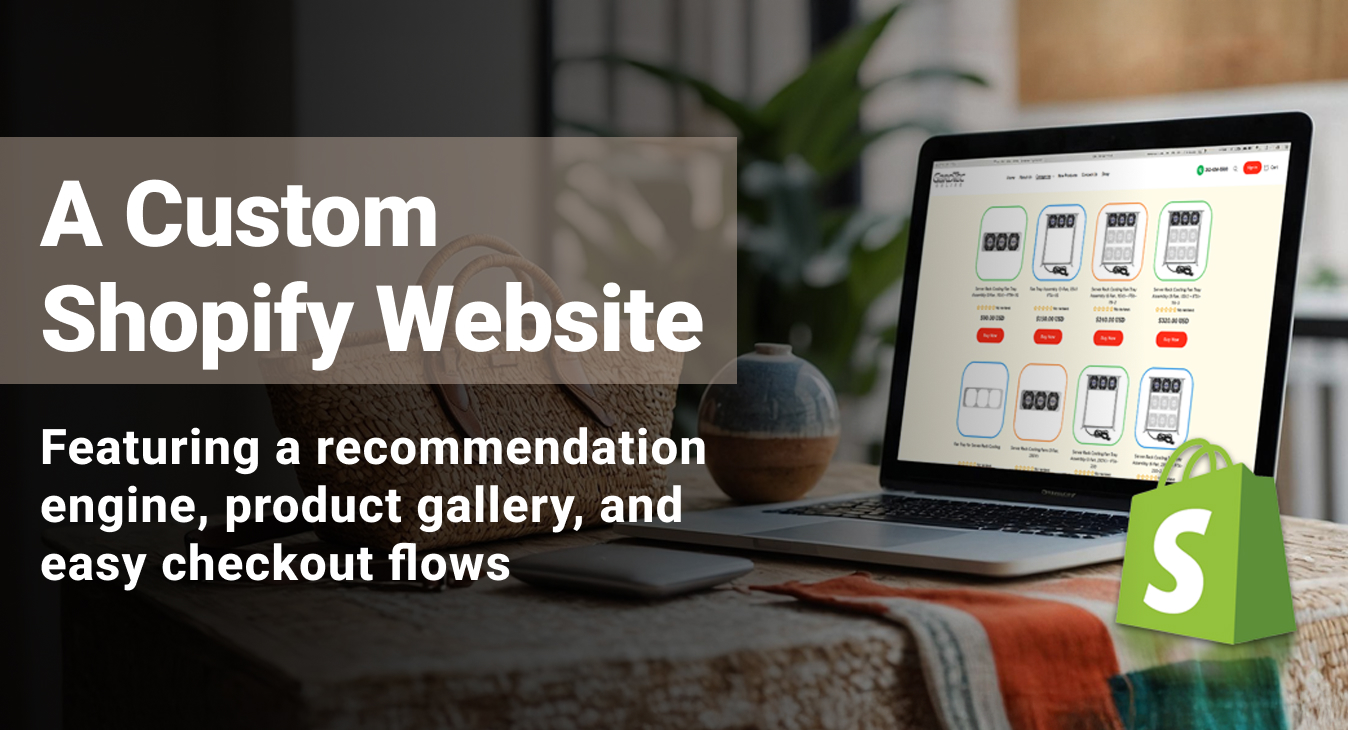
See how we delivered a custom JavaScript-based tile calculator for a Shopify website.
Your Platform Might Be Holding Your Business Back
You Know It. Your Engineering Team Definitely Knows It.
Traditional monolithic platforms promised simplicity. What they delivered was a ceiling on how fast your developers can ship and how quickly you can respond to market changes. Soon enough, they led to:

Front-end changes requiring back-end deployments, slowing release velocity to a crawl.

Content being locked inside a CMS that can serve only one channel - not your app, kiosk, mobile experience, and web simultaneously

Tightly coupled eCommerce functionality makes A/B testing and personalization expensive and fragile.

Scaling challenges that make one function means scaling the entire monolith — wasteful, slow, and costly
Our headless and composable architecture development services replace these rigid structures with a "Best-of-Breed" ecosystem where every component is replaceable, scalable, and connected via APIs.
Our Services
Headless & Composable Architecture Development Services
Build Faster. Integrate Freely. Scale Without Limits.
We build robust API-driven, composable architectures that act as the universal translator between your data and any presentation layer, ensuring seamless performance across web, mobile, and wearable tech. Our serverless developers separate the "head" (the UI) from the "body" (the back-end). Whether it’s a headless CMS architecture or a complex commerce engine, your data remains fluid and presentation-agnostic.

Architecture Assessment and Roadmap
Before we design anything, we map where you are and what it will actually take to move to a headless or composable architecture (whichever is relevant). This includes an audit of your current platform dependencies, an evaluation of your team's readiness, and a prioritized roadmap that sequences the transition to minimize disruption.
- Current-state analysis: platform coupling, API surface, integration dependencies
- Gap assessment against a target composable architecture
- Vendor and tooling evaluation (CMS, commerce engine, search, personalization)
- Phased modernization roadmap with effort estimates and business value sequencing
- Organizational readiness assessment: skills, workflows, and team structures

Headless CMS Architecture Design and Implementation
We design and implement a headless CMS architecture that separates content creation from content delivery. While your editorial teams work in structured, intuitive interfaces, developers consume clean content APIs and render that content wherever it needs to appear without coupling the two layers.
- CMS platform selection and configuration (Contentful, Sanity, Storyblok, Hygraph, and others)
- Content model design: structured schemas, localization, taxonomies, and versioning
- API design and documentation for frontend consumption
- Preview environments and editorial workflow setup
- Migration of legacy content from monolithic CMS platforms

Headless eCommerce Architecture and Implementation
Our headless architecture eCommerce implementations are designed for conversion performance, not just architectural purity. We build a headless commerce architecture that decouples your storefront from your commerce engine. This gives your front-end team the freedom to build any experience while keeping catalog, cart, checkout, and order management in a back-end system.
- Commerce platform selection and API integration (WooCommerce, Shopify, BigCommerce, and others)
- Custom storefront development against headless commerce APIs
- Checkout and cart architecture optimized for performance and extensibility
- Product catalog, pricing, and inventory API design
- Integration with payment processors, OMS, ERP, and 3PL systems
Headless API Architecture and Integration Layer Development
A composable system is only as coherent as its integration layer. We design the headless APIs that connect your CMS, commerce engine, search, personalization, analytics, and data systems into a unified, maintainable stack. This includes API gateway configuration, contract definition, authentication models, and event-driven or synchronous communication.
- API design, documentation, and versioning strategy
- API gateway configuration (Kong, AWS API Gateway, Apigee, and others)
- GraphQL, gRPC/tRPC, and REST API layer design for front-end consumption
- Webhook and event-driven integration patterns
- Authentication, authorization, and rate-limiting governance

Front-end Development for Headless Systems
Headless back-ends are only as good as the front-ends that consume them. We build the web and mobile front-ends that sit on top of your headless architecture. All front-ends are designed for performance (Core Web Vitals), accessibility, and long-term maintainability by your own engineering teams.
- Next.js and React-based front-end development against headless APIs
- Static site generation (SSG) and incremental static regeneration (ISR) for performance
- Personalization and A/B testing integration at the edge
- Component library and design system implementation
- Performance optimization (bundle size, Core Web Vitals, and CDN configuration)

Composable Development and Orchestration
A collection of headless tools can also become a management overhead. To help you manage a suite of headless solutions, our composable development services focus on orchestrating your "Best-of-Breed" stack. We ensure that independent services, such as Search, Auth, Tax, and Reviews, function as a single, coherent machine through a centralized logic layer, preventing data silos and vendor lock-in.
- Packaged Business Capabilities (PBCs) selection and integration
- Orchestration layer engineering and BFF (Back-end-for-Front-end) development
- Composable architecture implementation for modular state management
- Service communication patterns and event-driven mesh configuration
- Micro-front-end architecture design for independent deployment workflows

Swift Composable Architecture Implementation
For organizations building native Apple platform experiences, we implement the Swift Composable Architecture (TCA) pattern. This is a structured, predictable approach to state management that makes iOS and macOS applications easier to test, debug, and extend.
- TCA-based iOS and macOS application architecture design
- State management, side effect handling, and reducer composition
- Modular feature development with isolated, testable components
- Integration with back-end APIs and headless services
- Migration of existing UIKit or SwiftUI apps to TCA patterns

Governance and Optimization
Composable systems can become complex systems if not managed deliberately. We establish the governance framework: API contracts, component ownership, dependency management, and operational monitoring. This keeps your architecture clean, observable, and extensible over time.
- API versioning and deprecation policy design
- Component ownership and inter-team integration contracts
- Observability setup (distributed tracing, logging, and alerting across services)
- Dependency audit and vendor risk assessment
- Ongoing architecture review cadence and optimization recommendations
Stop Fighting Your Monolith.
Let’s build your architecture strategy together
Our architects can help you map out a risk-mitigated transition to a headless or composable architecture that prioritizes performance and deployment speed.
Headless vs. Composable: Which Suits Your Business
Understanding the difference matters for making the right architectural decisions.
| Headless Architecture | Composable Architecture | |
|---|---|---|
| What it Means | Presentation layer is decoupled from the backend, connected via APIs | The entire system is assembled from independent, best-of-breed services, each replaceable |
| Development Scope | Front-end/back-end separation | End-to-end system design philosophy |
| Main Benefit | Front-end freedom, any framework, any channel | Business agility, swap components without rebuilding the whole |
| Typical Starting Point | Replacing a monolithic CMS or commerce platform frontend | Full platform modernization across content, commerce, search, and data |
Most organizations benefit from a hybrid architecture: a headless architecture at the front-end layer and a composable architecture as the guiding principle for the entire system. We can help you determine which applies where and build accordingly.