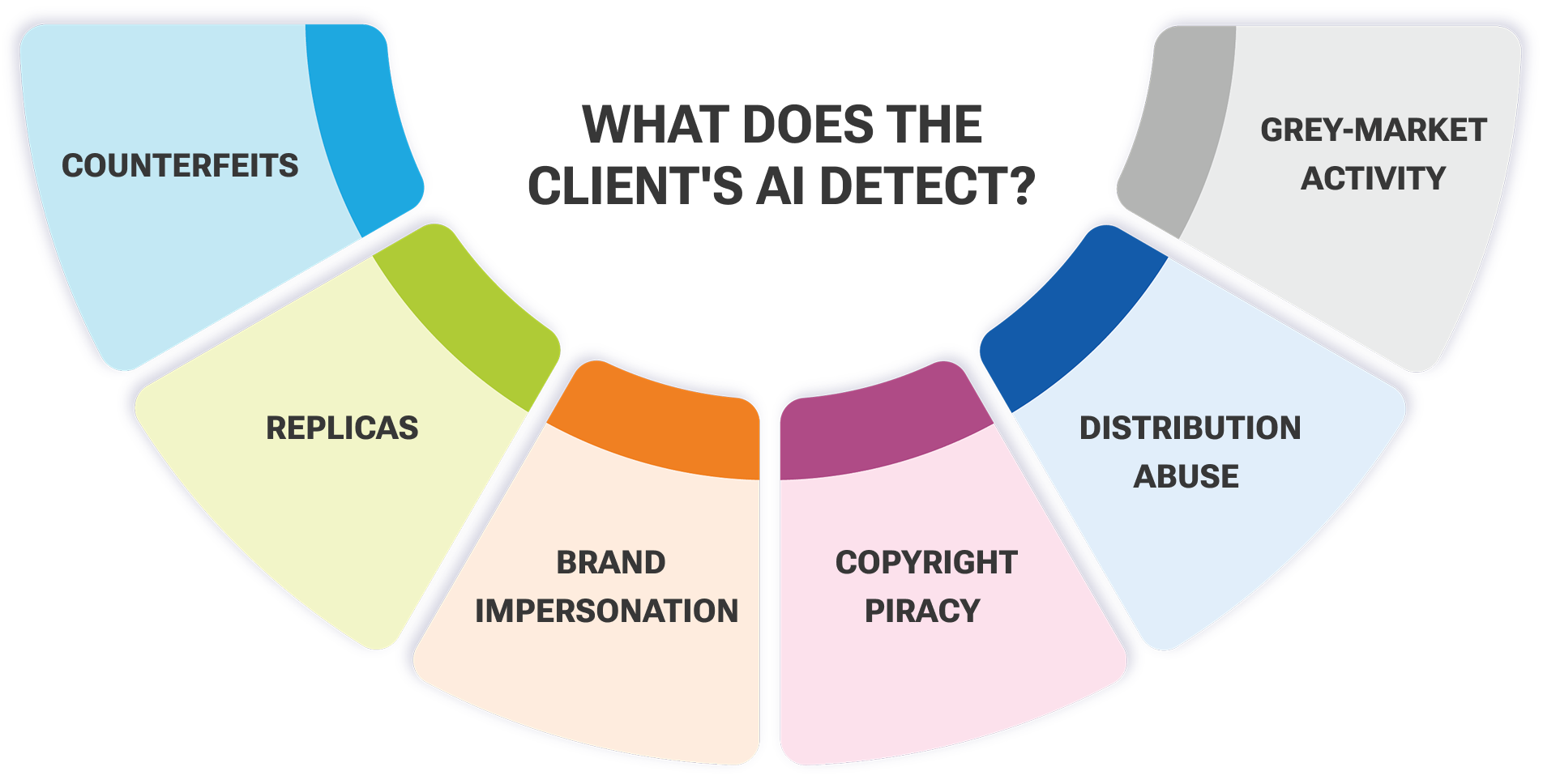
The client operates one of the most established AI brand protection platforms in the market, serving over 2,500 online brands with infringement detection, evidence gathering, and enforcement support. Their proprietary software continuously crawls websites, marketplaces, social media, social commerce storefronts, and dark web forums to detect intellectual property violations — counterfeits, replicas, brand impersonation, copyright piracy, distribution abuse, and grey-market activity. Their business depends on combining AI-driven detection at scale with the judgment needed to act credibly on it.
Counterfeiting, brand impersonation, and digital piracy scale with the internet itself. As new marketplaces, social commerce platforms, and regional storefronts emerge, the volume and nature of potential infringements grow faster than any AI model can be retrained to match. Our client needed a way to scale their online brand protection platform without sacrificing detection accuracy, without flooding their internal team with validation backlogs, while protecting the brand abuse detection platform from AI model drift.
Essentially, the project demanded the following data services for brand protection platforms:
The engagement expanded over time from a narrow scope (data validation) into a comprehensive data operation covering the full infringement lifecycle, from brand abuse detection and data validation to enforcement evidence documentation and model retraining. The scope today includes:
Brand abuse detection in AI brand protection software has matured rapidly, but the validation, classification, and enforcement stages have not kept pace. That is where the bottlenecks live — and that is where the sunTec India team had to deliver.
New brand abuse tactics emerge constantly — infringers adopting new platforms, using culturally specific framings, or mixing legitimate and counterfeit listings in the same storefront. AI models trained on yesterday's patterns cannot deterministically resolve today's edge cases. Every such case needs a human to make the call, and every such call is a potential training example for the next model generation.
As the client's platform scaled from hundreds to thousands of brands, the volume of AI-flagged listings requiring human validation grew faster than the internal team could absorb. Validation backlogs translated directly into slower enforcement, which, in turn, began to affect the platform's core value proposition to end-customer brands.
Infringement activity has migrated to places AI scrapers historically struggled with — social commerce storefronts on TikTok Shop and Instagram, newly launched regional marketplaces with inconsistent structures, private seller groups, and dark web forums. Each requires different investigation techniques, different evidence standards, and different human judgment to interpret what is actually infringing, as well as manual intervention in website data scraping, depending on where AI scrapers break.
Every enforcement venue — marketplace portals, registrars, hosting providers, platform-specific brand portals — has its own evidence format, submission requirements, and acceptance criteria. Evidence that wins a takedown on one platform gets rejected on another. It became our responsibility to structure evidence for the target market to improve the success rate of enforcement activities.
Our team functions as the judgment layer around the client's AI brand protection platform. Rather than replacing automation, we handle exactly the work AI structurally cannot — edge-case interpretation, evidence preparation, manual investigation on platforms where scrapers break, and the preparation of training data (via data annotation) that feeds back into model improvement. The operation now spans 200+ dedicated resources across six interlocking workstreams.
Every AI-flagged listing undergoes human validation before any enforcement action is taken. Analysts check product details against brand authenticity markers, assess listing context (seller history, pricing patterns, image provenance), and confirm or reject the flag. Ambiguous cases are routed to senior reviewers, preserving the platform's credibility with end-customer brands.
Confirmed infringements are sorted into the client's established categories, such as counterfeit, replica, brand impersonation, copyright violation, distribution abuse, and grey market. Taxonomy-related edge cases (e.g., a grey-market seller who has started crossing into counterfeiting) are flagged with rationale notes so the client's legal team can make informed enforcement decisions.
For platforms where the AI scraper is blocked, usually new regional marketplaces, social commerce storefronts, private seller groups, and dark web forums, our web research analysts investigate manually. They search by product keywords, track seller patterns across platforms, flag pricing anomalies that indicate grey-market routing, and use reverse image search to connect listings to known counterfeit supply chains. Missing data is also enriched during this stage. Findings are documented in a structured format and uploaded to the client portal in the same schema as AI-derived records, so downstream workflows treat them identically
We integrated an existing LLM as an internal triage layer that reads the listing context (seller language patterns, product descriptions, price-to-category fit) and marks cases as
The latter (high-suspicion cases) go to senior analysts first for expanded context. Routine cases are still reviewed but batched for improved throughput. This lets our team handle more volume without letting any case skip validation.
For each confirmed infringement, we compile an evidence package structured to the specific requirements of the enforcement venue. Marketplace portals, brand-specific platform portals, registrars, and hosting providers each get evidence in their preferred format. We also provide support for submitting notices through the client's brand portals and document rejection reasons to prevent the pattern from repeating.
Analysts cross-check each peer-validated brand abuse case on a sampled basis. Senior reviewers audit infringement classification consistency weekly and check every takedown evidence package. The QA lead checks the evidence packaging for submissions at frequent intervals before they are sent to a brand portal. This multi-layer QC process prevents rejected enforcement notices or mis-categorized datasets.
In addition to processing current infringement cases, the client also onboarded our AI training data services to strengthen the platform's future capability, as well as proactive prospecting support to expand their business.
Labeled dataset curation for model retraining at determined intervals
We use semi-automated annotation tools for pre-labeling. Then, our data annotation team (including domain experts who tackle the particular data annotation challenges of brand protection AI) reviews and corrects the low-confidence cases to keep the AI current with new infringement patterns—and, critically, to include the judgment captured during day-to-day validation flows back into the model.
Evidence-backed case creation for prospect brand outreach and lead development
We develop counterfeit and website impersonation evidence cases for brands that could become new customers for our client. Each case showcases a clear instance of suspected counterfeiting or fraud, the impact on the brand, the scale of the exposure, and how the client's platform could safeguard their reputation and recover revenue.
What began as a six-person team handling flagged-asset validation has grown to 200+ dedicated resources over the course of the partnership. Across that growth, our team has delivered measurable improvements on every dimension the client originally engaged us to address — and a few they did not initially expect.
$3.2B+ in Brand Revenue Protected For end-user brands through takedowns, piracy enforcement, and grey-market disruption.
98% Classification Accuracy Mitigating false positives in brand protection software by confirming whether AI-flagged listings are genuine infringements.
45% Faster Delivery to End-Customer Brands Optimized turnaround from AI detection to enforceable evidence creation and submission.
Handling 70% of the Client's Data Operations Up from 50% in the earlier phase — reflecting our capacity to take on an expanded scope.
Whether you run an online brand protection platform or operate a standalone digital brand protection product for your business, the work AI cannot deterministically resolve is the biggest obstacle. Our data services for brand protection platforms cover the full infringement lifecycle and help build the training data that keeps your AI solution current and, hence, more trustworthy.
Share your requirements or request a free sample to know more about how SunTec India can assist your brand protection agency.