Suppressed listings on Amazon: How to fix them and avoid a repeat occurrence
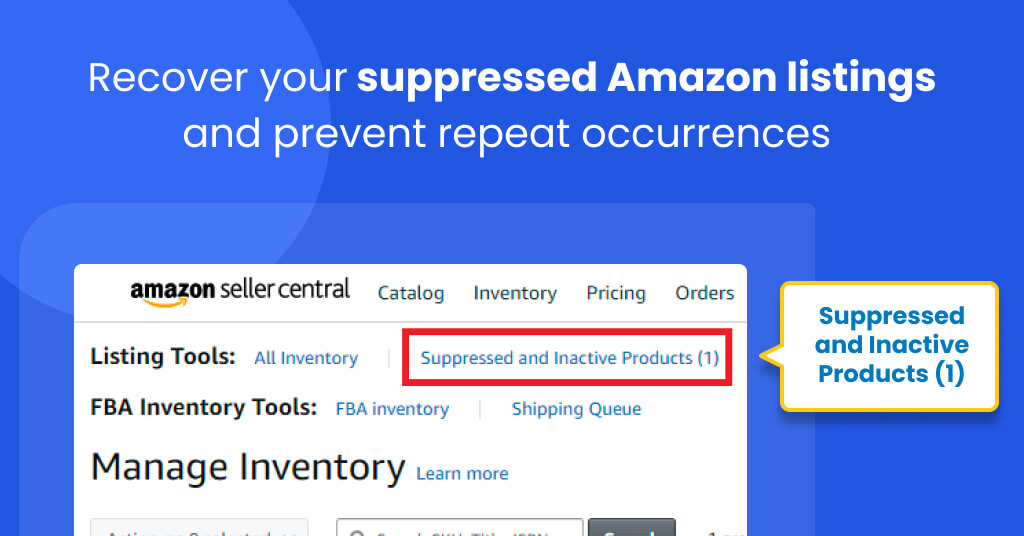
Table of Contents
- What does 'suppressed' mean in Amazon's terms?
- Why is my Amazon listing suppressed?
- Here's a 6-step guide to address and fix suppressed Amazon listings:
- Addressing incorrectly suppressed listings by Amazon
- Limitations and challenges of suppressed listings on Amazon
- How to prevent repeat occurrences of suppressed Amazon listings?
David, a retailer specializing in eco-friendly products, faced a setback when he found out that his best-selling item was no longer showing up in Amazon’s search results. His bamboo toothbrushes were a hit with environmentally conscious customers looking for alternatives to plastic brushes. During a routine check of his sales metrics, he noticed a sudden decline in sales for this product. Worried, he investigated his Amazon inventory page and realized that the bamboo toothbrush listing had been marked as ‘suppressed’ by Amazon due to violations of content policies.
What does ‘suppressed’ mean in Amazon’s terms?
David’s experience wasn’t unique. Amazon consistently surprises its sellers with stringent updates to product listing rules and quality standards. This approach is understandable given that over 60% of Amazon’s sales come from independent small and medium-sized business owners like David. The platform ensures that products, regardless of the seller’s size, meet strict quality standards to provide a positive customer experience.
Regarding suppressed Amazon listings, if a product listing doesn’t comply with Amazon’s selling standards and marketplace rules, it won’t appear in search results. These suppressed listings are hidden from both search and browse functions, preventing customers from purchasing the product and causing revenue stagnation.
In David’s case, he likely followed all the content, image, and category requirements when listing the bamboo toothbrush, especially since it was his flagship product. However, as Amazon continually analyzes, revises, and updates its policies, his current product description or title might contain errors according to the newly updated guidelines. Unless he addresses the issue, his listing will remain suppressed or deactivated. In the worst-case scenario, Amazon may even suspend or ban his account.
Such scenarios can occur to any seller on Amazon, including you, who forgets to constantly check, maintain, update, and fix Amazon suppressed listings. When faced with such a situation, the first question that comes to mind is-
Why is my Amazon listing suppressed?
Your Amazon listing can be suppressed or deactivated for various reasons, such as policy violations, technical issues, or non-compliance with Amazon’s algorithmic standards. Some significant reasons could include:
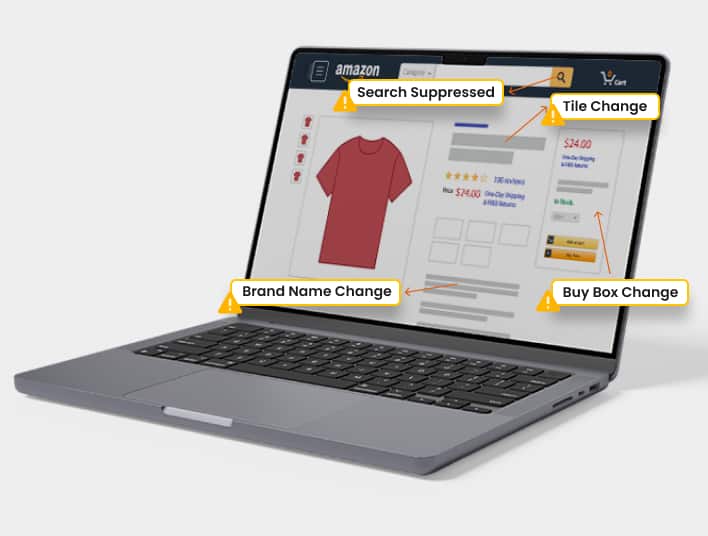
- Your product listing does not have the main image or the one that you have uploaded, does not follow the image requirement guidelines.
- Your product listing does not have a defined category
- You upload a listing that lacks an informative and detailed product description. This is not necessarily followed in the case of shoes, books, or apparel.
- Your clothing or accessory product listing features a title which is longer than 80 characters
- Your listing description contains restricted phrases or keywords, prohibited terms or inappropriate language
- You list a product that is prohibited to be sold on Amazon such as illegal or hazardous items
- Your product listing seems suspicious to Amazon including any counterfeit or inauthentic products
- You list a product that violates any ownership rights and needs a legal proof to highlight that there is no trademark or copyright infringement
- Your listing features a product which has quality issues or is unsafe
- You list a product with false claims, deceptive marketing strategies, or inaccurate or misleading information
- Your product listing does not fit in Amazon’s standards and does not fulfill customer engagement metrics, search relevance, or product quality indicator
- As a seller, you fail to meet performance metrics and have high order defects, product return, or late shipment rate which falls under poor seller performance.
A positive selling and buying environment is of utmost importance to Amazon. Such issues might be detected at any stage of the product life cycle. Thus, it becomes important for you as a seller to understand all updated Amazon guidelines, address the changes quickly, and fix your suppressed Amazon listing.
However, identifying what went wrong and how to rectify it can be challenging for both a small entrepreneur like David and a well-established brand that made unknown mistakes while uploading a bulk of products. So, if you notice any of your product listings are deactivated, how would you fix it? Let’s continue with David’s case and find out how to fix Amazon suppressed listings.

Here’s a 6-step guide to address and fix suppressed Amazon listings:
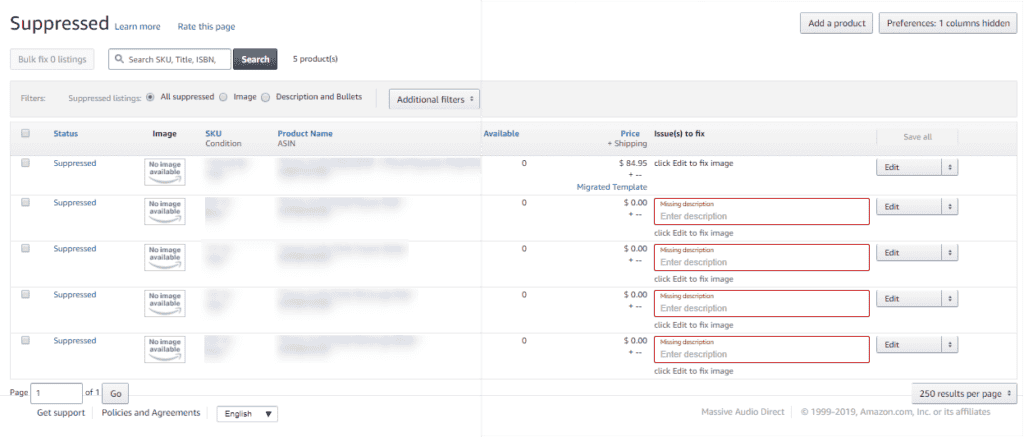
Step 1: David logs into his Amazon Seller Central account and navigates to the ‘Inventory’ tab. From the dropdown menu, he selects ‘Manage Inventory.’
Step 2: Here, he searches for his suppressed listing of the bamboo toothbrush product. These listings are easily identifiable on the dashboard, marked with a red exclamation mark or under the ‘Suppressed’ filter.
Step 3: David clicks on the bamboo toothbrush suppressed listing to identify the specific issue that led to the product being flagged for content policy violations.
Step 4: In the listing details, he discovers that he unknowingly used certain restricted keywords, triggering the action.
Step 5: Clicking on the ‘Edit’ button next to the suppressed listing, David revises the product description, makes relevant keyword-related changes, and removes the restricted keywords. He ensures that the revised description complies with Amazon’s guidelines.
Step 6: After making the necessary revisions, David clicks on the ‘Save’ button. Once saved, he can click on ‘Save and Finish’ to make his bamboo toothbrush listing live again.
Every suppressed Amazon listing results in revenue loss for every minute it remains inactive. You risk losing prime product positioning to competitors and potential sales. However, there are rare instances where your product listing is accurate, yet it’s deactivated. If this occurs, here’s what you can do!
Addressing incorrectly suppressed listings by Amazon
Amazon employs an algorithm to scan all listings for adherence to its rules. However, this algorithm can sometimes yield erroneous results, leading to unnecessary product suppression. What if the bamboo toothbrush listing didn’t violate any content policies, and David used all the correct keywords? In such a scenario, he could:
- Educate himself on product uploading guidelines and policies to confirm there was no mistake on his part.
- Navigate to Seller Central to register an appeal for the faulty flagging. He can then provide a detailed explanation, relevant screenshots, or documented evidence to prove his compliance with Amazon’s policy.
- After submitting the appeal, the listing will undergo review. Meanwhile, he can persistently follow up for a quick resolution and provide additional evidence as needed.
Limitations and challenges of suppressed listings on Amazon
In both cases, whether the suppression occurred due to the seller’s error or if it was incorrectly deactivated by Amazon, resolving the issue promptly is crucial! Delayed action can result in:
- Loss of visibility and sales, as customers won’t be able to see your listing in search results and make purchases.
- Negative impact on overall seller performance, affecting performance metrics.
- Waste of time and resources invested in manufacturing and marketing the specific product.
- Competitor advantage, as they can capitalize on your suppressed listing by promoting their products to your customer base.
- Loss of selling momentum and disruption in growth trajectory, especially if the product was a top seller.
- Damaged customer loyalty, as repeat buyers may be disappointed when they can’t find your product, potentially leading them to switch to a competitor brand.

How to prevent repeat occurrences of suppressed Amazon listings?
Adopting a ‘list and forget’ mindset won’t help sellers expand their eCommerce store, build a reliable customer base, or generate high revenue. To maintain a positive selling environment and increase sales, sellers must take steps to prevent frequent listing suppressions. Some preventive measures to reduce the chances of repeated deactivations include:
- Regular online store checkups: Conduct regular sales metric and inventory checks to analyze product performance. Ensure all images, titles, and descriptions comply with Amazon’s updated guidelines.
- Constant keyword research: Perform thorough keyword research to identify errors, updates, or gaps in content. This helps identify trending keywords, optimize listings for visibility, and avoid using words that could trigger listing suspension.
- Regular template revisions: If using a listing template for bulk product uploads, conduct template audits and revisions before creating new lists. This helps detect common mistake patterns and avoid multiple suppressions.
- Continuous feedback tracking: Monitor customer ratings, reviews, and complaints, and provide prompt resolution. Negative experiences related to product quality or authenticity can lead to policy violations and suppressions.
- Regular seller performance metrics management: Strive for high product quality and after-sales service to maintain positive seller performance. High defect rates, delayed shipment, or poor customer service may result in actions like regular listing suppressions or account bans by Amazon.
Unsure about why your product is not showing up in the search results and want assistance to fix Amazon suppressed listings? Connect with our team and know more!

Ravi Kant
Ravi Kant is the Vice President of the eCommerce division at SunTec India with an industry experience of over 20 years. His core expertise is in business development, lead generation, international sales, social media optimization, and digital marketing. At SunTec India, he has been instrumental in shaping the growth graph of numerous client businesses. He further likes to share insights that germinate from his experience, expertise, and domain understanding to help businesses pave their way to growth.


Rohit Bhateja, Director - Digital Engineering Services & Head of Marketing
Rohit Bhateja, Director of Digital Engineering Services and Head of Marketing at SunTec India, is an award-winning leader in digital transformation and marketing innovation. With over a decade of experience, he is a prominent voice in the digital domain, driving conversation around the convergence of technology, strategy, customer experience, and human-in-the-loop AI integration.