Creating Reliable Training Data for Automated Corrosion Detection
We approached the challenge by building a foundation of clarity and control — defining exactly what corrosion looks like, using the right tools to capture it with pixel-level precision, and validating every labeled image through a series of quality checks. The result was a dataset that the client could trust, i.e., consistent, verifiable, and suitable for training an AI model.
Creating a Reference Guide with Annotation Rules
Subjectivity was a significant challenge in this image labeling project. Corrosion appeared differently across tower materials (steel, galvanized metal) and environmental conditions (sunlight, shade, moisture). Additionally, what appeared to be rust to one annotator might have been perceived as dirt, paint wear, or shadow by another.
To eliminate this ambiguity and ensure a uniform understanding across the team, we developed a guide as a single, reliable reference for identifying corrosion under various conditions.
The guide contained:
- Visual examples of confirmed corrosion, side by side with non-corroded surfaces for comparison.
- Color range samples illustrating how corrosion might vary — from bright orange rust to dark brown oxidation.
- Texture patterns showing flaking, pitting, and surface roughness typical of rusted metal.
- Annotated image samples for each tower component — main structure, cross arms, bolts, ladders, and base — showing correct labeling boundaries.
- Edge-case scenarios (e.g., light reflections, shadow overlaps, mixed materials) with clear instructions on how to handle them.
- List of do’s and don’ts emphasizing that minor over-labeling was acceptable, but missing any spot with corrosion was not.
This reference enabled the faster onboarding of new team members without compromising quality, simplified reviews for QA personnel, and ultimately improved annotation consistency.
Image Segmentation and Labeling
The client’s AI corrosion detection system required extremely detailed training data. Every corroded section of the tower had to be captured with high spatial accuracy across hundreds of images. Even minor boundary errors — such as under-labeling or missing faint rust — could affect model performance.
We used Label Studio, an open-source data labeling platform. Although CVAT also supports pixel-level segmentation, Label Studio was selected for its greater flexibility and collaboration features. Its customizable labeling templates, real-time feedback tools, and user-friendly interface allowed multiple annotators and reviewers to work efficiently while maintaining consistent labeling standards across the dataset.
Here’s how we proceeded with this data annotation project:
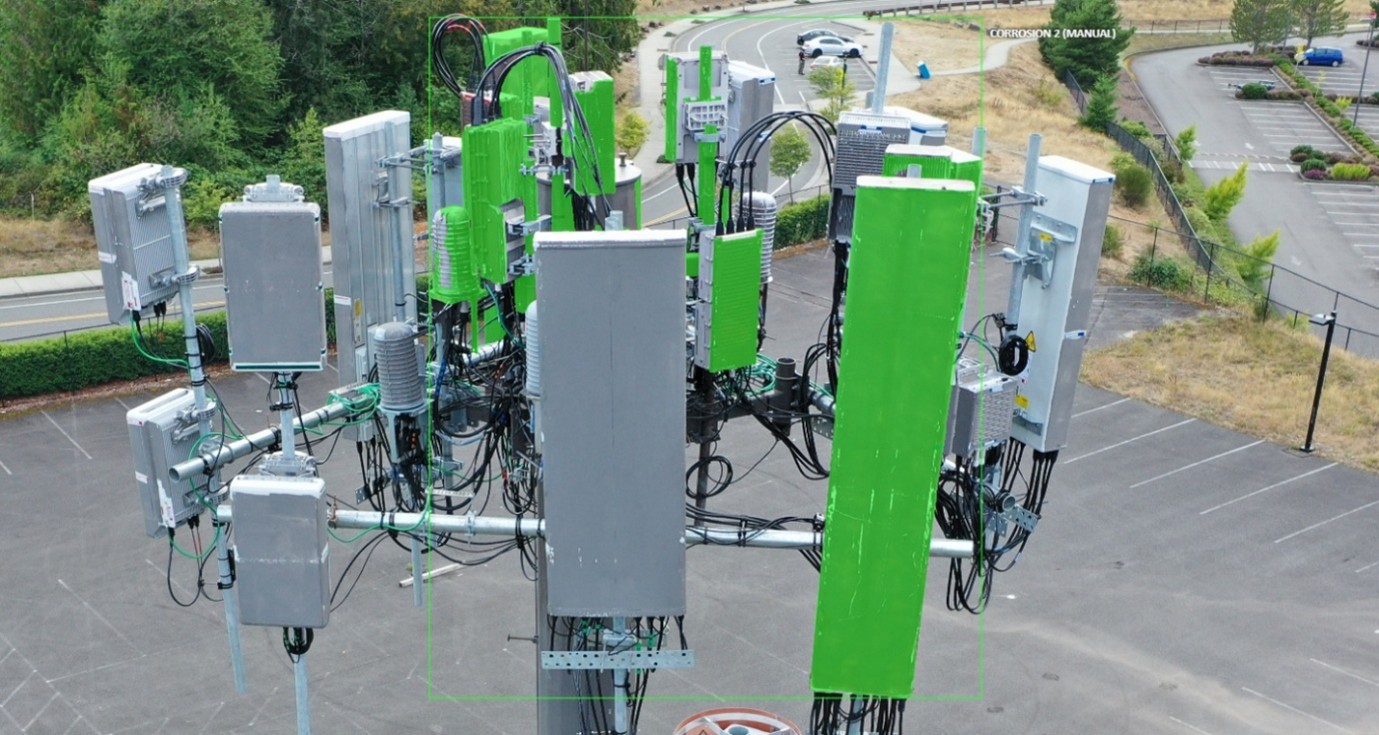
- Our team worked on each image in multiple passes: a rough outline first, followed by finer edge corrections to capture irregular corrosion boundaries.
- Smart brush and polygon tools were used for detailed labeling, especially around bolts, ladders, joints, and base plates, where rust typically appears in complex patterns.
- We frequently cross-referenced the guide to distinguish between actual rust and similar visual elements, such as paint marks or dirt.
- For images affected by lighting inconsistencies, we adjusted brightness and zoom levels within Label Studio to make subtle corrosion visible before labeling.
- Where corrosion was partially obstructed or faint, we followed the “slight over-labeling” rule from the guide — marking a slightly larger area to ensure complete capture.
Multi-Level Quality Control (QC)
Given the visual complexity of the images and the involvement of multiple annotators, we designed a layered QC process to identify and correct labeling inconsistencies before final delivery.
- Self-Review: Annotators used Label Studio’s overlay and comparison features to check their own work for missed or excess labeling.
- Peer Review: Another annotator reviewed the same image using the reference guide to ensure consistency, verifying that all visible corrosion was accurately captured and that non-corroded regions were clean.
- Final QA Review: A dedicated quality controller conducted random sampling and full-image audits using Label Studio’s review mode, verifying segmentation boundaries, completeness, and adherence to project guidelines.
By the final review, all corrosion labels were consistent and highly accurate, making the dataset ready for use. Additionally, each QC finding was logged in a shared feedback tracker. Corrections and examples of common errors were discussed during daily review sessions, allowing the team to continuously improve labeling accuracy throughout the project.
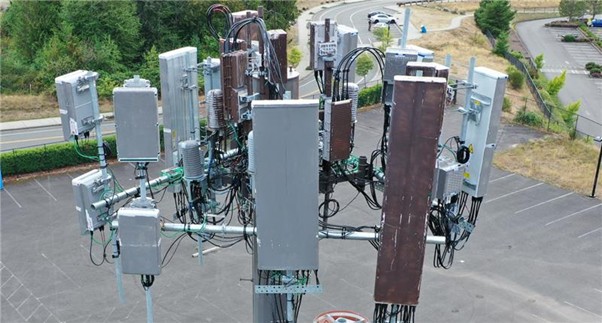
Raw image
Annotated image