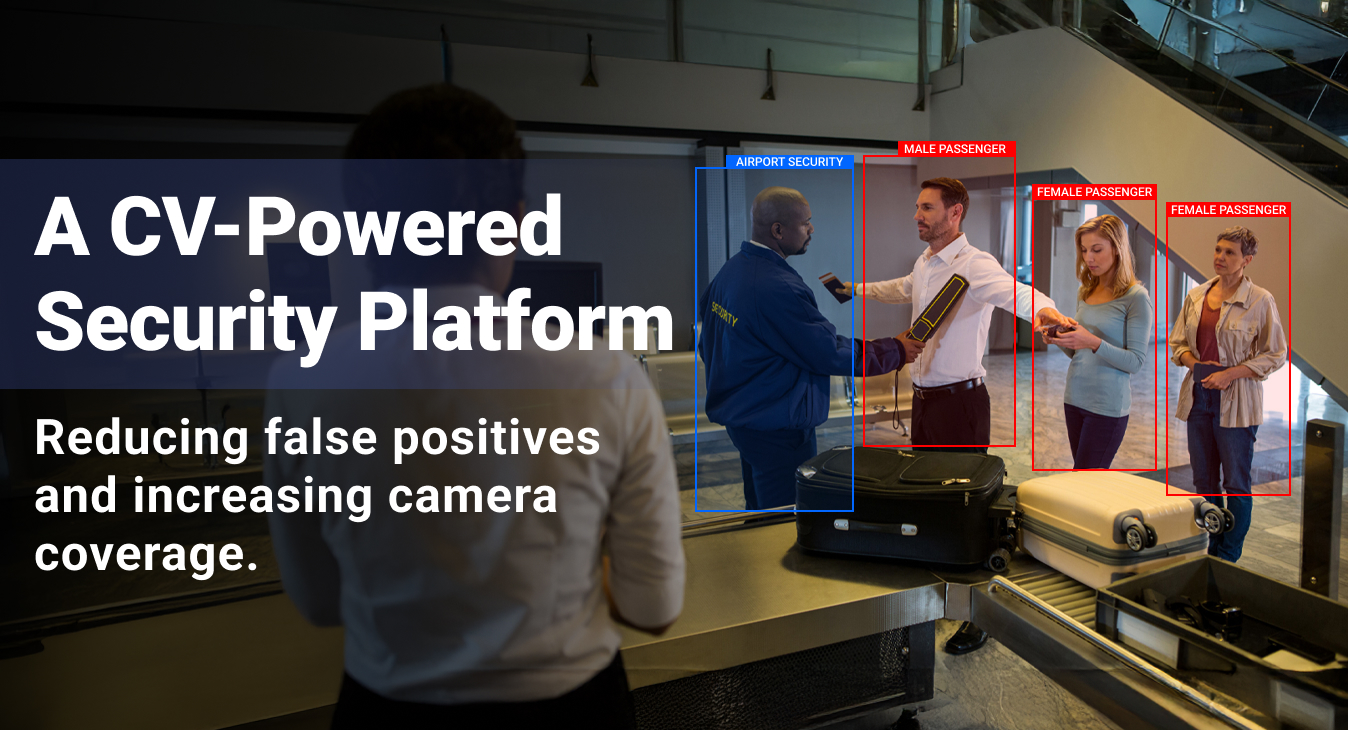
See how our CV specialists designed a tailored platform for better security analytics and coverage.
Hire Computer Vision Developers
Leverage The Power of Visual Intelligence
While human agents can monitor a single security feed or inspect a few parts on an assembly line, their vision is qualitative and prone to fatigue at scale. Conversely, a professionally engineered CV system provides quantitative, objective analysis at a scale and velocity that human operators cannot match.
1
Sub-Millimeter Precision Analysis
High-resolution inspection algorithms that can identify microscopic anomalies.
2
Volumetric and Spatial Mapping
Stereo Vision and LiDAR-fusion to derive 3D spatial coordinates from 2D inputs.
3
Contextual Semantic Interpretation
Vision Transformers (ViT) and Graph Neural Networks to understand complex scenes, behavioral intent, and inter-object relationships.
4
Low-Latency Inference at the Edge
Complex neural architectures executed in real-time on resource-constrained hardware.
Managed Talent. Engineered for Accountability.

Dedicated Full-Time Engineers
FTEs only No freelancers or gig marketplace.

Experienced Talent
Vetted Experts Rapid Deployment

Managed Operations
Senior oversight Time & Task Monitoring

Workflow-Ready Integration
Jira Slack GitHub Teams

Global Overlap
All Time Zones 24/7 Support

Security
ISO 27001 & CMMI3 NDA & IP Secure
Send an Inquiry
Our Services
Computer Vision Development Services
Bespoke Vision Solutions Engineered for Your Unique Hardware & Data
Experience end-to-end computer vision and multimodal AI development. When you hire our computer vision specialists, you aren't just getting CV software; you’re getting a vertically integrated solution. We handle everything from the initial data strategy to low-latency edge deployment, enabling deep visual intelligence.
Computer Vision Consulting
Gain access to architectural strategists for your visual AI roadmap. Our computer vision consultants conduct Exhaustive Feasibility Studies to validate your use case and Hardware-Software Co-Design Analysis to determine an architecture (CNNs, ViTs, ResNets, tc) while balancing computational cost and model precision. By evaluating your specific constraints, such as FLOPS limits on edge devices, we deliver a risk-mitigated technical blueprint that ensures long-term architectural integrity.
Data Collection & Curation
Hire computer vision developers to architect data acquisition pipelines designed to input neural networks with high-entropy, high-fidelity information. We go beyond simple scraping; our team implements Sensor-Susion Strategies and Automated Data Ingestion workflows using tools such as Apache NiFi and custom Python-based crawlers. By curating the collected datasets to account for occlusions, varied illumination, and perspective distortion, our engineers ensure your model is trained on a "ground truth" that represents the full complexity of the real world.
Image Pre-Processing
Our computer vision software developers specialize in transforming "noisy" raw sensor data into high-signal training inputs. Using libraries such as OpenCV, Scikit-Image, and Pillow, we build automated pipelines for adaptive histogram equalization (CLAHE) to enhance contrast and highlight important features and Bayer pattern interpolation to reconstruct missing details. To prevent overfitting and enhance model generalization, we apply advanced data augmentation techniques such as elastic transforms, grid distortions, and cutout strategies, enabling the model to handle a wide variety of real-world scenarios.
Model Selection, Training, & Fine-Tuning
Our developers are proficient in navigating the vast landscape of SOTA (State-of-the-Art) architectures to find your "perfect fit." Whether it’s deploying YOLOv10 or SSD for high-speed detection, or leveraging Swin Transformers for complex hierarchical feature extraction, hiring computer vision engineers from us can offload the heavy lifting of training from your teams. We use frameworks like PyTorch and TensorFlow to fine-tune key hyperparameters such as learning rates, weight decay, and loss functions (e.g., Focal Loss) to achieve your precise precision-recall targets.
Custom API Integration & CV Middleware Development
Hire computer vision software developers in India to build secure API bridges that transform raw model outputs into accessible, actionable data streams. Our API development approach prioritizes throughput and, accordingly, determines the ideal API architecture (REST, GraphQL, or gRPC). We can also implement API integration with cloud platforms like AWS Rekognition, Azure Computer Vision, and Google Vision AI for centralized access and on-demand scaling.
Model Evaluation & Stress Testing
We don't just "check" accuracy; our developers subject your models to rigorous Adversarial Testing. Hire computer vision engineers in India to identify specific failure modes in your CV models using Confusion Matrices, Precision-Recall Curves, and ROC curves. Our team also analyzes Intersection over Union (IoU) thresholds and performs per-class performance breakdowns to ensure that your system remains robust even when faced with "out-of-distribution" data or edge-case visual interference.
Edge Integration & Model Optimization
To bridge the gap between high-power model training and low-power deployment, our computer vision software developers employ advanced Model Compression techniques. We use NVIDIA TensorRT, Intel OpenVINO, and ONNX Runtime to perform INT8 quantization and weight pruning, drastically reducing the memory footprint of your models. Whether you are deploying on NVIDIA Jetson or on mobile via TFLite and CoreML, our engineers ensure your vision system delivers sub-10ms latency without compromising accuracy.
Lifetime CV Model Support & Maintenance
The real work begins after deployment, where our remote computer vision engineers act as guardians of your model’s performance. We deploy MLOps pipelines to monitor Feature and Concept Drift using telemetry tools such as Prometheus and Grafana. By establishing Automated Re-Training Loops and Active Learning protocols, our developers ensure that as the visual world changes, your model learns and adapts, maintaining its competitive edge indefinitely.
Ready to Give Your Software the Power of Sight?
From visual data streams to edge integration on NVIDIA Jetson or mobile, our CV developers are ready to build your custom vision solution.
Get started
Computer Vision Solutions
We make “the ability to see and interpret visual data” your product’s biggest competitive advantage. Our elite engineering approach and an established AI infrastructure enable you to build categorical, use-case-specific computer vision applications for:
We build systems that identify, localize, and monitor multiple entities across video frames with high temporal consistency for security and logistics.
Our developers categorize images and isolate specific regions of interest to prepare the CV solution for granular visual sorting and automated diagnostics.
We engineer biometric and behavioral systems that interpret human identity, intent, and non-verbal commands for secure access and HMI.
We deploy advanced spatial-textual pipelines to extract and digitize unstructured data from complex documents, labels, and real-world environments.
These computer vision solutions transform passive surveillance into active intelligence by detecting anomalies, crowd density, and specific event triggers in real time.
Our computer vision software developers map human skeletal structures and joint coordinates to analyze body mechanics for applications in fitness, healthcare, and industrial safety.
Our developers build "search-by-image" engines that utilize deep feature extraction to identify and suggest similar products or assets.
We leverage dual-network architectures to synthesize realistic imagery, perform style transfers, and augment datasets with high-fidelity synthetic data.
Our CV developers architect intelligent indexing systems that retrieve images from massive databases based on visual signatures rather than metadata.
We utilize photogrammetry and depth-estimation models to transform 2D visual inputs into accurate 3D digital twins and spatial maps.
Our developers achieve pixel-level scene understanding, labeling every element in a frame to provide the context necessary for autonomous navigation.
Industry-Specific CV Applications
Healthcare & Life Sciences
From diagnostic assistance to laboratory automation, we engineer high-precision healthcare computer vision systems for clinical decision support.
- Automated Tumor & Lesion Segmentation (MRI/CT scans)
- Surgical Tool Tracking & Workflow Analytics
- AI-Powered Skin Cancer (Dermatoscopic) Screening
Manufacturing & Industrial IoT
We transform production lines into self-correcting ecosystems using high-speed manufacturing and IoT-based computer vision solutions that offer visual inspection and safety monitoring.
- Surface Defect Detection (Micro-cracks and anomalies)
- Automated PPE Compliance Monitoring (Safety gear detection)
- Predictive Maintenance via Thermal Imaging Analysis
Retail & eCommerce
Our computer visions software developers bridge the physical and digital retail experiences through try-before-you-buy systems and intelligent shelf-edge analytics.
- "Just Walk Out" Autonomous Checkout Systems
- Real-time Shelf Gap & Planogram Compliance Analysis
- Visual Search & Image-based Product Recommendations
Automotive & Transportation
We architect the perception layers required for autonomous navigation and enhanced driver safety in volatile environments.
- Driver Drowsiness & Distraction Detection Systems
- Real-time Pedestrian & Obstacle Trajectory Prediction
- Automated License Plate Recognition (ALPR) for Tolling
Agriculture & AgriTech
We build multispectral imaging and aerial compute vision solutions to enable you to optimize crop yields and automate field-level interventions.
- Pixel-level Crop Health & Pest Infestation Mapping
- Automated Fruit Ripeness Detection & Robotic Harvesting
- Livestock Health & Behavioral Monitoring
Security & Smart Cities
Our security CV solutions convert passive surveillance into proactive intelligence for crowd management and threat detection.
- Crowd Density Analysis & Flow Optimization
- Unattended Baggage & Intrusion Detection
- Facial Recognition for Secure Access Control Systems
Banking & FinTech
We eliminate manual data entry bottlenecks through high-accuracy document intelligence systems and biometric verification.
- KYC Automation via Facial Liveness Detection
- Complex Data Extraction from Handwritten Financial Forms
- Real-time Signature Verification & Fraud Detection
Construction & Real Estate
We utilize spatial vision solutions to provide real-time progress monitoring and high-fidelity site safety audits.
- 3D Digital Twin Generation via Scene Reconstruction
- Construction Site Hazard & Equipment Utilization Tracking
- Automated Floor Plan Generation from 360° Imagery
TOOLS & TECHNOLOGIES
Computer Vision Tech Stack
Our computer vision consultants select the optimal mix of technologies—cloud, edge, and DL frameworks—to align with your use case, business goals, and deployment requirements.
- Vector Databases OpenAI Meta Mistral AI Google Hugging Face Grok
- Vector Databases Meta MongoDB Chroma Drant Pinecone Milvus
- LLM Frameworks LangChain LlamaIndex Haystack Microsoft NVIDIA
- Deployment Vertex ai Kubernetes Hugging Face Docker
Talent Hub
Hire Developers with Other Specializations
Regardless of what you are building or your stack, we provide pre-vetted, senior-level developers experienced in working with all technologies, programming languages, and frameworks.
- Hire AI Developers
- Hire AI Agent Developers
- Hire Computer Vision Developers
- Hire AR App Developers
- Hire Data Scientists
- Hire RAG Developers
- Hire AI Consultants
- Hire Wearable App Developers
- Hire ML Engineers
- Hire Data Engineers
- Hire Cloud App Developers
- Hire ChatGPT Developers
- Hire OpenAI Developers
- Hire MLOps Engineers
- Hire DevOps Engineers
- Hire Cloud Engineers
Frequently Asked Questions
Hire Computer Vision Developers: FAQs
Our computer vision engineers are proficient in frameworks like PyTorch and TensorFlow, deploying SOTA architectures like YOLOv11 for real-time speed, Vision Transformers (ViT) for complex spatial relationships, and Mask R-CNN for pixel-level segmentation.
100% ownership of the entire project, including the custom source code, annotated datasets, and final trained model weights (.pth, .pb, or .onnx files) is transferred to you upon completion.
When you hire ou computer vision application developers, you dont have to worry about the data as we follow GDPR/CCPA/SOC 2-compliant protocols. Our computer vision services also offer data anonymization and secure local or cloud-based processing. All development is conducted under strict NDA/NCA frameworks to protect your proprietary information.
We implement MLOps-based monitoring to track real-time confidence scores and data drift. Whenever performance dips, our CV software developers trigger automated retraining loops with new edge-case data to maintain peak accuracy.
A standard computer vision prototype or PoC generally takes about a few weeks to months, depending on the complexity. This timeline covers data auditing, annotation, and initial model training to validate feasibility and establish baseline mAP (mean Average Precision). For an estimate about your idea, contact us at info@suntecindia.com.
We select from the top engineering talent, specifically testing for proficiency in linear algebra, probability, and experience working with frameworks like PyTorch/TensorFlow. Typically, each CV software developer we hire possesses mid-to-senior level AI expertise and maintains a portfolio of previously delivered projects.