The client is an established US-based office supplies retailer that began by offering quality mailing envelopes and stationery at competitive prices. Over time, the company expanded its product portfolio to include notebooks, filing systems, copy paper, and other office essentials. Today, the business primarily sells through Amazon and Walmart Marketplace, managing inventory across its warehouse and Amazon fulfillment centers.
The client needed a reliable way to manage inventory & replenishment across Amazon, Walmart, its warehouse, and vendors. Although the business already used dedicated forecasting, inventory, and freight platforms, these systems operated independently.
A complete replenishment cycle required moving between several tools, manually transferring information, and coordinating decisions across purchasing, logistics, and warehouse operations.
To bring greater consistency and accountability, the client engaged SunTec India to manage the replenishment workflow.
Scope of work
Despite having multiple specialized platforms, the client lacked a connected operational process for managing replenishment. Each stage relied on manually coordinated activities, leading to delays, overspend, or inaccurate stock.
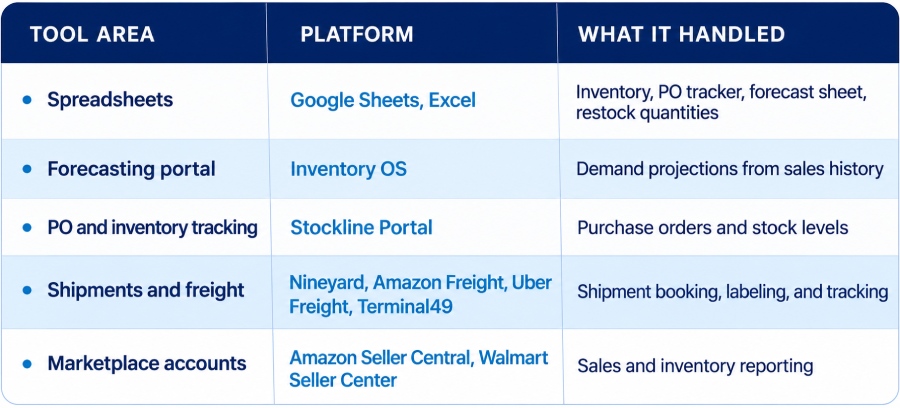
The replenishment workflow relied on Google Sheets and Excel, Inventory OS, Stockline Portal, freight platforms, and marketplace accounts. Because these tools did not automatically synchronize, the client had to move information between systems manually. This made it difficult to maintain consistent inventory, forecasting, purchasing, and shipment records throughout the replenishment cycle.
Before initiating replenishment, the team had to gather demand forecasts, review warehouse stock, check marketplace inventory, and verify outstanding purchase orders. Repeated data transfers and verification stretched a single replenishment cycle into several days, delaying purchasing and shipment-planning decisions.
The client worked with multiple freight providers, but it did not consistently compare transportation quotes before booking shipments. Without a structured comparison process, the business risked overlooking more cost-effective transportation options. Partially utilized containers and inefficient pallet configurations further increased freight costs.
Warehouse inventory records depended on updating spreadsheets in the correct sequence. Any mismatch between physical counts and system quantities required manual investigation. Without a consistent variance-review process, discrepancies affected subsequent replenishment calculations and inventory planning decisions.
To eliminate disconnected workflows, we integrated the client's forecasting, inventory, purchasing, freight, and marketplace systems through APIs, enabling coordinated data exchange and replenishment planning across the entire operational cycle.
Our team established a weekly forecasting routine using SKU-level demand projections from InventoryOS, alongside inventory information from Amazon, the warehouse, and purchase order records.
Before calculating replenishment requirements, we verified that the relevant data sources reflected current inventory and outstanding orders. This helped prevent replenishment decisions based on outdated stock positions.
The forecasting process incorporated three planning parameters:
Using these parameters, we calculated restocking requirements and aligned purchase quantities with projected demand and existing inventory commitments.
This provided the client with a more consistent basis for placing supplier orders while accounting for the lengthy international replenishment cycle.
Once we finalized replenishment quantities, we allocated purchase orders across the client's suppliers.
Supplier allocations considered established vendor relationships, factory production capacity, import conditions, tariffs, and freight costs. We reviewed these factors during each planning cycle rather than relying on fixed allocation rules.
We evaluated the resulting purchase quantities using a cubic-meter (CBM) calculator to determine how efficiently the products would fit inside shipping containers.
Where necessary, we made small quantity adjustments to improve container utilization without losing sight of the client's replenishment requirements.
This approach helped reduce unused container capacity and supported more economical freight planning.
Our team managed Amazon replenishment planning through Nineyard, using confirmed restock quantities and available warehouse inventory.
The process began by calculating required quantities against demand forecasts, available stock, and inventory already included in planned shipments.
We then adjusted quantities based on warehouse availability and rounded case totals as needed for shipment preparation.
For the documented shipment workflow, our team:
By validating quantities and reviewing fulfillment center distribution before shipment confirmation, we established a consistent execution process for Amazon restocking.
To improve freight cost control, SunTec India established a structured process to collect, compare, and select transportation quotes.
After creating Amazon shipments, our team recorded their shipment IDs in a centralized Google Sheet. We then obtained fulfillment-center-specific freight quotations from contracted transporters, Amazon Freight, and Uber Freight.
We entered each quotation into a comparison matrix, allowing our team to evaluate transportation costs for the same shipment requirements.
We selected the most cost-effective available option based on the quotations received and proceeded with freight booking.
Following freight planning, our team prepared the documentation required for warehouse shipment execution.
Using Nineyard, we processed each of the Amazon shipments individually and generated three essential documents:
We shared the documentation with the designated warehouse point of contact and coordinated shipment readiness dates.
Processing shipments individually allowed the team to complete document preparation and warehouse handoffs systematically before proceeding to the next shipment.
This created a more predictable flow between shipment planning and physical warehouse execution.
We also established a weekly inventory reconciliation routine to keep physical stock consistent with system records.
Warehouse personnel conducted physical inventory counts, while the warehouse manager updated the designated inventory layout sheet.
The warehouse inventory spreadsheet compared recorded quantities with physical counts and flagged discrepancies for review.
Our team applied a two-step verification approach. We documented and adjusted reasonable variances, while sending unusual discrepancies back to the warehouse manager for a physical recount.
This ensured that inventory adjustments followed a verification process instead of automatically treating spreadsheet quantities as accurate.
By bringing forecasting, purchasing, shipment execution, and reconciliation into a single managed workflow, SunTec India helped the client move away from fragmented, manually coordinated replenishment activities.
The engagement delivered the following operational improvements.
40% Faster Replenishment Planning
Reduction in turnaround time from demand forecasting to approved replenishment plans.
18% Lower Freight Costs
Savings through carrier rate comparisons, container planning, and pallet optimization.
99% Inventory Record Accuracy
Verified warehouse inventory records matched physical stock counts.
25% Fewer Stockout Incidents
Reduction in stockout frequency through demand forecasting and lead-time planning.
Keep inventory moving across your marketplaces & sales channels with strategic support for demand forecasting, shipment planning, freight coordination, and warehouse reconciliation.